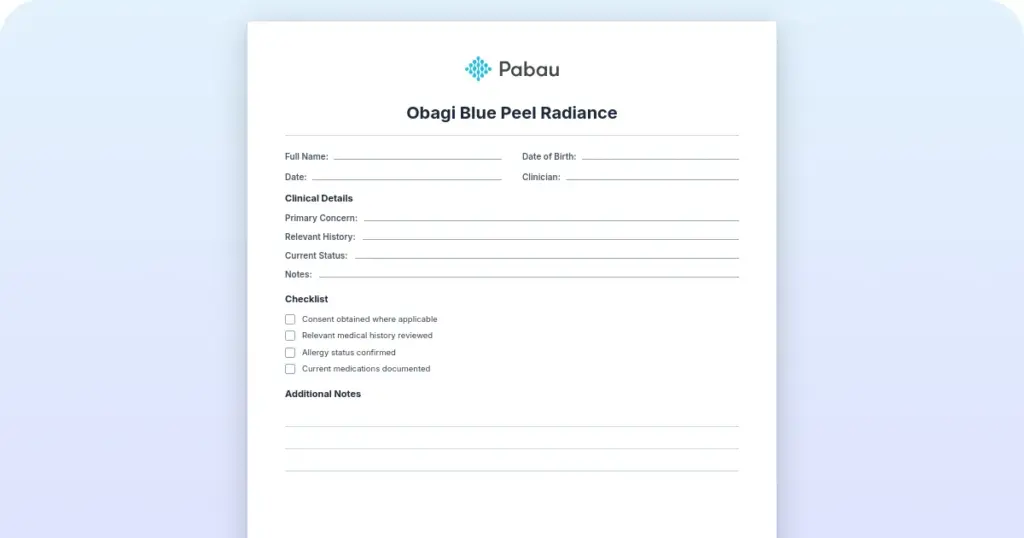
Obagi Blue Peel Radiance: Consent form and aftercare guide
An Obagi Blue Peel Radiance consent form records that your patient understood a ...

3
Last Updated: Sep 29, 2026

A structured aftercare template that guides patients through post-cyst removal wound care and recovery milestones.
The first 24-48 hours are critical for preventing infection through proper dressing, cleaning, and pain management.
Clear warning signs (increased redness, discharge, fever) help clinics educate patients on when to seek medical attention.
Pabau’s digital forms and patient portal let clinics send personalised, clinic-branded aftercare instructions directly to patients.
A ready-to-use aftercare instruction template covering wound dressing care, activity restrictions, infection warning signs, recovery timeline, and follow-up guidance for patients following cyst removal surgery.
Download templateAfter cyst removal surgery, patients need clear, structured guidance to heal safely at home. This guide covers what your cyst removal aftercare instructions template should include, how to use it, and why it matters to your clinic’s post-operative care workflow.
A cyst removal aftercare instructions template is a structured patient education document that clinics provide immediately after cyst excision. It outlines the precise steps patients must take during the critical healing phase-typically the first two to four weeks-and identifies warning signs that require urgent medical attention.
The template covers wound dressing protocols, cleaning methods, activity restrictions, pain management, suture removal timing, and infection warning signs. For clinics managing multiple cyst removals weekly, a consistent, clinic-branded template reduces patient confusion and minimises post-operative complications. Software built for med spas keeps the clinical record and the appointment history against one client.
Medically, post-cyst removal recovery follows a predictable timeline. The first 48 hours are critical for establishing haemostasis (stopping bleeding) and preventing infection. Weeks two through four involve epithelialisation (new skin formation) and early scar maturation.
Effective aftercare instruction delivery happens in five operational steps:
Dermatology clinics removing 5-15 sebaceous, epidermal, or epidermoid cysts weekly rely on aftercare templates to standardise patient education. Cosmetic surgery practices managing cyst excision alongside other minor procedures use templates to maintain infection control standards. Skin clinics in rural areas, where patients may live an hour from the clinic, depend on written aftercare instructions because phone support alone cannot cover all healing scenarios.
Physiotherapy clinics treating pilonidal cyst drainage also benefit, as do general practices in the UK managing minor cyst excisions under local anaesthesia. Private GPs especially value downloadable templates because they free staff time from writing individualised instructions and reduce medicolegal exposure through documented, evidence-aligned guidance.
Medical records software keeps every version of a completed form audit-ready.
Compliance and safety: Patients who receive written instructions in their hand before leaving have higher adherence rates. A structured checklist format lets patients self-assess daily, catching early infection signs before they escalate.
Reduced complications: Infection rates after minor cyst excision typically range 2-5%. Clear guidance on wound cleaning technique, dressing changes, and activity restrictions substantially reduces this. Documentation of provided instructions protects the clinic if post-operative questions arise.
Clinic efficiency: Your front desk staff spend minutes personalising a template rather than hours writing individualised guidance.

Scar prevention: Patients who follow activity restrictions during weeks 2-4 experience less incision tension during the critical epithelialisation phase, resulting in thinner, less noticeable scars. This improves patient satisfaction and reduces requests for revision procedures.
A comprehensive cyst removal aftercare instructions template contains these core sections:

Pabau’s digital forms let you send personalised, clinic-branded cyst removal aftercare instructions to every patient. Track compliance and flag warning signs automatically.

Cyst location influences aftercare. A sebaceous cyst on the scalp heals differently than one on the back.
Facial cysts: Extra caution during dressing changes because facial skin is thinner. Instruct patients to avoid makeup and sunscreen on the incision for at least two weeks. Hair-bearing areas (scalp, beard) require guidance on gentle hair washing without disturbing sutures.
Back and trunk cysts: These experience higher mechanical tension during movement and healing, so activity restrictions are stricter. Sleeping position matters-patients should avoid pressure on the incision for the first week.
Axillary (armpit) and groin cysts: Moisture from sweat increases infection risk. Patient portal access to detailed instructions lets you send location-specific guidance-e.g., “avoid tight clothing over the incision for two weeks” or “change dressing immediately if you sweat through it.”
Pabau’s SMS reminder notifications automate aftercare follow-up. Set reminders to send 24 hours before wound check appointments and 7 days post-removal prompting patients to report any concerns.
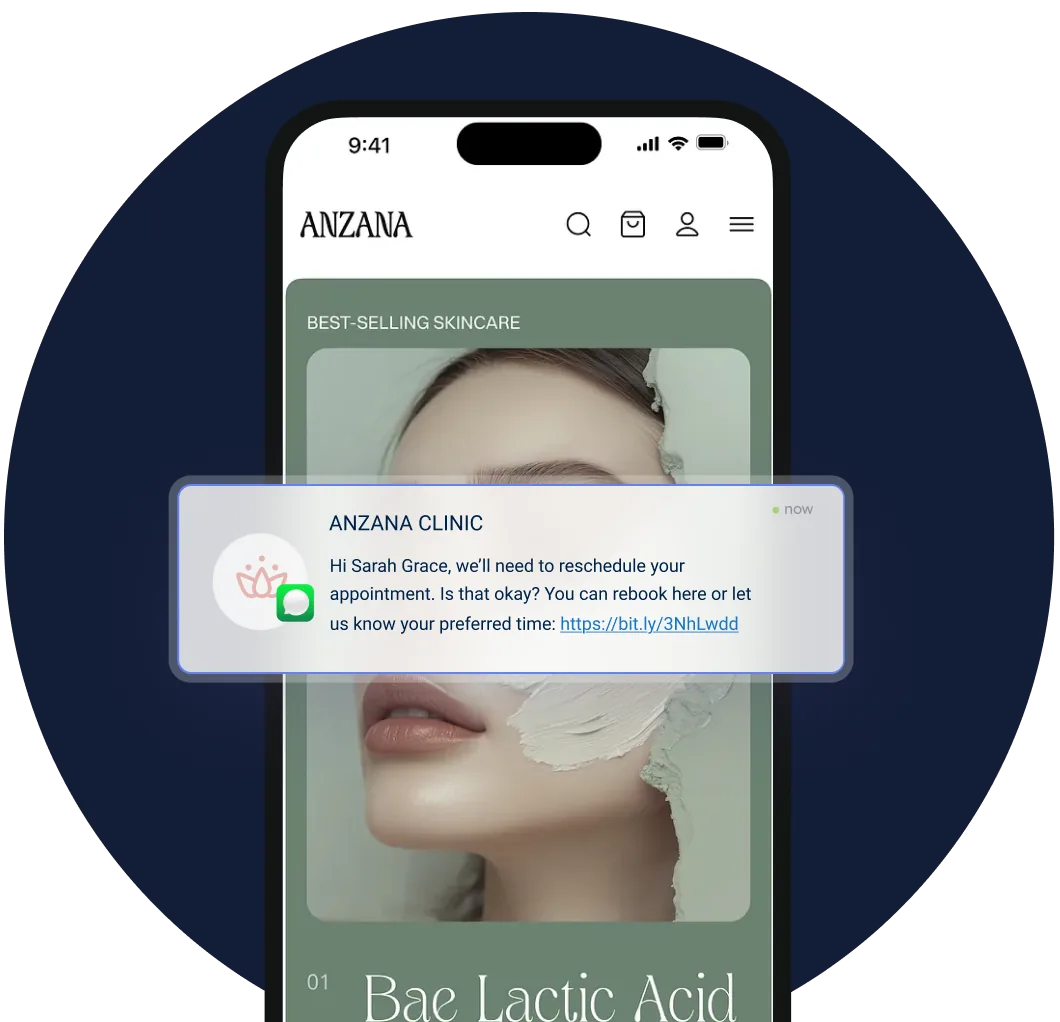
Track compliance by noting in the patient record whether they attended the post-op wound check and whether any complications were reported. Over time, clinics with systematic aftercare tracking see measurably lower infection and revision rates.
Research from Cleveland Clinic and the British Association of Dermatologists confirms that structured post-operative wound care reduces infection risk and improves scar appearance. The first 48 hours are critical-this is when infection risk is highest if the wound is contaminated.
Guidelines emphasise that skin clinic best practice includes written aftercare instructions in the patient’s primary language, printed delivery in recovery, and a follow-up phone call or message within 24 hours.
Cyst removal aftercare instructions are a non-negotiable component of post-operative care. A well-designed, clinic-branded template ensures every patient receives consistent, evidence-aligned guidance and empowers them to recognise complications early. By systematising your aftercare delivery through clinic management software, you protect patient safety while freeing your team from repetitive documentation tasks. The result is faster healing, fewer infections, happier patients, and a more efficient clinic.
Suture removal typically occurs 10-14 days post-removal for facial incisions and 14-21 days for body incisions. Your template should reserve space for you to write the specific removal date, as timing varies by cyst size, location, and closure method (absorbable vs. non-absorbable sutures).
In the first 24-48 hours, dressing changes may occur daily or twice daily depending on bleeding. After initial haemostasis, daily changes with fresh gauze and antibiotic ointment are standard until the incision is fully closed or sutures are removed. Your clinic’s specific protocol should be clearly stated on the template.
Patients can shower when the incision is fully closed (typically 7-10 days) or as directed by your clinic. Bathing or submersion should be avoided for 2-3 weeks to prevent water infiltration into the healing wound. The template should specify your clinic’s policy based on closure method and patient location.
Normal healing includes mild redness, slight swelling, and occasional oozing in the first 48 hours, followed by gradual fading of redness over weeks 2-4. Abnormal signs requiring clinic contact include spreading redness beyond the immediate incision, purulent discharge, fever, or the wound opening after closure. Include a visual comparison chart if possible on your template.
Yes, if your clinic prescribes it. Topical antibiotic ointment (commonly mupirocin or triple antibiotic) applied during dressing changes reduces surface bacterial colonisation. Your template should specify the exact product name, application frequency, and duration per your clinic protocol.
Scar minimisation depends on strict activity restriction during weeks 2-4 (reducing incision tension), sun avoidance on the incision (UV exposure darkens scars), and moisturising with fragrance-free cream after epithelialisation. Silicone gel sheets applied after suture removal can further improve appearance. Your template should mention these options.