Tanja Lepcheska

MRC dyspnea scale (mMRC): Grades, GOLD cutoff and free PDF
What the MRC dyspnea scale measures and where it came from The MRC dyspnea scale...

1
Last Updated: Nov 5, 2026
Free PDF 2 pages, print-ready Clinician-reviewed
The Charlson Comorbidity Index is a weighted score that estimates a patient's comorbidity burden from 19 chronic conditions. Each condition is worth 1, 2, 3 or 6 points. Mary Charlson and colleagues built it in 1987 to predict one-year mortality. An age-adjusted version adds 1 point per decade from age 50, and higher totals mean a heavier comorbidity burden. This template gives internal medicine, primary care and clinical governance teams one worksheet to record each condition, assign its weight and document the total. Every clinician scores the same way, so totals stay comparable across patients and reviews.
A printable PDF with the weighted condition checklist, the age adjustment table and boxes for comorbidity points, age points and the total index. It also includes the burden bands and a field for the estimated 10-year survival.
Start from scratch, or upload this PDF or any form you already use, and Pabau's AI Form rebuilds it with tick boxes, text fields and a signature. Attach it to the treatment once, and every patient gets it on time.
AI Form rebuilds the consent, history and aftercare forms you already use. You review each one, then publish.
Patients complete forms on their phone before they arrive, so the front desk stops retyping paper.
Every signed form is versioned and attached to the treatment record, ready when you need it.
Set how long a consent stays valid. Returning patients skip forms they have already signed.
Supports HIPAA and GDPR compliance AES-256 encryption 4.8 on G2 4.7 on Capterra Trusted by 4,000+ practices worldwide
The Charlson Comorbidity Index is a weighted score that estimates a patient’s comorbidity burden from 19 chronic conditions.
Each condition is worth 1, 2, 3 or 6 points, and the points add up to one total. Mary Charlson and colleagues built it in 1987 to predict one-year mortality. An age-adjusted version adds 1 point per decade from age 50.
Higher totals mean a heavier comorbidity burden. Internal medicine, primary care and clinical governance teams use the score for risk stratification and case mix. What follows covers the 19 weighted conditions, the age adjustment, a worked example and how to document the total consistently across patients.

The Charlson Comorbidity Index is a weighted score of 19 chronic conditions, scored as 1, 2, 3 or 6 points.
The original index was published by Charlson and colleagues in 1987 in the Journal of Chronic Diseases.
The age-adjusted version adds 1 point for each decade of age from 50 upward (50-59 = 1, 60-69 = 2, and so on).
Scores support risk stratification and research, but they do not replace clinical judgment.
Use the worksheet to keep condition, weight and score documentation consistent across patients.
The Charlson Comorbidity Index is a clinical scoring system that sums weighted points for chronic comorbid conditions to estimate overall comorbidity burden. Mary Charlson and colleagues published it in 1987 in the Journal of Chronic Diseases. Its original purpose was to predict one-year mortality, and it is now used in clinical risk stratification and health research.
Clinicians and researchers use the score to compare patients with different disease profiles on a common scale. The score is a population-level estimate, so it should inform rather than dictate individual care decisions.
The index covers 19 conditions, each carrying a weight of 1, 2, 3 or 6 points. The table below lists each condition and its weight for quick reference alongside the template.
To calculate the score, check each of the 19 conditions against the patient record and add the weight of every condition that applies. Record the total in the score section of the template. Where a condition appears at two severities, score only the higher one. Diabetes with end-organ damage scores 2, for example, with no extra point for uncomplicated diabetes.
The age-adjusted version adds 1 point for each decade of age from 50 upward. Patients under 50 score 0 and patients aged 50 to 59 score 1. Each further decade adds 1, up to 5 points at 90 to 99. A 65-year-old patient therefore receives 2 age points on top of the comorbidity total.
Record whether the adjusted or unadjusted score is used so results stay comparable across reviews. As a worked example, take a 65-year-old patient with congestive heart failure and diabetes with end-organ damage. The two conditions add 1 and 2 points, age adds 2, and the age-adjusted total is 5.
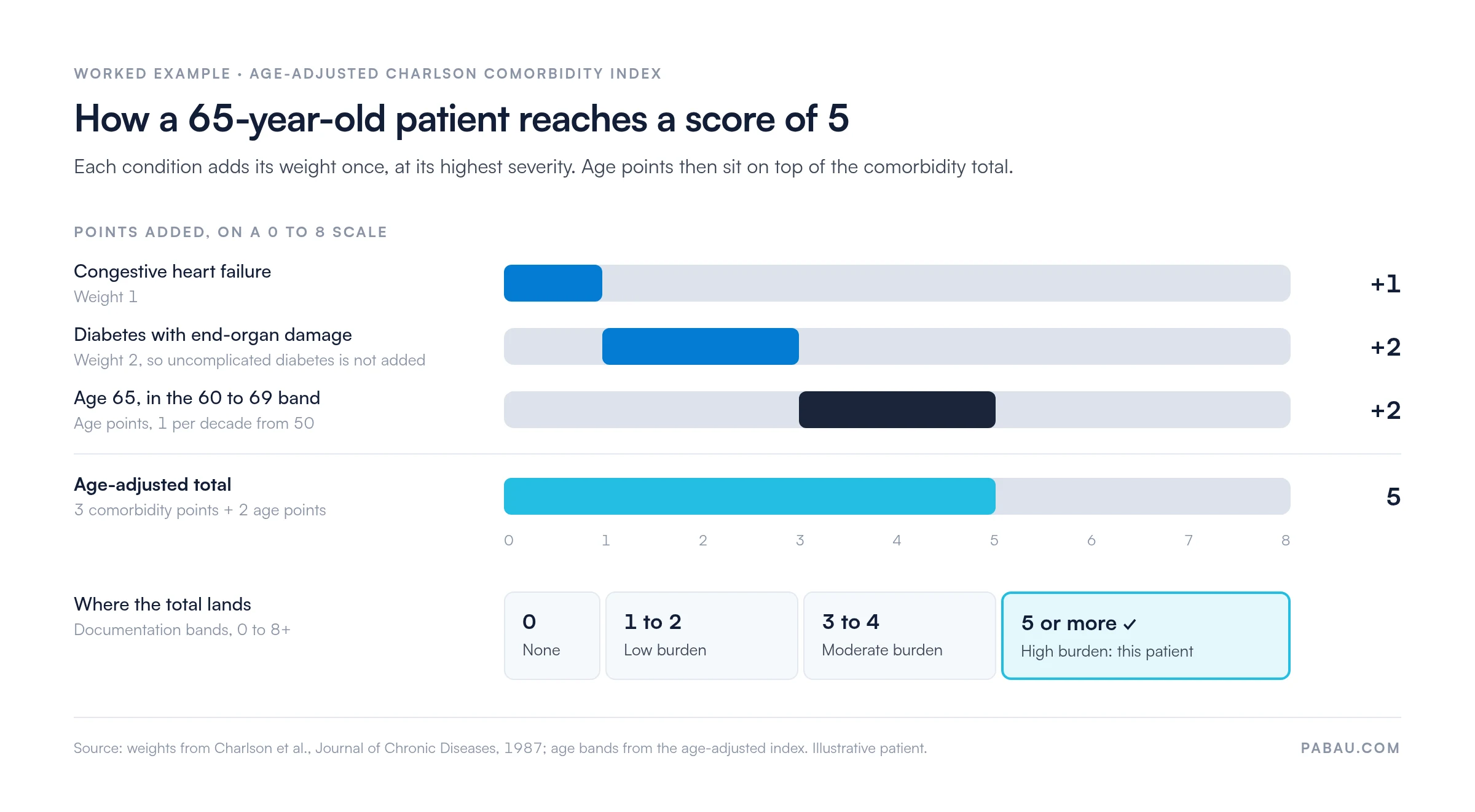
Higher totals indicate greater comorbidity burden and higher one-year mortality in the derivation cohort. Scores are grouped below for documentation purposes only, and each band should be read alongside the clinical picture.
The worksheet also carries an estimated 10-year survival, calculated as 0.983 raised to the power of e(0.9 × total score). Treat that figure as a population estimate rather than a prediction for the patient in front of you.
Administrative datasets often identify Charlson conditions through diagnosis codes rather than chart review. The Deyo adaptation, published in 1992 in the Journal of Clinical Epidemiology, mapped each condition to ICD-9-CM codes. Quan and colleagues published ICD-10 coding algorithms for the same conditions in 2005.
Confirm code ranges against the current CMS ICD-10 code resources before use, because codes are updated annually. If your claims or EHR workflow records diagnosis codes, the template’s condition checklist lets you cross-reference each code to its Charlson category.
In Pabau, the practice management platform we build, the patient record keeps clinical forms, notes and patient history in one place.

The original index is scored from clinical chart review, while the Deyo-Charlson adaptation is scored from administrative ICD coding. Choose the original when you have full clinical notes and the Deyo version when you only have claims or discharge data.
The two versions produce different totals, so never compare a Deyo score against an original CCI score in the same analysis.
The Elixhauser comorbidity index uses a broader list of conditions than the Charlson index, and it is scored differently. Researchers often choose Elixhauser when they want more condition coverage in outcome studies, and Charlson when they need a long-established weighted score for mortality estimation.
Clinical teams use the index for surgical risk discussions, oncology prognosis and population health reporting. Clinical governance leads also use it to evidence how complex patients are managed.
For cardiac risk before noncardiac surgery specifically, the Revised Cardiac Risk Index is the more targeted tool.
The index was developed on a 1984 cohort, so its weights may not reflect current treatment patterns. It grades severity for only a few conditions, such as liver disease and diabetes. Two patients with the same score can therefore differ considerably in clinical risk.
Where the severity of liver disease drives the decision, the MELD score grades it far more finely than the index’s two liver categories.
Download the PDF, record each condition present, enter the weights, and add the age adjustment if your protocol requires it. Store the completed form in the patient record so the score can be reviewed later.
A standard worksheet makes documentation consistent across clinicians, which helps during clinical governance review. It also reduces the chance that a condition is missed because it sits outside the note template.
Audit a sample of completed forms each quarter. Check that the condition list matches the record and that the score total is correct. Small, regular checks catch drift early.
Internal medicine, primary care, long-term care and clinical governance teams use the template most often. Research teams extracting comorbidity data from records also find a common worksheet useful.
On paper, a completed Charlson worksheet sits in a folder or gets scanned into a separate file. The next clinician often rebuilds the score from the chart, and two reviewers can reach different totals.
Pabau’s digital forms let you build the worksheet once, with the same condition list and weights for every clinician. Each completed form saves to the patient’s Client records, beside their notes and history.
For internal medicine and family practices, Pabau’s primary care practice software keeps forms, notes and appointments in one system. Governance reviews and audits then start from one consistent record.

See how Pabau keeps completed clinical forms beside notes and history in the patient record, so your team can review past scores in one place.

The CCI gives you a quick, comparable read on comorbidity burden, provided every clinician scores it the same way. Pick one version for your team, original or Deyo, adjusted or unadjusted, and record it on every form.
Treat the total as context for a risk discussion, and keep the clinical picture in charge of the decision. Pabau’s digital forms can carry the same worksheet into your intake workflow. Book a demo to see how Pabau keeps clinical scores consistent across your team.

Scoring a sore throat in primary care? Centor score covers the four criteria, McIsaac age points and a free PDF.
Assessing stroke severity? NIH Stroke Scale template gives you a structured worksheet for each scale item.
Reviewing complex patients as a team? Multidisciplinary review template structures the meeting and its documentation.
Interpreting lung function results? PFT interpretation chart walks through each step with a free printable.
The Charlson Comorbidity Index is a weighted score of 19 chronic conditions used to estimate comorbidity burden and mortality risk. It was published by Charlson and colleagues in 1987.
Add the weight of each of the 19 conditions present, using weights of 1, 2, 3 or 6 points. Add age points only if you are using the age-adjusted version.
The original CCI is scored from clinical records, while the Deyo-Charlson version is scored from administrative ICD codes. The two totals are not directly comparable.