Dental vacuum form: Free template for appliance records
A dental vacuum form is a production record for each vacuum-formed appliance you...

Last Updated: Oct 6, 2026

The NIH Stroke Scale (NIHSS) is a standardized 11-item neurological exam that scores stroke severity from 0 to 42.
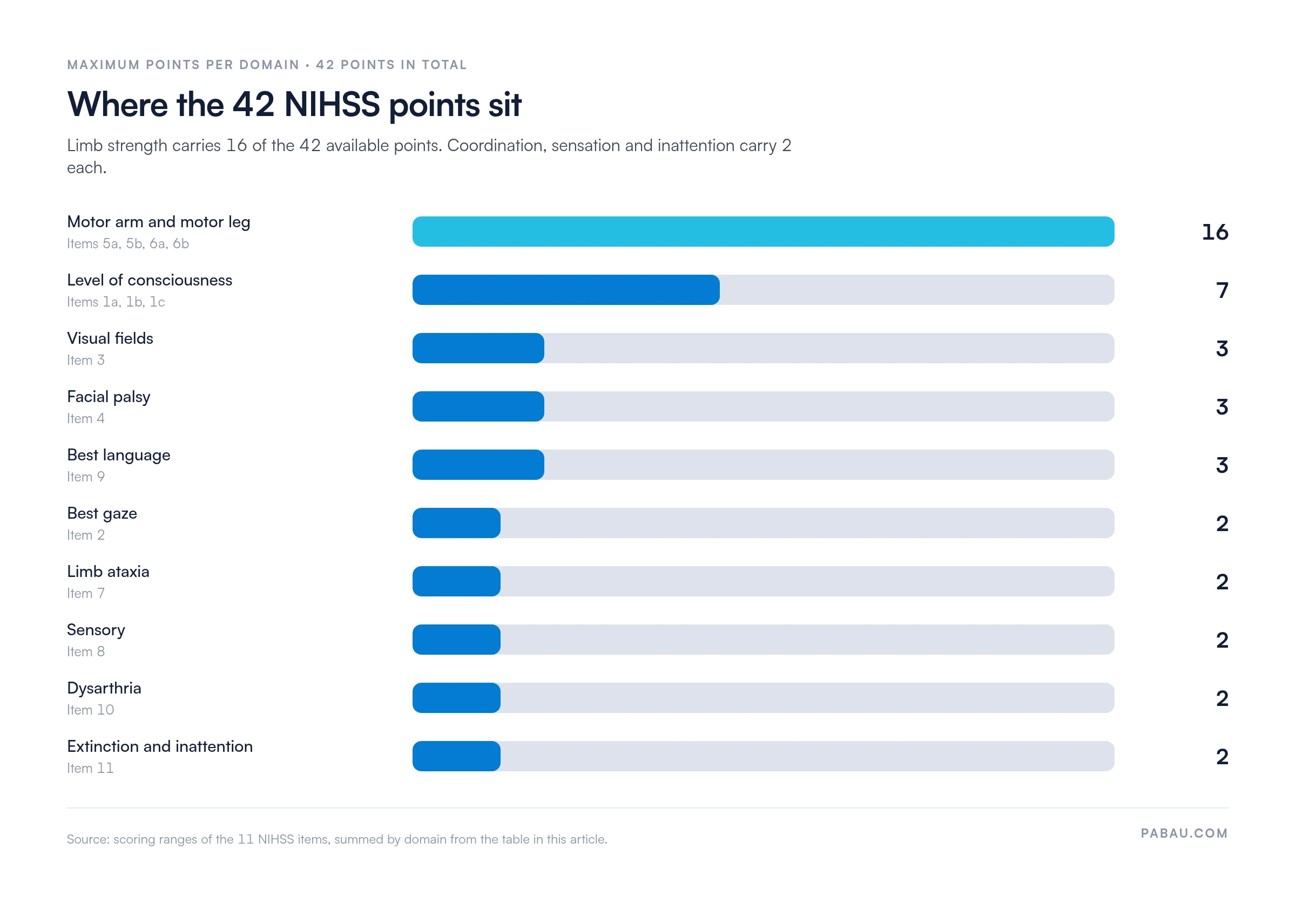
The 42 points are spread unevenly, with motor arm and leg items carrying 16 of them and limb ataxia carrying 2.
Score bands run from minor stroke at 1 to 4 up to severe stroke at 21 to 42, and they guide triage.
Practice management software like Pabau keeps each NIHSS score in the client record, so the baseline is there at handoff and follow-up.
A two-page bedside form covering all 11 NIHSS items, with the wording for every scoring level from 0 upward. It also carries fields for patient details, the examiner’s name and signature, and the assessment date.
Download templateThe NIH Stroke Scale (NIHSS) is the neurological assessment used in acute stroke care worldwide. Clinicians administering it therefore need accuracy and speed. Incorrect administration can delay thrombolytic treatment, and a thin note creates handoff errors that follow the patient through the rest of their care.
This guide covers what the scale measures, how to administer each item, how to read the total, and how certification actually works. A score is only as useful as the note it lands in, so it also draws on our guidance on safer clinical documentation.
Specifically, the NIH Stroke Scale is a systematic, 11-item neurological examination developed by the National Institutes of Health to quantify the severity of acute stroke symptoms. It measures impairment across consciousness, language, motor function, visual fields, and other neurological domains. The total runs from 0 to 42, and a higher score means a more severe stroke.
The scale was designed for rapid bedside assessment in emergency departments and acute stroke units, so an experienced clinician completes the full examination in under 10 minutes. Prehospital teams usually screen for stroke first with a three-item field test such as the Cincinnati stroke scale. The NIHSS then quantifies severity once the patient arrives.
Because NIHSS scores feed straight into treatment decisions, consistency between examiners matters. The score shapes thrombolysis and thrombectomy eligibility and helps predict functional outcome. The American Heart Association and American Stroke Association recommend the NIHSS as the standard severity measure in acute stroke protocols.
Specifically, each of the 11 items assesses a specific neurological domain. Knowing what each one tests, and where its scoring anchors sit, is what makes administration reliable.
In particular, the most common scoring errors happen in the motor items (5a, 5b, 6a, 6b). Examiners have to separate normal strength (score 0), subtle drift (score 1), and obvious weakness (scores 2 to 4). Position the limb correctly, then watch for downward drift or an inability to hold against gravity. Each motor item is scored separately for the left and right sides.
Proper scoring means knowing the anchor points for each level. Most items use a 0-3 or 0-4 scale, where 0 is normal function and higher numbers mean worse impairment.
Above all, the critical rule is to score what you observe, not what the patient reports. A patient may deny weakness and still show clear arm drift, and you score the drift.
Mark an item untestable with a ‘U’ when the patient refuses testing or cannot physically take part, such as after an amputation. That is not the same as scoring 4 for profound impairment, and the difference changes the total.
Overall, the total NIHSS score runs from 0 to 42. Clinicians read that total against standard severity bands, which predict functional outcome and guide treatment decisions.
However, the score alone does not decide treatment eligibility. Time from symptom onset, imaging findings, and contraindications all feed into thrombolysis and thrombectomy decisions.
Still, what the total does well is carry severity to every member of the care team in a single number. Record the baseline in the patient’s record so any later change is visible and can be escalated straight away.
Administration follows a strict protocol so that scores stay consistent between examiners. Overall, the full examination takes 5 to 10 minutes in experienced hands.
After completing all items, add the scores together for the total NIHSS. Document the time of assessment clearly, because comparing scores over time is how neurological decline gets caught. Between scored assessments, nursing teams chart neurological vital signs, and a change there is the prompt to repeat the scale.
Stroke survivors then return to primary care for follow-up, so the baseline score needs to travel with them. A shared record in primary care practice software keeps the original number in front of whoever reviews the patient next.
The download at the top of this page is a two-page bedside form. It lists all 11 items with the wording for each scoring level, plus fields for patient details, the examiner’s signature, and the assessment date.
However, it does not carry a severity conversion table or a separate administration guide. Keep the score bands and anchor points above to hand while you learn the scale. The National Institute of Neurological Disorders and Stroke publishes the official form alongside its full instructions.
Therefore, check that any NIHSS form you use matches the current version before you score a patient. Many practices laminate a copy for the bedside so clinicians can check the anchor points quickly during handoff.
In practice, the American Heart Association runs NIHSS certification as a series of online test groups. Each group plays scored patient videos, and you record a score for every item as if you were at the bedside. Certification is voluntary, but it is expected of most clinicians who use the scale in acute stroke care.
Certification demonstrates competency and is increasingly expected at Joint Commission-accredited stroke centers. Keep the completion record for each test group, since credentialing and peer review will ask for proof of current certification.
The NIHSS is a well-validated instrument with high inter-rater reliability when examiners are trained. Indeed, studies confirm that trained clinicians scoring the same patient produce consistent totals. The scale still has known limitations, and most of them trace back to how its points are distributed.
Where a posterior stroke is suspected, the scale needs supplementing with further examination and imaging. Consequently, teams that want a fuller picture of consciousness usually chart the Glasgow Coma Scale alongside the NIHSS total.
Despite the limitations, the NIHSS remains the international standard for acute stroke severity. Read the total together with imaging, the clinical picture, and the patient’s own baseline rather than on its own.
Stroke teams track NIHSS scores, imaging results, treatment windows, and medication records at once. When the scale lives on a paper form, that score sits in a folder while the rest of the record is digital. The next clinician has to go looking for it.
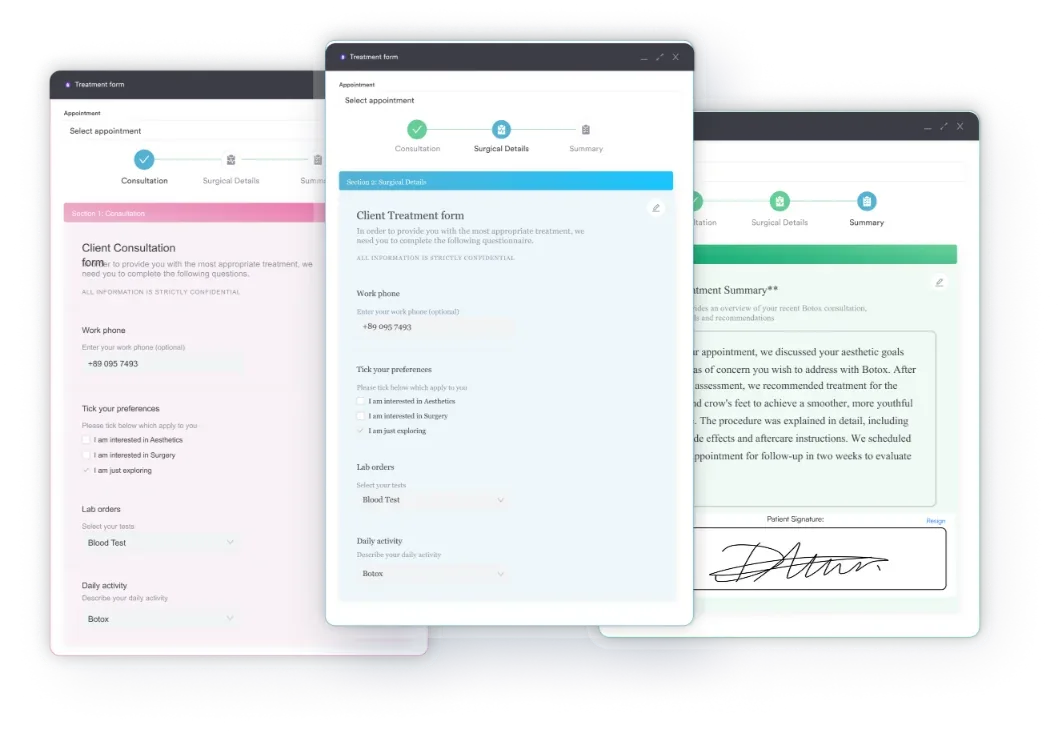
Pabau is practice management software that keeps clinical forms and client records in one place. Build the 11 items as a custom digital form, and each completed assessment saves into the client record with the date and the examiner attached.
The baseline is then in front of whoever picks the patient up, at handoff or at a follow-up visit months later. Rehabilitation and community teams work from the same record, so nobody has to rescore a patient to find out where they started.

Build the 11-item scale as a custom digital form and save each score straight into the client record. The baseline stays visible at handoff and at follow-up.

The NIHSS earns its place in acute stroke care because it turns a neurological examination into one number the whole team can act on. However, that only holds if every examiner scores the same patient the same way. Certification and a fixed protocol are what buy you that consistency.
Learn where the points sit before you learn the shortcuts. As a result, a clinician who knows that limb strength carries 16 points reads a low total in a dizzy, ataxic patient with more suspicion. Ultimately, that judgment matters more than shaving a minute off the examination.
Print the form, score it the same way every time, and keep the result where the next clinician will find it. Book a demo to see how Pabau holds NIHSS scores and stroke documentation in one client record.

Need the field screen that comes before the NIHSS? Cincinnati stroke scale scoring template covers the three-item test used to flag a suspected stroke before arrival.
Scoring consciousness as well as stroke severity? Glasgow Coma Scale template sets out the eye, verbal and motor scoring that stroke units chart alongside the NIHSS.
Want the wider neurological examination? Neurological exam checklist walks through cranial nerve, motor, sensory and reflex testing on one printable form.
Tracking a patient between scored assessments? Neurological vital signs explains which observations to chart and what a change in them should trigger.
The NIHSS measures stroke severity at the bedside by scoring 11 neurological domains, including consciousness, language, motor function and visual fields. The total runs from 0 to 42. Clinicians use it to classify severity, predict functional outcome, and judge candidacy for thrombolysis or thrombectomy. The scale is administered on arrival, repeated to detect worsening, and documented in the record so the whole team sees the same number.
Items 1a to 1c cover level of consciousness, the orientation questions, and the commands. Item 2 is best gaze, item 3 visual fields, and item 4 facial palsy. Items 5a to 6b score motor arm and motor leg on each side. Item 7 is limb ataxia and item 8 sensory function. Item 9 is best language, item 10 dysarthria, and item 11 extinction or inattention. Each item is scored on its own range, either 0-2, 0-3 or 0-4, and a higher score means worse impairment.
Specifically, a total of 0 means no stroke symptoms or neurological deficits were detected during the examination. The patient performed normally on all 11 items and shows no detectable impairment from stroke.
The NIHSS is used across ischemic and hemorrhagic stroke and transient ischemic attack, and it is the recommended standard severity measure. The scale is weighted toward anterior circulation deficits, so it can underestimate posterior circulation strokes in the brainstem and cerebellum. Add further neurological testing and imaging whenever a posterior stroke is suspected.