Anja Dodevska

MELD score: MELD 3.0 formula, ranges and free worksheet
Download your free MELD 3.0 score worksheet A two-page MELD 3.0 worksheet that o...

Last Updated: Nov 4, 2026
Free PDF 1 page, print-ready Clinician-reviewed
The Centor score is a four-point clinical rule that estimates how likely a sore throat is to be group A streptococcal pharyngitis. One point each goes to fever over 38°C (100.4°F), absence of cough, tender anterior cervical nodes, and tonsillar swelling or exudate. The McIsaac modification adds a point for ages 3 to 14 and subtracts one from age 45, so totals run from −1 to 5. A total of 1 or less needs no test and no antibiotic. A total of 2 to 3 calls for a rapid antigen test or watchful waiting. At 4 or more, current IDSA guidance still asks for a test or culture before any antibiotic.
A one-page form with the four Centor criteria, the McIsaac age bands and a table linking each total to a suggested action. It also has fields for the test, the result, any antibiotic and the review date.
Start from scratch, or upload this PDF or any form you already use, and Pabau's AI Form rebuilds it with tick boxes, text fields and a signature. Attach it to the treatment once, and every patient gets it on time.
AI Form rebuilds the consent, history and aftercare forms you already use. You review each one, then publish.
Patients complete forms on their phone before they arrive, so the front desk stops retyping paper.
Every signed form is versioned and attached to the treatment record, ready when you need it.
Set how long a consent stays valid. Returning patients skip forms they have already signed.
Supports HIPAA and GDPR compliance AES-256 encryption 4.8 on G2 4.7 on Capterra Trusted by 4,000+ practices worldwide

The Centor score gives one point each for fever, absence of cough, tonsillar exudate or swelling, and tender anterior cervical nodes.
The McIsaac modification adds a point for ages 3 to 14 and subtracts one from age 45, so totals run from −1 to 5.
Totals of 1 or less need no test and no antibiotic, while 2 to 3 call for a rapid antigen test or watchful waiting.
At 4 or more, current IDSA guidance still calls for a rapid antigen test or culture, with antibiotics only if it is positive.
Pabau, the practice management platform we build, turns the worksheet into a digital form that saves the score to the patient record.
The Centor score worksheet is a structured form for a patient with a sore throat. It records the four Centor criteria, the age adjustment, the total and the next step. It standardizes how a practice assesses the risk of streptococcal pharyngitis and documents the reasoning behind each decision.
Centor and colleagues described the original criteria in 1981, working with adults who came to an emergency department with a sore throat. In 1998, McIsaac and colleagues added an age adjustment for children and older adults. The worksheet uses that modified version, so one form covers patients from age 3 upward.
Work through the form in the order you examine the patient. Each step maps to a field on the worksheet.
The form also has space to note the red flags you considered, such as airway compromise, drooling, trismus or unilateral swelling. Where your local protocol differs from the worksheet, record the reason. If the fever history is unclear, a fever temperature chart gives the team one reference for what counts as raised.
Primary care and urgent care teams use the worksheet when a patient presents with a sore throat and a streptococcal infection is a realistic possibility. Nurse-led minor illness services and walk-in centers use it for the same reason.
A fixed format makes assessments comparable across clinicians and visits. It also leaves a clear record if an antibiotic decision is questioned at audit.
Fixed fields stop a busy clinician from skipping a criterion, so every total rests on all four signs plus age. Pabau’s digital forms let practices move the worksheet into the patient record instead of keeping paper copies.
The score uses four yes-or-no criteria, each worth one point. The worksheet lists each criterion with the clinical description used in the original validation work.
The McIsaac modification adds an age criterion that the original score lacked. Children aged 3 to 14 add one point, patients aged 15 to 44 add nothing, and patients aged 45 or older lose one point.
Streptococcal pharyngitis is most common in school-age children, and its likelihood falls with age. That is why the modified total runs from −1 to 5. Use the modified version when the patient is a child or an older adult, and record which version you applied.
For a child, the score is one part of a wider pediatric assessment. That assessment also covers breathing, hydration and the red flags the four criteria leave out.
The total sets the action band. Each band reflects a different estimated likelihood of group A Streptococcus, so the decision follows the band rather than a single cut-off. The chart below traces the path from the signs to the action.
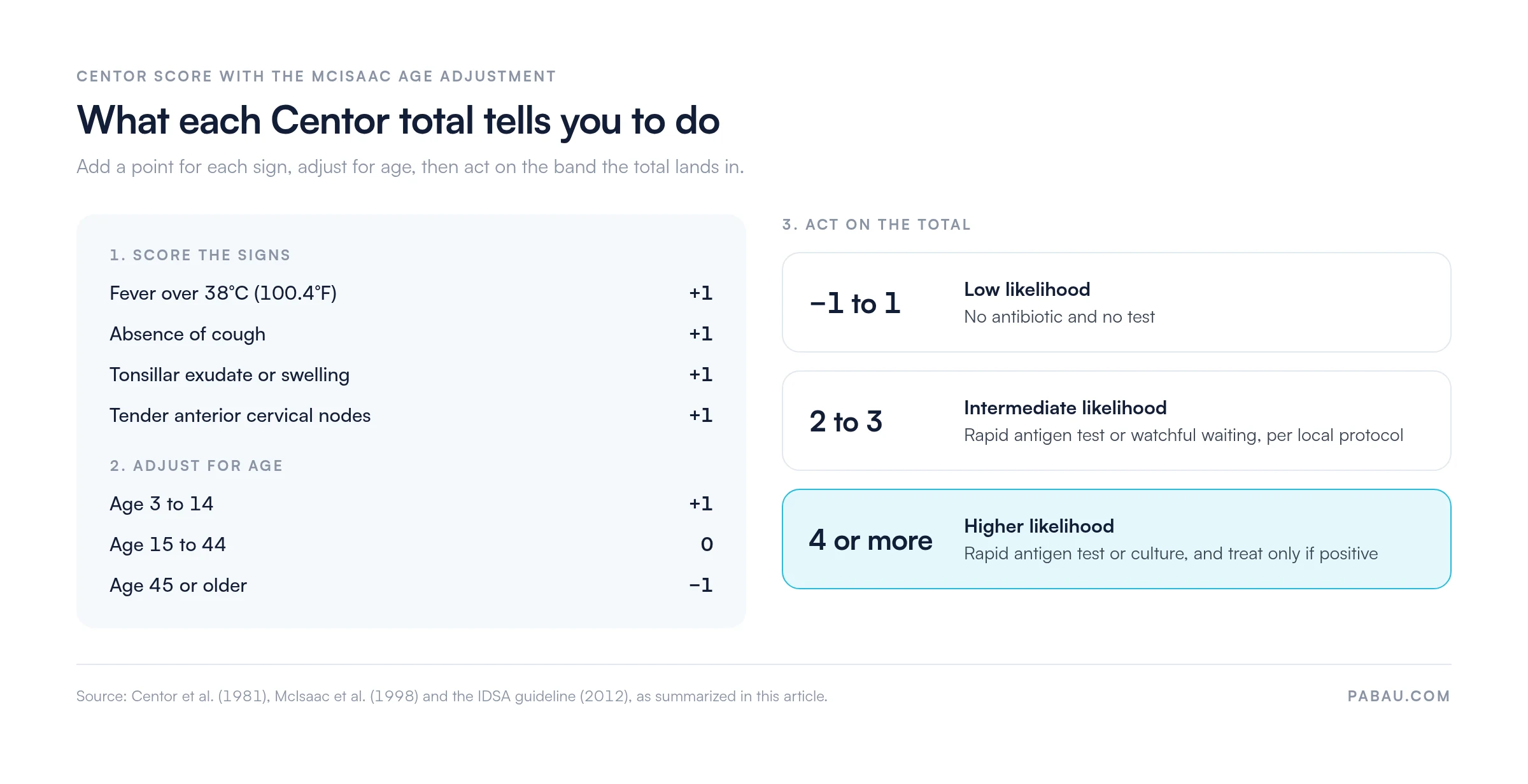
Probabilities vary between studies and populations, so the worksheet records bands rather than exact percentages. The 2012 Infectious Diseases Society of America (IDSA) guideline recommends confirming group A strep with a test before prescribing, even at a high score. In children and adolescents, back up a negative rapid test with a throat culture.
Score the patient before you decide on treatment. A total recorded first shows a reviewer that the decision followed the criteria.
The FeverPAIN score is an alternative tool with five criteria, including symptom onset within three days and purulence. Both aim to support the same decision, but they were validated in different populations.
Your local guideline determines which tool to use. Practices that use both should choose one per pathway, so the worksheet and the documentation stay consistent.
The original derivation was in adults, so pediatric use depends on the McIsaac modification and local guidance. The score also cannot diagnose viral illness or other causes of sore throat.
Clinical judgment should override the score when the patient looks systemically unwell, has red flags, or has a history the criteria do not capture.
Many practices still score sore throat on a paper worksheet or in free text. The paper copy gets scanned, or the total is retyped into the note, and the reasoning behind the antibiotic decision is easy to lose.
In Pabau, you can rebuild this worksheet as a digital form inside the patient record. The clinician ticks the criteria during the consultation, and the completed form is saved against that patient and that visit.
Because the form sits beside the appointment and the treatment note, a reviewer sees the score, the test result and the prescription in one place. Practices running a primary care service can see how this fits a wider GP clinic software setup, from booking to follow-up.

Pabau’s digital forms turn the Centor worksheet into a form that saves to the patient record. The score, the test result and the antibiotic decision stay together for every sore throat visit.

Use the Centor score to decide who needs a test, and let the test decide who needs an antibiotic. A low total spares the patient both. A total of 2 or more points to a rapid antigen test or watchful waiting before any prescription.
The score only estimates probability, so the record has to carry the rest. Write down the version you used, the red flags you checked and the result you acted on, and the decision will stand up at review. Book a demo to see how Pabau keeps each sore throat assessment, test result and prescription in one patient record.

Examining the chest as well as the throat? Respiratory exam template walks through the IPPA steps and how to document each one.
Sore throat with ear pain? Ear infection test covers the types of test and when a patient should see a doctor.
Assessing a child with a rash as well as a sore throat? Pediatric rash chart helps you tell common childhood rashes apart.
Need a checklist for the full examination? Head-to-toe assessment cheat sheet is a printable guide to a complete physical assessment.
The Centor score is a four-criterion tool that estimates the likelihood of group A streptococcal pharyngitis in a patient with a sore throat. Each criterion scores one point, and the total guides whether to test or treat.
The original score was derived in adults. The McIsaac modification adds a point for children aged 3 to 14, so use that version and follow local pediatric guidance.
Yes. Many clinicians use CENT: C for cough absent, E for exudate, N for tender nodes and T for temperature over 38°C (100.4°F). The McIsaac version then adjusts the total for age.
A score of 2 to 3 usually falls in the band where a rapid antigen test is considered or watchful waiting is chosen. The decision depends on local protocol and the patient’s overall picture.