Tanja Lepcheska

Healthcare dashboard examples: 6 real-world use cases
The most useful healthcare dashboard examples fall into six types: executive, cl...

Last Updated: Nov 11, 2026
Free PDF 2 pages, print-ready Clinician-reviewed
The FIB-4 index is a non-invasive score that estimates the risk of advanced liver fibrosis from four routine values: age, AST, ALT and platelet count. A score under 1.30 means low risk, and a score over 3.25 means high risk, though many MASLD pathways use 2.67 instead. A result in between needs a second-line test, such as elastography. Because it uses blood results you already have, it is usually the first step in a liver fibrosis pathway. This free worksheet sets out the calculation, the score bands and the next steps on one page.
A two-page printable PDF with patient details, the FIB-4 calculation table, score bands with next steps, the age 65 cutoff and a follow-up plan.
Start from scratch, or upload this PDF or any form you already use, and Pabau's AI Form rebuilds it with tick boxes, text fields and a signature. Attach it to the treatment once, and every patient gets it on time.
AI Form rebuilds the consent, history and aftercare forms you already use. You review each one, then publish.
Patients complete forms on their phone before they arrive, so the front desk stops retyping paper.
Every signed form is versioned and attached to the treatment record, ready when you need it.
Set how long a consent stays valid. Returning patients skip forms they have already signed.
Supports HIPAA and GDPR compliance AES-256 encryption 4.8 on G2 4.7 on Capterra Trusted by 4,000+ practices worldwide

The FIB-4 index estimates the risk of advanced liver fibrosis from age, AST, ALT and platelet count.
Scores under 1.30 indicate low risk, and scores over 3.25 indicate high risk.
Scores between 1.30 and 3.25 need a second-line test, such as elastography, before any conclusion.
For patients aged 65 and over, a low-risk cutoff of 2.0 avoids over-referral.
Digital forms in Pabau, our practice management platform, record each FIB-4 result the same way at every review.
The FIB-4 index is a non-invasive scoring tool that estimates the likelihood of advanced liver fibrosis in adults with chronic liver disease. It was developed in patients with HIV and hepatitis C coinfection. It is now widely applied to metabolic dysfunction-associated steatotic liver disease (MASLD), formerly called non-alcoholic fatty liver disease.
Viral hepatitis is another common reason for assessment, and the CDC’s hepatitis resources cover testing and monitoring. The score is most often used for three purposes:
NICE’s NG49 guidance on MASLD, formerly called non-alcoholic fatty liver disease, recommends the ELF test to assess advanced fibrosis. It also advises against using routine liver blood tests alone. Check the current NICE text before applying FIB-4 in your setting.
The FIB-4 index is calculated as (age × AST) ÷ (platelet count × √ALT). Sterling and colleagues first described the formula in a 2006 paper in Hepatology, and each input comes from a routine test or record.
Here is a worked example. Take a 60-year-old with an AST of 40 IU/L, an ALT of 35 IU/L and 200 ×10⁹/L platelets. The sum is (60 × 40) ÷ (200 × √35), which is about 2.03.
Watch the platelet units. Enter the count in ×10⁹/L, which is the same number as ×10³/µL. A raw per-microliter count gives a result a thousand times too small.
Because all four values come from routine tests, the calculation takes minutes and needs no extra procedure. Recalculate it whenever new AST, ALT or platelet results arrive.
A FIB-4 score below 1.30 indicates low risk, a score above 3.25 indicates high risk, and a score in between is indeterminate. Each band points to a different next step, and the scale below places the worked example in context.
FIB-4 index · risk of advanced liver fibrosis
Where a FIB-4 score lands, and what happens next
A low score rules advanced fibrosis out. A high score calls for referral. The middle band needs a second test.
Low · under 1.30
Routine monitoring under current guidance.
Indeterminate · 1.30 to 3.25
Second-line test, such as elastography or an ELF blood test.
High · over 3.25
Specialist referral for further assessment.
Age 65 and over: a low-risk cutoff of 2.0 replaces 1.30. Some MASLD pathways, including our worksheet, set the high-risk cutoff at 2.67.
The worked example from the calculation section scores 2.03, in the indeterminate band. Cutoffs from Sterling et al., Hepatology 2006, and McPherson et al., Am J Gastroenterol 2017.
Some MASLD pathways, including the one on our worksheet, use 2.67 as the high-risk cutoff instead of 3.25. The lower figure sends more patients straight to hepatology, so note which cutoff your service follows.
Treat these bands as guidance rather than a diagnosis. The FIB-4 index is a starting point for clinical judgment, so read it alongside the patient’s history and an abdominal physical exam.
Once cirrhosis is confirmed, FIB-4 has done its job. The MELD score then takes over to estimate short-term prognosis.
FIB-4 rises with age independently of fibrosis, so the 1.30 cutoff over-refers adults aged 65 and over. McPherson and colleagues proposed a cutoff of 2.0 for this group in 2017. Check the current NICE or AASLD guidance before applying it.
The FIB-4 index has three main limitations. It is less reliable in older patients, it leaves an indeterminate middle band, and AST and ALT can rise for reasons unrelated to fibrosis.
The score reduces the need for biopsy but does not replace it. Biopsy is still used when results conflict with the clinical picture or when treatment decisions depend on the exact stage of disease.
The worksheet is designed to be completed in one sitting at the point of review. Work through it in this order so each result is complete before it reaches the patient record.
Save the completed worksheet to the patient file so the result and the next step can be audited. Digital storage also makes it easier to repeat the calculation when new results arrive.
Free-text notes can bury a score halfway down a long entry. Structured fields make it easier to find, and AI-assisted note writing can draft the summary for clinician review before it is signed.
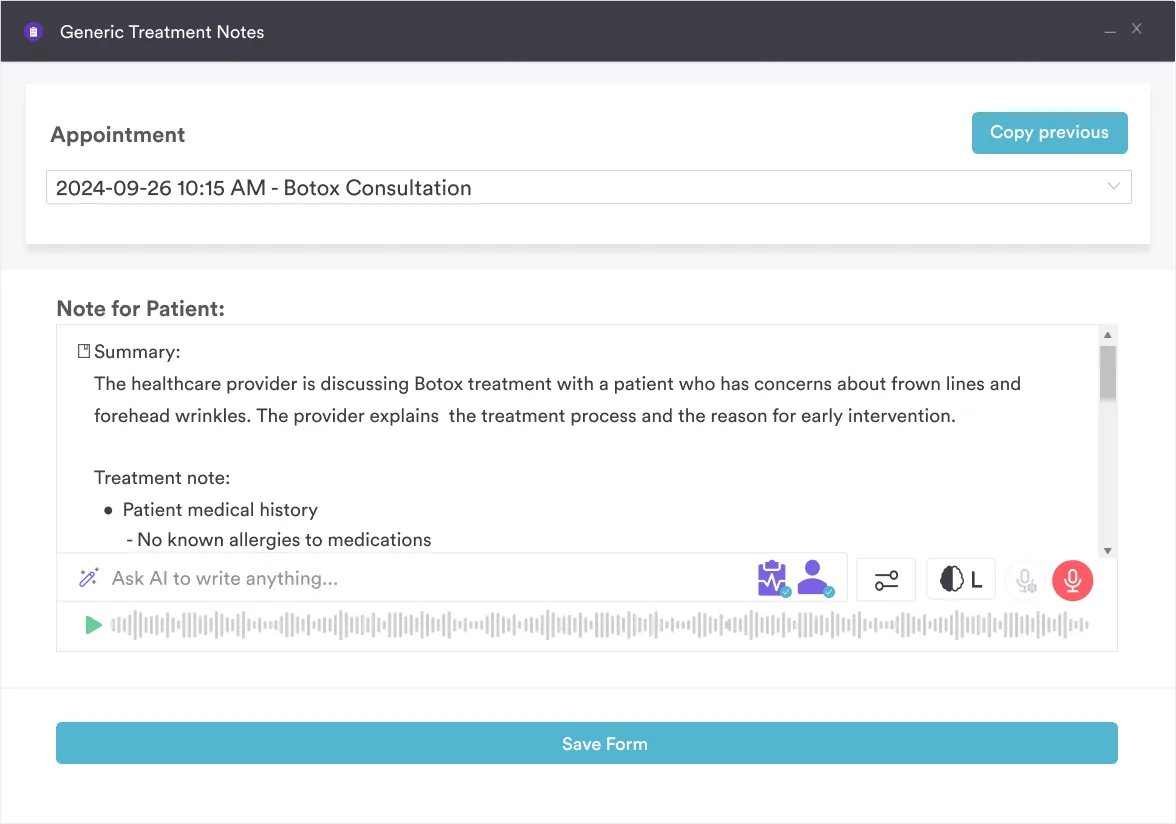
Ideally, each note records the score, the risk band and the next step in one line. Recording every FIB-4 result this way makes it easier to compare results across reviews.
Our safer clinical notes guide covers the wider principles of structured documentation, which apply to any scoring tool.
For primary care teams running a liver fibrosis pathway, our GP clinic software page shows how these records fit into a primary care workflow.
On paper, a FIB-4 result usually means a calculation on the worksheet and a score typed into a free-text note. The band and the next step can end up in different places, so the next reviewer has to piece them together.
Pabau’s AI Form rebuilds this worksheet as a digital form, with fields for each input, the score, the band and the next step. Pabau’s Client records keep that score history beside the rest of the patient’s notes, so changes between reviews are easy to spot.
For US practices with Labs switched on, Quest and Labcorp results import into the patient record automatically. A lab trends chart on the record then shows how each biomarker moves between reviews.

Book a demo to see how Pabau’s digital forms, Client records and lab trends keep liver fibrosis scores consistent from one review to the next.

FIB-4 earns its place as a rule-out test. A score under 1.30, or under 2.0 from age 65, lets you reassure a patient without further testing. A score above your service’s high cutoff earns a referral.
The middle band is where the work is. Agree on your second-line test in advance, so an indeterminate result moves straight to elastography or an ELF test instead of waiting for a decision.
Record the band and the next step beside every score, and recalculate when new blood results arrive. Book a demo to see how Pabau keeps each FIB-4 result, band and follow-up on one patient record.

Assessing prognosis once cirrhosis is confirmed? MELD score covers the MELD 3.0 formula, its ranges and a free worksheet.
Examining the liver at the bedside? Abdominal physical exam sets out the steps for a structured abdominal assessment.
Building a wider screening routine? Health screening tests explains which tests to offer and at what age.
Using other scores in primary care? Centor score walks through the four criteria and the McIsaac age points.
Drawing bloods for the next review? Blood test consent gives you a ready-made consent form for venipuncture.
The FIB-4 index is a non-invasive score that estimates the risk of advanced liver fibrosis using age, AST, ALT and platelet count.
No. A score above 3.25 indicates high risk of advanced fibrosis and should prompt specialist assessment, but it is not a diagnosis on its own.
Not entirely. A low score can reduce the need for biopsy, but intermediate results and cases where clinical findings conflict still need further testing.
Recalculate it whenever new AST, ALT or platelet results are available, and follow the monitoring plan set by current guidance.