HIPAA compliant texting: What you can send patients & how to communicate securely
HIPAA compliant texting is possible when a text holds no protected health inform...

Last Updated: Oct 16, 2026

A repeat prescription request is how a patient on long-term medication orders their next supply without booking an appointment.
The form needs the patient’s name, date of birth, and NHS number, plus each medicine’s name, strength, and quantity.
Most practices quote 48 to 72 hours, or three working days, from submission to dispensing.
Schedule 2 and 3 controlled drugs cannot go on a repeat, and that restriction comes from the Misuse of Drugs Regulations 2001.
Practice management software like Pabau links the request, the prescriber’s approval, and the prescription record in one place.
A patient-completed PDF covering personal and contact details, the medicines currently prescribed, how well they are working, and safety screening questions. It closes with a privacy and contact consent section you can brand as your own.
Download templateA repeat prescription request is how a patient on long-term medication orders their next supply without seeing the prescriber. The form has one job. It has to carry enough detail for the prescriber to approve or refuse the request safely.
This guide covers the template above, the fields a complete request needs, and how long processing usually takes. It also covers the medicines that cannot be repeated, and what reception should do when one of them lands in the inbox.
A repeat prescription request is a standing arrangement for medicines a patient takes long term. Rather than book an appointment each time, the patient submits a request and the prescriber reviews it. Once it is approved, the medicine goes to the pharmacy that will dispense it.
It suits patients on stable treatment, such as blood pressure tablets, thyroid replacement, or hormone replacement therapy. Every request still needs prescriber authorization under GMC prescribing standards, even where the repeats were agreed months ago.
Both routes collect the same information, but they run on different rails. An NHS repeat travels through the practice’s clinical system and reaches the nominated pharmacy over the Electronic Prescribing Service.
A private GP practice handles the whole loop itself. The request arrives on a form, a prescriber reviews it, and the script goes to a dispensing partner instead of through the NHS service. The practice owns the audit trail, which is why the form and the record have to be tight.
Patients and staff have three channels. Online is the fastest and the most secure, because the request is timestamped and legible. Paper and telephone stay open for anyone without digital access.
Online ordering removes the most clerical work, and nothing gets mistyped from a handwritten slip. Patients have to be registered for online services first.
Plenty of practices still run on tear-off slips, and patients can order from the counterfoil that came with their last prescription. They can also fill in a downloadable form like the template above and hand it in or post it.
A complete request carries enough detail for the prescriber and the pharmacy to act without calling the patient back. Missing detail is the main reason a request stalls or gets rejected.
The template above already sets these out for the patient to complete. A digital intake form does the same job and files the answers straight into the patient record, so nothing gets rekeyed.
Most practices quote 48 to 72 hours, or three working days, from submission to dispensing. It is never instant, because a prescriber has to review every request before it goes anywhere.
Delays usually trace back to one of four things. The prescriber is away, the request is incomplete, the pharmacy is busy, or the medicine is out of stock. Where a request covers a long list, the prescriber may hold it for a full medication review first.
Urgent and acute medicines should never come through this route. They need an appointment, and telling patients so up front saves a wasted three days.
Some medicines are not eligible for a repeat, and the reasons are legal as well as clinical. Reception needs to recognize them at the point of request, not three days later.
The restriction on Schedule 2 and 3 drugs comes from the Misuse of Drugs Regulations 2001, which the Home Office administers. An NHS prescription for one of them is written on a standard FP10. The FP10PCD form is for private prescriptions of controlled drugs only.
Most guidance stops at the list of exclusions, which leaves the front desk to improvise. This is the triage most practices end up writing for themselves.
| What the patient asked for | What reception does | Why |
|---|---|---|
| Schedule 2 or 3 controlled drug | Book a prescriber appointment or telephone review | Each supply needs its own signed prescription |
| Antibiotic or other acute medicine | Offer a same-week appointment | The prescriber has to assess the current problem |
| Medicine started in the last month | Route it to the prescriber who started it | The dose may still be changing |
| Medicine the patient had stopped taking | Flag it for a medication review | The repeat list needs correcting first |
| A larger quantity than usual | Check the last issue date, then pass it up | Early requests can signal overuse or travel |
Writing down why a request was refused is worth the extra 30 seconds. It gives the next prescriber context, and it answers the question a CQC inspection raises about medicines management.
On paper, the request arrives at reception, gets carried to the prescriber, and gets logged twice. Forms sit in a tray, and nobody can say where any single one has got to. When a patient rings to chase it, someone has to go and look.
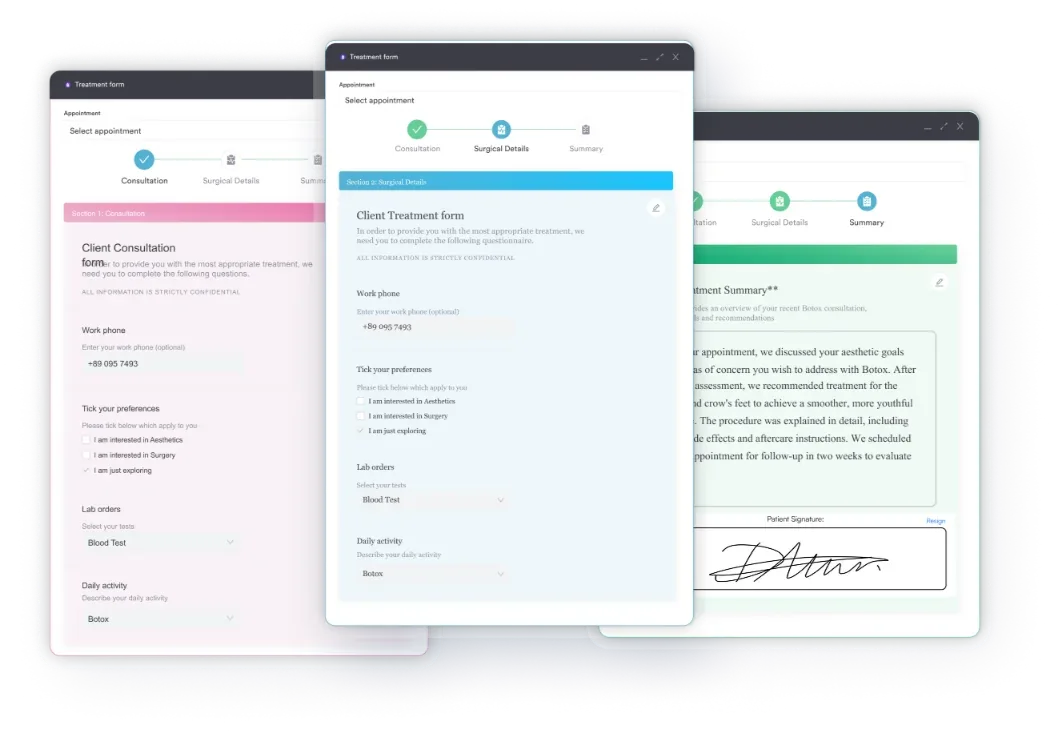
Pabau keeps that loop in one system. The patient completes a digital form, the prescriber gets an alert and approves it inside the record, and the outcome is written back automatically. Pabau also connects to UK prescribing services such as CloudRx and Pharmacierge, so the approved script leaves without a second login. Before and after photos are only comparable when lighting, angle and distance are consistent, which the record should enforce.
For the practice, that means fewer lost forms, a faster turnaround, and one place to show how each medicine was authorized. Automated workflows chase the reviews that fall due, so the repeat list does not quietly drift out of date.
Patients get an SMS or email the moment their prescription is ready. That single message is what stops reception fielding a run of calls asking whether it has been done yet.

Pabau collects the request on a digital form, alerts the prescriber for approval, and writes the outcome back to the patient record. Your team stops chasing paper and can show an inspector how every medicine was authorized.

The form is the easy part. What decides whether repeats run smoothly is reception’s ability to tell a routine request from one that needs a prescriber. The other half is writing down the reason whenever a request is refused.
So download the template and adapt the clinical section to what your practice actually prescribes. Then agree the exclusion rules with your prescribers before you put the form in front of patients. A form that collects the wrong detail creates more phone calls than it saves.
Book a demo to see how Pabau moves a repeat request from form to approval to audit trail without paper.

Ready to send prescriptions electronically? electronic prescribing software comparison compares 7 platforms for EPCS compliance, Surescripts certification, and pricing.
Want a fuller picture than the scale gives? body composition test guide explains methods, healthy ranges, and how practitioners use results to judge metabolic risk.
Explaining a lab test to a patient? bone marrow test guide explains what happens during the procedure and what the results mean.
Reviewing lab work before a renewal? C4 complement blood test explains what the test measures and why an abnormal complement level matters.
Explaining a routine lab panel result? carbon dioxide blood test guide explains what CO2 levels measure and why results are often misunderstood.
A repeat prescription request lets a patient on long-term medication order their next supply without seeing the prescriber. The prescriber still authorizes every request, to confirm the medicine is still clinically appropriate.
Most practices quote 48 to 72 hours, or three working days, from submission to dispensing. Delays happen when the request is incomplete, the prescriber is away, or the pharmacy is busy. Urgent medicines need an appointment instead.
No. Schedule 2 and 3 controlled drugs, including opioid painkillers and stimulants, cannot go on a repeatable prescription. That restriction comes from the Misuse of Drugs Regulations 2001, not from the MHRA. Most benzodiazepines sit in Schedule 4 and can be repeated, subject to regular review.
Give your full name, date of birth, NHS number, address, and a contact number. For each medicine, add the name, strength, quantity, and the pharmacy that will dispense it. Missing detail is what holds a request up.
The Electronic Prescribing Service, or EPS, is the NHS system that routes prescriptions to a patient’s nominated pharmacy. Once the prescriber authorizes a repeat, it reaches the pharmacy without any paper changing hands. US practices choosing electronic prescribing software weigh similar factors, including EPCS compliance and Surescripts certification.
Yes. Most practices can set up online access at reception in a few minutes. Ask to be registered for the NHS App or the practice portal, which also lets you book appointments and read your record.