Sulcus Test: Shoulder Instability Assessment
The sulcus test is an orthopedic special test that checks for inferior glenohume...

3
Last Updated: Oct 22, 2026
The Ballard scale newborn assessment estimates a baby’s gestational age by scoring six neuromuscular and six physical signs of maturity. The 12 scores add up to a total between −10 and 50, and every 5 points equals 2 weeks of gestation. That places the estimate between 20 and 44 weeks, accurate to within about 2 weeks.
Ballard and colleagues published the original scale in 1979, and the New Ballard Score of 1991 extended it to extremely premature infants. Labor and delivery teams and neonatal intensive care units (NICUs) use it when prenatal dating is missing or unreliable. The free template below lays out all 12 criteria, the scoring steps, and the score-to-weeks conversion.
A printable assessment form with all six neuromuscular and six physical maturity criteria, scoring instructions, and a score-to-weeks lookup table. It is ready for labor and delivery, NICU, and follow-up documentation.
Download template
The Ballard scale scores six neuromuscular and six physical maturity signs to estimate gestational age between 20 and 44 weeks.
Total scores run from −10 to 50, and every 5 points adds 2 weeks of gestation.
Term gestation of 37 to 42 weeks corresponds to a total score of roughly 33 to 45.
The estimate carries a margin of about ±2 weeks and is most reliable within 12 to 20 hours of birth.
A Ballard estimate more than 2 weeks away from the obstetric dates is a prompt to check for growth restriction or a dating error.
The Ballard scale is a structured bedside exam that estimates gestational age from two domains. Neuromuscular maturity covers how reflexes and muscle tone develop. Physical maturity covers visible changes in the skin, hair, and genitalia. Since its introduction in 1979, it has become the standard bedside method for rapid dating in neonatal medicine.
The New Ballard Score (NBS) of 1991 extended the range down to extremely premature infants of 20 weeks. The original scale started at about 26 weeks. Teams use the exam for five main jobs.
The original Ballard scale (1979) was the first validated method for dating a baby after birth. The New Ballard Score refined it in 1991 to improve accuracy at the extremes of prematurity.
Most modern settings use the New Ballard Score, especially NICUs that care for extremely premature infants.
Neuromuscular maturity is assessed through six muscle tone and reflex signs. Each one scores from −1 to 5, and higher scores mean more mature development.
The six scores add up to the neuromuscular subtotal, which makes up half of the total Ballard score.
Physical maturity is assessed from six visible features. Each one scores from −1 (immature) up to 4 or 5 (fully mature).
The ear criterion grades cartilage maturity only. Hearing checks and ear infection testing stay separate assessments with their own tools.
The physical scores are summed separately and then added to the neuromuscular subtotal to give the total Ballard score.
Scoring takes two stages. You sum the two subtotals, then convert the total to gestational age in weeks.
The assessment is most reliable within 12 to 20 hours of birth, before postnatal stress changes the infant’s muscle tone.
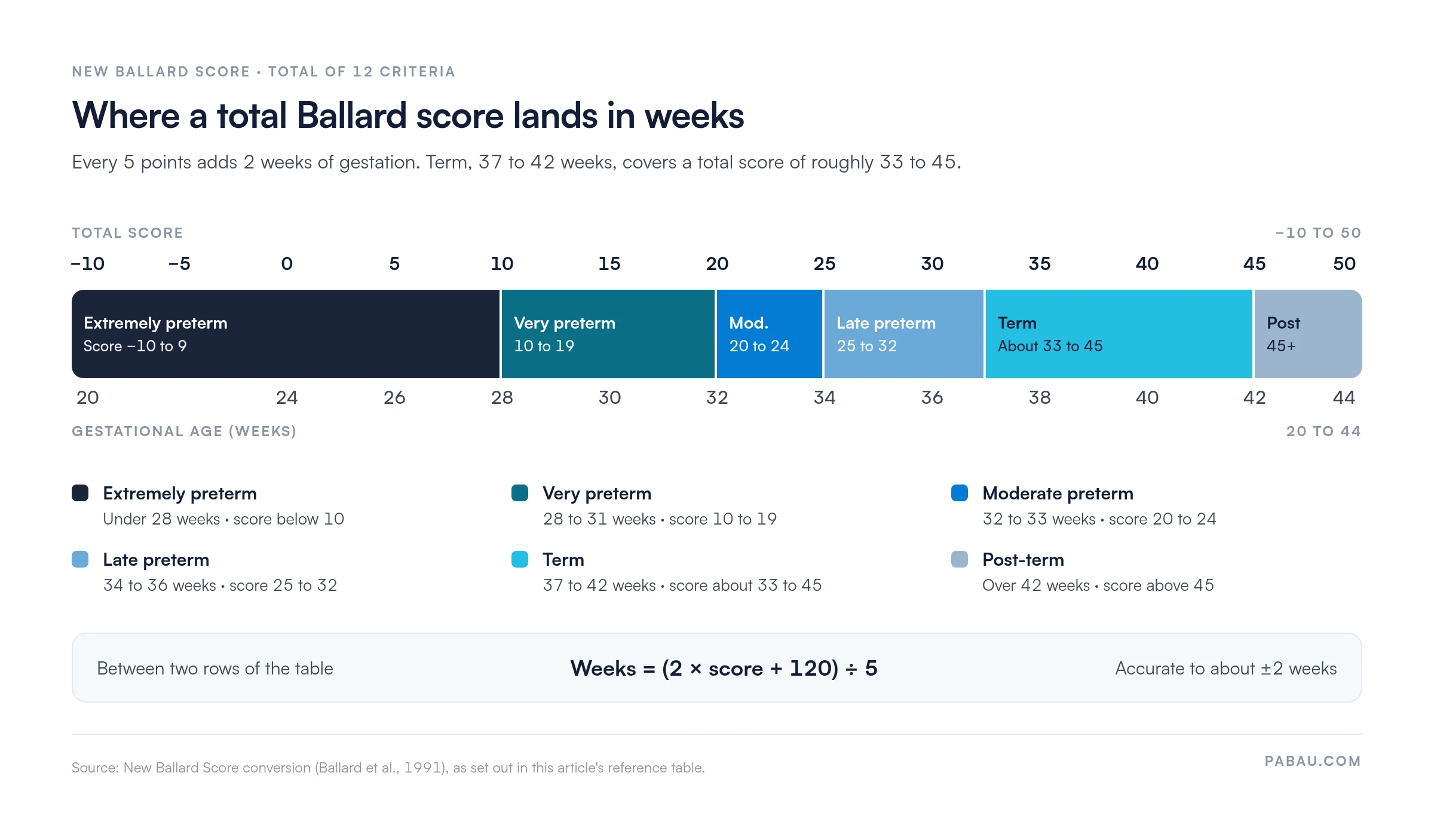
Use this table to convert a total New Ballard Score to estimated gestational age. The estimate moves 2 weeks for every 5 points, from 20 weeks at a score of −10 to 44 weeks at 50.
Term gestation, 37 to 42 weeks, corresponds to a total score of roughly 33 to 45. For a score between two rows, use the formula: Weeks = (2 × score + 120) ÷ 5.
A Ballard estimate that differs from the obstetric dates by more than 2 weeks warrants a closer look for growth restriction or a dating error. The chart below shows which clinical band each score falls into, so you can place a result at a glance.
The Ballard exam is indicated in several common obstetric and neonatal situations.
Timing matters. The exam is most accurate during the first day after birth, and it becomes less reliable after 96 hours as muscle tone normalizes. In the delivery room, it usually follows the Apgar score, which rates the infant’s condition at one and five minutes after birth.
The Ballard scale has recognized limitations. Two examiners can score the same infant differently, especially on the scarf sign and popliteal angle, and that matters most in borderline cases. Accuracy also drops after significant postnatal stress, respiratory distress, or hypoglycemia, because each one alters muscle tone.
With a ±2-week margin, the scale works as a screening estimate. First-trimester ultrasound remains the gold standard for dating a pregnancy, so the Ballard exam is the fallback when no early scan exists.
Pregnancies conceived through IVF sit at the other end, because the embryo transfer date fixes gestational age precisely. There, the Ballard exam checks maturity against a known date, taken from the cycle record kept in software for fertility clinics.
Obstetric and midwifery practices, NICUs, pediatric practices, and primary care providers all use the Ballard exam. Maternity hospitals score newborns at delivery to decide on feeding, monitoring, and transfer to a higher level of care. Neonatal units use it to confirm dates and track growth.
Outpatient providers use it in the days after discharge, for infants born at home or transferred with uncertain dates. The exam also suits rural and resource-limited settings without first-trimester ultrasound, because it needs only trained hands and eyes.
The template is built for obstetric nurses, midwives, neonatologists, and pediatricians in labor and delivery, the NICU, and outpatient follow-up. Download it, print or save the PDF, and adapt the fields to your practice’s documentation workflow.
A standardized form helps every clinician in your practice score infants the same way. Structured fields reduce the risk of a skipped criterion or an addition error. The form also doubles as a teaching tool for nursing students and new staff.
Gestational age assessment is a core part of the neonatal documentation that maternity and pediatric accreditation bodies expect. Obstetric practices and hospitals must keep accurate, accessible records of every newborn assessment, including the Ballard score. Many keep them in OBGYN EMR software, next to the mother’s prenatal record.
Clinical governance standards expect the exam to be done by trained staff, recorded at the time, and available to the whole care team. Once recorded, the score is protected health information, so US practices store and share it under HIPAA rules.
On paper, a Ballard exam means a printed grid, a hand-added total, and a lookup against the conversion table. The sheet then has to be scanned or copied before the next shift can see it.
In Pabau, the all-in-one practice management platform we build, the Ballard form becomes one of your digital intake forms. Its sections mirror the six neuromuscular and six physical criteria, and the completed form saves straight to the infant’s record.

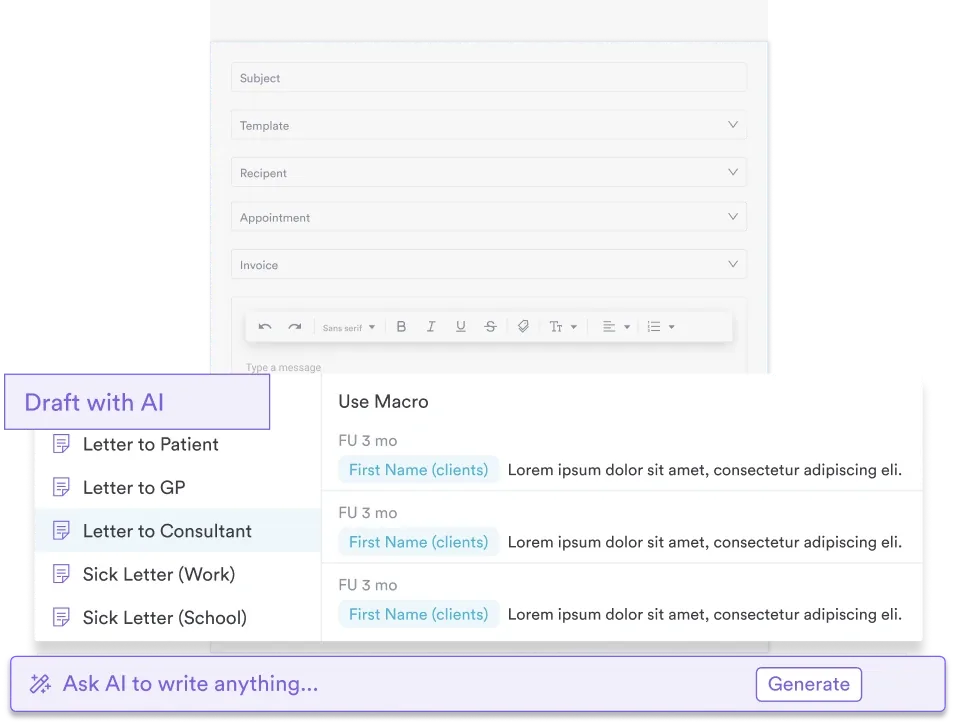
Pabau Scribe, our AI scribe, helps draft clinical letters and assessment summaries from the consultation. The clinician reviews and signs the note instead of typing it from scratch.
Centralized patient records let nurses, physicians, and midwives open the same Ballard result and gestational age estimate. Handovers across the NICU or obstetric service then start from one shared record.


From digital assessment forms to AI-drafted clinical letters, Pabau helps obstetric and NICU teams record the Ballard score once. The result is then shared securely with the whole care team.

Score all 12 criteria within the first day, convert the total with the table or the formula, and compare the result with the obstetric dates. When the two disagree by more than 2 weeks, look for growth restriction or a dating error before the estimate drives feeding or monitoring decisions.
Remember the trade-off in precision. The Ballard exam gives a fast, equipment-free estimate to within about 2 weeks, but it cannot replace an early ultrasound where one exists.
A shared form keeps every examiner scoring the same way, which is what makes results comparable across shifts. Book a demo to see how Pabau stores Ballard assessments on the infant’s record and shares them with the whole care team.

Scoring the newborn in the first minutes? Apgar score template covers the 1- and 5-minute checks that come before the Ballard exam.
Monitoring the baby before delivery? Normal fetal heart rate template sets out the baseline ranges and patterns to record during labor.
Assessing fetal well-being in late pregnancy? Nonstress test guide explains how the test works and how to read reactive and nonreactive results.
Documenting pain during labor? Pain scale for giving birth gives you a structured way to track labor pain and response to relief.
Planning the mother’s recovery? Postpartum checklist lists the checks and follow-ups to complete in the weeks after delivery.
The Ballard scale estimates a newborn’s gestational age by scoring neuromuscular and physical maturity. Clinicians use it when prenatal dating is uncertain or unavailable. The result helps them judge the infant’s developmental stage and choose the right care protocols.
Score six neuromuscular criteria from −1 to 5 points each and six physical criteria from −1 to 4 or 5 points each. Add the two subtotals together. The combined score, from −10 to 50, is then matched to gestational age in weeks using a conversion table.
The original Ballard score (1979) assessed infants from 26 to 44 weeks. The New Ballard Score (1991) extended the lower range to 20 weeks, so it suits extremely premature infants. It is more accurate at the extremes of prematurity and is the version most settings use today.
Yes. The New Ballard Score assesses infants from 20 weeks onward. It is especially useful for infants born before 26 weeks, where the original scale had limited use.
Term gestation, 37 to 42 weeks, corresponds to a total New Ballard Score of roughly 33 to 45. A score of 35 maps to 38 weeks, and a score of 40 maps to 40 weeks. Scores below about 33 indicate preterm birth, and scores above 45 suggest post-term gestation.
Use the free download link above to get the Ballard scale template. It includes the full assessment form with neuromuscular and physical maturity criteria, scoring instructions, and the reference conversion table.