GLP-1 diet plan
A GLP-1 diet plan is a structured eating framework for patients taking semagluti...

2
Last Updated: Oct 13, 2026
A cardiovascular medication list is a structured reference that organizes heart and blood pressure medications by drug class. Each entry carries the generic and brand name, the primary indication, and the clinical notes that affect prescribing. Clinicians and practice managers use it during medication reconciliation, pre-consultation reviews, and patient education.
Coronary heart disease affects about 18.2 million US adults, according to CDC figures, and medication management sits at the center of treatment. A reliable template cuts documentation errors and speeds up the reconciliation step before a consultation.
The version below groups drugs by class and carries a clinical notes column for contraindications, side effects, and monitoring intervals.
A reference table grouping cardiovascular drugs by class, with generic and brand names, primary indications, and clinical notes. Built for medication reconciliation and patient consultations.
Download template
A cardiovascular medication list is a structured reference that groups heart and blood pressure drugs by class, with generic and brand names and indications.
The template covers antihypertensives, anticoagulants, statins, and heart failure medications including SGLT2 inhibitors. Antihypertensives are split into ACE inhibitors, ARBs, calcium channel blockers, diuretics, and beta-blockers.
Teams review medications faster, make fewer transcription errors, document consistently, and explain therapy without hunting through several sources.
Practice management software like Pabau brings the template into the patient record through digital forms and clinical records. Teams can open, print, and update it without duplicate entry.
A cardiovascular medication list is a clinical reference that centralizes the drugs used to treat heart disease, hypertension, atrial fibrillation, and related conditions. It gives a single point of reference during patient encounters, so staff stop cross-checking several sources and fewer medication errors slip through.
Primary care physicians, cardiologists, nurses, and practice managers reach for it in several workflows. Staff verify drug names and drug classes before a consultation starts. Clinicians also hand it to patients as an education sheet, explaining each medicine in plain terms.
Reconciliation is where it earns its place, because patients often report their medicines verbally or from an outdated printout. Practices collecting that history through patient intake software can check submitted names against the template in seconds.
The list matters most in multi-practitioner practices and larger healthcare settings, where consistency is hard to hold. A standardized reference keeps every team member on the same drug class definitions and the same terminology.
The template groups medications by the therapeutic drug classes used in cardiology and primary care. Each class has its own mechanism of action and its own clinical role.
The list supports daily use. Five operational steps put it into your medication management process.
The list answers what a drug is and why a clinician prescribed it. For patients whose doses need tracking over time, a medication log records each administration alongside it.
Medication errors are among the most preventable adverse events in healthcare. A standardized cardiovascular list lowers the odds of confusing a generic name with a brand name. It also catches look-alike drug names, such as hydralazine and hydroxyzine, and duplicate therapy.
When reconciliation is inconsistent, patients may double up on doses, miss a critical medicine, or meet a dangerous interaction. One trusted reference that the whole team consults keeps that from happening. The American Heart Association reports that adherence improves when patients and clinicians talk clearly about what the clinician prescribes and why.
Holding the list inside your clinical record systems keeps it current and reachable, even when the network drops.
Hypertension is the most common reason clinicians prescribe a cardiovascular medication. The list sorts antihypertensives into five classes, each with its own mechanism and clinical role.
First-line agents for uncomplicated hypertension are ACE inhibitors, ARBs, calcium channel blockers, and thiazide diuretics. Clinicians prefer them for their trial evidence, their tolerability, and the cardiovascular protection they give beyond blood pressure reduction. ACC/AHA guidelines note that resistant hypertension, heart failure, or diabetes often need combination therapy.
Heart failure takes up a large part of the list, because the treatment landscape has moved fast. Current therapy runs to beta-blockers, ACE inhibitors or ARBs, mineralocorticoid receptor antagonists, SGLT2 inhibitors, and angiotensin receptor-neprilysin inhibitors such as sacubitril/valsartan.
SGLT2 inhibitors such as empagliflozin and dapagliflozin are now guideline-recommended for heart failure with reduced ejection fraction. Landmark trials showed a mortality benefit. Older reference lists predate them entirely, so a current list is what lets clinicians recognize these agents and dose them correctly.
Reconciliation in heart failure is harder than most, because patients often take four or more cardiovascular drugs at once. A structured list helps the team record every agent and check dosing at follow-up.
Anticoagulants and antiplatelet drugs sit at the core of cardiovascular prevention. The list covers direct oral anticoagulants (DOACs), warfarin, and antiplatelet agents. DOACs include apixaban, rivaroxaban, dabigatran, and edoxaban. Antiplatelet agents include aspirin, clopidogrel, and ticagrelor.
Clinicians need to know which anticoagulation strategy each patient is on, because switching or stopping one takes planning and a conversation. A standardized reference prevents prescribing errors and keeps monitoring consistent, from INR checks on warfarin to renal function on DOACs.
Adherence matters more here than almost anywhere else, since a missed anticoagulant dose raises the risk of stroke and clot.
Different roles use the list differently. Primary care physicians and nurse practitioners managing hypertension want a fast lookup on a busy day. Cardiologists and heart failure specialists use it to hold documentation and nomenclature steady across a practice.
Practice managers and administrative staff pull from it during prior authorizations, formulary checks, and patient communications. Nurses and care coordinators use it on telephone follow-ups, and when they explain therapy to a patient.
In integrated systems that span internal medicine, geriatrics, and acute care, one shared list keeps handoff communication clean between departments.
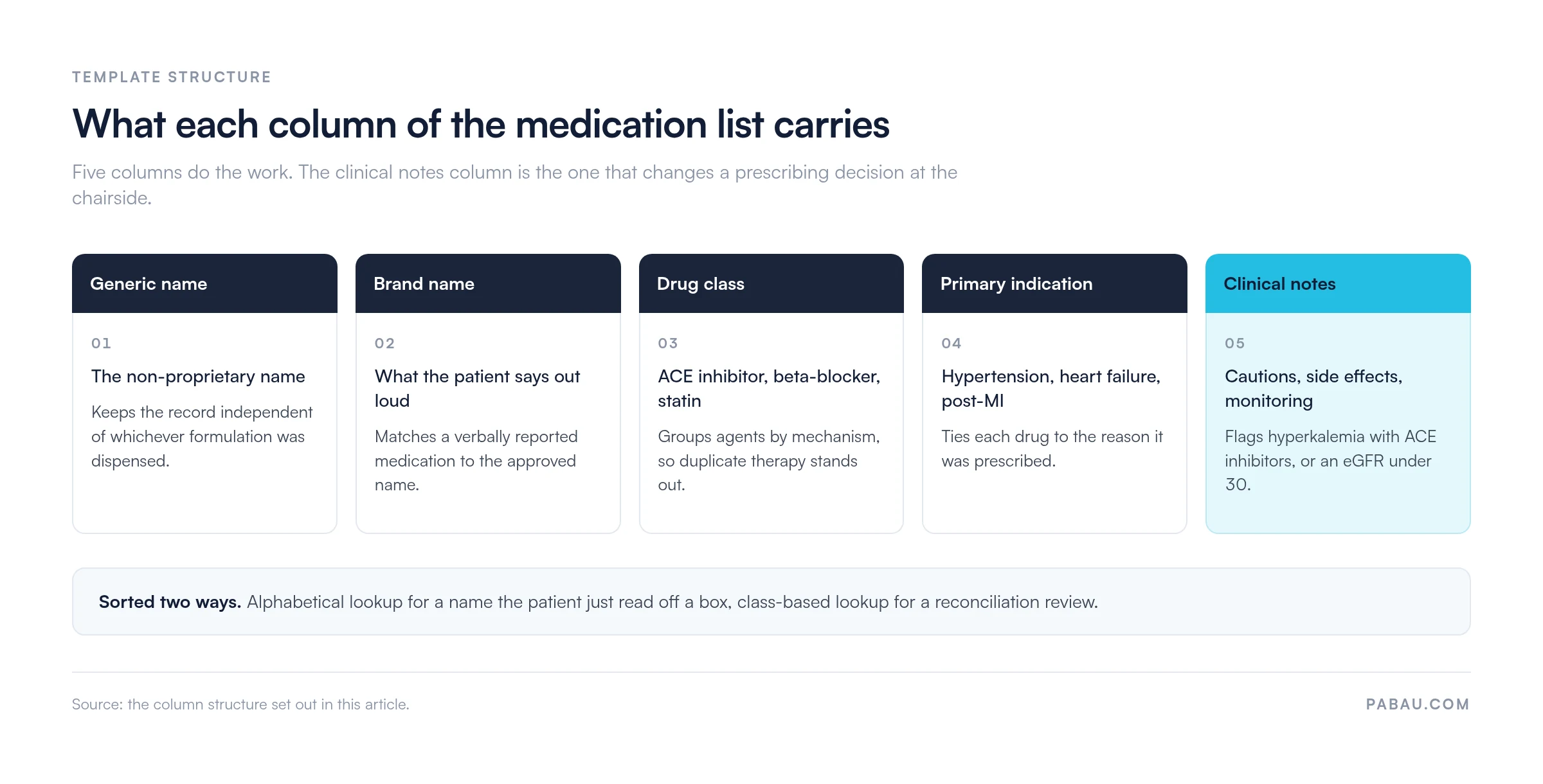
The best templates share the same structure. Dual organization, alphabetical and by drug class, suits two different lookup habits. A generic and brand name column stops proprietary and generic formulations from being read as two drugs. A primary indication column ties each drug to its clinical use.
Clinical notes carry the rest. They flag contraindications, such as avoiding an agent below an eGFR of 30, and name key side effects, such as hyperkalemia with ACE inhibitors or gout risk with thiazides. Monitoring intervals follow, such as annual renal function checks on ACE inhibitors.
The five columns below are what turn a drug list into a reference a clinician can act on mid-consultation.
Pabau’s prescription management links the template to the prescriptions your team issues. The record then flags when a prescribed medicine sits outside the reference list.

The cardiovascular drug landscape shifts as agents win FDA approval and ACC/AHA revises its guidelines. SGLT2 inhibitors and sacubitril/valsartan changed recommended therapy after most practices printed their older reference materials.
Review the list once a year against current ACC/AHA guidance. Give one clinical team member the job of watching FDA approvals and adding new agents each quarter. That keeps the reference current and shows diligence at audit.
Keeping the master copy in one central system means every team member reads the same version, and outdated printouts stop circulating in the practice.
Most practices keep a medication reference in one place and the patient record in another. Someone prints the list, pins it near the desk, and retypes drug names into the chart during a consultation. The printout ages, and the chart carries whatever staff typed that day.
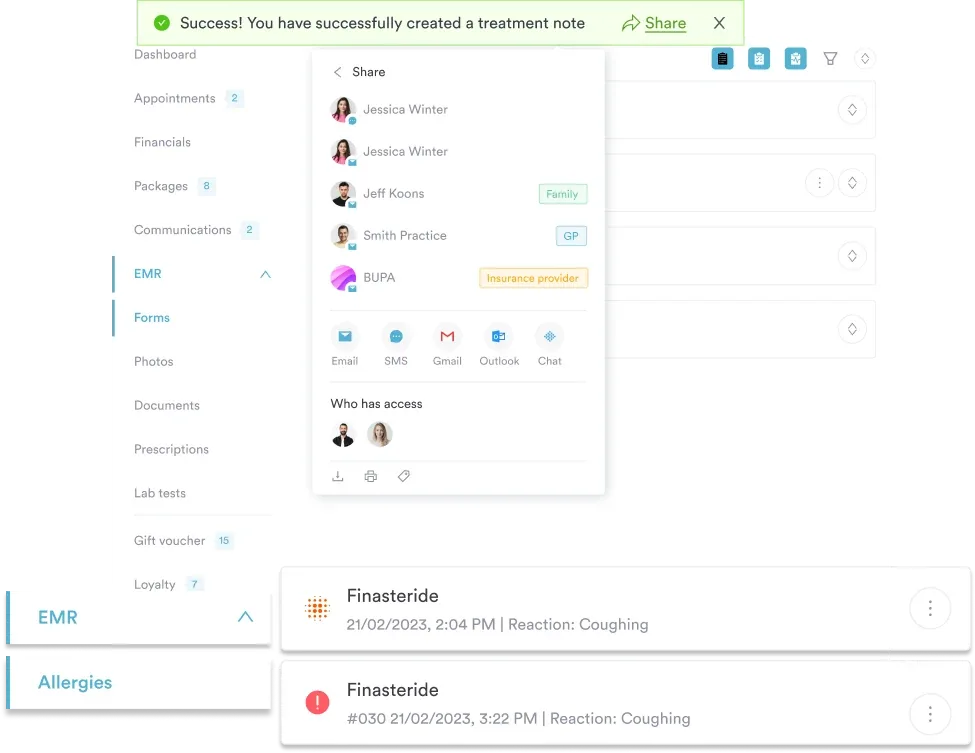
Practice management software like Pabau holds the two together. The medication list lives as a digital form on the patient record, so a clinician opens it in the same screen as the chart. Updates reach every user at once.
Prescriptions issued in Pabau sit next to that reference, so a reconciliation check takes one screen rather than three. Your team spends the saved minutes with the patient instead of the filing cabinet.

Pabau’s prescription management and digital forms bring the cardiovascular medication list into patient consultations and reconciliation, so your team stops working from paper.

A cardiovascular medication list earns its place by being the one reference the whole team checks. What makes it work is that the list stays current, and that everyone reads the same copy.
Download the template, adapt the columns to what your practice prescribes, and put it where clinicians already work. Review it annually against ACC/AHA guidance, and appoint someone to add new agents as they land. A list nobody maintains is worse than no list, because people trust it.
The trade-off is a few minutes each quarter, against a reconciliation step that stops guessing. Book a demo to see how Pabau keeps the medication list, the chart, and the prescription in one record.

Need to plan doses across the day? Medication schedule template lays out timing for each drug so patients and caregivers can follow it.
Teaching drug pharmacology to students? Drug card template captures mechanism, dosing, and nursing considerations one medication at a time.
Recording a patient reaction to a medicine? Adverse reaction form gives you a structured way to document what happened and what was done.
Planning care for a failing heart? Decreased cardiac output nursing care plan sets out the assessments, interventions, and expected outcomes.
Want the paperwork to stop piling up? Clinical documentation software explains how practices move notes and forms off paper for good.
The most commonly prescribed cardiovascular medications are antihypertensives (ACE inhibitors, beta-blockers, calcium channel blockers, diuretics), statins, and anticoagulants. In heart failure, beta-blockers, ACE inhibitors/ARBs, and SGLT2 inhibitors are guideline-recommended.
Review your cardiovascular medication list annually, and whenever major guideline updates are published. ACC/AHA typically revise every two to three years. Add newly approved agents within three to six months of approval.
ACE inhibitors (lisinopril, ramipril) block angiotensin-converting enzyme, while ARBs (losartan, valsartan) block the angiotensin II receptor directly. Both reduce blood pressure and protect the cardiovascular system. Which one you choose depends on patient tolerance and comorbidities.
No. SGLT2 inhibitors such as empagliflozin and dapagliflozin are now approved for heart failure with reduced ejection fraction. That approval covers patients without diabetes, on trial evidence of mortality and hospitalization benefit.
Yes. A medication reference list for internal clinical use is a standard practice tool. It must be evidence-based, regularly updated, and compliant with your jurisdiction’s standards of care. Include a disclaimer that it supplements, and does not replace, current prescribing information.