Nursing narrative note template
A nursing narrative note template is a structured PDF that guides you through re...

3
Last Updated: Oct 21, 2026

ACE inhibitors block angiotensin-converting enzyme, which relaxes blood vessels and lowers blood pressure.
Lisinopril, enalapril, ramipril, and benazepril are the agents you will meet most often in primary care.
Captopril starts at 25 mg three times daily for hypertension, with 6.25 to 12.5 mg reserved for at-risk patients.
A dry cough affects 5 to 10 percent of users, and it is the usual reason to move a patient to an ARB.
Practice management software like Pabau keeps the current dose in the patient record and schedules the potassium and creatinine rechecks.
A one-page reference covering eight FDA-approved ACE inhibitors, with brand names, starting doses, maintenance ranges, maximum daily doses, and approved indications. Print it for the exam room, or attach it to your prescribing guidelines.
Download templateEight ACE inhibitors are in routine use across US practices, and each one carries its own starting dose, titration range, and approved indications. That detail sits in eight separate package inserts, which is why prescribers end up searching on a phone mid-consultation.
This page pulls all eight into one table you can download and print. The sections below cover what a table cannot hold. That means the reason behind the cough, the patients who should never receive this class, and the labs to recheck after a dose change.
A reference list of this kind organizes every major angiotensin-converting enzyme inhibitor into one scannable table. Each row carries the generic name, the brand names, the adult dosing range, and the FDA-approved indications.
The value is speed. ACE inhibitors are first-line antihypertensive agents, so dosing questions come up constantly. They surface during reconciliation, during a switch between agents, and whenever a patient asks what their tablet actually does.
The FDA approves each ACE inhibitor through a New Drug Application, and every label sets its own indications, contraindications, and warnings. Off-label use is common and defensible, but it belongs in the record as a deliberate decision. A current reference keeps your documentation aligned with the labeling an auditor will read.
The table is built for speed rather than study. Five uses cover most of what a practice needs from it.
The list works hardest when it sits where the team already works, so pharmacists, nurses, and physicians all read the same version.

ACE inhibitors act on the renin-angiotensin-aldosterone system, the loop that governs blood pressure and fluid balance. Four steps run that loop.
An ACE inhibitor interrupts the third step. With less angiotensin II in circulation, vessels relax and pressure falls. The heart works against less resistance, and kidney disease in diabetes progresses more slowly.
Below are the FDA-approved ACE inhibitors used in US practice, with generic names, brand names, and dosing. The ranges reflect current labeling for hypertension. Heart failure and post-MI use often follow different titration schedules under ACC/AHA guidance.
Renally impaired patients, meaning an eGFR under 30 mL/min, usually need a reduced dose. Check the current prescribing information and the patient’s renal function before you prescribe.
Hypertension: First-line therapy for elevated blood pressure, and particularly useful in patients with diabetes or chronic kidney disease. Send the patient home with a blood pressure log so the follow-up visit has numbers behind it.
Heart failure: Lisinopril, enalapril, and ramipril reduce mortality and hospitalization in symptomatic heart failure, NYHA Class II to IV. ACC/AHA guidelines treat them as foundational therapy.
Post-MI cardioprotection: Ramipril and lisinopril cut long-term mortality and limit left ventricular remodeling after a myocardial infarction. Treatment usually starts within 24 hours if the patient is stable, then continues long term.
Diabetic nephropathy: The class slows the decline in glomerular filtration rate and reduces albuminuria in Type 1 and Type 2 diabetes. Captopril was the first ACE inhibitor approved specifically for this use.
Dry persistent cough: The most common complaint, affecting roughly 5 to 10 percent of users. Bradykinin accumulates in the lungs and triggers it. The cough settles within weeks of stopping, and switching to an ARB is standard practice when a patient cannot live with it.
Angioedema: Rare, at 0.1 to 0.2 percent, but serious swelling of the face, lips, tongue, or throat. It is more common in Black patients and in anyone with a prior episode. Stop the drug immediately and send the patient for emergency care.
Hyperkalemia: ACE inhibitors reduce aldosterone, so potassium is retained. The risk climbs in renal impairment, in diabetes, and alongside potassium-sparing diuretics, NSAIDs, or supplements. Take a baseline potassium level and recheck it periodically.
Dizziness and syncope: Most likely on the first dose or after an increase, especially in volume-depleted patients or those already on a diuretic. Tell patients to stand up slowly for the first week.
Pregnancy, second and third trimester: ACE inhibitors cause fetal renal dysgenesis, oligohydramnios, and death, so they are strictly contraindicated. Patients of childbearing age need reliable contraception, or a switch to methyldopa or labetalol if they are planning a pregnancy.
Renal artery stenosis: The class can precipitate acute renal failure in bilateral stenosis, or in stenosis affecting a solitary kidney. Screen with renal artery ultrasound or CT angiography where suspicion is high, such as repeated kidney injury on treatment or abdominal bruits.
Severe renal impairment: Reduce the dose below an eGFR of 30 mL/min/1.73m². Check serum creatinine and potassium within one to two weeks of starting or increasing the dose.
Documentation: Record the indication, the baseline potassium and creatinine, and the date of the next lab check in the patient record. That trail is what a covering clinician or an auditor needs to see.
Read together, the warnings and interactions sort into three actions. The panel below shows which trigger leads to which one.
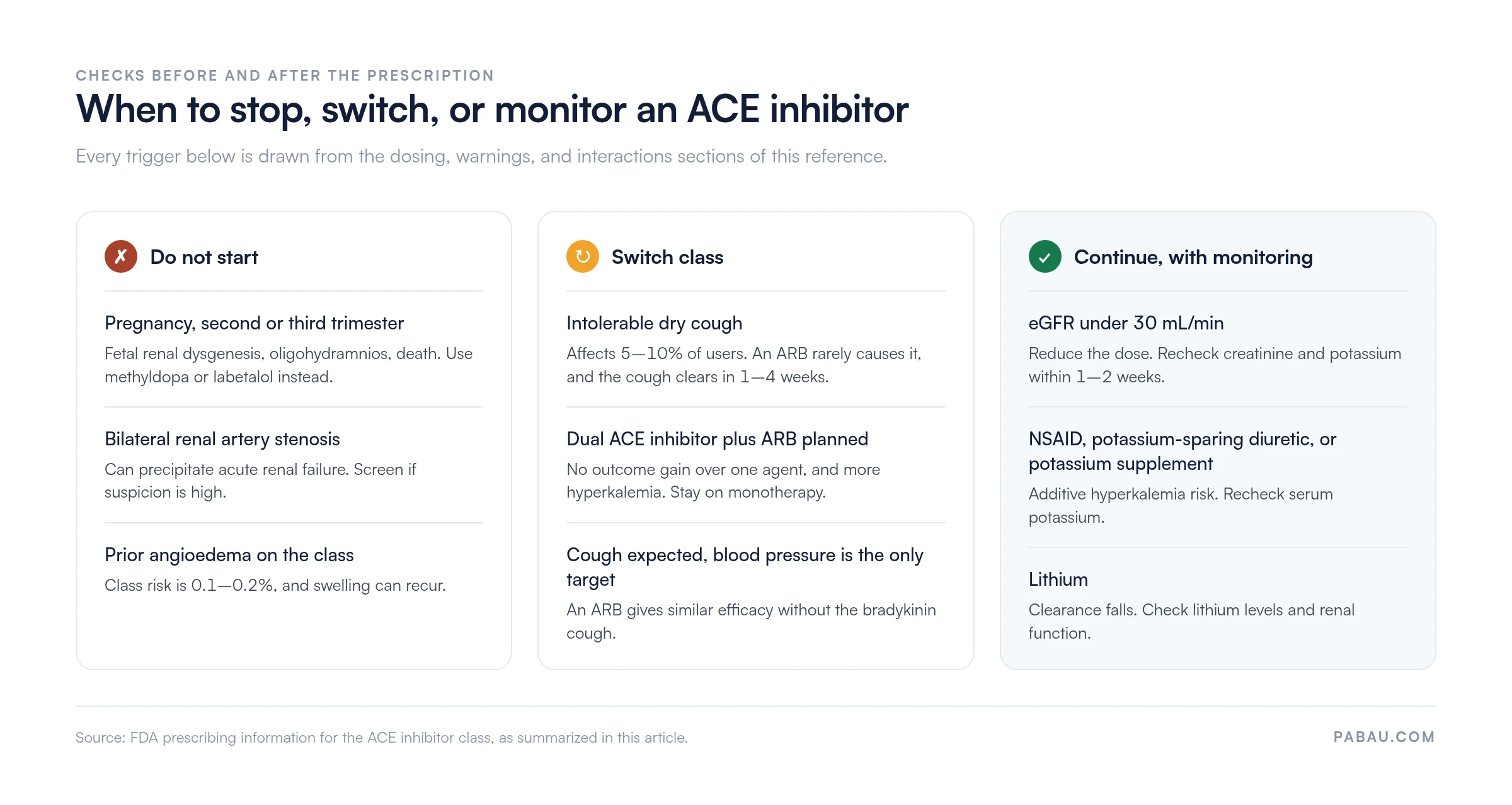
NSAIDs, including ibuprofen and naproxen: They blunt the blood pressure effect and raise the risk of acute renal failure and hyperkalemia. Use them cautiously, and counsel patients against routine over-the-counter use.
Potassium-sparing diuretics, such as spironolactone and amiloride: The hyperkalemia risk is additive. Monitor serum potassium closely if the combination is necessary, or move to a thiazide where that works clinically.
Lithium: ACE inhibitors reduce lithium clearance, which raises the risk of toxicity. Monitor lithium levels and renal function, and consider a dose reduction when you add the ACE inhibitor.
Angiotensin receptor blockers: Combining the two classes does not improve outcomes over one agent alone, and it raises hyperkalemia and renal failure risk. Avoid the combination without a compelling cardiology indication.
Both classes reduce angiotensin II signaling, but they do it at different points and carry different side effects.
ARBs are the obvious alternative when the cough becomes intolerable. ACE inhibitors still lead in heart failure and after a myocardial infarction, where the outcome evidence is stronger. Do not run the two classes together without specific cardiology guidance. When the chart also carries beta-blockers, diuretics or anticoagulants, a cardiovascular medication list covers those classes in one place.
Audit your charts for ACE inhibitor doses that never moved past the starting point. Provider inertia leaves patients on subtherapeutic doses for years, and a short dosing review finds the ones who could be titrated toward target. Record each dose-adjustment decision in the patient record, with the reason behind it, so the next clinician does not repeat the work.
A reference only earns its place if the team reaches for it. Five steps put it in the path of the work.
Step 1: Store it with the records. Upload the PDF to the patient records area of your practice system. Teams running hypertension reviews at volume, from direct primary care to practices on GP clinic software, keep it beside the prescribing guidelines.
Step 2: Print a copy for each exam room. A laminated card beats a database search when the patient is sitting in front of you. One or two pages is enough.
Step 3: Mark up your formulary. If your practice or health system restricts agents, annotate the list with the preferred ones. Lisinopril, enalapril, and ramipril are usually the cheapest generics.
Step 4: Brief the wider team. Medical assistants and nurses should know the red flags. Those are pregnancy status, baseline potassium, renal function, and any NSAID, diuretic, or lithium already on the chart.
Step 5: Schedule the recheck. Automated workflow reminders can prompt a potassium and creatinine test one to two weeks after starting or changing a dose. That catches quiet hyperkalemia early.

In most practices the drug reference and the patient record live apart. The PDF sits on a shared drive, the prescription sits in the chart, and the potassium recheck sits in someone’s head. Each handover is a chance for one of the three to drift.
Practice management software like Pabau closes that distance. Prescribing, clinical notes, and lab results share one record, so the dose a patient takes today sits next to their last creatinine result. Reminders for the recheck are scheduled the moment the dose changes.
The result is a shorter review and a cleaner audit trail. The clinician opens one screen and sees the current dose, the indication, and the monitoring history. Nobody has to reconstruct why a dose changed 18 months ago.

Pabau brings prescriptions, clinical notes, and lab results into a single patient record, and schedules the potassium and creatinine rechecks that follow a dose change. Your team stops tracking follow-ups from memory.

The table answers the dosing question. The harder calls come after it, when you decide who should never start this class and how quickly the labs need rechecking.
Download the reference, keep it where prescriptions get written, and put the two-week recheck on a schedule instead of in your memory. That one habit prevents most of the potassium and creatinine surprises this class produces.
Book a demo to see how Pabau holds the prescription, the indication, and the monitoring history in one patient record.

Reviewing a patient’s whole regimen rather than one class? The medication review template structures the reconciliation and records what changed.
Need the numbers behind a dose change? A blood pressure log gives the patient a simple record to bring to the follow-up visit.
Checking whether a reading is on target? The normal blood pressure chart sets out the thresholds by category.
Prescribing for heart failure rather than hypertension? The congestive heart failure nursing care plan covers the monitoring and education tasks around it.
Lisinopril is the most widely prescribed ACE inhibitor in the US, followed by enalapril and ramipril. Low-cost generics and a wide range of strengths make it a first-line choice for hypertension in primary care, cardiology, and endocrinology.
ACE inhibitors are often protective in mild to moderate kidney disease, especially diabetic nephropathy. They still call for close monitoring of serum potassium and creatinine. When eGFR falls under 30 mL/min, reduce the dose and monitor closely, or avoid the class on nephrology advice.
Yes. Lisinopril, sold as Zestril and Qbrelis, is a long-acting ACE inhibitor approved for hypertension, heart failure, and post-MI use. It is the most frequently prescribed agent in the class.
A dry, persistent cough is the most common side effect of the class, affecting 5 to 10 percent of users. If the patient cannot tolerate it, stop the ACE inhibitor and switch to an ARB, which rarely causes cough. The cough usually clears within one to four weeks of stopping.
No. Amlodipine is a calcium channel blocker, not an ACE inhibitor. Both treat hypertension, but amlodipine blocks calcium entry into smooth muscle cells while ACE inhibitors act on the renin-angiotensin system. The two can be combined safely for additive blood pressure reduction.