Orthopedic examination template: Free 6-stage form (PDF)
An orthopedic examination is a structured physical assessment of the bones, join...

2
Last Updated: Oct 16, 2026

The 4 stage balance test evaluates static balance across four progressively challenging standing positions, each held for 10 seconds.
Inability to hold tandem stance for 10 seconds is associated with increased fall risk and warrants further assessment or referral to physical therapy.
The test is part of the CDC STEADI fall prevention protocol and is validated for screening older adults in primary care and rehabilitation settings.
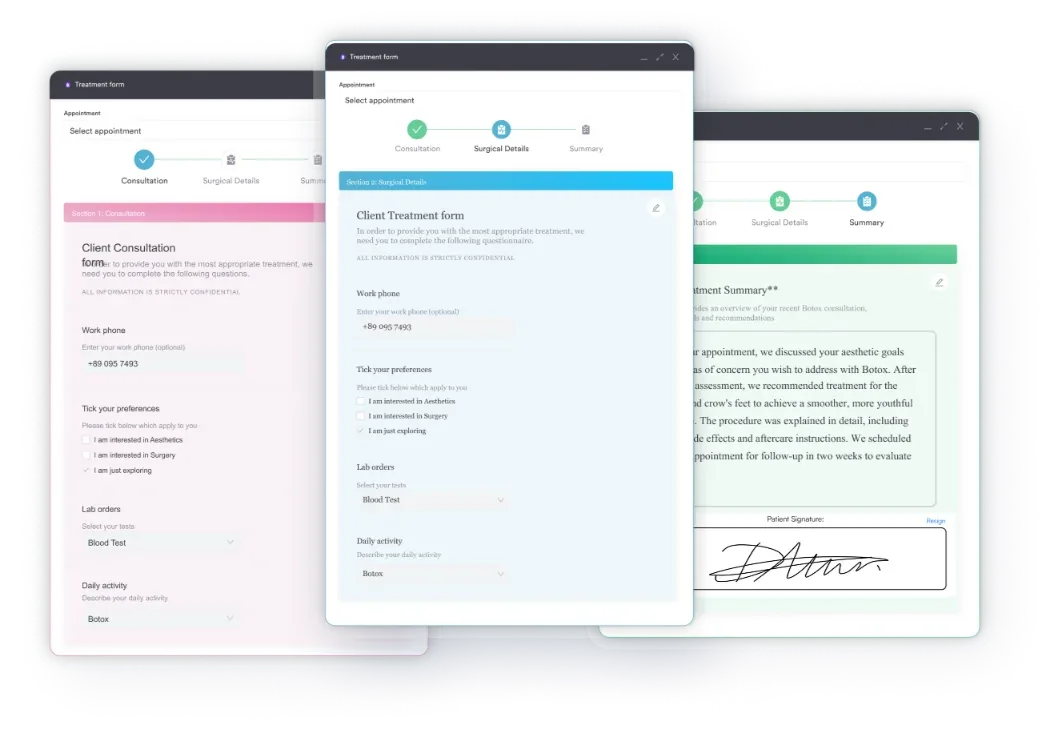
Pabau’s digital forms and client records simplify test administration, scoring documentation, and fall-risk tracking across patient populations.
4 Stage balance test (PDF)
A standardized assessment form for evaluating patient balance and postural stability across four progressive difficulty levels. Includes administration checklist, 10-second timing guidance, scoring table, and fall-risk interpretation for older adult screening.
Download PDF templateThe 4 stage balance test is a validated screening tool from the CDC’s STEADI program that identifies balance impairment and fall risk in older adults. A patient who cannot hold the tandem stance for 10 seconds is at increased fall risk. This downloadable PDF template gives you a ready-to-use assessment form, pass/fail scoring, and interpretation guidance you can print, administer in minutes, and file in the patient record for ongoing monitoring.
The 4 stage balance test is a brief, standardized clinical assessment that evaluates static balance by having patients hold four progressively more challenging standing positions for 10 seconds each. The positions range from easiest (feet together, eyes open) to most difficult (single-leg stance with eyes open), providing a graduated measure of balance control and stability.
Developed as part of the CDC’s STEADI (Stopping Elderly Accidents, Deaths & Injuries) program, the test screens for fall risk in primary care and community settings. It takes under 5 minutes, requires no special equipment, and fits into a busy practice schedule. Patients keep their eyes open and use no walking aids. Anyone who cannot hold a position for the full 10 seconds without losing balance or needing support fails that stage, signaling increased fall risk.
The test measures static balance, the ability to hold a position without moving, rather than dynamic balance. That sets it apart from tests like the Timed Up and Go (TUG) or the Berg Balance Scale, which measure functional movement. Static balance deficits are what predict falls in older adults.
Administering the 4 stage balance test requires a safe environment, clear instructions, and clinician readiness to support the patient if balance is lost. Follow these five operational steps to complete the assessment:
Ensure the patient stands away from walls, furniture, or equipment they might grab. Position yourself within arm’s reach, alert to catch them if they lose balance. Wear appropriate footwear and remove any hazards. Inform the patient that the test is optional and they can stop at any time.
Ask the patient to stand with their feet together and eyes open, arms free to help them balance. Say “Ready, begin” and start a 10-second timer. If they hold the position without moving their feet or needing support for the full 10 seconds, they pass Stage 1 and move to Stage 2. If they fail, stop the test and note the time they lasted.
Ask the patient to move into a semi-tandem stance: the instep of one foot touching the big toe of the other foot. Time 10 seconds. Pass = move to Stage 3. Fail = stop and record the time held.
Ask the patient to stand heel-to-toe (one foot directly in front of the other). This is the hardest stage for many patients. Time 10 seconds. It is the most predictive of fall risk: an inability to hold a tandem stance points to balance impairment. Pass = move to Stage 4. Fail = stop and record the time held.
Ask the patient to stand on one leg (usually their non-dominant leg) with the other leg lifted slightly. Time 10 seconds. This stage is rarely passed by older adults at high fall risk. If the patient cannot complete this stage, document the stage at which they failed.
Safety note: If the patient shows signs of unsteadiness, dizziness, or loss of balance at any point, support them or ask them to step down. Do not push beyond safe limits. The test is a screening tool, not a performance challenge. Safety is always the priority.
Scoring is straightforward: the patient either passes or fails each stage. A pass = holding the position for 10 seconds without moving their feet or requiring support. A fail = losing balance, moving their feet, or needing assistance before 10 seconds are complete.
| Stage | Position | Pass criteria | Clinical interpretation |
|---|---|---|---|
| 1 | Feet together, eyes open | Hold 10 seconds without moving feet | Most patients pass; failure suggests significant balance impairment |
| 2 | Semi-tandem (instep to big toe) | Hold 10 seconds without moving feet | Intermediate difficulty; many older adults pass |
| 3 | Tandem stance (heel-to-toe) | Hold 10 seconds without moving feet | High fall-risk indicator; inability to hold is strongly associated with increased fall risk |
| 4 | Single-leg stance | Hold 10 seconds without moving feet | Very difficult for older adults; failure does not necessarily indicate high fall risk if earlier stages passed |
The key cut-off score: inability to hold tandem stance (Stage 3) for 10 seconds is associated with significantly increased fall risk. Patients who fail Stage 3 or earlier stages warrant further assessment or referral to physical therapy for balance training. Patients who pass all four stages have better static balance control and lower fall risk (though individual factors still apply).
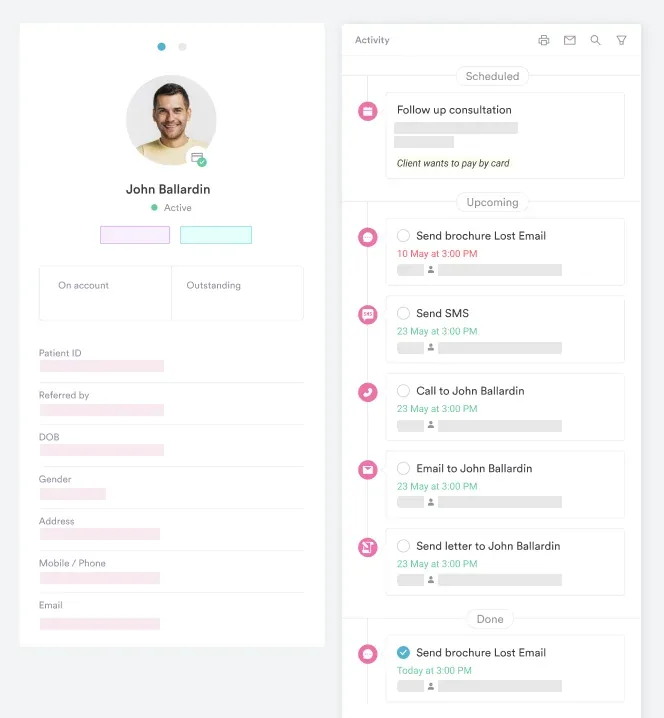
Use practice management software like Pabau to record scores in the patient’s chart and track them over time. Document which stage the patient failed, the number of seconds they held each position, and any safety concerns. This longitudinal data measures progress during rehabilitation and informs discharge planning.
Unlike the Berg Balance Scale, the 4 stage balance test has no age-stratified normative scores. STEADI applies the same fail-at-tandem-stance cutoff to every patient regardless of age, which is exactly what keeps the test short enough for a primary care visit.
Consider referring the patient to physical therapy if they fail Stage 2 or Stage 3, show balance inconsistency across attempts, report fear of falling, or have a recent fall history. The 4 stage balance test is a screening tool. It flags risk, while a physical therapy evaluation pins down the specific impairment driving the balance deficit, whether that is weakness, proprioception loss, vestibular dysfunction, or a medication side effect.
Clinical form capture tools let staff complete assessments like this on a tablet during the session itself.
The 4 stage balance test is used across multiple healthcare settings and specialties, each with specific clinical drivers:
Any clinician working with older adults or patients with neurological, orthopaedic, or vestibular conditions benefits from incorporating the 4 stage balance test into their assessment repertoire.
Nurses and medical assistants who administer this screen in primary care also take certification exams that cover cardiac rhythm recognition. An EKG practice test builds that skill with timed rhythm strip identification and a full answer key.
Quick administration: Takes 2-5 minutes and fits easily into a busy schedule. No expensive equipment required, just a safe space and a timer.
Validated clinical measure: Recommended by the CDC as part of the STEADI protocol and backed by peer-reviewed research.
Clear interpretation: Pass/fail scoring is objective and requires minimal training. Clinicians quickly identify patients at risk without complex calculations or subjective judgment.
Guides referral decisions: Standardised results inform whether to refer to physical therapy, occupational therapy, or fall-prevention programs. Eliminates guesswork in deciding who needs intervention.
Tracks progress: Serial testing over weeks or months quantifies the benefit of balance training, motivating patients and justifying ongoing therapy or exercise programs.
Audit and compliance-ready: Documentation of balance screening demonstrates adherence to fall-prevention guidelines and can support quality improvement initiatives or regulatory compliance reviews.
The 4 stage balance test sits at the front of fall-prevention pathways. After administration and interpretation, clinicians typically follow one of three pathways:
Many patients are motivated by concrete results and clear risk communication.
Test patients in the morning when balance is typically best and fatigue is lowest. Ensure consistent lighting and footwear across repeat tests. Always complete Stages 1-3 even if the patient struggles. The stage at which they fail is clinically informative. Document the exact number of seconds they held each position, not just pass/fail, for longitudinal tracking.
The 4 stage balance test is one of several validated balance measures. Here is how it compares:
The 4 stage balance test remains the fastest, lowest-cost screening option for primary care and community settings.

Need to assess ankle stability after injury? eversion stress test covers the technique, Grade I-III findings, and what to document for a positive result.
Clearing an athlete to return to running? return to running protocol lays out five evidence-based phases with objective criteria and walk-run progressions.
Need a criterion-referenced tool for early development? Hawaii Early Learning Profile rates six developmental domains from birth to age six as pass, emerging, not yet, or atypical.
The 4 stage balance test is a quick, validated, and practical screening tool for identifying fall risk in older adults and guiding referral to physical therapy or fall-prevention programs. This downloadable template gives you a ready-to-use assessment form, scoring guidance, and clinical interpretation framework. By building the test into routine patient encounters and using Pabau to document and track results, you standardize fall-risk assessment across your patient population, so no at-risk patient slips past unnoticed.
The four stages progress from easiest to hardest, eyes open throughout: (1) feet together, (2) semi-tandem, with the instep of one foot touching the big toe of the other, (3) tandem stance, heel-to-toe, and (4) single-leg stance. Each position must be held for 10 seconds to pass.
Inability to hold tandem stance (Stage 3) for 10 seconds is strongly associated with increased fall risk. Patients failing Stage 3 or earlier warrant further assessment or referral to physical therapy.
The test typically takes 2-5 minutes depending on how many stages the patient passes and whether they require safety support between stages.
Any licensed healthcare professional can administer the test: physical therapists, occupational therapists, nurses, primary care physicians, or geriatricians. Minimal training is required. The test is straightforward and objective.
Yes. The CDC’s STEADI (Stopping Elderly Accidents, Deaths & Injuries) program recommends the 4 stage balance test as a validated screening tool for identifying fall risk in older adults during routine primary care visits.
No. The test screens for static balance impairment and fall risk but does not diagnose specific conditions. Results warrant further evaluation (vestibular testing, imaging, neurology assessment) to identify the underlying cause of balance deficits.
No official age-stratified norms exist for the 4 stage balance test the way they do for the Berg Balance Scale. STEADI deliberately uses one pass/fail cut-off (failing tandem stance, Stage 3) at any age, which is what makes the test fast enough for routine primary care screening.
No. A 2024 study of 115 community-dwelling older adults found that switching which foot leads in the semi-tandem, tandem, and single-leg stages doesn’t change stability performance, so you don’t need a standardized dominant-leg protocol. The same study confirmed the four stages get progressively harder in the order STEADI assumes, and found enough overlap between the middle stages that some researchers now propose a shortened 3-stage version for screening.