CPT Code 62284: Injection procedure for myelography
CPT Code 62284: official descriptor and procedure overview The American Medical ...

Last Updated: Oct 19, 2026
V5336 is the HCPCS Level II code for repair/modification of augmentative communicative system or device (excludes adaptive hearing aid). It covers fixing or adapting an AAC device the patient already owns, such as a speech-generating device.
The most common denial is an AAC evaluation billed as a V5336 repair when it belongs under CPT 92607. Claims also fail over a missing modifier or letter of medical necessity, and some commercial payers refuse V codes outright.
Let Pabau's smart automation suggest the right codes, reduce claim denials, and keep your practice compliant—effortlessly.
Automate repetitive tasks and focus on what matters most—your patients.
Reduce coding errors and ensure compliance with the latest regulations.
Clean claims, fewer denials, and faster reimbursements.
Powerful insights and reporting to help your practice thrive.
HIPAA compliant SOC 2 certified GDPR-compliant Trusted by 4,000+ clinics worldwide

HCPCS Code V5336 covers repair and modification of an AAC device the patient already owns, not new devices or separately billed accessories.
AAC evaluations bill under CPT 92605, 92607 and 92608, while V5364 is dysphagia screening and has no AAC meaning.
Medicare Part B covers AAC device repairs through DMEPOS suppliers enrolled with the relevant DME MAC, subject to applicable LCD requirements.
A missing letter of medical necessity or prior authorization is the leading cause of V5336 claim denials.
Pabau’s claims management software flags incomplete documentation before submission, so fewer AAC repair claims get rejected.
HCPCS Code V5336 is the Level II code for repair or modification of an augmentative communicative system or device, excluding adaptive hearing aids. It sits in the V5336-V5364 group of speech-related screenings and communication device repair. That group is part of the HCPCS code set the Centers for Medicare and Medicaid Services (CMS) maintains.
The code applies when a clinician or DME supplier repairs or modifies a patient’s own augmentative and alternative communication (AAC) device. Replacing a broken component counts. That includes speech-generating devices (SGDs), dedicated AAC tablets and other communication aids that meet the clinical definition.
V5336 doesn’t cover buying a new device, AAC accessories billed under their own supply codes, or speech therapy services. Those lines trip up experienced billers too. The most common mix-up is billing an SLP’s AAC evaluation as a V5336 repair, when the evaluation belongs under CPT 92607.
The official descriptor for HCPCS Code V5336 in the CMS HCPCS Alpha-Numeric file is Repair/modification of augmentative communicative system or device (excludes adaptive hearing aid). The table below sums up the code attributes billers and SLPs need at a glance. Neighboring V codes are listed in our full HCPCS code index.
V5336 is specifically scoped to the act of repair or modification. Understanding its boundaries prevents miscoding and the downstream denials that follow.
Covered under V5336:
Excluded from V5336:
ForwardHealth (Wisconsin Medicaid) issued policy document 2004-24 on AAC device billing, including how repairs under V5336 are handled. Practitioners in other states should check their own state Medicaid agency’s guidance, because coverage rules differ by state.
The codes around an AAC device come from three places. HCPCS V5336 covers repair, CPT 92605-92609 cover SLP evaluation and therapy, and E2500-E2599 cover the device itself. Picking the wrong one is the most common reason V5336 claims are rejected for incorrect coding. The guide below maps each service to its code.
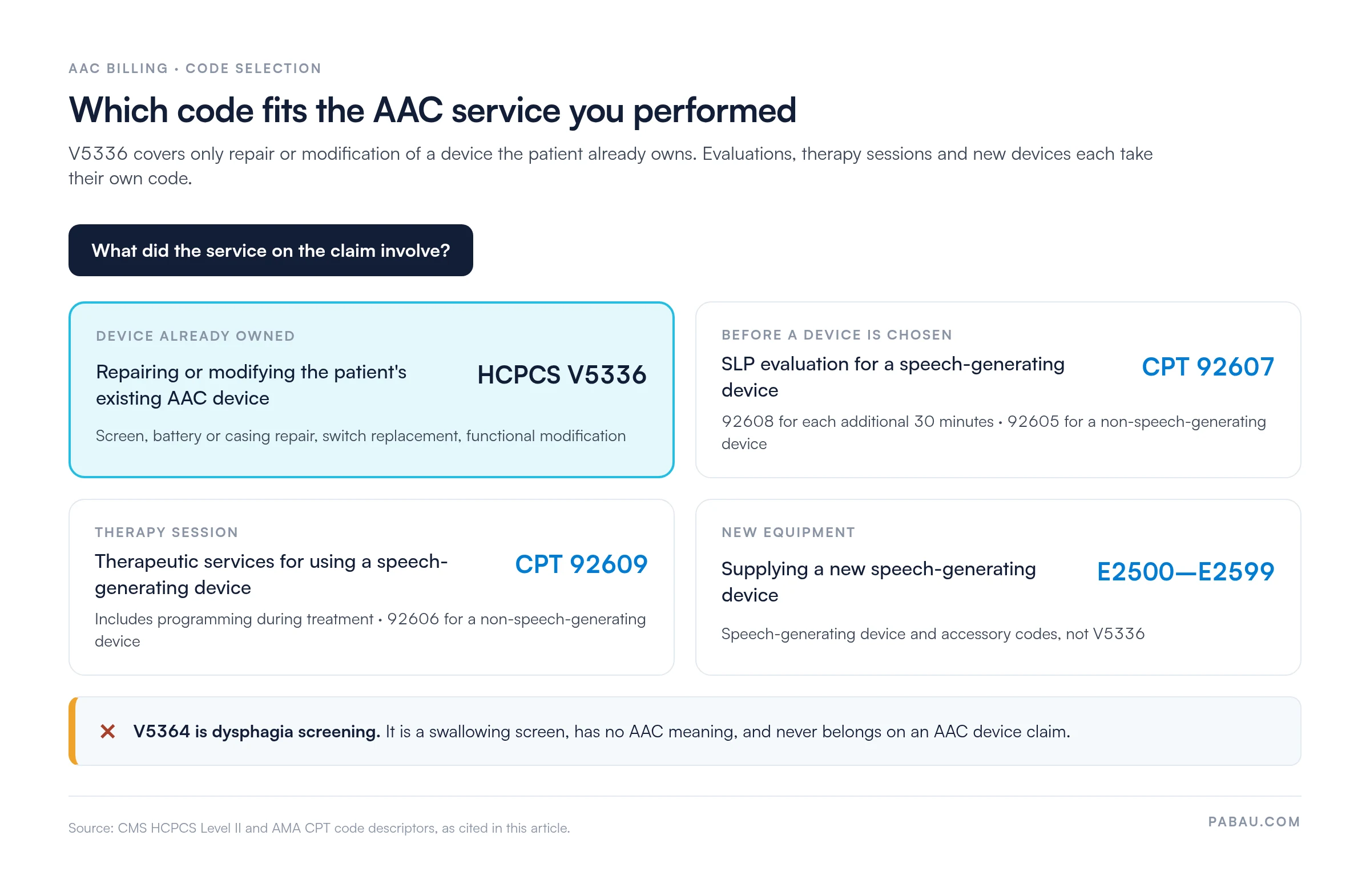
The distinction that matters most is between V5336 and the CPT evaluation codes. An SLP running a feature-matching assessment before recommending a replacement device bills CPT 92607, plus 92608 for each additional 30 minutes. A repair that follows the evaluation bills V5336 separately, on its own date of service.
Provider eligibility to bill V5336 depends on the payer and the billing arrangement. The American Speech-Language-Hearing Association (ASHA) lists V5336 in both its audiology and speech-language pathology HCPCS coding references. Both provider types use the code.
Billing rights differ by payer type, as the table below shows. Pabau, the practice management platform we build, lets SLPs track enrollment status and payer credentialing requirements next to patient records. That lowers the risk of submitting claims under an unenrolled billing entity.
Documentation drives reimbursement for augmentative communication device repair. A claim without complete supporting records will not survive payer review, regardless of whether the repair was clinically justified.
A compliant AAC repair claim has these records in place before it is submitted. Assembling them after an audit request arrives is too late.
The most frequent missing element on denied V5336 claims is the letter of medical necessity. Payers that require it treat its absence as a non-covered service, not as a correctable documentation error. Submit the LMN with the initial claim, not as a response to a denial.
Coverage for augmentative communication device repair under government payers varies by program and by the specific payer contract in force.
Prior authorization for V5336 is common among Medicaid plans and Medicare Advantage plans. Fee-for-service Medicare through a DMEPOS supplier may not require PA for every repair. The threshold varies by DME MAC jurisdiction and by the cost of the repair.
PA rules change on plan-year renewal cycles. Verify requirements annually, not just when a claim is denied.
Before submitting a V5336 claim, run an eligibility verification for the specific repair date. Confirm the patient’s plan still covers AAC device repair and check for any open PA requirements. Then verify the DMEPOS supplier’s enrollment is active with the relevant DME MAC. Catching these issues before submission takes minutes. Correcting a denied claim takes hours.
HCPCS and CPT modifiers refine what a V5336 claim describes and signal to the payer that specific conditions have been met. Using the wrong modifier or omitting a required one is a common denial trigger on DMEPOS claims.
Whether KX applies to V5336 depends on your DME MAC. It is needed only where the jurisdiction’s LCD names V5336 and requires KX to signal documentation compliance. Verify against current LCD language from your DME MAC before appending KX, as incorrect use of KX is an audit trigger.
A clean V5336 claim follows a defined workflow. Skipping or reversing steps is the most preventable source of rejections in augmentative communication device repair billing.
Most V5336 denials fall into a small number of categories. The table below maps each denial pattern to its root cause and the corrective action that resolves it.
Practices with low denial rates run these checks before a claim goes out. The ones that skip them spend days each month on appeals.
AAC device repair billing runs on paperwork. Every V5336 claim needs a letter of medical necessity, a device serial number and a repair order. Many also need a prior authorization record, all tied to one date of service. Tracked by hand across several patients and payers, one missing signature is enough to get a claim denied.
Pabau’s denial-reducing claims management builds those checks into the billing workflow itself. It runs pre-submission documentation checks, tracks prior authorization status, and flags incomplete claims before they reach the payer. That means fewer V5336 denials for missing paperwork, the leading denial category for this code.
SLP practices and DME suppliers often handle several AAC repair claims a week. For them, that structure cuts the hours spent on appeals and shortens the wait for payment.

Pabau’s claims management tools flag missing documentation before submission, track prior authorization status, and keep V5336 claims moving through payer adjudication without manual chasing.

Most V5336 denials are decided before the repair starts. Put the LMN, repair order, serial number and prior authorization on file first. Bill the evaluation under its own CPT code, and a repair claim has very little left to fail on.
The trade-off is front-loaded admin: a few minutes of checks per claim instead of weeks of appeals. For practices billing AAC repairs every week, that trade pays for itself within a month or two of denials avoided.
Book a demo to see how Pabau catches missing AAC repair paperwork before a V5336 claim reaches the payer.

Need a structured approach to tracking claim denials? Denial management in healthcare covers the end-to-end process for identifying, categorizing, and resolving denied claims before they age into write-offs.
Billing the therapy session that follows an AAC evaluation? CPT code 92609 explains how SLPs bill therapeutic services for using a speech-generating device.
Want your AAC repair records to hold up in an audit? Medical billing compliance sets out the documentation and coding rules payers check first.
Want to understand how billing software fits your clinical workflows? What is medical billing explains how practice management systems connect documentation, coding, and payer submission into one process.
HCPCS Code V5336 covers repair and modification of an augmentative communicative device the patient already owns. It doesn’t cover new devices, accessories billed under separate codes, or SLP evaluations, which bill under CPT 92605, 92607 or 92608.
V5336 covers repair or modification of an existing AAC device. V5364 is dysphagia screening, a swallowing screen with no connection to AAC devices. The two codes never stand in for each other, and V5364 has no place on an AAC repair claim.
Yes, when the repair is medically necessary. Medicare Part B covers V5336 repairs submitted by an enrolled DMEPOS supplier through the relevant DME MAC. Coverage is subject to applicable local coverage determinations. There is no national coverage determination specific to V5336 repair as of 2026. Verify with your DME MAC before submitting.
Billing V5336 takes a letter of medical necessity, the treating clinician’s evaluation report, a signed repair or modification order, and the device serial number. Add prior authorization records where the payer requires PA. Missing any of these is the most common cause of V5336 claim denials.
The usual modifiers are RA (replacement of a DME item) and RB (replacement of a part during repair). KX signals that documentation requirements are met, where the applicable LCD requires it. Verify modifier requirements against the current LCD from your DME MAC, because incorrect modifier use is an audit trigger.
Prior authorization requirements for V5336 vary by payer. Medicaid plans and Medicare Advantage plans often require PA for AAC device repair. Fee-for-service Medicare requirements depend on the DME MAC jurisdiction and repair cost. Verify with each payer annually, as PA rules change on plan-year renewal cycles.
The most common causes are a missing letter of medical necessity, missing prior authorization, or a missing modifier. Another is an AAC evaluation billed as a V5336 repair instead of under CPT 92607. Plans that exclude V codes and untimely filing cause the rest. The denial reason code on the remittance advice shows which one applies.