CCSD code G5100: Bypass of duodenum billing guide
CCSD code G5100 bills a bypass that leaves the duodenum in place CCSD code G5100...

Last Updated: Oct 16, 2026
92607 is the CPT code for the first 60 minutes of a speech-generating device (SGD) evaluation, billed by a qualified speech-language pathologist who assesses a patient's communication abilities and identifies the appropriate augmentative and alternative communication (AAC) device. Add-on code 92608 reports each additional 30 minutes, and CPT 92609 reports a separate visit to train the patient on the device.
Medicare requires the GN modifier on every claim and pays 92607 at the non-facility rate in every place of service. Most denials trace back to a missing GN modifier, no prior authorization on file, or same-day billing with CPT 92507 without modifier 59.
Let Pabau's smart automation suggest the right codes, reduce claim denials, and keep your practice compliant—effortlessly.
Automate repetitive tasks and focus on what matters most—your patients.
Reduce coding errors and ensure compliance with the latest regulations.
Clean claims, fewer denials, and faster reimbursements.
Powerful insights and reporting to help your practice thrive.
HIPAA compliant SOC 2 certified GDPR-compliant Trusted by 4,000+ clinics worldwide

CPT code 92607 covers the first 60 minutes of an SGD evaluation. Add-on code 92608 reports each additional 30 minutes.
Code 92609 reports training on the use of a speech-generating device. It is a standalone billable service, not an add-on.
Only qualified speech-language pathologists may bill 92607 independently. Billing under physician supervision follows strict incident-to rules and varies by payer.
Medicare requires the GN modifier for all outpatient SLP services billed under 92607. Prior authorization requirements vary by Medicare Administrative Contractor jurisdiction.
Medicare pays 92607 at the non-facility rate in every place of service, so an outpatient hospital or SNF setting does not reduce the allowable.
Pabau’s claims management software helps SLP practices track modifiers, document medical necessity, and submit 92607 claims through its Claim.MD clearinghouse integration.
CPT code 92607 reports the first hour of an SGD evaluation by a speech-language pathologist. Specifically, the SLP assesses the patient’s communication abilities and identifies the most appropriate speech-generating device. The American Medical Association (AMA) maintains the CPT code set and its official descriptors.
The evaluation covers the patient’s candidacy for an AAC device, the selection of a specific SGD, and the customization needed for that patient. The code is time-based and covers one hour of face-to-face evaluation time. If the evaluation runs longer, add-on code 92608 reports each additional 30-minute increment.
Only qualified speech-language pathologists (SLPs) may independently bill CPT code 92607. In addition, Medicare requires the evaluating clinician to hold a Certificate of Clinical Competence in Speech-Language Pathology (CCC-SLP). The American Speech-Language-Hearing Association (ASHA) issues that credential, and an equivalent state license also satisfies the requirement.
Physicians may bill 92607 only when an SLP performs the evaluation as an incident-to service. That requires direct physician supervision in a non-facility setting. Specifically, the physician must be in the office suite during the evaluation and must have established the plan of care. Ongoing involvement in the patient’s treatment is also required.
Medicare reimburses CPT code 92607 through the Medicare Physician Fee Schedule (MPFS), with rates updated every January 1. The CMS Physician Fee Schedule lookup tool is the authoritative source for the current allowable in your locality.
Statute pays outpatient SLP services at the non-facility rate in every place of service. The same allowable therefore applies in an office, a patient’s home, an outpatient hospital department, and a skilled nursing facility. Geographic adjustment still applies through the Geographic Practice Cost Index (GPCI), so the figure varies by Medicare Administrative Contractor (MAC) jurisdiction.
Specifically, the MPFS lookup tool reports the RVU components and the current conversion factor. Reconcile any published dollar figure against RVU multiplied by that conversion factor. A figure that does not reconcile is stale.
Practice management software like Pabau submits 92607 claims to Medicare and thousands of other US payers through its Claim.MD clearinghouse integration. As a result, that keeps the rate lookup and the submission in one place.
Medicaid coverage for SGD evaluations varies by state. For example, some states cover AAC evaluations under the Medicaid speech-language pathology benefit. Others require a durable medical equipment (DME) prior authorization separate from the evaluation code.
Verify the requirements with your state Medicaid program before you schedule the evaluation. In other words, another state’s policy is no guide to your own.
Before scheduling a Medicare SGD evaluation, verify prior authorization requirements with the relevant Medicare Administrative Contractor for your jurisdiction. MAC policies on prior auth for CPT code 92607 vary, and a missing auth is one of the most common reasons for post-service denials. Check with your billing team before the evaluation date, not after.
Modifier selection for CPT code 92607 depends on the setting and the payer. The most common error SLP practices make is omitting the GN modifier on Medicare claims, which triggers an automatic denial for outpatient therapy services. So, use the table below to match modifier to context.
Every claim for CPT code 92607 requires at least one ICD-10-CM diagnosis code that supports medical necessity for an SGD evaluation. The diagnosis must reflect a condition that impairs the patient’s ability to communicate through natural speech. Pabau’s ICD-10-CM code library carries the official descriptor and billable status for each code below.
The AAPC Codify CPT lookup carries CPT-to-ICD-10 crosswalks that surface additional valid pairings for a specific clinical presentation. Therefore, always select the most specific ICD-10-CM code available. As a result, a nonspecific code is a common audit trigger.
CPT code 92608 reports each additional 30-minute increment beyond the first hour covered by 92607. Consequently, the two codes are billed together on the same date of service. 92608 cannot be billed without 92607 as the primary code.
For example, a 90-minute evaluation bills as 92607 x1 plus 92608 x1. A two-hour evaluation bills as 92607 x1 plus 92608 x2. The bands below map each evaluation length to the units it supports.
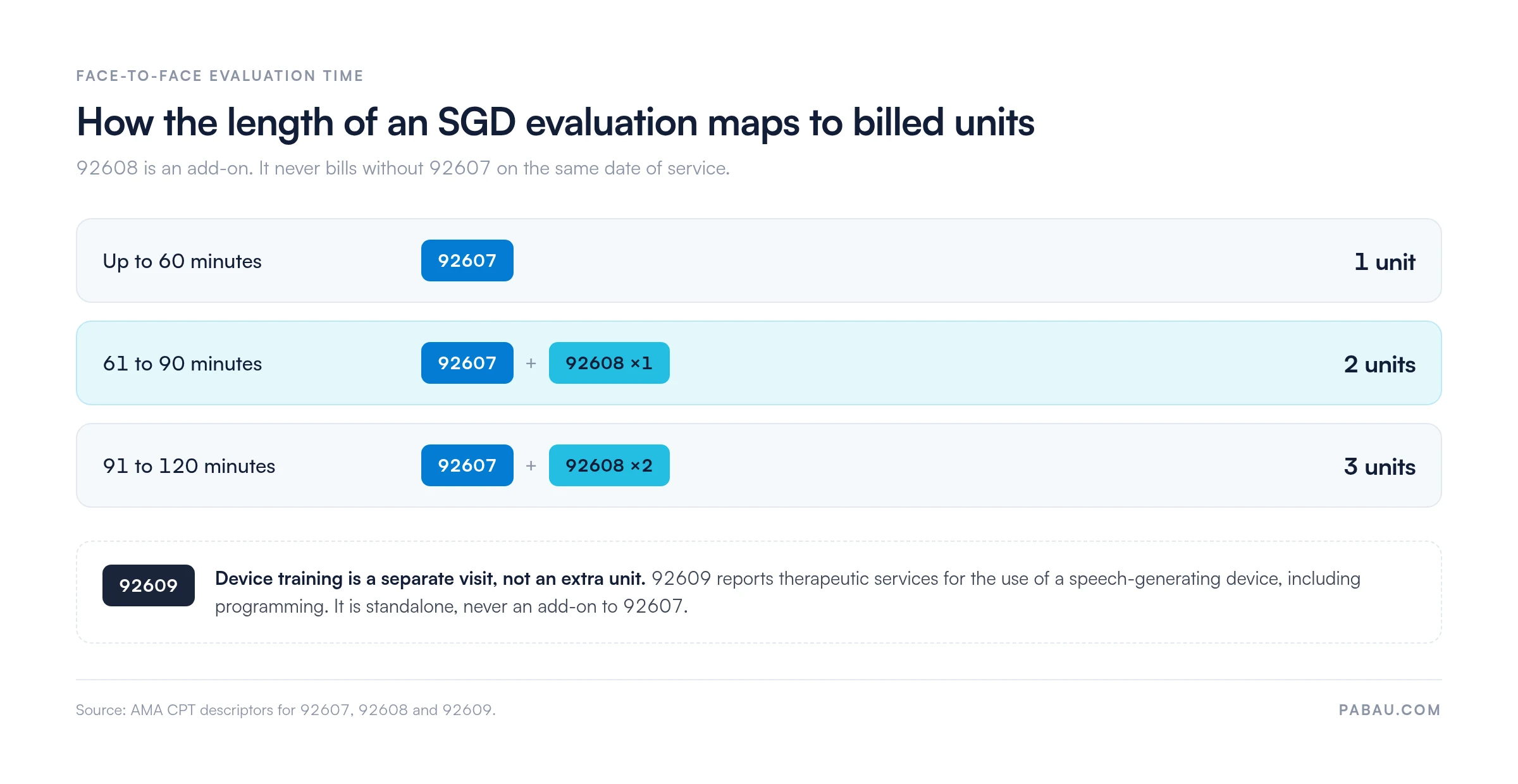
CPT code 92609 is a standalone code for therapeutic services in the use of a speech-generating device, including programming and modification. However, it is not an add-on to 92607.
An SLP who bills 92607 on one date may return later for a training session. The training visit bills as 92609. Some payers allow 92607 and 92609 on the same date when the services are clinically distinct and documented separately. Verify same-day billing with the payer first.
CMS and payers require the medical record for a CPT code 92607 claim to contain specific documentation elements. A claim submitted without them may be paid initially, then recouped on post-payment audit. Specifically, the list below is what a reviewer looks for.
The National Correct Coding Initiative (NCCI) governs which codes may be billed together on the same date of service. NCCI edits update quarterly, so verify the current edit status before you submit a same-day combination.
The most commonly questioned pairing is CPT code 92607 with CPT 92507, individual speech treatment, on the same date. NCCI edits may bundle the two, treating the evaluation as inclusive of same-day treatment.
Where the two services are clinically distinct, modifier 59 may be appended to show that. One example is a brief treatment session followed by a separate formal SGD evaluation. First, check the edit’s override indicator. Appending modifier 59 to a bundling edit that permits no override is an audit trigger.
Most CPT code 92607 denials are preventable. In fact, the errors below account for the majority of rejections and post-payment audit findings. A pre-submission checklist catches most of them, and claim denial management reporting shows which ones keep recurring.
Run a monthly audit of your 92607 claims by pulling every denied claim filtered to this code. Sort by denial reason code to see whether the pattern is modifier, medical necessity, or prior authorization. One hour a month on denial trends shows which fix to make first.
SLP practices billing CPT code 92607 carry a heavier documentation and modifier load than most routine therapy codes. Pabau’s claims management software supports that workflow end to end.
Structured evaluation templates capture every required documentation element before the claim goes out. In addition, modifier tracking flags a Medicare claim that is missing the GN modifier. Submission runs through the Claim.MD clearinghouse, which reaches Medicare fee-for-service and thousands of other US payers.
Pabau’s reporting tracks 92607 claim outcomes, denial reasons, and paid amounts by payer and by provider. So a practice running several SLPs across settings can see which payer denies the code, and why. Every subscription includes the full billing workflow and reporting, with no feature gating.

Pabau helps speech-language pathology practices manage CPT code 92607 documentation, modifier compliance, and claim submission through a single integrated platform. See how it works for your practice.

CPT code 92607 rewards practices with strong pre-submission workflows. Three failures account for most denials. They are a missing GN modifier, no prior authorization, and an evaluation report that never states why natural speech is inadequate.
In short, the fix sits in the appointment, not in the claim. Confirm authorization and credentials before the evaluation date, and write the necessity statement while the assessment is fresh. After all, a reviewer may read that report two years later.
Pabau’s evaluation templates and integrated claim submission help SLP practices get 92607 right the first time. Book a demo to see how it fits an SLP billing workflow.

What makes a claim pay on the first pass? Clean claim guide sets out the fields a payer checks before it releases payment.
How does claim submission through a clearinghouse work? Medical claims clearinghouse guide explains how electronic claim routing reduces manual errors and accelerates payment.
Want to understand the full billing cycle for therapy practices? Revenue cycle management explained covers the end-to-end process from coding through payment posting.
CPT code 92607 covers the first 60 minutes of a speech-language pathologist’s evaluation to determine the appropriate speech-generating device (SGD) for a patient. The evaluation includes assessment of communication abilities, trialing of devices, and preparation of a device recommendation report.
Qualified speech-language pathologists holding a CCC-SLP credential or equivalent state licensure may bill CPT 92607 independently. Physicians may bill the code only when an SLP performs the evaluation as an incident-to service. That requires direct supervision in a non-facility setting and follows strict incident-to billing rules.
The GN modifier is required on all Medicare outpatient SLP claims for 92607. The KX modifier is required when the therapy cap exception applies to confirm medical necessity documentation is on file. Modifier 59 may be used to distinguish 92607 from bundled codes on the same date of service. Use it only where the NCCI edit’s column indicator permits an override.
Medicaid coverage for CPT 92607 varies by state. Some states cover SGD evaluations under the speech-language pathology benefit; others require a separate durable medical equipment prior authorization. Practitioners must verify coverage and prior authorization requirements directly with their state Medicaid program before performing and billing the service.