



CCSD code G5100: Bypass of duodenum billing guide
CCSD code G5100 bills a bypass that leaves the duodenum in place CCSD code G5100...

Last Updated: Oct 16, 2026

CPT code 92609 covers therapeutic services for using a speech-generating device (SGD), including programming and modification, and is billed by speech-language pathologists
92609 is the treatment code, and 92607 and 92608 are the evaluation codes used before a device is selected
Medicare covers 92609 under the Physician Fee Schedule, and modifier GN is required for services under an outpatient plan of care
Documentation must name the device, describe the programming done, and record a measurable patient response to be billable
Pabau’s claims management software supports CPT billing with built-in claim submission and denial tracking
CPT code 92609 is the treatment code for augmentative and alternative communication (AAC) services. It covers therapeutic services for the use of a speech-generating device (SGD), including programming and modification of that device. A speech-language pathologist (SLP) performs the service and bills the code.
The full AMA descriptor reads: “Therapeutic services for the use of speech-generating device, including programming and modification.” The code applies once a device has been selected and the patient is learning to use it.
Patients with autism, ALS, cerebral palsy, or an acquired neurological condition may rely on an SGD as their main route to functional communication. 92609 is billed for each session in which the SLP delivers that therapeutic instruction.
According to the American Medical Association’s CPT code set, 92609 sits in the Evaluative and Therapeutic Services for Central Auditory Processing and Speech-Generating Devices range. It shares that range with the evaluation codes 92607 and 92608. It is separate from swallowing evaluation codes such as 92610 and 92611.
Choosing the wrong code from the 92607 to 92609 group is a frequent source of AAC denials. The three codes share a clinical context but describe different services. Use the table below to work out which one applies to a given session.
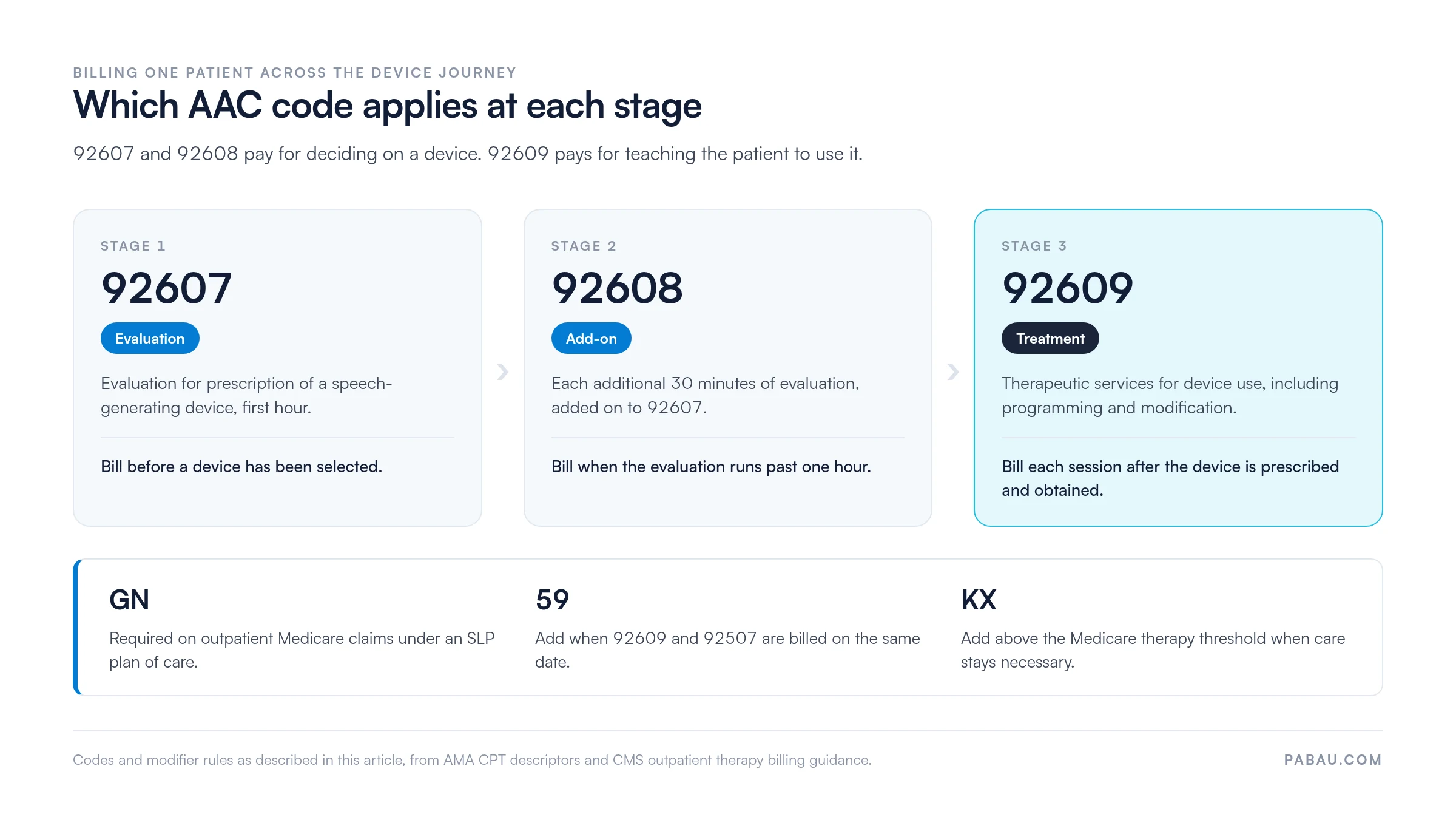
92607 and 92608 apply before or during device selection. CPT code 92609 begins after the patient has the device in hand. A patient might have one or two sessions billed as 92607 or 92608. Regular 92609 sessions follow as they learn to use the device in daily communication.
The sequence below maps each code to the point in the device journey where it becomes billable, and shows where each modifier attaches.
Speech-language pathologists bill CPT code 92609. Physicians do not typically bill it. According to the American Speech-Language-Hearing Association (ASHA) and CMS billing guidance, eligible providers include:
Settings where 92609 is commonly billed include private outpatient speech therapy practices, rehabilitation hospitals, and pediatric therapy practices. A practice running a full AAC caseload can bill 92609 dozens of times a month. That volume is why a single coding habit, right or wrong, repeats across every claim.
Medicare covers CPT code 92609 under the Medicare Physician Fee Schedule (MPFS). Rates vary by geographic location, using Geographic Practice Cost Indices (GPCIs), and by whether the service is delivered in a facility or non-facility setting.
Rates are updated annually, so check current amounts with the CMS Physician Fee Schedule Look-Up Tool before you submit. You can also look up current Work RVU values via FastRVU.
Coverage checks belong before the session rather than after the denial. An eligibility check confirms whether the patient’s plan covers 92609 and whether prior authorization is required. For a Medicare beneficiary it also shows whether the therapy threshold has already been crossed.
Medicaid coverage for 92609 varies widely by state. Some state programs cover AAC therapeutic services outright. Others require prior authorization or cap session frequency. Check your state’s Medicaid fee schedule and the Local Coverage Determinations (LCDs) issued by your Medicare Administrative Contractor (MAC) before billing.
Before billing 92609 for a new patient, confirm that a valid SGD evaluation (92607 or 92608) was completed and documented in the record. Medicare and most private payers want evidence that the device was prescribed appropriately before they cover ongoing therapeutic services.
Modifier selection for 92609 depends on the service setting and the billing scenario. Applying the wrong modifier, or leaving out a required one, is a leading cause of AAC denials.
Modifier GN is the modifier Medicare requires for beneficiaries receiving outpatient SLP services. GP belongs to physical therapy plans of care and never applies to 92609. The two get swapped often enough that it is worth auditing your billing templates for it.
Check your MAC’s Local Coverage Determination for jurisdiction-specific modifier requirements, since policies vary across contractors. The AAPC CPT code reference is a useful cross-check on current modifier guidance.
Insufficient documentation is the second leading cause of 92609 denials, after modifier errors. Each session note has to show medical necessity and capture what the therapeutic service actually involved.
Notes should also record how caregiver training fits into each SGD session, because family carryover is part of the functional communication goal. The required elements for a billable 92609 session note include:
Submitting a clean claim starts with a clean note. Reviewers look for specificity. “Patient practiced activating 12 core vocabulary symbols using partner-assisted scanning” is a billable description. “Worked on device use” is not.
Notes that skip the programming or modification detail are the ones that fall apart in an audit. That detail is what separates 92609 from a general speech treatment session.
AAC billing draws more denials than general speech therapy codes, partly because fewer billers handle 92609 claims regularly. Knowing the common failure points lets a practice fix the process before the denials arrive.
Tracking 92609 denials by reason shows whether the fault sits in the documentation, the modifier, or the authorization. Each category needs a different process fix, so reason-level tracking beats counting total denials. Our reference on denial codes explains what each code on a remittance advice actually means.
Run a monthly audit of your 92609 denials filtered by denial code. If CO-97 (benefit included in allowance) keeps appearing, you likely have an unbundling issue with 92507. If CO-50 (not medically necessary) dominates, your note templates need to capture more device-specific therapeutic detail.
92609 is one of several CPT codes SLPs use regularly. The table below is a quick reference to the adjacent codes, covering both AAC evaluation and general speech therapy services. Knowing how they relate helps a coder pick the right one and avoid cross-coding errors.
AAC billing has more moving parts than standard speech therapy coding. A practice billing 92609 every week needs the session note and the claim to come out of one record. That way nobody retypes a code between two systems.
Practice management software like Pabau closes that loop. Pabau’s claims management software submits claims through Claim.MD, our US clearinghouse partner, which supports real-time eligibility checks across thousands of US payers. It handles CMS-1500 and 837P claims plus electronic remittance advice.
So an SLP practice can track 92609 claim status and read denial reasons with their CARC codes. Resubmissions happen in the same place that holds the clinical notes and the schedule. Built-in CPT and ICD-10 catalogs attach the right code sets to each encounter, which keeps the GN modifier from going missing.

Pabau’s claims management software brings documentation, CPT coding, and claim submission into one workflow. Built-in denial tracking helps SLP practices catch recurring coding issues before they cost you revenue.

The evaluation-versus-treatment boundary drives every other decision around 92609. It settles which sessions qualify, which modifier belongs on the claim, and what the note has to capture. Get the boundary right and whole categories of denial stop showing up.
Two fixes are worth making this week, and both are mechanical. Put GN in the billing template for every outpatient Medicare SLP claim. Then add a programming-detail prompt to your 92609 note template. Each one removes a denial category rather than a single denial.
Pabau connects SLP session notes to CPT claim generation, with Claim.MD submission built in. Book a demo to see how that workflow cuts 92609 denials in your practice.

Need to check coverage before an AAC session? Insurance eligibility verification covers what to confirm at intake so a 92609 claim is not denied on benefits.
Want to understand denial patterns across your claims? Denial management in healthcare covers how to categorize and resolve recurring claim rejections by CARC code.
Looking for a step-by-step guide to medical billing fundamentals? What is medical billing explains the full claims lifecycle from charge capture through remittance.
CPT code 92609 bills a speech-language pathology session in which a patient learns to use a speech-generating device (SGD). It also covers any programming or modification of the device during that session. The code applies after the SGD has been prescribed and obtained, not during the evaluation phase.
CPT 92607 and 92608 are evaluation codes used to assess whether a patient needs a speech-generating device. CPT 92609 is the treatment code billed for ongoing therapeutic services after the patient has the device. The evaluation codes come first, and 92609 follows once the device is in use.
Licensed speech-language pathologists are the primary providers who bill CPT code 92609. Physicians do not typically bill this code. SLPs may bill it in private practice, hospital outpatient, and skilled nursing settings, plus telehealth where current CMS policy allows.
Yes, Medicare covers CPT code 92609 under the Medicare Physician Fee Schedule. Billing it requires modifier GN for outpatient services delivered under a certified plan of care. Modifier KX is required once the Medicare therapy threshold is reached and the services remain medically necessary.
Modifier GN is the correct one for 92609. GN identifies services delivered under an outpatient speech-language pathology plan of care, which is what a 92609 session is. GP identifies a physical therapy plan of care, so it does not belong on an SLP claim.
A billable 92609 note needs a medical necessity statement, the specific speech-generating device, and a description of the therapeutic activities performed. It also needs details of any programming or modification, a measurable patient response, and linkage to the treatment goals. Session start and end times plus the SLP’s credentials and signature complete it.
Yes, 92609 can be billed alongside 92507 on the same date when both services are clinically justified and distinct. Modifier 59 goes on one of the codes to show they are separate services. Without it, the payer applies an automatic bundling denial.
Medicare reimbursement for CPT code 92609 varies by geographic location and by facility or non-facility setting. The published Work RVU is 1.50. Rates are updated annually, so verify current amounts with the CMS Physician Fee Schedule Look-Up Tool before submitting claims.



