CPT Code 62284: Injection procedure for myelography
CPT Code 62284: official descriptor and procedure overview The American Medical ...

Last Updated: Oct 19, 2026
V2718 is the HCPCS Level II code for press-on lens, fresnell prism, per lens. It covers one thin Fresnel prism membrane applied to the back of an existing spectacle lens, billed as one unit per eye.
Practices use it for diplopia, strabismus, and nerve palsies while the prism power is still being tested. A prism ground into a new lens is billed with V2715 instead. Medicare coverage depends on the local contractor's medical necessity rules.
Let Pabau's smart automation suggest the right codes, reduce claim denials, and keep your practice compliant—effortlessly.
Automate repetitive tasks and focus on what matters most—your patients.
Reduce coding errors and ensure compliance with the latest regulations.
Clean claims, fewer denials, and faster reimbursements.
Powerful insights and reporting to help your practice thrive.
HIPAA compliant SOC 2 certified GDPR-compliant Trusted by 4,000+ clinics worldwide

HCPCS Code V2718 covers one press-on (Fresnel) prism lens applied to an existing spectacle lens, billed per lens.
V2715 (ground-in prism, per lens) is the code most often confused with V2718, which covers the press-on Fresnel type only.
Medicare’s routine vision exclusion applies to most V-series codes, so coverage needs MAC or LCD support and a qualifying diagnosis.
Link a binocular vision diagnosis such as diplopia or strabismus, because a refractive error code alone gets V2718 denied.
Bill each eye on its own claim line, with one unit and an RT or LT modifier.
HCPCS Code V2718 is the permanent Level II code for one press-on (Fresnel) prism lens, billed per lens. The Centers for Medicare and Medicaid Services (CMS) maintains it as one of the V-series vision supply codes. The official descriptor is Press-on lens, fresnell prism, per lens.
A press-on prism (also called a Fresnel prism or stick-on prism) is a thin, flexible plastic membrane with a prismatic surface. It adheres directly to the back of an existing spectacle lens rather than being ground into a new lens. That makes it a lower-cost, reversible option during diagnosis or prism titration, before the patient commits to ground-in lenses.
V2718 is used when a clinician prescribes a press-on prism lens to manage a binocular vision disorder. The three most common clinical scenarios are diplopia, strabismus, and post-surgical or neurological recovery affecting ocular alignment.
The ICD-10 diagnosis linked on the claim must document a specific binocular vision impairment, not a general refractive error. Payers reject V2718 when the only diagnosis code is a routine refractive error such as H52.1 (myopia) or H52.4 (presbyopia).
Knowing the boundaries of V2718 prevents unbundling errors and denials caused by overcoding or billing two codes for the same item.
V2718 sits among a group of V-series lens and prism codes, and choosing the wrong one is a common error on press-on prism claims. An accessory or service component billed with another vision code goes on V2797, which never stands alone on a claim. Use the table below to tell V2718 apart from its neighbors.
The V2715 vs V2718 distinction matters most at audit. A press-on prism applied to an existing lens is V2718. A prism ground into a new lens during fabrication is V2715. Billing V2715 when the patient received a Fresnel membrane is a coding misrepresentation, even if the payer pays the claim at first.
Prism ground into only the reading zone of one multifocal lens is a slab-off grind, billed as V2710. It is an add-on code, so it sits beside the base lens code rather than replacing it.
Medicare’s statutory vision exclusion under Section 1862(a)(7) of the Social Security Act excludes routine vision care, including most spectacle lenses and vision supplies. Most V-series codes fall under this exclusion by default.
Whether V2718 qualifies under medical necessity depends on the Medicare Administrative Contractor (MAC) and any published Local Coverage Determination (LCD). Before billing Medicare, ask your MAC whether an active LCD covers press-on prisms for the beneficiary’s diagnosis. Verifying eligibility and benefits before dispensing avoids the most predictable denials.
State Medicaid programs vary significantly. Texas Medicaid (TMHP) includes V-series vision supply codes in its vision and hearing services chapter. Coverage there depends on the recipient’s benefit category and age eligibility.
Alabama’s ADOL optometrist fee schedule lists V2718 with an assigned fee, indicating active coverage for enrolled Medicaid beneficiaries. Check the relevant state Medicaid fee schedule every year, because covered code lists and allowed amounts change with each fiscal year.
Commercial plans and some Medicaid managed care organizations require prior authorization (PA) for vision supply codes, V2718 included. Ambetter Louisiana and Absolute Total Care, for example, list V-series codes among their PA-required items. A plan that covers routine vision supply codes may still refuse V2718 without a PA request.
There is no single national allowed amount for V2718. Reimbursement follows whichever fee schedule applies to the claim:
Fee schedules update every year, so check current rates directly rather than relying on historical figures. The CMS Physician Fee Schedule lookup tool and the CMS HCPCS overview page are the authoritative sources for current payment data.
Check the CMS DMEPOS fee schedule each January when the new fee year takes effect. Payment amounts for V-series codes can shift by more than 5% year to year in some jurisdictions. Build the lookup into your annual billing review rather than relying on rates carried over from prior years.
Insufficient documentation is the leading cause of post-payment audits on V2718 claims. Before submitting, confirm every element below is present in the patient record.
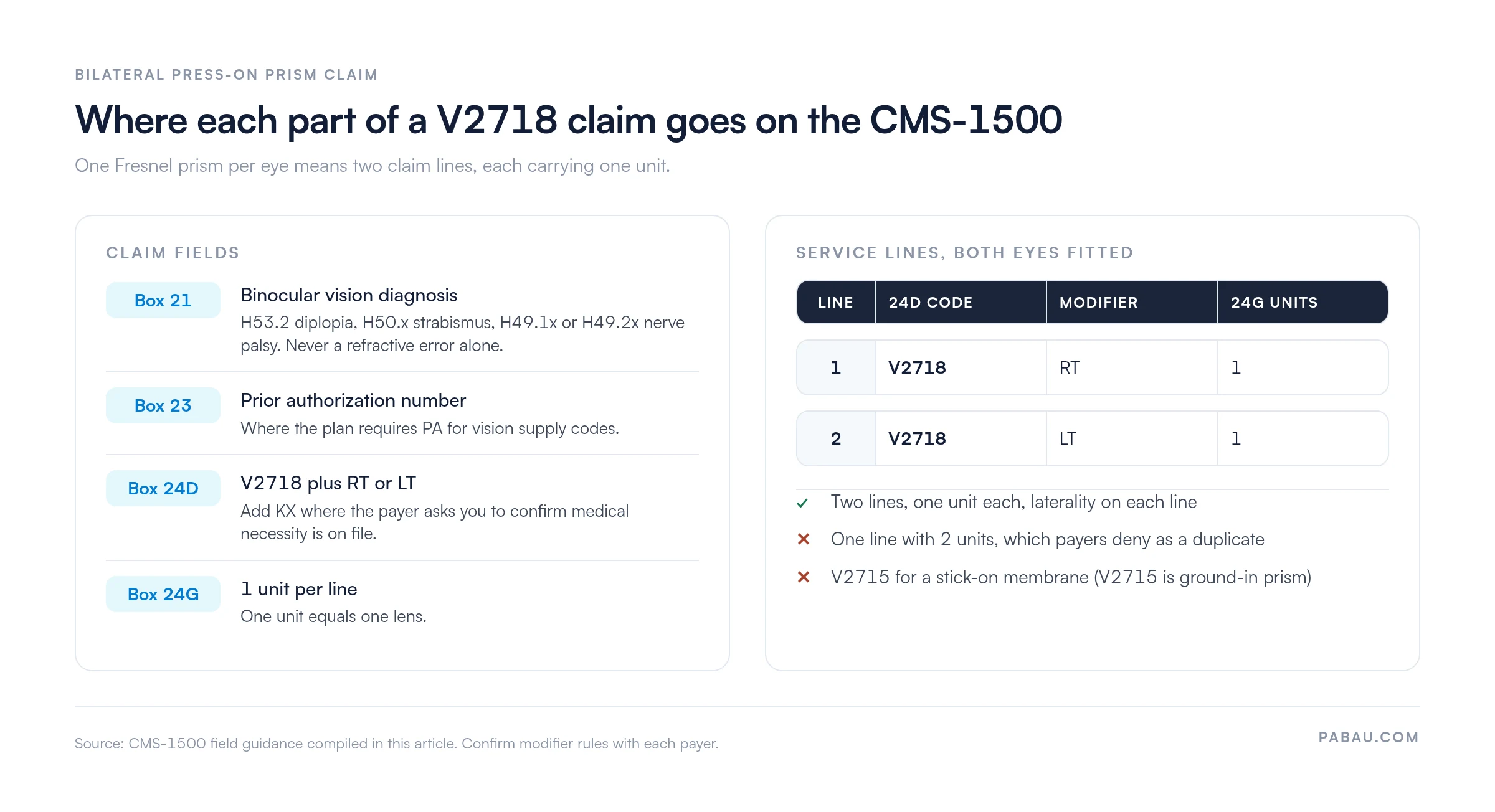
A clean claim submission for V2718 means every field on the CMS-1500 matches the documentation. Box 21 carries the ICD-10 code, Box 24D carries V2718, and Box 24G carries one unit per lens dispensed. Box 23 carries any PA number. Mismatches between the claim and the chart note are the most common audit trigger.
V2718 denials cluster around a small set of preventable errors. The table below pairs each one with its root cause and the fix.
Denial management for V2718 starts with the reason code returned on each electronic remittance advice (ERA). Group denials by type, then fix the systemic causes at the front end of the billing process instead of appealing the same error repeatedly. This guide to medical billing denial codes explains what payers are flagging and why.
These workflow adjustments reduce claim errors and speed up payment on V2718 without requiring a change to clinical practice.
Box 24D is where V2718 appears. Box 24G must reflect the unit count of one unit per lens, so bilateral dispensing means two lines, not one line with 2 units. Enter the RT (right side) or LT (left side) modifier after the code in Box 24D where the payer requires laterality.
Some MAC contractors and Medicaid plans also require modifier KX to confirm that medical necessity documentation is on file. Check the plan’s modifier policy before submitting, then map each element to its box as shown below.
Run an eligibility check on every patient before the encounter, not just new patients. Vision benefits and covered code lists change at plan renewal, and a patient who was covered for V2718 last year may not be this year. Confirming the vision supply benefit at check-in lets the provider discuss coverage with the patient before the prism is dispensed.
File four documents together under the service date: the signed prescription, the chart note documenting medical necessity, the dispensing record, and any PA approval. HIPAA-compliant record keeping means you can retrieve them quickly if an audit or reopening request arrives 12–18 months later.
Medical billing compliance for vision supply codes also covers the supplier documentation for the Fresnel prism product itself. Some auditors request proof that the item dispensed matches what was billed.
A structured approach to revenue cycle management in an optometry practice tracks V-series reimbursement separately from exam-based revenue. Fresnel prism dispensing is often a small but high-denial segment of overall claims volume. Isolating it in reporting makes denial trends visible faster.
Without a claims tool, a denied V2718 line can sit unnoticed until the patient’s statement goes out, weeks after the prism was dispensed. By then the chart note, the prescription, and the PA letter are scattered across different systems.
Practice management software like Pabau keeps the claim in the same place as the prescription, the chart note, and the dispensing record. Its medical claims management tools let you submit, track, and reconcile insurance claims without leaving the patient file.
Each V2718 claim’s status and payment amount sits next to the patient record. You can see which payers reimburse Fresnel prisms, and at what rate. That view is useful when you compare Medicaid allowed amounts against what the membranes cost you.

Pabau’s claims management tools help optometry practices track claim status, manage denials, and submit clean claims for HCPCS vision supply codes including V2718. See how it works in a live demo.

V2718 is one of the simpler vision codes to bill, because the product leaves little room for doubt. A stick-on Fresnel membrane is V2718, and a prism ground into a new lens is V2715.
Claims fail on the paperwork around the code. Confirm coverage and prior authorization before you dispense. Then link a binocular vision diagnosis rather than a refractive error, and bill each eye on its own line.
The trade-off is a few minutes at check-in against weeks of rework later, and an eligibility check costs far less than an appeal. Book a demo to see how Pabau tracks your V2718 claims from submission to payment.

Need help understanding how HCPCS claim denials work? Denial management in healthcare covers how to track, categorize, and reduce denial rates across your claim mix.
Want a clean billing process from intake to payment? Revenue cycle management fundamentals explains how practices build an end-to-end billing workflow that reduces leakage.
Submitting HCPCS claims and want to avoid common errors? Clean claim submission outlines what every field on the CMS-1500 must contain for first-pass acceptance.
Checking vision benefits before you dispense? Insurance eligibility verification walks through what to confirm with the payer before the patient’s visit.
Want the PA number and diagnosis on one document? What is a superbill? shows what a superbill includes and how it supports insurance reimbursement.
HCPCS Code V2718 covers a press-on (Fresnel) prism lens applied to an existing spectacle lens, billed per lens. It does not include the spectacle frame, lens grinding, fitting fees, or the examination that generates the prescription. Each eye is billed as a separate unit.
Medicare’s routine vision exclusion typically applies to V-series supply codes including V2718. Coverage under medical necessity is possible but depends on your MAC’s Local Coverage Determination for the patient’s specific diagnosis. Verify with your regional MAC before billing Medicare for press-on prism lenses.
Bill V2718 on the CMS-1500, one line per lens dispensed (Box 24D), with 1 unit per line (Box 24G). Link the appropriate ICD-10 diagnosis code in Box 21 and reference it in Box 24E. Add RT or LT laterality modifiers where the payer requires them, and enter any prior authorization number in Box 23.
V2718 is for press-on (Fresnel) prism lenses adhered to an existing spectacle lens. V2715 is for ground-in prism built into a new lens during fabrication. V2718 is reversible and suits prism titration or short-term management. V2715 is a permanent lens solution.
You need a signed prescription that specifies the prism power and the press-on format. The chart note must document medical necessity with a qualifying ICD-10 diagnosis, such as H53.2 for diplopia. Add a dispensing record showing which lens was fitted and when, plus any prior authorization approval the payer requires. Keep it all in the patient file under the service date.
Coverage varies by payer and plan year. Some state Medicaid programs, including Texas TMHP and Alabama Medicaid for enrolled optometrists, list V2718 as a covered benefit. Commercial coverage depends on the patient’s vision supply benefit and on whether the diagnosis meets the plan’s medical necessity criteria. Medicare coverage requires MAC or LCD support. Always verify before dispensing.