CCSD Code H3334: Low anterior resection billing guide
CCSD Code H3334: Definition and clinical scope CCSD Code H3334 covers an open an...

Last Updated: Oct 16, 2026
V2626 is the HCPCS Level II code for reduction of ocular prosthesis. It reports an ocularist removing acrylic from an artificial eye the patient already wears, so it fits a socket that has changed shape.
Because V2626 modifies an existing prosthesis, it never covers a new eye, which is V2623. Medicare pays it through the DME MAC, with an RT or LT modifier on every line.
Let Pabau's smart automation suggest the right codes, reduce claim denials, and keep your practice compliant—effortlessly.
Automate repetitive tasks and focus on what matters most—your patients.
Reduce coding errors and ensure compliance with the latest regulations.
Clean claims, fewer denials, and faster reimbursements.
Powerful insights and reporting to help your practice thrive.
HIPAA compliant SOC 2 certified GDPR-compliant Trusted by 4,000+ clinics worldwide

HCPCS code V2626 reports reduction of an existing ocular prosthesis, where an ocularist removes acrylic so the artificial eye fits a changed socket.
Medicare covers one enlargement or reduction without extra documentation under LCD L33737, and any further reduction needs support in the medical record.
A reduction made within 90 days of delivering a new prosthesis is part of that prosthesis allowance and is not separately payable.
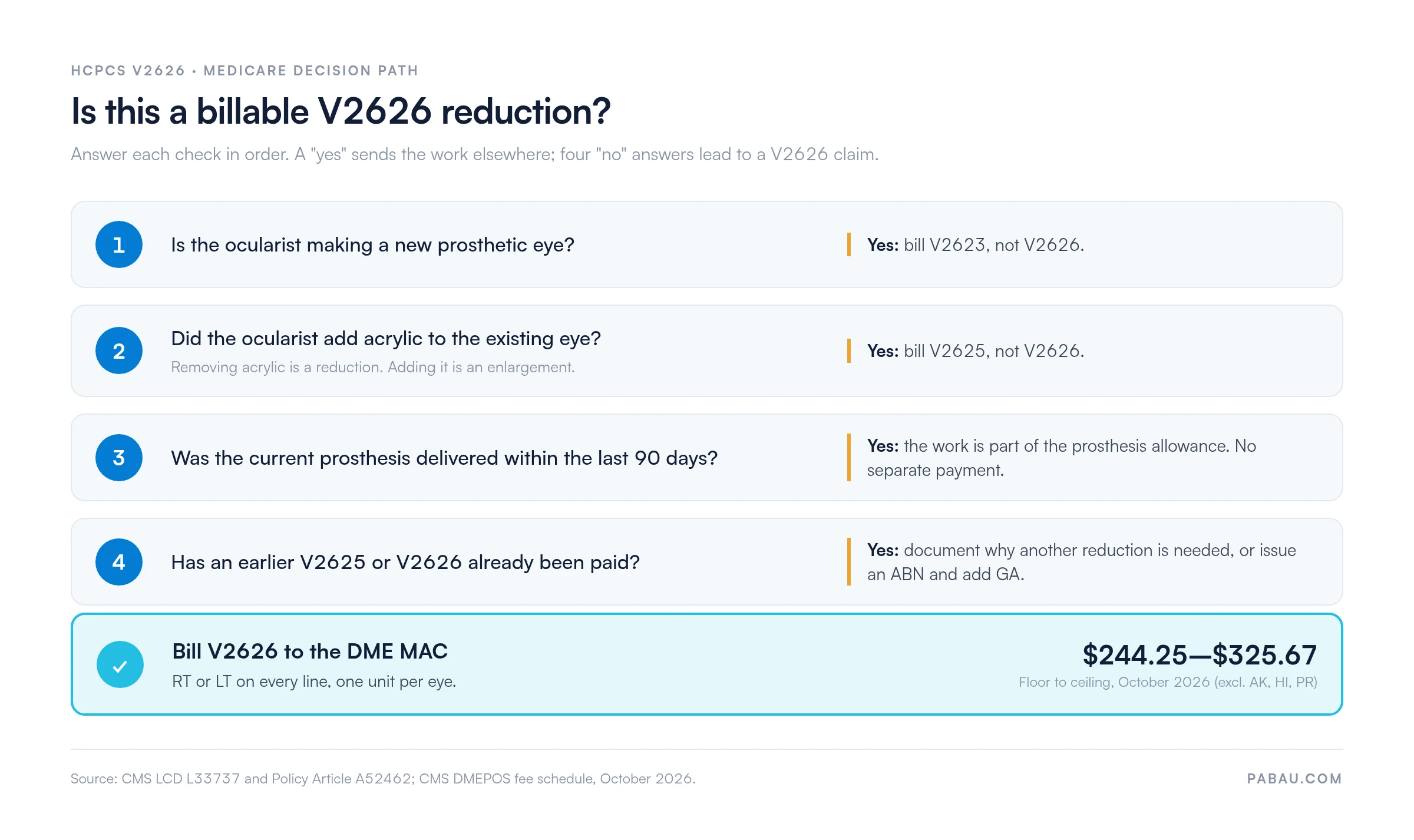
Every V2626 line needs an RT or LT modifier, and the October 2026 DMEPOS fee schedule sets state allowables between $244.25 and $325.67.
Pabau, the practice management platform we build, keeps the order, ocularist notes, and delivery proof on one patient record before the claim goes out.
HCPCS code V2626 is the HCPCS Level II code for reduction of ocular prosthesis. It reports one ocularist service: removing acrylic from a prosthetic eye the patient already wears. The smaller shell then sits comfortably in a socket that has changed shape. The code is maintained by the Centers for Medicare and Medicaid Services (CMS) and has been in the HCPCS Level II set since 1993.
V2626 reports work on a prosthesis the patient already owns. A new custom prosthetic eye is V2623, and adding material to an existing one is V2625. The ocularist’s notes decide which of the three applies, so the code has to match what those notes describe.
Reduction is performed when an existing prosthesis has become too large for the socket it sits in. The ocularist grinds acrylic from the back or edges of the shell, reshapes it, and polishes the surface before refitting. The patient keeps the same prosthesis, which is the detail that separates V2626 from a new fabrication.
An oversized prosthesis presses on the socket tissue and the lower lid. Over time that weight can stretch the lid, cause discharge, or stop the lids from closing over the eye. The common reasons a treating practitioner orders a reduction are listed below.
Among the HCPCS procedure codes, the V2623-V2629 range covers new prostheses, maintenance, modifications, and the temporary devices used after surgery. Each code describes a different job, so the fitting notes need to name the work done. The table uses the official CMS HCPCS descriptors and the October 2026 DMEPOS fee schedule ceilings.
V2625 and V2626 are the pair most often swapped, because both modify an existing prosthesis. If the notes describe added acrylic, the code is V2625. If they describe material ground away, the code is V2626. Billing V2625 for a reduction overstates the service, since its ceiling is almost double the V2626 amount.
Medicare covers eye prostheses for a beneficiary with absence or shrinkage of an eye due to birth defect, trauma, or surgical removal. That is the indication in LCD L33737 Eye Prostheses, which all four DME MACs publish. Reviewing your medical billing compliance process against it before the first claim saves most of the rework later.
The LCD covers one enlargement (V2625) or reduction (V2626) of the prosthesis without supporting documentation. Further enlargements or reductions are treated as rarely medically necessary. They are covered only when the medical record explains why another modification is needed.
Policy Article A52462 folds modifications made within 90 days of delivery into the allowance for the prosthesis itself. A reduction needed a few weeks after a new V2623 eye is therefore not billed as V2626. Modifications more than 90 days after delivery are separately payable when a change in the patient’s condition requires them.
Check the delivery date of the patient’s current prosthesis before you schedule a reduction. Inside 90 days, the work belongs to the original prosthesis and earns no separate payment. Past 90 days, confirm whether a V2625 or V2626 has already been paid, because a second modification needs its reason documented.
Medicare pays V2626 from the DMEPOS fee schedule, not the Physician Fee Schedule. Each state has its own amount, held between a national ceiling and floor. The figures below come from the CMS October 2026 DMEPOS fee schedule file, and CMS updates the file each quarter.
Alaska, Hawaii, Puerto Rico, and the US Virgin Islands are not subject to the ceiling and floor. That is why some of them sit outside the range. Medicare pays 80% of the amount for the beneficiary’s state after the Part B deductible. Commercial plans and Medicaid set their own rates, so check each contract.
DME MAC reviewers compare the claim with the order, the medical record, and the delivery record. Each document has to name the same service, the same eye, and the same date. Keeping that paper trail together is what turns a V2626 claim into a clean claim.
The diagnosis on a V2626 claim has to show why the patient wears an eye prosthesis. Policy Article A52462 publishes no restricted diagnosis list, so the record and the code need to establish absence or shrinkage of the eye. The codes below are the usual pairings in the current ICD-10-CM tabular list.
Z90.01 has no laterality, so the RT or LT modifier carries the side on the claim. The modifier, the ocularist’s notes, and any lateral diagnosis code must all point to the same eye.
A V2626 claim is a DMEPOS supplier claim, so it follows supplier rules rather than professional billing rules. Claims management software helps by keeping each claim tied to the patient record it came from. The decision path below settles the code and the payment window before the claim steps begin.
Medicare does not require prior authorization for V2626, and no eye prosthesis code is on the CMS Required Prior Authorization List. The risk sits in the frequency rule instead. A repeat reduction without documented medical necessity can be denied as not reasonable and necessary.
When the supplier expects that denial, it should issue an Advance Beneficiary Notice (form CMS-R-131) before the service. With a signed ABN on file, the claim carries the GA modifier and the patient can be billed if Medicare denies it. Without one, the supplier usually absorbs the cost. Commercial and Medicaid plans may require prior authorization, so check each plan before the appointment.
Most V2626 denials trace back to a short list of causes. Effective denial management starts by logging each one against its reason code.
Ocular prosthetic practices often keep the pieces of a V2626 claim in different places. The order arrives by fax, the ocularist’s notes sit in a paper chart, and the delivery date lives in an old invoice. Nobody notices the missing piece until the remittance advice comes back.
Pabau, the practice management software we build, keeps those documents on the patient record. The order, the fitting notes, the signed delivery record, and the invoice sit beside the appointment history. Billing staff can see the delivery date of the current prosthesis before they decide whether a reduction is billable.
When a DME MAC asks for records, the documents are retrievable from one place. That shortens the response to an additional documentation request and keeps the claim defensible.

Pabau keeps orders, ocularist notes, and delivery records on the patient record. Each V2626 claim then goes out with its supporting documentation in one place.

V2626 pays for a small piece of work, and it is easy to lose. Most losses come from timing and history rather than coding. The two usual causes are a reduction inside 90 days of delivery and a repeat reduction with no reason recorded.
Check those two facts before the appointment and the claim has little left to fail on. The modifier, the order, and the delivery record are routine once they live in one place. Book a demo to see how Pabau keeps ocular prosthesis documentation ready for every claim.

Need a denial management framework? Denial management in healthcare covers how to build a structured appeals and denial-prevention workflow for DMEPOS and other payer categories.
Looking for a clean claim checklist? Clean claim submission outlines the field-by-field requirements that keep claims from rejecting before a clinical review begins.
Want to understand the broader billing landscape? Medical billing fundamentals provides context on how DMEPOS claims fit into the overall revenue cycle.
HCPCS code V2626 covers reduction of an ocular prosthesis. An ocularist removes acrylic from an artificial eye the patient already wears, so it fits a socket that has changed. It never covers a new prosthesis, which is V2623.
Both codes modify an existing ocular prosthesis. V2625 reports enlargement, where material is added to increase volume. V2626 reports reduction, where material is removed to decrease volume. The ocularist notes decide which code applies.
LCD L33737 covers one enlargement or reduction of the prosthesis without supporting documentation. Further modifications are covered only when the medical record explains why they are needed. A reduction within 90 days of delivering a new prosthesis is not separately payable.
Yes. Policy Article A52462 requires the RT or LT modifier on every code in the eye prosthesis policy. When both eyes are treated on the same date, bill two lines, one with RT and one with LT, with one unit each.
Under the October 2026 DMEPOS fee schedule, state amounts for V2626 run from a $244.25 floor to a $325.67 ceiling. Alaska, Hawaii, and Puerto Rico sit outside that range. Medicare pays 80% after the Part B deductible.
No. V2626 is not on the CMS Required Prior Authorization List. Suppliers should still issue an Advance Beneficiary Notice before a repeat reduction that the record may not support. Commercial and Medicaid plans set their own rules.