HCPCS code E0198: Water pressure pad billing guide
HCPCS code E0198 is a water pad for a standard mattress HCPCS code E0198 is the ...

Last Updated: Oct 13, 2026
Billable Code
V2625 is the HCPCS Level II code for enlargement of ocular prosthesis.
Billers most often confuse it with V2623 (a new custom prosthetic eye) or V2624 (polishing an existing one). That single coding error is the fastest route to a denial. Missing a signed physician order or billing under the wrong supplier type runs a close second.
Let Pabau's smart automation suggest the right codes, reduce claim denials, and keep your practice compliant—effortlessly.
Automate repetitive tasks and focus on what matters most—your patients.
Reduce coding errors and ensure compliance with the latest regulations.
Clean claims, fewer denials, and faster reimbursements.
Powerful insights and reporting to help your practice thrive.
HIPAA compliant SOC 2 certified GDPR-compliant Trusted by 4,000+ clinics worldwide

HCPCS code V2625 covers enlargement of an existing ocular prosthesis shell, not new fabrication or repair
V2625 must be billed by an enrolled DMEPOS supplier, not under the physician professional fee schedule
Missing or unsigned physician order is the top denial trigger; documentation must specify enlargement, not general fitting
Pabau’s claims management software helps DMEPOS practices attach letters of medical necessity, physician orders, and fitting notes directly to patient records before claim submission
HCPCS code V2625 is an HCPCS Level II code with the official descriptor “Enlargement of ocular prosthesis.” It belongs to the V-series vision and prosthetic items range maintained by the Centers for Medicare and Medicaid Services (CMS). The code covers one ocularist service: Adding material to an existing prosthetic eye shell to increase its volume. It is usually needed because the orbital socket has changed shape after enucleation or evisceration.
That distinction matters for coding. V2625 describes a modification to a prosthesis the patient already owns, and fabrication and repair each sit under their own code. Billing V2625 in place of a fabrication or polishing code misstates the work performed. Auditors read that as a coding error rather than a clerical one.
Ocular prosthesis enlargement is performed by a certified ocularist when a patient’s existing prosthetic eye no longer fits the orbital socket correctly. After enucleation or evisceration, socket volume can decrease over time. The change is fastest in pediatric patients, whose orbit is still developing. Poor fit causes discomfort, discharge, and an unnatural appearance, all of which are documented indications for the service.
The ocularist adds acrylic material to the existing shell, reshapes it, and polishes the surface. For billing, what counts is that the original prosthesis is retained and modified rather than replaced. Where socket changes are severe enough to demand a completely new prosthesis, V2623 applies instead of V2625.
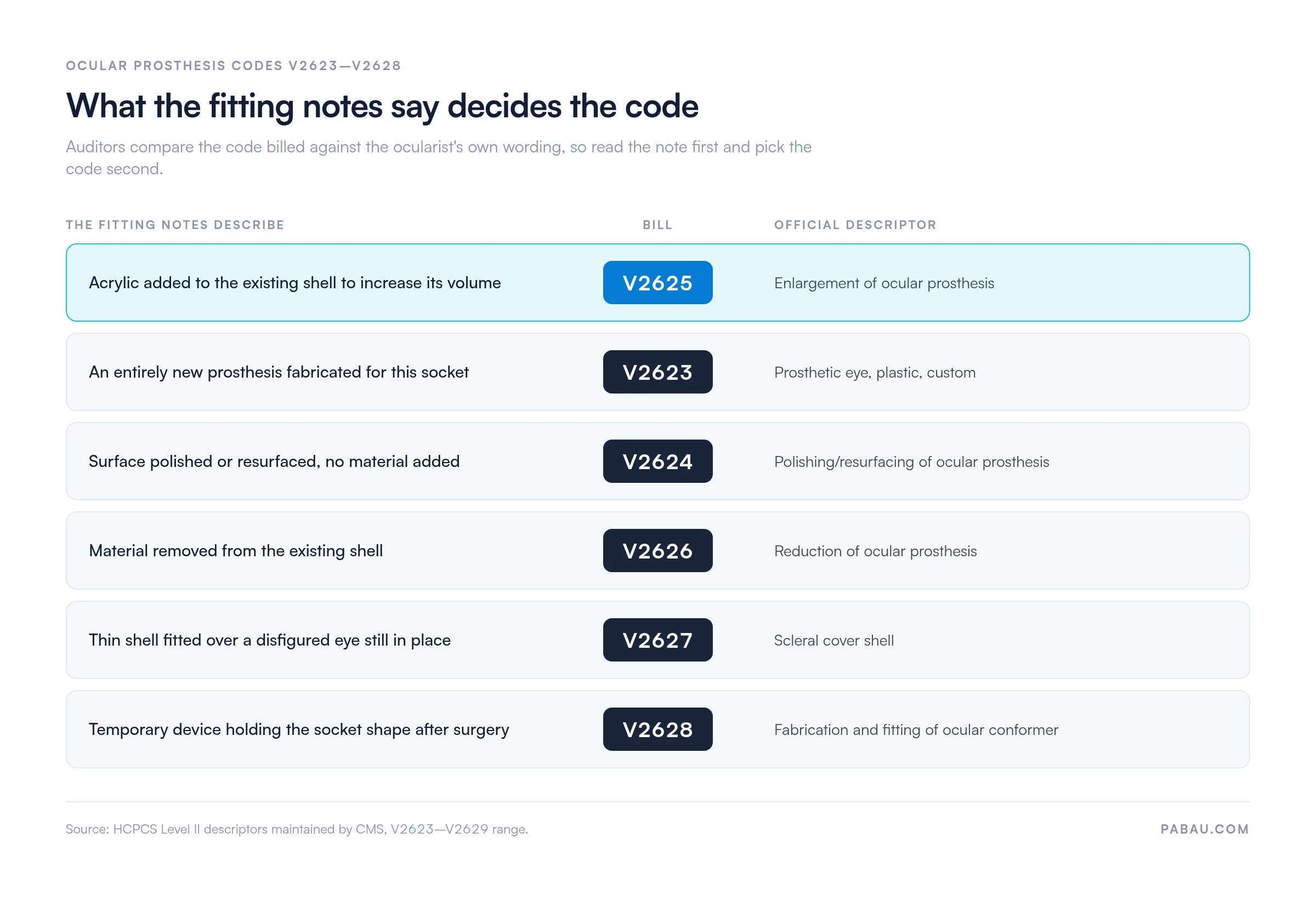
The V2623-V2629 range covers fabrication, maintenance, modification, and the temporary devices used after surgery. Choosing the wrong code in this range is the most avoidable billing error an ocularist makes. The comparison below reflects the official HCPCS Level II code descriptors maintained by CMS.
The V2623 vs. V2625 distinction is the one auditors look at most closely. If the ocularist’s fitting notes describe adding acrylic to an existing shell, V2625 is correct. If the patient received an entirely new individually fabricated prosthetic eye, V2623 applies. Billing V2623 when only an enlargement was performed is an upcoding error regardless of intent.
V2624 runs the opposite risk. It pays for polishing or resurfacing a prosthesis the patient already owns, a maintenance service CMS covers twice a year under LCD L33737. Polishing restores the surface without adding volume, so notes that describe added acrylic belong under V2625. The mapping below turns each of those note descriptions into the code that matches it.
Medicare covers V2625 under its DMEPOS benefit when medical necessity is established and the supplier meets enrollment requirements. CMS Policy Article A52462 governs coverage for eye prostheses including enlargement services, and it is the primary reference for Medicare billing staff. Local Coverage Determinations (LCDs) from each Medicare Administrative Contractor may add region-specific requirements. Verify against the LCD in effect for your jurisdiction before you submit.
Checking the patient’s coverage before the appointment prevents most disputes later. The record must establish anophthalmos, meaning absence of the eye, resulting from enucleation, evisceration, or a congenital condition.
Request CMS Policy Article A52462 from your MAC’s website and save it alongside your ICD-10 and LCD references. Assembling the documentation before the appointment settles the problem that sinks most claims. The physician order turns up unsigned, and by then the claim has already gone out.
Medicare reimburses V2625 through the DMEPOS fee schedule rather than the Physician Fee Schedule. Rates are locality-adjusted and updated every January 1, so any figure printed here dates quickly. Verify the current allowable through the CMS fee schedule lookup tool or your MAC’s provider portal.
Submitting electronically gives DMEPOS suppliers real-time eligibility checks and ERA-based payment tracking. Both make it simpler to reconcile the locality-adjusted Medicare allowable against what the MAC actually paid. The difference is often only a few dollars per claim.
Incomplete documentation is the leading cause of V2625 claim denials. A DMEPOS claim needs a paper trail connecting the patient’s diagnosis to the specific service billed. Assembling those records before submission, rather than after a denial, is what turns a V2625 claim into a clean claim that pays first time.
The ICD-10-CM diagnosis code on a V2625 claim must establish the clinical reason the prosthesis requires enlargement. Anophthalmos or loss of the eye is the essential finding. A code describing a condition unrelated to the absence or dysfunction of the eye produces a medical necessity denial. The table below reflects current ICD-10-CM codes; verify against the fiscal year edition in effect at the time of service.
Code to the highest level of specificity the tabular list offers. Z90.01 carries no laterality subcodes, so the affected eye is established in the clinical record rather than in the diagnosis code itself.
Medicare generally does not require prior authorization for V2625. The supplier may still need to issue an Advance Beneficiary Notice (ABN) where coverage looks doubtful. A patient who has passed the frequency limit is the usual example. The ABN (CMS form CMS-R-131) lets the supplier transfer the cost to the patient if the claim is denied. Without a valid ABN in that situation, the supplier cannot collect from the patient at all.
Commercial payers take a different approach. Aetna’s Clinical Policy Bulletin 619 governs eye prosthesis coverage for commercial members and may require prior authorization before the enlargement service is performed. Check the current version of the applicable policy every time. Commercial guidelines are updated periodically, so the requirements agreed at contracting may no longer hold.
Most V2625 denials come from a short list of causes, and each one can be headed off upstream. Our reference on denial reason codes covers the full taxonomy across DMEPOS claims. It explains how CARC and RARC codes map to the documentation problem behind them.
Medicare gives providers a structured redetermination process for denied claims. The request must reach the MAC that processed the original claim within 120 days of the denial notice. That window is set by the Medicare Claims Processing Manual. Logging every V2625 denial by reason code makes the pattern visible across claims rather than one case at a time.
Commercial payer appeal timelines vary by contract. Most require a written appeal within 60 to 180 days of the denial, so verify the exact window in your provider agreement.
Knowing the code is the easy part of V2625 compliance. The workflow around it is what has to hold up under audit. The Office of Inspector General has historically flagged ocular prosthetic billing as a review target, because the supporting documentation so often arrives incomplete.
Using claims software for suppliers that keeps documentation and submission in one workflow closes the most common failure point. The physician order or LMN sits somewhere in the practice, and nobody attaches it before the claim goes out.
Audit your last 12 months of V2625 claims on three points. Was the supplier PTAN active on the date of service? Was the physician order signed before it? Does the diagnosis code support absence of the eye? Those three questions account for most preventable V2625 denials. Fixing them upstream costs less than one successful redetermination.
Most DMEPOS practices keep the pieces of a V2625 claim in separate places. The physician order arrives by fax and the letter of medical necessity sits in a shared drive. The ocularist’s fitting notes stay in a paper file until somebody asks for them. Nobody notices a missing signature until the remittance advice comes back.
Practice management software like Pabau holds all of it on the patient record instead. Physician orders, letters of medical necessity, and fitting notes attach to the same record that carries the appointment and the invoice. Billing staff can see whether a V2625 claim is ready before it is submitted.
When a MAC auditor asks for records inside a tight response window, the documentation chain is retrievable from one place. That removes the scramble through fax files and email folders that usually follows an audit letter.

Pabau attaches physician orders, letters of medical necessity, and ocularist fitting notes to the patient record. Every V2625 claim then goes out with its supporting documentation complete.

V2625 claims fail for predictable reasons: Wrong supplier type, missing physician orders, and diagnosis codes that don’t support the service billed. None of those are complicated problems. They do require a documentation workflow that runs before the appointment rather than after the denial.
Pabau builds that workflow into the patient record, so orders, letters of medical necessity, and fitting notes are captured at the source. Nobody has to chase them at submission. To cut first-pass denials on ocular prosthetic codes, book a demo and see how the documentation chain holds together.

List Item #1
List Item #2
HCPCS code V2625 covers enlargement of an ocular prosthesis. That is the service of adding acrylic material to an existing prosthetic eye shell to restore proper socket fit. It applies when the original prosthesis no longer fits after post-enucleation socket changes, pediatric orbital growth, or inflammation. The code covers the modification only, never fabrication of a new prosthesis.
The Medicare allowable for V2625 is set by the DMEPOS fee schedule and adjusted by locality. Rates change every January 1, so verify them through the CMS fee schedule search tool or your MAC’s portal. No fixed national figure is stated here because it would be outdated within months of publication.
V2624 is the maintenance code for polishing or resurfacing a prosthesis the patient already owns, which CMS covers twice a year under LCD L33737. V2625 is for enlarging that existing prosthesis by adding material to the shell. V2629 is the catch-all code for a prosthetic eye of another type that no specific V-code describes. The code for a brand-new custom prosthetic eye is V2623, and billing it when only an enlargement was performed constitutes upcoding.
A V2625 claim requires a physician order signed before the date of service that specifies enlargement, plus a letter of medical necessity. It also needs the ocularist’s fitting notes describing the procedure and an ICD-10-CM code establishing anophthalmos or acquired absence of the eye. The billing entity’s active DMEPOS supplier NPI and PTAN must appear on the claim. Missing any of these is the primary denial trigger.
Medicare generally does not require prior authorization for V2625. The supplier may still need to issue an Advance Beneficiary Notice (ABN) when coverage is uncertain. Reaching the frequency limit is the usual example. Commercial payers including Aetna may require prior authorization under their eye prosthesis policies, so always verify with the specific plan before the service date.
Common denial reasons include a missing or unsigned physician order and billing by a non-enrolled DMEPOS supplier. Duplicate billing with V2623 on the same date of service is another common trigger. A diagnosis code that does not support medical necessity for enlargement, or a frequency limit violation, will also fail the claim. Correcting the documentation and submitting a redetermination within 120 days resolves most Medicare denials.
V2623 is the new custom prosthetic eye code, and it cannot be billed with V2625 on the same date of service for the same eye. Enlargement and new fabrication are mutually exclusive on a single date of service. V2624 polishing carried out as part of the same enlargement is bundled into V2625 rather than billed separately. V2627 (scleral cover shell) and V2628 (ocular conformer) describe different devices, so bill them only when a distinct, separately documented service was performed.