CCSD Code M7940: Internal urethrotomy
What is CCSD Code M7940? CCSD Code M7940 is the UK private-sector procedure code...

Last Updated: Nov 6, 2026
V2623 is the HCPCS Level II code for prosthetic eye, plastic, custom. It reports a new artificial eye that an ocularist fabricates from an impression of one patient's socket.
The codes beside it describe different work. A stock eye that is not custom fabricated is V2629. Polishing, enlarging or reducing an eye the patient already wears is V2624, V2625 or V2626. Medicare pays V2623 through the DME MAC, with an RT or LT modifier on every line.
Let Pabau's smart automation suggest the right codes, reduce claim denials, and keep your practice compliant—effortlessly.
Automate repetitive tasks and focus on what matters most—your patients.
Reduce coding errors and ensure compliance with the latest regulations.
Clean claims, fewer denials, and faster reimbursements.
Powerful insights and reporting to help your practice thrive.
HIPAA compliant SOC 2 certified GDPR-compliant Trusted by 4,000+ clinics worldwide

HCPCS Code V2623 reports a new plastic prosthetic eye, custom-fabricated for one patient’s socket. A stock eye that is not custom fabricated is billed as V2629.
V2624, V2625 and V2626 are services on a prosthesis the patient already wears: polishing, enlargement and reduction. None of them is a new eye.
Medicare covers V2623 under the Part B prosthetics benefit, paid by the DME MAC. Replacement is typically covered once every five years unless an earlier one is medically necessary.
RT or LT is required on every V2623 claim line, and leaving it off is a leading denial cause.
Pabau, the practice management platform we build, keeps the order, fitting notes and claim on one patient record. The claim then goes out with its paper trail.
HCPCS Code V2623 is the Level II code for a prosthetic eye made from plastic and custom-fabricated to fit an individual patient. The Centers for Medicare and Medicaid Services (CMS) maintains V2623 within the HCPCS V-code range.
That range covers vision items such as spectacles, contact lenses and ocular prosthetics. Our code library lets you look up other HCPCS codes in the same format.
The descriptor names two things: the material (plastic) and the construction (custom). Custom means an ocularist fabricated the prosthesis from an impression of this patient’s socket.
CMS Policy Article A52463 sets the other half of the rule. A prosthetic eye that is not custom fabricated, such as a stock eye, is billed as V2629. No code in the range splits plastic from glass, so material alone never moves a claim to another code.
V2623 covers one item only: a new prosthetic eye fabricated from plastic and custom-made to fit a specific patient’s anophthalmic socket. Custom fabrication means an ocularist took individual measurements of the socket, created an impression, and produced the prosthesis specifically for that patient.
Several related items fall outside V2623’s scope:
Payers require a documented medical reason for the absence of the natural eye before approving a V2623 claim. The qualifying diagnoses are specific and must appear in the patient record.
Accepted clinical indications generally include:
The physician’s order and the operative or pathology report confirming why the eye was lost must be on file. Without them, the payer cannot establish medical necessity, however clear the clinical picture.
The diagnosis on a V2623 claim has to show why the patient needs an eye prosthesis. Policy Article A52462 publishes no restricted diagnosis list. The record and the code have to establish absence or shrinkage of the eye.
Z90.01 has no laterality, so the RT or LT modifier carries the side on the claim. The modifier, the fitting notes and any lateral diagnosis code must all point to the same eye.
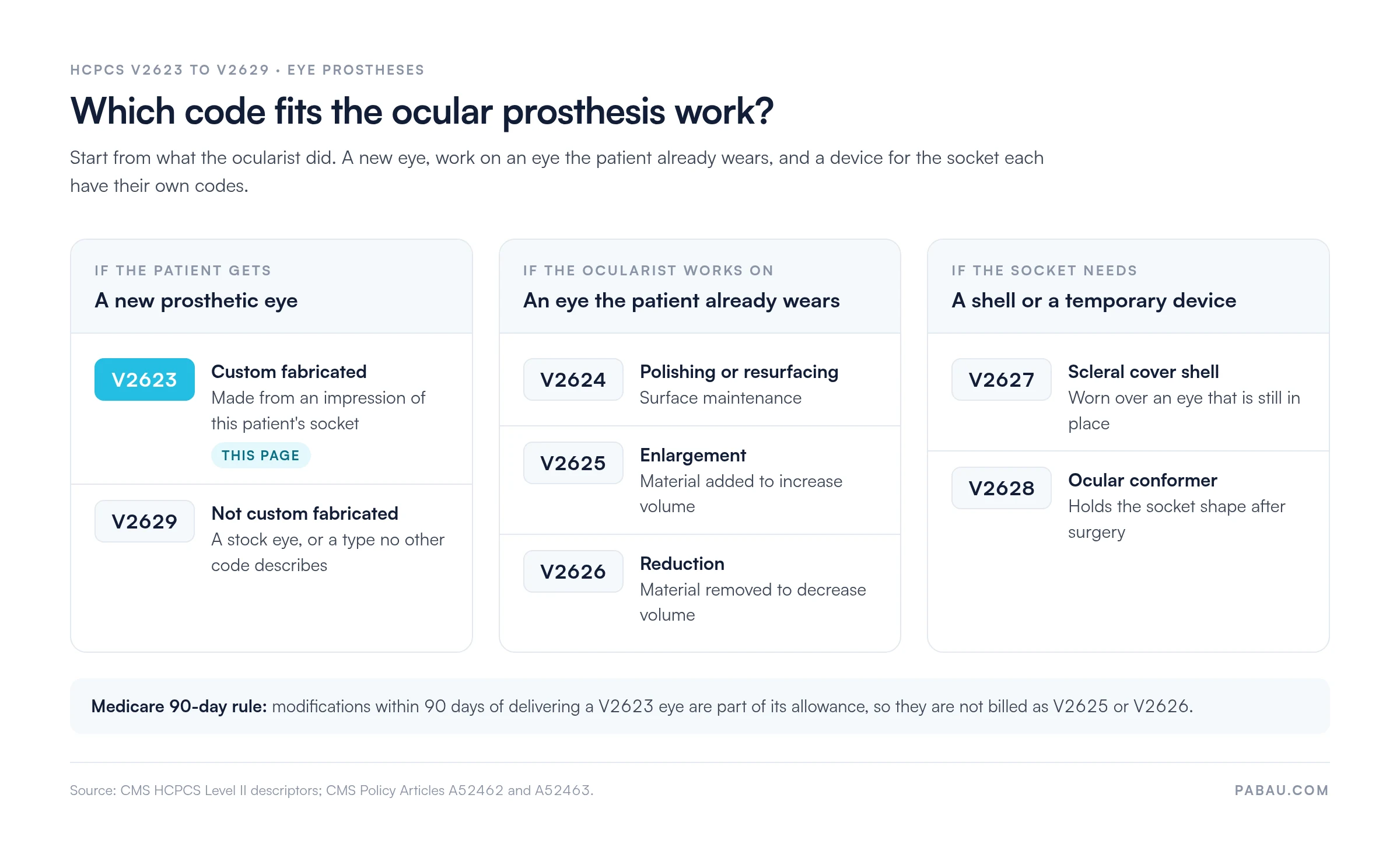
The V2623-V2629 range covers new prostheses, maintenance, modifications and the temporary devices used after surgery. Choosing the wrong code from this group is the most common root cause of denials on prosthetic eye claims. The table uses the official CMS HCPCS descriptors.
Common confusion point: V2623 and V2629 are the pair that decides most new-eye claims. V2623 is a prosthesis custom fabricated for this patient. V2629 covers an eye that is not custom fabricated, such as a stock eye selected from inventory. Record the impression, the fabrication and the fitting date, and that record becomes the defense if the claim is audited.
The second error is billing V2623 for work on an eye the patient already wears. Polishing is V2624, and enlargement or reduction is V2625 or V2626. A new eye and a modified one never share a code. The chart below sorts all seven codes by the work the ocularist did.
Medicare covers prosthetic eyes under the Part B DMEPOS benefit. Part B names prosthetics as a statutory benefit category, and V2623 falls within it. The code is covered when medical necessity criteria are met and an enrolled DMEPOS supplier submits the claim.
Medicare applies a frequency limitation to custom prosthetic eyes. Under LCD L33737 Eye Prostheses, replacement is typically covered once every five years.
An earlier replacement needs documented medical necessity. Valid reasons include socket changes after further surgery, damage beyond repair, or a loss of fit that affects the patient’s health.
Policy Article A52462 adds a 90-day rule. Modifications made within 90 days of delivery are part of the V2623 allowance, so they are not billed as V2625 or V2626. Confirm the current limits with your DME MAC before submitting an early-replacement claim.
Medicaid coverage for V2623 varies by state. Some state programs cover prosthetic eyes the way Medicare does. Others impose stricter prior authorization requirements or lower reimbursement rates.
Children on Medicaid may qualify for more frequent replacement under EPSDT (Early and Periodic Screening, Diagnostic and Treatment). That applies when socket growth needs a new fit within five years. Always verify the applicable state plan before submitting.
Before submitting a V2623 claim for a pediatric patient under Medicaid, check whether EPSDT applies in that state. Growing children’s sockets change faster than adults’, and some state plans specifically allow more frequent replacement for minors when documented by the treating ocularist. Missing this exception means unnecessary denials on clinically valid claims.
Commercial payers set their own V2623 coverage rules, so check the payer’s written policy before submitting. Aetna, for example, publishes its eye prosthesis criteria in Clinical Policy Bulletin 619. It generally follows Medicare’s medical necessity criteria but may require prior authorization where Medicare does not.
Key differences to verify with any commercial payer include:
Find each payer’s current policy on their provider portal. Relying on past claim experience rather than the current written policy is a common root cause of unexpected denials.
Medicare reimbursement for V2623 is set through the DMEPOS fee schedule, not the Physician Fee Schedule. CMS updates the file each quarter. The 2026 allowed amount can be looked up in the CMS DMEPOS fee schedule. In the October 2026 file, the national ceiling for V2623 is $1,465.24, and each state has its own amount.
Medicare pays 80% of the lesser of the submitted charge or the fee schedule amount. The patient (or their supplemental insurance) is responsible for the remaining 20% after the Part B deductible is satisfied.
Custom prosthetic eyes can carry significant costs. Check the allowed amount before you discuss the patient’s share, so the bill holds no surprises and the balance is paid sooner.
Confirm the descriptor and the code’s active status in the current CMS quarterly HCPCS update before you build a fee estimate.
HCPCS Code V2623 claims require a specific documentation package. Missing any element from this list is the second most common denial cause after incorrect code selection.
Laterality is the modifier that matters on every V2623 claim, and missing it causes avoidable denials.
Laterality (RT or LT) is not optional. CMS DMEPOS modifier policy requires laterality modifiers on prostheses for paired body parts. The eye counts as one, even when only one prosthesis is billed. A claim submitted without RT or LT will typically be rejected or denied before it reaches adjudication.
V2623 is billed by enrolled DMEPOS suppliers, not by physicians or hospital outpatient departments. The billing supplier must hold an active Medicare DMEPOS supplier number and meet every Medicare supplier standard. Those standards include a physical location, posted business hours, and the applicable CMS performance standards.
In practice, most V2623 claims come from ocularists working as, or for, enrolled DMEPOS suppliers. Many hold board certification from the National Examining Board of Ocularists (NEBO). A physician who orders the prosthesis does not bill V2623. The ocularist or supplier who fabricates and fits it does.
This provider type distinction matters for medical billing compliance. Billing V2623 from a physician’s NPI rather than an enrolled DMEPOS supplier NPI is an audit flag and can result in claim recoupment.
V2623 denials follow predictable patterns. Understanding where claims break down makes prevention straightforward. Good denial management starts with knowing which issues to watch for before the claim goes out.
Many of these denials are recoverable through clean claim resubmission or formal appeal. Recovery costs time and staff hours, though. Building modifier checks and document collection into the workflow before submission pays back far more per claim.
Build a V2623 checklist into your pre-submission workflow. (1) The fitting notes show custom fabrication, not a stock eye billed as V2629. (2) RT or LT is on the claim line. (3) The standard written order and operative report are on file. (4) For a Medicare replacement within five years, the reason is documented.
Ocularist practices bill in a documentation-heavy, modifier-sensitive setting, and that makes DMEPOS claims error-prone. The order, the operative report and the fitting notes often sit in different places, and one of them goes missing at claim time.
In Pabau, those documents sit on the patient record, next to the encounter. Pabau’s claims management software builds the claim from that same record, so nobody has to re-key the fitting details.
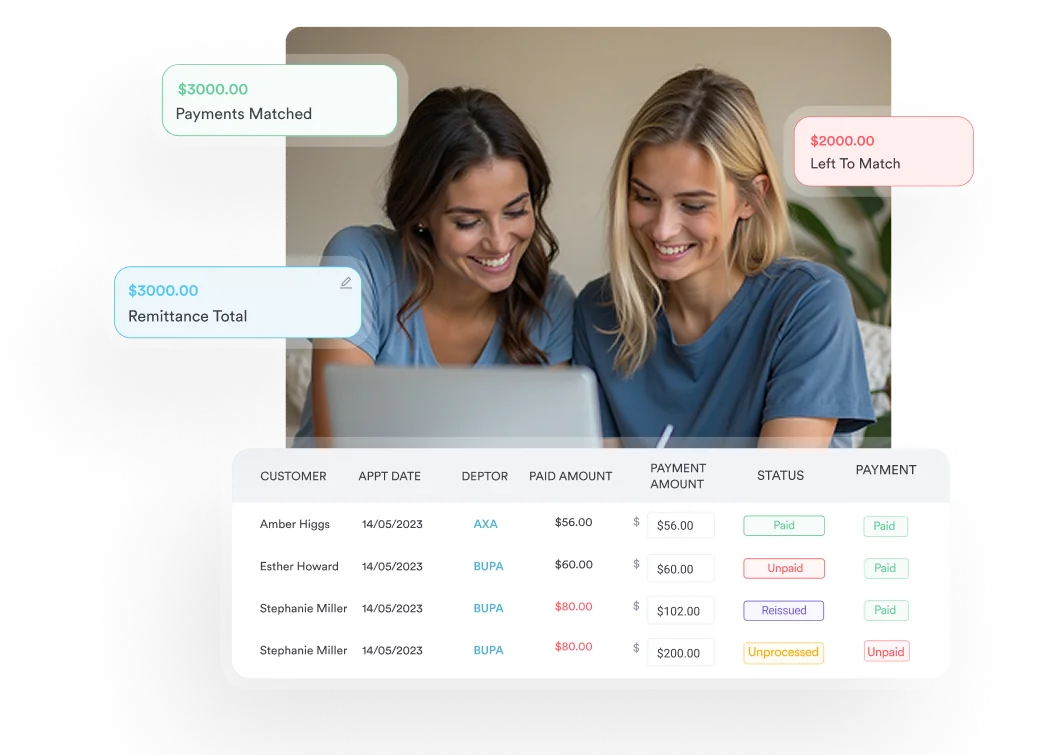
With billing and the clinical record in one system, the RT or LT check and the document check happen before the claim leaves the practice. A missing order or an unmarked side surfaces while the claim is being built, weeks before a payer could deny it.
If your team is newer to DMEPOS work, the basics of medical billing explain where each document fits in the claim.

Pabau keeps the order, operative report and fitting notes on the patient record, next to the claim. Ocularist practices send cleaner claims and chase fewer denials.

V2623 is a narrow code, and the risk on it sits in the codes beside it. A new custom eye is V2623, and a stock eye is V2629. Work on an eye the patient already wears belongs to V2624 through V2626.
The fitting notes decide which code is right, so write them to say plainly what the ocularist made or changed. Get that right before the claim is built, and the five-year rule and supplier enrollment are the only checks left. Book a demo to see how Pabau keeps orders, fitting notes and claims together for ocularist practices.

Want to understand how claim denials are managed? Denial codes in medical billing explains common CARC denial reason codes and the appeal process for rejected DMEPOS claims.
Looking to understand the full billing cycle? Revenue cycle management breaks down each stage from patient registration through final payment posting, with context for ocularist suppliers managing DMEPOS claims.
HCPCS Code V2623 covers a new prosthetic eye made of plastic and custom-fabricated to fit one patient’s socket. A stock eye that is not custom fabricated is billed as V2629. Polishing, enlargement and reduction of an existing prosthesis are V2624, V2625 and V2626.
Yes. Medicare covers V2623 under the Part B prosthetics benefit when medical necessity is met and an enrolled DMEPOS supplier submits the claim. All required documentation must be on file. Replacement is typically limited to one prosthetic eye per five years under LCD L33737.
V2623 is a new plastic prosthetic eye, custom-fabricated for the patient. V2624 is polishing or resurfacing of a prosthesis the patient already wears, so it is maintenance, not a new eye. V2629 covers a prosthetic eye of another type, including a stock eye that is not custom fabricated. Billing either one for a new custom eye misstates the service.
Required documentation includes a standard written order from the treating practitioner and an operative or pathology report confirming the eye loss. It also includes ocularist fitting notes showing custom fabrication, and proof of delivery. Commercial payers may also require a prior authorization approval.
Every V2623 claim must include a laterality modifier: RT for the right eye or LT for the left eye. Add KX only where a payer’s written policy asks for it. Omitting RT or LT is one of the most common denial causes on prosthetic eye claims.
Medicare’s frequency limitation for custom prosthetic eyes is typically one per five years. Earlier replacement is covered when medical necessity is documented, such as socket changes after surgery, damage beyond repair, or a loss of fit. Confirm the current limit in LCD L33737 Eye Prostheses.