HCPCS Code E0272: Foam rubber mattress billing guide
HCPCS Code E0272: official descriptor and code overview HCPCS Code E0272 is the ...

Last Updated: Nov 6, 2026
V2107 is the HCPCS Level II code for a spherocylinder, single vision lens, billed per lens. It covers plus or minus 4.25 to 7.00D sphere with .12 to 2.00D cylinder.
Coding errors on V2107 usually involve its two closest neighbors. V2108 shares the same sphere band but covers 2.12 to 4.00D cylinder. V2103 shares the same .12 to 2.00D cylinder band but covers sphere from plano to plus or minus 4.00D.
Let Pabau's smart automation suggest the right codes, reduce claim denials, and keep your practice compliant—effortlessly.
Automate repetitive tasks and focus on what matters most—your patients.
Reduce coding errors and ensure compliance with the latest regulations.
Clean claims, fewer denials, and faster reimbursements.
Powerful insights and reporting to help your practice thrive.
HIPAA compliant SOC 2 certified GDPR-compliant Trusted by 4,000+ clinics worldwide

HCPCS Code V2107 covers a spherocylinder, single vision lens with sphere of plus or minus 4.25 to 7.00D and cylinder of .12 to 2.00D.
Its closest neighbors are V2108 (same sphere, 2.12 to 4.00D cylinder) and V2103 (same cylinder, plano to plus or minus 4.00D sphere).
Medicare Part B covers V2107 only in limited circumstances, primarily after cataract surgery with lens implant, not for routine vision correction.
Each lens bills as one unit on its own line, with LT for the left lens and RT for the right. Both lenses on one line is a denial trigger.
Pabau’s claims management software scrubs each claim for missing details and checks eligibility before the visit, so fewer lens claims come back denied.
HCPCS Code V2107 is a Level II code for a spherocylinder, single vision lens. The Centers for Medicare and Medicaid Services (CMS) maintains it. The V21xx series splits single vision lenses into sphere and cylinder power bands, and V2107 covers one of them.
The official CMS descriptor reads: “Spherocylinder, single vision, plus or minus 4.25 to plus or minus 7.00 sphere, .12 to 2.00d cylinder, per lens.” In plain terms, the lens corrects moderate nearsightedness or farsightedness with low astigmatism.
CMS updates the HCPCS file every year. Check the current descriptor in the CMS HCPCS Level II code file before billing, not a third-party lookup alone.
The V21xx spherocylinder codes form a grid. Each sphere (SPH) band is split into cylinder (CYL) bands, and every pairing gets its own code. V2107 sits where the plus or minus 4.25 to 7.00D sphere band meets the lowest cylinder band, .12 to 2.00D.
Map a prescription by checking both values together. A lens of minus 5.50 sphere with 1.25 cylinder is V2107. Raise the cylinder to 2.25 and the same lens becomes V2108. Lower the sphere to minus 3.75 with 1.25 cylinder and it becomes V2103.
V2107 has two boundary-confusion neighbors, one on each axis. V2108 sits across the cylinder boundary, and V2103 sits across the sphere boundary.
V2106 is often assumed to be a neighbor because of its number, but it belongs to the lower sphere band and covers cylinder over 6.00D. The grid below shows where each neighbor sits.
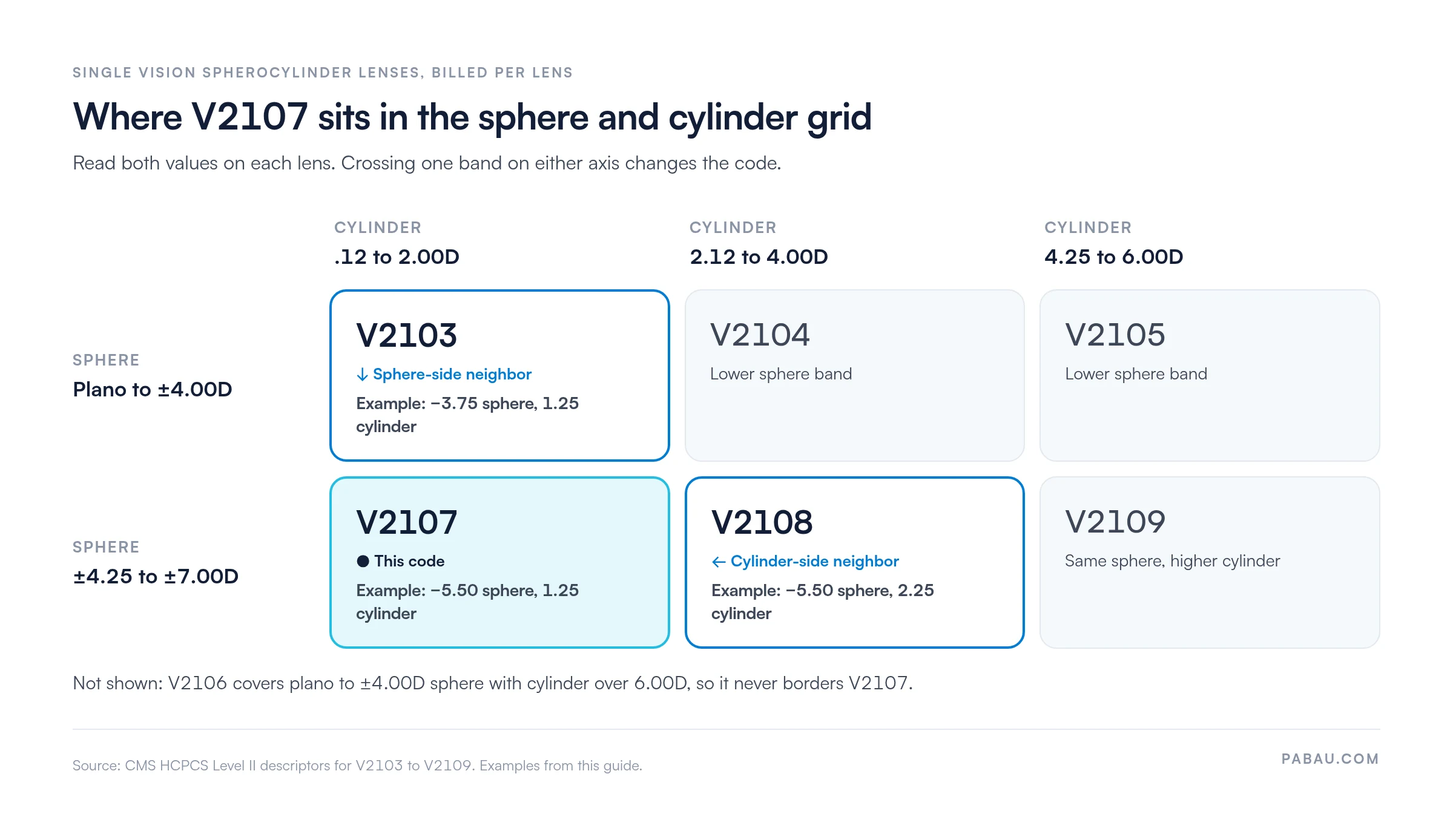
V2107 and V2108 share the same sphere range of plus or minus 4.25 to 7.00D. Only the cylinder separates them: .12 to 2.00D is V2107, and 2.12 to 4.00D is V2108. A lens of plus 5.00 sphere with 2.25 cylinder is V2108, not V2107.
This boundary matters most when a prescription is updated. A patient whose astigmatism climbs past 2.00D moves from V2107 to V2108, even though the sphere has not changed.
V2103 and V2107 share the same cylinder range of .12 to 2.00D. Only the sphere separates them: plano to plus or minus 4.00D is V2103, and plus or minus 4.25 to 7.00D is V2107. A lens of minus 4.00 sphere with 1.50 cylinder is V2103.
Code each lens on its own values. A patient can need V2107 for one eye and V2103 or V2108 for the other, so never copy one lens code to both claim lines.
HCPCS Code V2107 may be billed by providers and suppliers who are enrolled with the relevant payer as optical suppliers or dispensing practitioners. A claim becomes billable once a qualifying lens is dispensed to the patient.
The prescription on file must show sphere and cylinder values that fall within V2107’s diopter ranges. The lens must already be dispensed to the patient. V2107 is a supply code, not a service code. Billing it before the patient receives the lens is a claim for services not yet rendered.
Medicare Part B does not cover routine eyeglasses or contact lenses. The exception sits in Section 1861(s)(8) of the Social Security Act. It covers one pair of eyeglasses or contact lenses after cataract surgery with an intraocular lens. V2107 may be covered under this exception when the post-cataract prescription maps to its diopter range.
Outside this exception, a V2107 claim submitted to Medicare for routine vision correction will be denied as a non-covered benefit. Using claims management software that distinguishes post-cataract from routine visits at the point of billing prevents these avoidable non-covered denials.
Reimbursement rates for V2107 are set through the Medicare DMEPOS fee schedule, not the Physician Fee Schedule. The allowable amount varies by DMEPOS fee schedule year and geographic area.
Check the CMS DMEPOS fee schedule to confirm the current allowable for V2107 in the practice’s jurisdiction. Never quote a fee schedule figure without checking the applicable year.
V2107 is billed one unit per lens, so a complete pair takes two claim lines. Laterality modifiers are the ones that matter on every V2107 claim.
V2107 itself does not take the KX modifier. Under CMS Policy Article A52499 (Refractive Lenses), KX, GA, GY and GZ belong on deluxe lens-feature add-on codes.
Those include tints (V2744, V2745), anti-reflective coating (V2750), oversize lenses (V2780) and polycarbonate or Trivex (V2784). Confirm any local laterality rules with your Medicare Administrative Contractor (MAC).
A V2107 claim must be supported by records that confirm both the prescription parameters and the lens that was dispensed. Keeping HIPAA-compliant records at every stage of the dispensing workflow protects the practice in a payer audit.
V2107 denial patterns cluster around four root causes. For the remittance advice reason codes behind each one, see our guide to denial codes in medical billing.
Medicare’s post-cataract exception is one of the few standardized coverage pathways for V2107. Commercial payers vary significantly, and many exclude routine optical hardware entirely from covered benefits unless the plan includes a vision rider.
Build a payer eligibility check into the dispensing workflow before fabricating any lens in the V2107 diopter range. A real-time eligibility query surfaces the patient’s optical benefit status, prior authorization requirements, and plan year limits before the lens is ordered. A lens ordered without that check can leave the practice holding the cost after a denial.
Picking a V21xx code usually means reading the prescription and scanning a lookup table. That works until a cylinder of 2.25 lands on V2107 instead of V2108. Pabau, the practice management platform we build, keeps the patient record, insurer details and claim in one system. Fewer of those slips reach the payer.
For optometry and ophthalmology practices, that means fewer resubmissions and more lens claims paid on the first pass.

Pabau scrubs each claim for missing or invalid details and verifies eligibility before the visit. Optometry and ophthalmology practices fix lens claim errors before submission.

V2107 is a narrow code, and that is the point. A quarter-diopter change in sphere or cylinder moves the lens to V2103 or V2108, and the payer will not fix it for you.
Code each lens from its own prescription values and bill it on its own line with LT or RT. Confirm coverage before the lens is ordered. Practices that build those checks into the dispensing workflow stop fighting the same denials every month.
Book a demo to see how Pabau helps your practice get optical supply claims right the first time.

Billing a lens with 4.25 to 6.00D cylinder? HCPCS code V2109 covers the highest cylinder band in the V2107 sphere range.
HCPCS Code V2107 is a supply code for a spherocylinder, single vision lens. It covers sphere power of plus or minus 4.25 to 7.00 diopters with cylinder power of .12 to 2.00 diopters. Enrolled optical suppliers and dispensing practices bill it per lens once the lens is delivered to the patient.
V2107 and V2108 share the same sphere range of plus or minus 4.25 to 7.00 diopters. They differ only on cylinder. V2107 covers .12 to 2.00 diopters, and V2108 covers 2.12 to 4.00 diopters. On the sphere side, V2103 covers the same cylinder range with sphere from plano to plus or minus 4.00 diopters.
Yes, but only in limited circumstances. Under Section 1861(s)(8) of the Social Security Act, Medicare Part B covers one pair of eyeglasses or contact lenses after cataract surgery. The surgery must include an intraocular lens. V2107 is covered when the post-cataract prescription maps to its diopter range. Routine vision correction is not a covered Medicare Part B benefit, and a V2107 claim filed without a qualifying post-cataract event will be denied.
Laterality modifiers LT (left) and RT (right) are required, with each lens on its own claim line. The NU modifier is required under Medicare DMEPOS when billing for a new lens. V2107 itself does not take KX. Under CMS Policy Article A52499, KX, GA, GY and GZ go on deluxe add-on codes such as tints, anti-reflective coating, oversize and polycarbonate lenses. Confirm payer-specific variations with your MAC.
The four most common triggers are boundary errors, missing modifiers, non-covered Medicare claims and bilateral billing. A boundary error means filing V2108 or V2103 for a lens that maps to V2107. The others are omitting LT or RT, billing routine eyewear to Medicare without a post-cataract event, and putting both lenses on one claim line.
Reimbursement for V2107 is set through the Medicare DMEPOS fee schedule and varies by geographic area and benefit year. There is no single national rate. Use the AAPC HCPCS lookup or the CMS fee schedule search to confirm the current allowable for your jurisdiction. Always verify the applicable year’s fee schedule before quoting a reimbursement rate, as amounts change annually.