CCSD code F0420: Lip reconstruction using a skin flap
CCSD code F0420: definition, descriptor and procedure scope CCSD code F0420 is d...

Last Updated: Oct 16, 2026
HCPCS code V2106 bills one spherocylinder single vision lens for a patient with high astigmatism. The prescription decides it: a sphere from plano to plus or minus 4.00 D, and a cylinder over 6.00 diopters. If either power falls outside those limits, a neighboring code applies, usually V2105 or V2110.
Getting the band right matters because each lens is billed on its own line, and one band off sends the claim back. Traditional Medicare also pays only after cataract surgery with an intraocular lens. This guide covers the code ranges, coverage rules, documentation, a worked example and a checklist to run before you submit.
Let Pabau's smart automation suggest the right codes, reduce claim denials, and keep your practice compliant—effortlessly.
Automate repetitive tasks and focus on what matters most—your patients.
Reduce coding errors and ensure compliance with the latest regulations.
Clean claims, fewer denials, and faster reimbursements.
Powerful insights and reporting to help your practice thrive.
HIPAA compliant SOC 2 certified GDPR-compliant Trusted by 4,000+ clinics worldwide

V2106 bills one spherocylinder single vision lens with sphere from plano to +/-4.00 D and cylinder over 6.00 D.
A cylinder of exactly 6.00 D stays on V2105, and a sphere of +/-4.25 D or more moves the lens to V2110.
Traditional Medicare pays only after each cataract surgery with an intraocular lens, with Z96.1 on the claim.
Bill each lens on its own line with the RT or LT modifier and one unit of service.
Frames, tints, coatings and polycarbonate material go on separate lines under their own codes.
HCPCS code V2106 is defined by CMS as “Spherocylinder, single vision, plano to plus or minus 4.00d sphere, over 6.00d cylinder, per lens.” It belongs to the V2100-V2199 single vision lens range of the CMS HCPCS Level II code set.
A spherocylinder lens corrects astigmatism along with nearsightedness or farsightedness. Its prescription carries two powers in diopters (D), a sphere value and a cylinder value. V2106 applies only when both values fit its ranges at once.
Cylinder power over 6.00 D is a high degree of astigmatism. You’ll see it most often with corneal conditions such as keratoconus, or after a corneal transplant.
Source: CMS HCPCS Level II long descriptor for V2106.
V2106 covers one finished single vision spectacle lens whose sphere and cylinder powers both fall inside the descriptor. The frame and most lens add-ons are billed on separate lines under their own codes.
Covered under V2106:
Not covered under this code:
Picking the code takes two checks. The cylinder must be over 6.00 D, and the sphere must stay within plano to plus or minus 4.00 diopters. Change either value and the code changes, as the grid below shows.
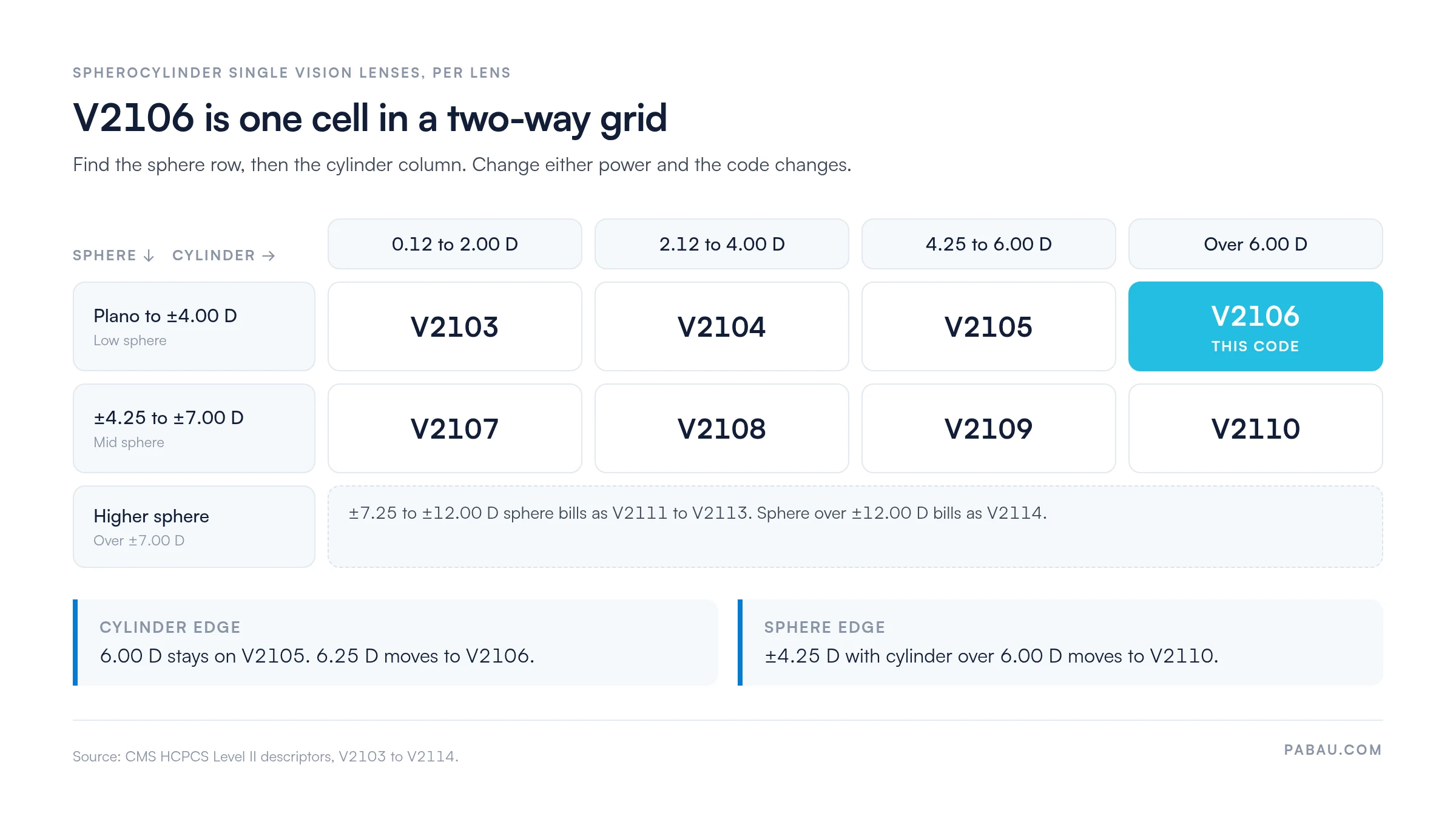
Two neighbors cause most mix-ups. V2105 covers cylinder from 4.25 to 6.00 D, so a 6.00 D cylinder stays on V2105. Any cylinder above 6.00 D, such as 6.25 D, moves to V2106.
V2110 keeps the over-6.00 D cylinder band but needs a sphere of plus or minus 4.25 to 7.00 D. Higher spheres move again. V2111 to V2113 cover plus or minus 7.25 to 12.00 D, and V2114 covers sphere over plus or minus 12.00 D.
Keep the full series handy for any prescription that sits near a band edge.
Source: CMS HCPCS Level II descriptors, as published in the NLM Clinical Tables HCPCS dataset.
Each eye is coded on its own, and the two often land on different codes. Take a patient fitted with an intraocular lens (IOL) after cataract surgery, with this signed prescription:
The right lens has a low sphere and a cylinder over 6.00 D, so it bills as V2106 with RT. The left cylinder is 5.75 D. That sits in the 4.25 to 6.00 D band, so the left lens bills as V2105 with LT.
Both lines carry one unit, the same date of service and Z96.1 as the covered diagnosis. Two codes on one pair of glasses is normal, and payers expect it when the prescription supports it.
Traditional Medicare does not cover routine eyeglasses. The exclusion comes from Social Security Act Section 1862(a)(7).
The exception is the prosthetic device benefit after cataract surgery. Medicare covers one pair of eyeglasses or contact lenses after each cataract surgery with insertion of an IOL.
Lens claims go to the DME MAC under the Refractive Lenses LCD (L33793) and its Refractive Lenses policy article (A52499). The covered diagnoses are pseudophakia (Z96.1), aphakia (H27.0-) and congenital aphakia (Q12.3). Lenses billed with any other diagnosis are denied as noncovered.
In practice, Z96.1 is the diagnosis that fits V2106. An aphakic eye usually needs high plus sphere power, which falls outside V2106’s sphere limit.
Medicare Advantage, Medicaid and commercial plans set their own prior authorization rules. Run insurance eligibility verification before you order the lenses. That way any authorization number is on file at dispensing.
A V2106 claim needs records that prove the lens matches the code and the benefit. The prescription is the anchor, because it shows both powers that decide the code.
DMEPOS suppliers must keep proof of delivery for seven years. Keep the prescription and order records for at least as long, since an audit can ask for any of them.
Every V2106 claim needs a diagnosis that explains why the patient needs a high-cylinder lens. Astigmatism codes carry most of that weight, with a refractive or post-surgical code alongside where it applies.
For traditional Medicare, Z96.1 must be on the claim, because refractive codes alone are denied as noncovered. Use laterality codes, such as H52.221 for the right eye, when the record supports them. Confirm each full descriptor in the ICD-10-CM code library before you pick one.
Most V2106 denials trace back to a short list of errors, and you can catch each one before submission. That is where good denial management starts.
On the 835 remittance, CARC 16 points to missing information or a billing error. CARC 96 marks a noncovered charge.
Medicare pays V2106 from the DMEPOS fee schedule, not the Physician Fee Schedule. Allowed amounts are set by state and updated quarterly. Pull the current file for your state before quoting a patient.
State Medicaid programs publish their own vision fee schedules. Commercial and vision plans set lens allowances by contract. For code-level references, use the AAPC single vision lens code range or the NLM HCPCS API.
Check the DMEPOS fee file at each quarterly update rather than once a year. A rate sheet saved in January can change mid-year, which skews the patient’s out-of-pocket estimate.
A lens claim follows the same path every time. Each step below is a point where a V2106 line can fail if the check is skipped. If you’re newer to the wider cycle, our guide on how medical billing works covers the basics.
Run this list against every lens line before it leaves the practice. Each item maps to one of the denials above.
Most V2106 errors start when the prescription doesn’t reach the claim intact. Staff retype powers by hand, miss a modifier, or submit before the diagnosis is attached.
Pabau, the practice management platform we build, includes pre-filled claims management. Each claim starts from the patient record, with the service code and recorded diagnoses already in place. Built-in HCPCS and ICD-10-CM lookups let staff search codes without leaving the claim.
Required fields, such as authorization numbers, must be complete before the claim can go out. In the US, Pabau submits through Claim.MD, with eligibility checks, claim-status tracking and electronic remittance posting. More lens lines go out as a clean claim on the first attempt.
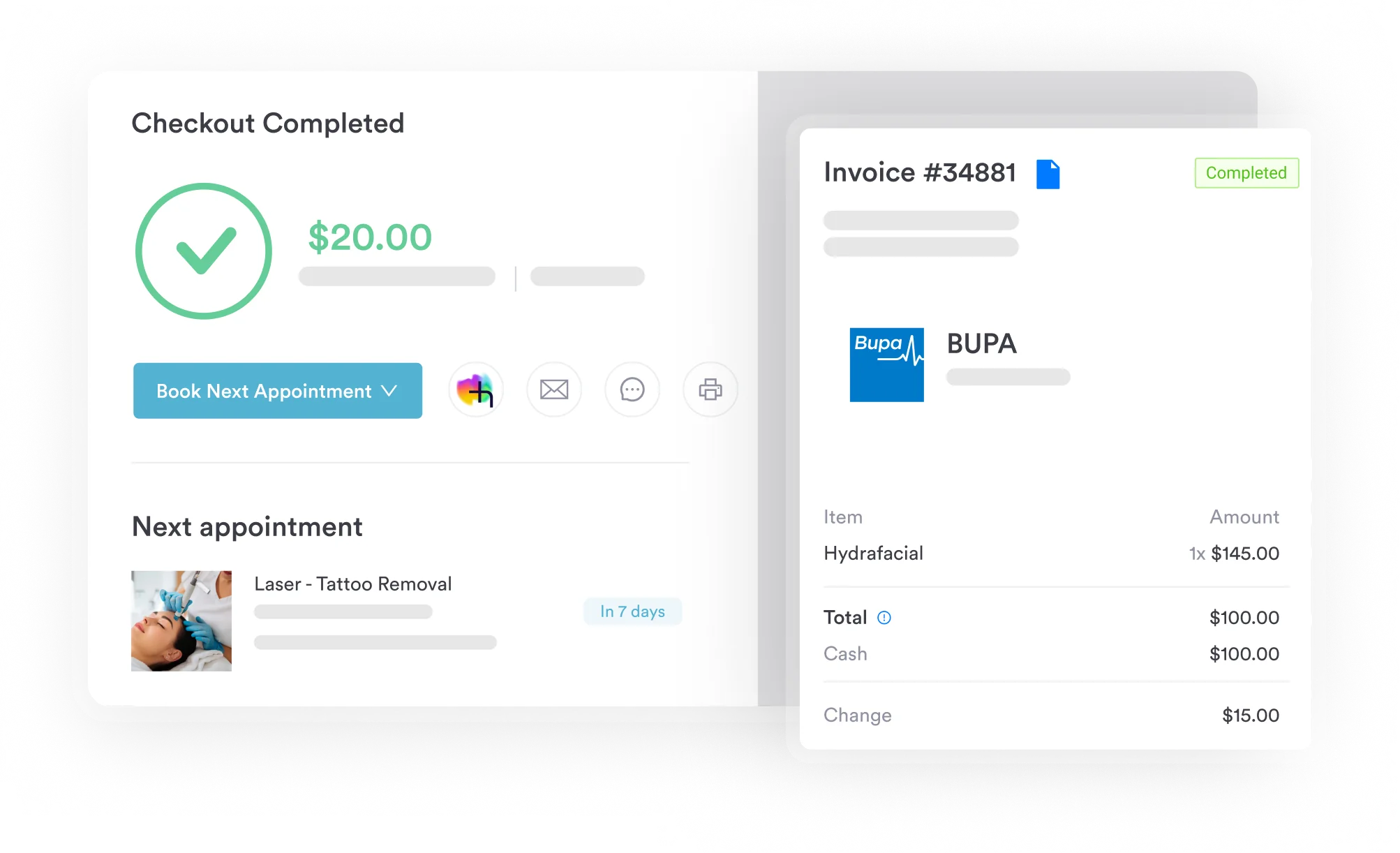

Pabau pre-fills claims from the patient record, checks required fields before submission, and tracks each lens claim through to payment.

V2106 is decided on the prescription, long before anyone opens the claim form. Read both powers for each eye before the lens is ordered, and the code follows. A 6.00 D cylinder or a 4.25 D sphere is where the slips happen, so slow down at those edges.
Coverage deserves the same early check. Traditional Medicare pays only after cataract surgery with an IOL, so other patients need a plan with an eyewear benefit. Settle that at dispensing, and you won’t meet the denial weeks later on the remittance.
Slowed down by retyped powers and missing modifiers? Book a demo to see how Pabau pre-fills each lens line and tracks it to payment.

Need to understand HCPCS billing denials in more depth? Denial codes in medical billing explains the most common CARC codes and how to respond to each one.
Want claims that hold up under review? Medical billing compliance covers the documentation and coding standards payers check in an audit.
Wondering what happens after you submit? Medical claims clearinghouse explains how clearinghouses validate HCPCS codes and route claims to the right payer.
Billing a lens with lower cylinder? HCPCS code V2103 covers spherocylinder lenses with 0.12 to 2.00 D cylinder at the same sphere range.
Working with a very high sphere? HCPCS code V2114 covers spherocylinder single vision lenses with sphere over plus or minus 12.00 D.
No. V2106 covers single vision lenses only. Progressive lenses bill as V2781, and Medicare’s refractive lens policy denies V2781 as noncovered. Commercial and vision plans may set their own progressive allowance.
Only in a narrow case. Bill the material as V2784 on its own line. Medicare covers it when the patient has functional vision in only one eye, and then for both lenses.
Contact lenses have their own HCPCS range, V2500 to V2599. Medicare covers one pair of eyeglasses or contact lenses after each cataract surgery with an IOL, so never bill V2106 for contacts.
Both codes cover cylinder over 6.00 diopters. V2106 applies when the sphere is plano to plus or minus 4.00 diopters. V2110 applies when the sphere is plus or minus 4.25 to 7.00 D.
One. V2106 is a per-lens code, so each lens gets its own line with one unit and an RT or LT modifier. Two lenses on one line are rejected for incorrect coding.