

CCSD code G5100: Bypass of duodenum billing guide
CCSD code G5100 bills a bypass that leaves the duodenum in place CCSD code G5100...

Last Updated: Oct 16, 2026
V2108 is the HCPCS Level II code for one spherocylinder single vision lens with a +/-4.25D to +/-7.00D sphere and a +/-2.12D to +/-4.00D cylinder. It is billed per lens.
It sits between V2107 and V2109, which share its sphere range. Only the cylinder power separates the three, so the prescription's cylinder value decides the code. Medicare Part B does not cover routine eyeglasses. Most V2108 claims therefore go to Medicaid or commercial vision plans, each with its own prior authorization and documentation rules.
Let Pabau's smart automation suggest the right codes, reduce claim denials, and keep your practice compliant—effortlessly.
Automate repetitive tasks and focus on what matters most—your patients.
Reduce coding errors and ensure compliance with the latest regulations.
Clean claims, fewer denials, and faster reimbursements.
Powerful insights and reporting to help your practice thrive.
HIPAA compliant SOC 2 certified GDPR-compliant Trusted by 4,000+ clinics worldwide

V2108 covers a spherocylinder single vision lens: Sphere +/-4.25D to +/-7.00D, cylinder +/-2.12D to +/-4.00D, billed as one unit per lens.
Medicare Part B excludes routine eyeglasses. V2108 may be covered after cataract surgery when an IOL cannot fully correct vision.
Neighboring codes V2107 and V2109 share the same sphere range (+/-4.25D to +/-7.00D) and differ in cylinder power. Check both values before submission.
Practice management software like Pabau runs validation checks before a V2108 claim is submitted, then tracks it through to payment.
HCPCS code V2108 describes a spherocylinder, single vision lens whose power falls within a specific two-dimensional range. The sphere component runs from plus or minus 4.25 diopters to plus or minus 7.00 diopters. The cylinder component runs from plus or minus 2.12 diopters to plus or minus 4.00 diopters. Both conditions must be met simultaneously for the code to apply.
The “per lens” billing unit means a pair of glasses generates two claim lines, one for each lens. Submitting two units on a single line is a common error that triggers a medical-necessity or quantity edit at many payers.
The spherocylinder designation means the lens corrects both spherical refractive error (nearsightedness or farsightedness) and astigmatism simultaneously. A sphere-only lens bills under V2100-V2102 instead, even at the same sphere power.
The V2100-V2199 range covers all HCPCS single vision spectacle lens codes, organized by ascending sphere and cylinder power. V2108 occupies the mid-to-high sphere tier within the spherocylinder sub-group. Selecting the correct code requires checking both axes against the patient’s prescription before submission.
V2107, V2108, and V2109 share the same sphere range, so only the cylinder power separates them. A cylinder of 2.12D falls in V2108, not V2107. Coders should verify the written prescription rather than relying on a verbal report from the dispensing optician.
Spherocylinder lenses with a sphere of plano to +/-4.00D use V2103-V2106 instead. V2110 keeps this sphere range but covers cylinder over 6.00D, and sphere powers from +/-7.25D move to V2111 and above. Within the plano to +/-4.00D band, a cylinder of 4.25 to 6.00D uses V2105.
The AAPC HCPCS code lookup provides a searchable reference for the full single vision family with descriptor text for each code.
The V2100-V2199 codes all describe spectacle lenses. A spectacle-mounted low vision aid is a different device, prescribed where lenses cannot correct the vision loss, and it is billed under V2610. That code sits in the V2600-V2615 low vision aid family.
V2108 covers a finished or uncut single vision spectacle lens that simultaneously corrects spherical and astigmatic refractive error within the defined power windows. The lens may be glass or plastic and may carry anti-reflective or scratch-resistant coatings, though most payers reimburse only the basic lens, not premium add-ons.
Within scope:
Outside scope:
Ophthalmic dispensing practices should map each prescription lens to both axes before selecting the code. A cylinder of 2.00D selects V2107, while 2.12D selects V2108. Payers that apply strict descriptor matching can deny a lens billed on the wrong side of that line.
Billing V2108 correctly requires the right unit count, the right modifier when applicable, and documentation that justifies the prescription. Errors in any of these three elements are the primary reasons V2108 claims are returned or denied. Practices using dedicated claims management software can build unit-quantity and modifier checks into the workflow before submission.
Submit one unit of V2108 per lens. A patient receiving both lenses in a pair generates two lines: V2108 x1 for the right lens and V2108 x1 for the left lens. Each line carries the matching RT or LT eye modifier, and payers differ on the exact format. Never bill V2108 x2 on a single claim line, as payers flag this as a unit-quantity error.
Common modifiers applied with V2108 include RT (right eye) and LT (left eye) to identify which lens the claim line represents. Some payers also require modifier NU (new equipment) when dispensing a new pair rather than a replacement. Check the payer’s specific modifier requirements, as applying an unrequired modifier can cause a claim to reject on a technical edit.
A clean claim submission for V2108 relies on documentation that ties the dispensed lens directly to an authorizing prescription. The encounter record for an ophthalmic dispensing visit should capture all of the following before the claim is generated:
Some payers require the dispensing record to be retained for up to seven years. Practices should confirm their local coverage determination (LCD) requirements and add ophthalmic documentation standards to their compliance checklist.
Medicare Part B generally does not cover routine eyeglasses or contact lenses. This exclusion applies to most V2108 claims billed to Medicare, because standard spectacle dispensing following a refractive examination is classified as a routine vision service.
One narrow exception exists. Medicare covers one pair of spectacles or contact lenses after cataract surgery with an intraocular lens (IOL) implant. It applies when residual refractive error needs correction that the IOL cannot provide. In these cases, V2108 may be covered if the dispensed lens meets the descriptor criteria. The CMS HCPCS Level II overview outlines the general Medicare V-code coverage framework.
Practices billing V2108 to Medicare in the post-cataract context should follow these steps:
Outside the post-cataract exception, a Medicare beneficiary who wants spectacles pays out of pocket. Some beneficiaries have supplemental vision coverage through Medicare Advantage plans, which vary widely in their benefit design for ophthalmic lenses.
State Medicaid programs vary significantly in their vision benefits. Some states cover medically necessary spectacle lenses for adults and children; others limit coverage to children under 21 or to patients with diagnosed ocular conditions. Billing staff should never assume a Medicaid patient has eyeglass coverage without first running insurance eligibility verification against the specific state plan.
Common Medicaid coverage patterns for V2108:
Commercial vision plans (VSP, EyeMed, Davis Vision, UnitedHealthcare Vision) generally cover spectacle lenses on an annual or biennial benefit cycle. Most cover one pair of lenses per benefit period. V2108 is a standard code these plans recognize, but allowable amounts and patient cost-sharing vary. Always verify the specific plan’s fee schedule and coverage limits before telling a patient what their out-of-pocket cost will be.
Before dispensing high-power spherocylinder lenses, run the patient’s insurance through your eligibility system. Confirm the covered benefit period and whether the cylinder power triggers a prior authorization requirement. A 10-minute pre-authorization check prevents a far more time-consuming appeals process after the fact.
V2108 reimbursement rates are set through the CMS DMEPOS (Durable Medical Equipment, Prosthetics, Orthotics, and Supplies) fee schedule rather than the Physician Fee Schedule. For current allowed amounts, consult the CMS DMEPOS fee schedule directly. Rates vary by MAC jurisdiction and are updated annually.
General fee schedule context for V2108 in 2026:
Because V2108 covers a relatively high-power lens, reimbursement rates tend to be modestly higher than lower-power codes in the same family. However, practices should not rely on publicly aggregated third-party rate estimates for billing decisions. Contracted rates with commercial vision plans are negotiated separately and may differ substantially from the Medicare floor.
Most V2108 denials fall into four categories: Wrong code selection, missing or inadequate documentation, unit-quantity errors, and non-covered benefit. Each is preventable with the right pre-submission checks. Denial prevention starts at the dispensing desk, before the claim ever reaches the clearinghouse.
Knowing the common denial codes tells billing teams whether a V2108 denial is a technical edit or a coverage determination. A technical edit is fixable on resubmission, while a coverage denial needs an appeal or a conversation with the patient. Validating every claim against a pre-submission checklist cuts that rework cycle significantly.
V2107, V2108, and V2109 share the same sphere range but differ only in cylinder power. A sphere of +/-7.25D or stronger leaves the tier and bills under V2111 or above. Keep the 2.12 to 4.00D cylinder but drop the sphere below +/-4.25D, and the lens bills as V2104.
Many miscoding errors come from misreading the cylinder value. Others come from transposing the prescription between plus-cylinder and minus-cylinder form without recalculating the sphere.
Before selecting between these three codes, convert the prescription to a consistent cylinder notation. Either plus-cylinder or minus-cylinder form works, as long as the code matches the resulting sphere and cylinder values. The PGM Billing HCPCS lookup tool offers a free, searchable reference for the full V2100-V2199 descriptor list.
There is a gap between 2.00D and 2.12D: The HCPCS code set does not cover that .12D interval. In practice, optical prescriptions are written to the nearest 0.25D step, so a cylinder of 2.00D selects V2107 and a cylinder of 2.25D selects V2108. The theoretical 2.12D minimum is a mathematical boundary rather than a prescription value you will typically encounter. The bands below show where each code in this sphere tier starts and stops.
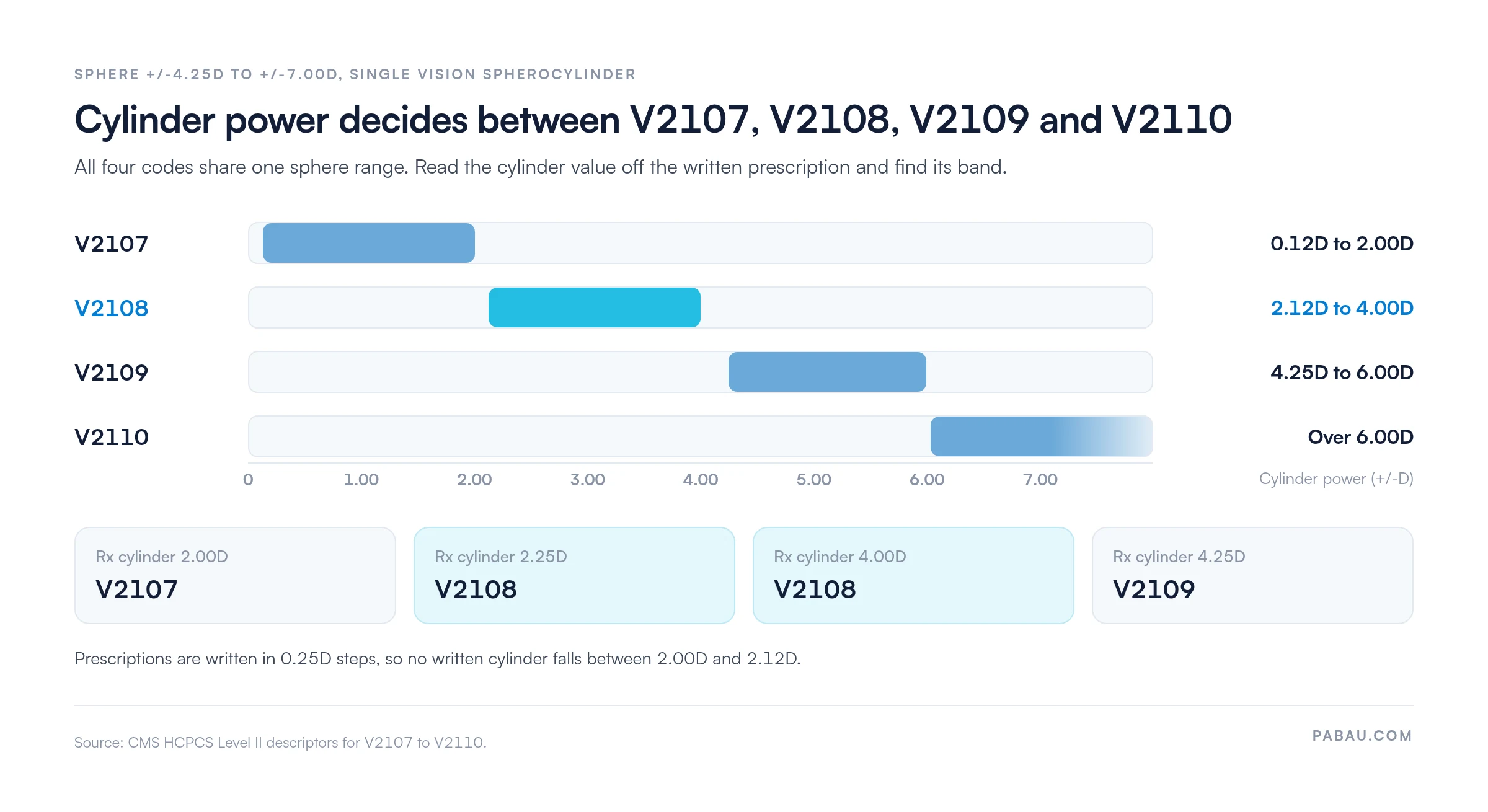
Print the V2107/V2108/V2109 cylinder boundary chart and post it at the dispensing desk. Coders who can see the ranges at a glance make fewer boundary errors than those who look up each code individually during a busy day.
Many optical practices still key a lens prescription into one system and the claim into another. That second round of typing is where a 2.25D cylinder gets billed as V2107, or both lenses land on one claim line.
Pabau keeps the prescription, the dispensing notes and the claim in the same patient record. Its claims management runs validation checks in the background, so a claim missing a membership number or authorization code is held back before submission.
In the US, Pabau connects to the Claim.MD clearinghouse for real-time eligibility checks and electronic remittance posting. Every claim’s status sits on one dashboard, so your billing team spots a rejected V2108 line the day it comes back.

Pabau keeps the optical prescription and the lens claim in one patient record, then checks each claim for missing details before it goes out. See how it works for your eye care practice in a live demo.

Code V2108 from the written prescription, never from memory or a verbal report. Confirm the sphere sits between 4.25D and 7.00D, place the cylinder in its band, and bill one line per lens with RT or LT.
That check takes a minute at the dispensing desk. Skipping it costs a denial, a resubmission and a patient waiting on their glasses. Plan for Medicare separately, because outside post-cataract care the patient pays, and they should hear that before the lenses are ordered.
To see how it fits an eye care or dispensing practice, book a demo.

Need a complete guide to the billing claims process? What is medical billing explains the full cycle from encounter documentation through payment posting.
Want to reduce claim rejections across all code types? Clean claim submission covers the pre-submission checks that prevent the most common denial triggers.
Looking for guidance on handling denied ophthalmic claims? Denial codes in medical billing maps the most frequent CARC codes and the corrective actions for each.
Want to stop denials before they start? Denial management in healthcare sets out a workflow for tracking, appealing and preventing rejected claims.
Checking your billing against the rules? Medical billing compliance covers the documentation and audit habits payers expect.
HCPCS code V2108 covers one spherocylinder single vision spectacle lens, billed per lens. Its sphere power runs from +/-4.25D to +/-7.00D, and its cylinder power from +/-2.12D to +/-4.00D. It covers the lens only, not the frame, and applies to single vision lenses specifically, not bifocal or multifocal designs.
Medicare Part B does not cover routine eyeglasses, so V2108 claims are generally not covered under standard Medicare. The exception follows cataract surgery with an implanted intraocular lens. Medicare then covers one pair of spectacles for residual refractive error, provided the lens meets the V2108 descriptor and the post-surgical refraction is documented.
All three codes share the same sphere range (+/-4.25D to +/-7.00D) and differ only in cylinder power. V2107 covers cylinders up to +/-2.00D; V2108 covers cylinders from +/-2.12D to +/-4.00D; V2109 covers cylinders from +/-4.25D to +/-6.00D. Select the code by checking the cylinder value on the written optical prescription.
Medicaid coverage for V2108 depends on the state. Most states cover spectacle lenses for children under 21 through the EPSDT mandate. Adult coverage varies widely: Some states provide an annual eyeglass benefit, others do not cover adult vision at all. Always verify the patient’s specific state Medicaid plan before dispensing, and check whether the high cylinder power triggers a prior authorization requirement.
A V2108 claim needs a current signed optical prescription with sphere and cylinder values inside the code’s ranges. Add the prescribing provider’s name and NPI, the dispensing provider’s credentials, an itemized dispensing order, and proof of delivery where the payer requires it. For Medicare post-cataract claims, also include the surgery date, IOL documentation, and diagnosis code Z96.1.
The most common reason is a wrong code: V2107 or V2109 submitted because the cylinder was not checked against the written prescription. Billing two units on one claim line comes next. Claims also fail when sent to Medicare without post-cataract IOL documentation, or when they exceed the plan’s benefit frequency limit. A prior authorization denial occurs when a Medicaid plan requires PA for high-power lenses and it was not obtained before dispensing.
The 2026 DMEPOS allowable for V2108 varies by Medicare Administrative Contractor (MAC) jurisdiction and is updated annually. Commercial vision plan rates are negotiated separately and are typically higher than the Medicare floor. Check the CMS DMEPOS fee schedule lookup tool or your plan’s contracted fee schedule for the current applicable rate in your jurisdiction.



