

CCSD code G5100: Bypass of duodenum billing guide
CCSD code G5100 bills a bypass that leaves the duodenum in place CCSD code G5100...

Last Updated: Oct 16, 2026
V2109 is the HCPCS Level II code for one single vision spherocylinder spectacle lens, with a ±4.25D to ±7.00D sphere and 4.25D to 6.00D cylinder. It is billed per lens, with 1 unit for each lens.
V2107 and V2108 share its sphere range with less cylinder, and V2110 covers cylinder over 6.00D. Medicare excludes routine eyeglasses but covers V2109 lenses after cataract surgery with an intraocular lens, and for aphakia.
Let Pabau's smart automation suggest the right codes, reduce claim denials, and keep your practice compliant—effortlessly.
Automate repetitive tasks and focus on what matters most—your patients.
Reduce coding errors and ensure compliance with the latest regulations.
Clean claims, fewer denials, and faster reimbursements.
Powerful insights and reporting to help your practice thrive.
HIPAA compliant SOC 2 certified GDPR-compliant Trusted by 4,000+ clinics worldwide

V2109 bills one single vision spectacle lens with a ±4.25D to ±7.00D sphere and a 4.25D to 6.00D cylinder.
It is a per-lens code, so each lens is one unit on its own claim line with an RT or LT modifier.
The cylinder value separates V2109 from V2107, V2108 and V2110, which share its sphere range.
Medicare excludes routine eyeglasses but covers lenses after cataract surgery with an intraocular lens, and for aphakia.
V2109 is not a contact lens or bifocal code. Bifocal spectacle lenses sit in V2200-V2299, and contact lenses sit in V2500-V2599.
HCPCS code V2109 describes one spherocylinder single vision spectacle lens. Its official descriptor appears in the CMS HCPCS Level II file.
Spherocylinder, single vision, plus or minus 4.25 to plus or minus 7.00d sphere, 4.25 to 6.00d cylinder, per lens.
The short descriptor is Spherocylinder 4.25d/4.25-6d. Every part of the long descriptor narrows which lens the code fits.
V2109 has been in the HCPCS file since 1985. It covers the lens alone, so the frame bills separately under V2020 or V2025.
Among the HCPCS Level II codes, the V2100-V2199 range holds the single vision spectacle lens codes. Two prescription values place a lens in the range: the sphere power and the cylinder power. V2109 is the cell where a ±4.25D to ±7.00D sphere meets a 4.25D to 6.00D cylinder, as the grid below shows.
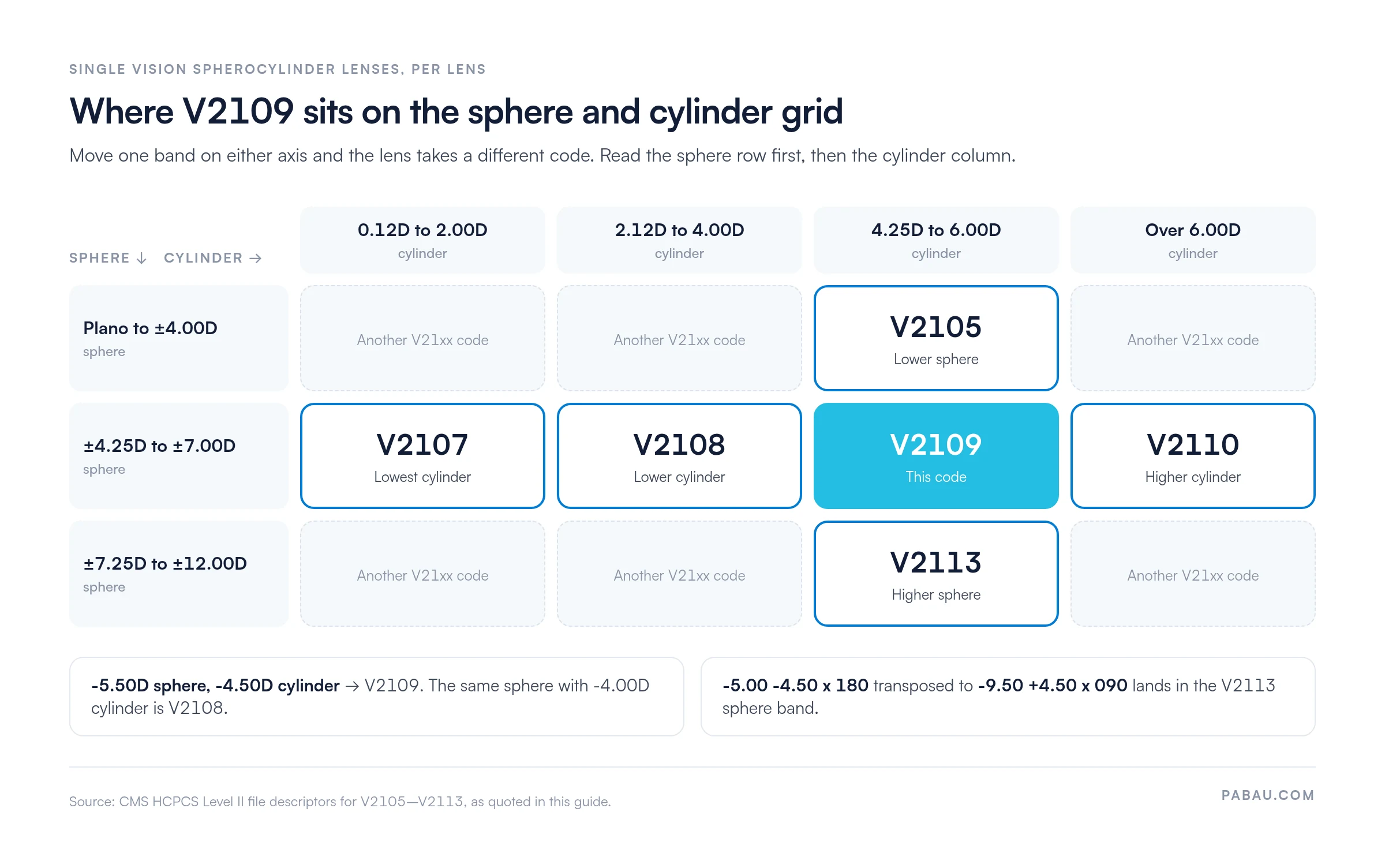
Read the sphere first, then the cylinder, and the code follows. A lens with a -5.50D sphere and -4.00D cylinder is V2108, while -5.50D with -4.50D cylinder is V2109.
Watch the cylinder form, though. Transposing a prescription between minus and plus cylinder changes the sphere value but leaves the cylinder unchanged. For example, -5.00 -4.50 x 180 transposes to -9.50 +4.50 x 090. Written the second way, the same lens falls in the V2113 sphere band.
Code from the prescription exactly as the lab order states it. If a lens sits near the ±4.00D or ±7.00D sphere boundary, check which cylinder form your payer expects before you assign V2109.
V2109 covers one finished single vision spectacle lens whose prescription falls inside both of its power bands. The lens material does not change the code. A reading segment does, so a bifocal with the same powers bills as V2209.
Bill 1 unit of V2109 for each lens. The Medicare refractive lenses policy article A52499 allows only one V21xx code per lens. A pair goes on two claim lines, one per eye, each with 1 unit.
Medicare does not cover routine eyeglasses, so V2109 is not payable for an ordinary refractive prescription. The exception is lenses that replace the vision of the natural lens of the eye.
The post-cataract benefit sits in the Medicare Benefit Policy Manual, chapter 15, section 120. Refractive lens claims go to the DME MAC for the patient’s region, under LCD L33793 and policy article A52499.
Timing matters with two surgeries. If the patient gets no glasses between the first and second cataract surgery, Medicare covers only one pair, after the second surgery.
Policy article A52499 lists the diagnoses that support Medicare coverage of refractive lenses. A routine refractive diagnosis alone does not open the benefit.
Refractive diagnoses such as astigmatism still belong in the record, because they explain the prescription. On a Medicare claim, though, coverage turns on one of the diagnoses above.
Outside Medicare, V2109 is usually a routine eyewear benefit. Coverage depends on the plan.
Medicare pays V2109 from the DMEPOS fee schedule, which sets an allowable amount by state. The CMS HCPCS file assigns it pricing indicator 38, the group for orthotics, prosthetics and vision items.
Look up the current allowable in the CMS DMEPOS fee schedule for your state. Medicaid programs and commercial plans publish their own rates, so check each payer’s fee schedule or contract.
Most V2109 denials trace back to the code band, the claim line setup, or the Medicare benefit. Denial management works best when these checks happen before the claim goes out.
A clean claim on the first pass depends on the prescription, the order and the delivery record agreeing with the code.
Optical billing often runs across separate tools. The refraction sits in one system, the invoice in another, and the claim somewhere else. When a payer asks why a lens was billed as V2109, staff have to piece the record back together.
Pabau, the practice management and EHR platform we build, keeps the patient record, clinical notes, forms and invoices in one place. Clinicians can log the refraction and the cataract surgery details in a note or form on that record. A biller then checks the code against one file, and an auditor sees the same file.
Once your team has coded the claim, Pabau’s claims management submits it through Claim.MD and tracks its status. Your billers can then follow each lens claim from submission to payment.

Pabau keeps patient records, notes, forms and invoices together, then submits and tracks your claims through Claim.MD.

V2109 rewards a simple habit: read the sphere and the cylinder before you pick the code. Most errors come from a lens that sits one band away, in V2108, V2110 or V2113. Others come from treating a spectacle lens as a contact lens.
The Medicare side is narrower than it looks. Routine glasses are excluded, so the benefit turns on cataract surgery or aphakia, one pair at a time. Book a demo to see how Pabau keeps the patient record, invoice and claim status together for every lens you bill.

Is the cylinder over 6.00D? HCPCS code V2110 covers the same sphere band with the highest cylinder.
Is the cylinder 2.12D to 4.00D? HCPCS code V2108 explains the band directly below V2109.
Is the sphere ±4.00D or lower? HCPCS code V2105 covers the same cylinder band with a lower sphere.
Need a broader foundation in billing workflows? Medical billing fundamentals covers the claim lifecycle from patient encounter to payment posting.
Struggling with claim rejections across your payer mix? Denial management in healthcare explains how to build denial prevention and appeals workflows.
HCPCS code V2109 describes one spherocylinder single vision spectacle lens. The sphere runs from plus or minus 4.25D to plus or minus 7.00D, and the cylinder from 4.25D to 6.00D. It covers the lens only, not the frame.
No. V2109 is a single vision spectacle lens code. Bifocal spectacle lenses bill under V2200-V2299, and V2209 has the same powers as V2109 in bifocal form. Contact lenses bill under V2500-V2599.
Bill 1 unit per lens. For a pair, use two claim lines, V2109 with RT and V2109 with LT, each with 1 unit. If the eyes fall in different power bands, each lens gets its own code.
Only in limited cases. Medicare excludes routine eyeglasses. It covers one pair of lenses after each cataract surgery with an intraocular lens, and lenses for aphakia or congenital aphakia. Claims go to the DME MAC under policy article A52499.
Both share the plus or minus 4.25D to 7.00D sphere band. V2108 covers a 2.12D to 4.00D cylinder, while V2109 covers 4.25D to 6.00D. The cylinder value on the prescription decides between them.
RT or LT is required on every V2109 line under the Medicare refractive lenses policy. The GY modifier marks routine eyeglasses that Medicare excludes by statute, when a denial is needed for a secondary payer.



