CPT Code 63075: Anterior cervical discectomy billing guide
CPT Code 63075: Official descriptor and what the procedure covers CPT Code 63075...

Last Updated: Nov 3, 2026
V2118 is the HCPCS Level II code for aniseikonic lens, single vision.
It describes a spectacle lens built to correct aniseikonia, a difference in image size between the two eyes, billed one unit per lens. Medicare treats V2118 as an add-on, billed beside the base single-vision lens code. Original Medicare covers it only for aphakia, congenital aphakia or pseudophakia.
Let Pabau's smart automation suggest the right codes, reduce claim denials, and keep your practice compliant—effortlessly.
Automate repetitive tasks and focus on what matters most—your patients.
Reduce coding errors and ensure compliance with the latest regulations.
Clean claims, fewer denials, and faster reimbursements.
Powerful insights and reporting to help your practice thrive.
HIPAA compliant SOC 2 certified GDPR-compliant Trusted by 4,000+ clinics worldwide

HCPCS Code V2118 describes an aniseikonic single-vision spectacle lens, which corrects a difference in image size between the two eyes.
Medicare’s DME MAC policy treats V2118 as a lens add-on, billed beside the base single-vision lens code for the same eye.
Bill one unit per lens with RT or LT, and put a bilateral pair on two separate claim lines.
Original Medicare pays only for aphakia, congenital aphakia or pseudophakia, so aniseikonia alone does not qualify.
V2118 has never been a contact lens code, since contact lenses take codes from the V2500-V2599 range.
HCPCS Code V2118 is the CMS HCPCS Level II code for an aniseikonic single-vision spectacle lens. The long descriptor reads “Aniseikonic lens, single vision,” and each unit is one lens.
The code sits in the V2100-V2199 single-vision lens range of the HCPCS Level II codes. It describes the lens design, so the sphere and cylinder powers on the prescription do not decide it.
On a Medicare claim, V2118 does not stand alone. The DME MAC policy article A52499 lists it among the add-on features of lenses. These are billed in addition to the code for the basic lens.
Aniseikonia is a difference in the size or shape of the image each eye perceives. Patients report eyestrain, headaches, double vision or poor depth perception. It often follows anisometropia, a large difference in prescription between the eyes.
Every spectacle lens magnifies or shrinks the image slightly as it corrects focus. An aniseikonic lens, also called an iseikonic or size lens, controls that effect. The lab adjusts factors such as base curve, center thickness and vertex distance until the two images match more closely.
These lenses are custom-made and uncommon. A typical case is a patient whose cataract surgery on one eye leaves the two eyes with unequal image sizes. V2118 applies when that patient wears a single-vision lens.
V2118 reports the aniseikonic design on one single-vision lens. The base lens, the frame and most lens options carry their own codes.
The single-vision range splits by lens type before power. Two codes in the middle of the range, V2116 and V2117, were deleted at the end of 2003. Any reference that still lists them is out of date.
V2218 and V2318 are the closest near misses, because they share the aniseikonic design. Read the segment count on the lab order first. A single-vision order means V2118.
Original Medicare covers V2118 only when the lens restores vision after the natural lens is missing. The DME MAC Refractive Lenses LCD (L33793) and its policy article set the rules. Refractive lenses fall under the prosthetic devices benefit, Social Security Act §1861(s)(8).
A V2118 lens for a patient with neither aphakia nor pseudophakia is outside the benefit. Claims go to the DME MAC, not the Part B MAC, and are priced from the DMEPOS fee schedule.
Medicare Advantage plans must offer the same post-cataract benefit, and many add a routine eyewear allowance. Medicaid vision benefits differ by state, and specialty lenses often need prior approval there.
Each V2118 claim needs a complete record before it goes out. Good records also hold up in the medical billing compliance checks payers run after payment.
The diagnosis on a V2118 claim should explain why the patient needs a size-correcting lens. On a Medicare claim it must also show a covered lens status.
Aniseikonia alone does not meet the Medicare criteria. Pair H52.32 with Z96.1, an aphakia code or Q12.3 where the record supports it.
A52499 requires RT or LT on every lens code in the policy, V2118 included. When the same code is billed for both eyes, each lens goes on its own line with one unit.
Never bill RTLT on one line with two units. Medicare rejects that line as incorrect coding. The KX, GA and GZ rules in A52499 apply to coatings, tints, oversized lenses and polycarbonate, not to V2118.
Build the claim from the lab order and the dispensing record. Two checks come first. The record must show a covered lens status, and the lab order must show how many segments the lens has.
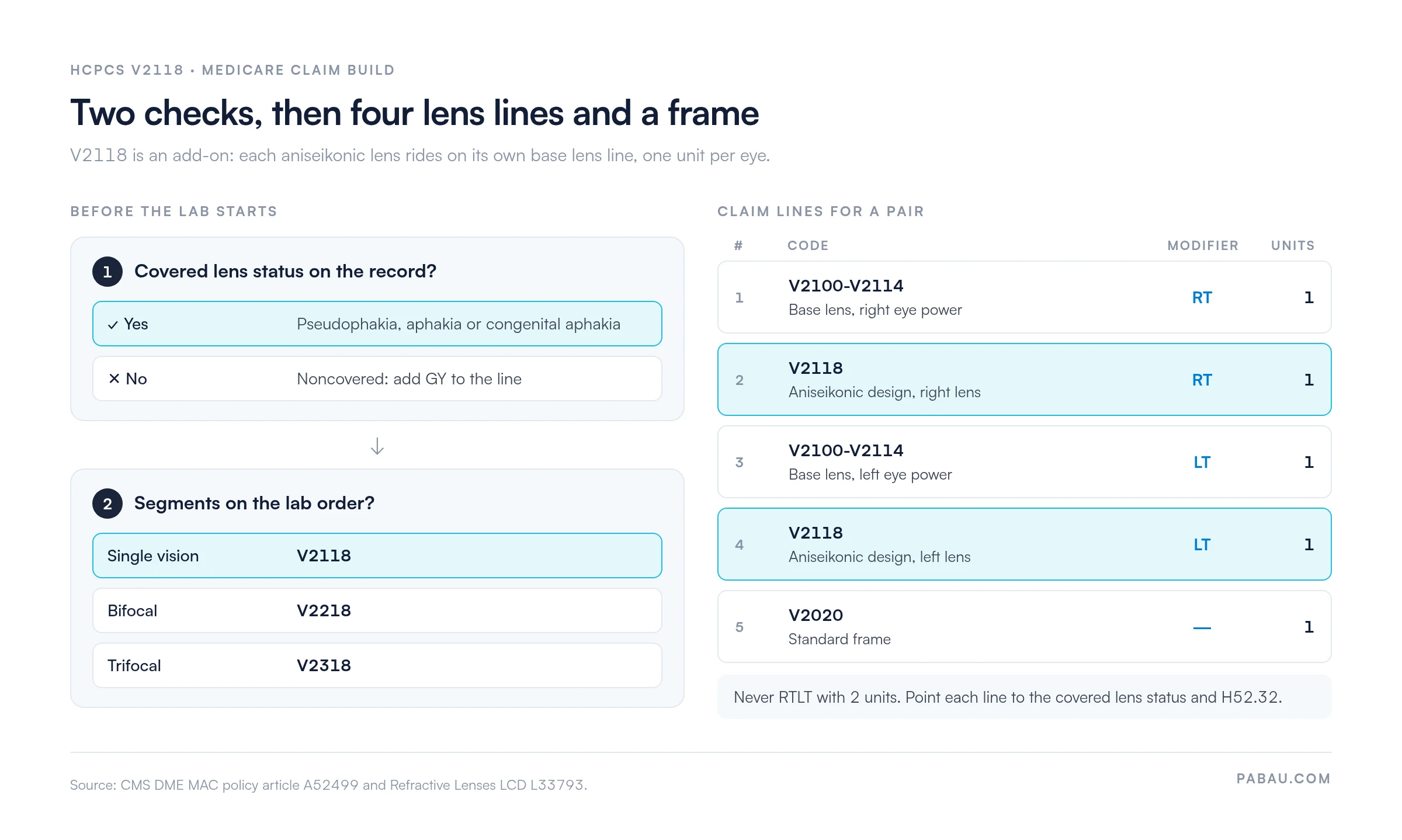
Once both checks pass, a Medicare claim for a pair of aniseikonic single-vision lenses in a standard frame looks like this.
Commercial, Medicaid and vision plans set their own rules for specialty lenses. Some may expect a different claim structure or prior approval, so check the plan before the lab starts work.
Most V2118 denials trace back to a short list of avoidable errors. Tracking them through denial management in healthcare shows which one costs your practice the most.
Each of these is cheaper to stop before submission than to appeal. A clean claim review covering the base lens line, laterality and the diagnosis link catches most of them.
Medicare pays V2118 from the CMS DMEPOS fee schedule, not the Physician Fee Schedule. Its pricing indicator, 38, places it with prosthetics and vision services, priced within floors and ceilings.
Allowed amounts vary by state and change each January, so check the current-year file before quoting a patient. Once the Part B deductible is met, the patient pays 20% coinsurance on the approved amount. Outside Medicare, the vision plan, Medicaid program or commercial payer sets its own allowance.
The facts that decide a V2118 claim sit in different places. The image-size finding is in the exam notes, the lens design is on the lab order, and the surgical history is in the chart.
Pabau, the practice management and billing platform we build, keeps the prescription, the exam notes and the claim on one patient record. The biller can confirm the order says aniseikonic and single vision before pairing V2118 with its base lens line.
Before a claim goes out, Pabau’s claims management software checks that details insurers need, such as member IDs and authorization codes, are in place. In the US, claims are sent through Claim.MD, with claim status tracked in one dashboard.
Fewer lens claims come back for a missing base line or modifier. Your team fixes the claim in the queue, which costs far less than working a denial.

Pabau keeps the prescription, lens order and claim on one patient record, and tracks every V-code claim from submission to payment.

Code V2118 from the lab order and the base lens from the prescription. The order has to read aniseikonic and single vision before V2118 goes on the claim.
Settle Medicare coverage before the lab starts work. The patient must be aphakic or pseudophakic, and a pseudophakic patient gets one pair per surgery. Where neither applies, add GY and agree the cost with the patient before the lens is made.
Book a demo to see how Pabau keeps lens orders and V-code claims on one record for your optometry practice.

Want to understand what makes a claim clean before it reaches the payer? Submitting a clean claim explains the field-level requirements that prevent automatic edits and rejections at the clearinghouse.
Coding the frame on the same claim? HCPCS Code V2020 explains the standard frame code that sits beside the lens lines.
HCPCS Code V2118 covers an aniseikonic single-vision spectacle lens, billed per lens. An aniseikonic lens corrects a difference in image size between the two eyes. It is not a contact lens code.
Not on a Medicare claim. DME MAC policy article A52499 lists V2118 as a lens add-on, billed in addition to the base lens code. Pair each V2118 line with a V2100-V2114 or V2199 line for the same eye.
Original Medicare covers V2118 only for aphakia, congenital aphakia or pseudophakia. A pseudophakic patient gets one pair of eyeglasses or contact lenses after each cataract surgery with an IOL. The rules are in LCD L33793.
No. V2117 described an aspheric lenticular single-vision lens and was deleted on December 31, 2003. V2119 is not a valid HCPCS code. Aniseikonic lenses with segments use V2218 for bifocals and V2318 for trifocals.
Every V2118 line needs RT or LT. Bill a bilateral pair on two lines with one unit each, never RTLT with two units. Add GY when the patient has no covered lens diagnosis.
H52.32 (aniseikonia) describes the condition the lens corrects, often with H52.31 (anisometropia). Medicare claims also need Z96.1, an H27.0x aphakia code or Q12.3.