HCPCS Code Q4185: Cellesta flowable amnion billing guide
HCPCS Code Q4185: definition and official descriptor HCPCS Code Q4185 is the Lev...

Last Updated: Nov 20, 2026
T2050 is the HCPCS Level II code for financial management, self-directed, waiver; per diem. A fiscal intermediary bills one unit for each day it runs payroll, taxes or budget tracking for a waiver participant who directs their own care.
Each state Medicaid agency sets the rate and billing rules, and Medicare does not pay T-codes. The same service billed per 15 minutes is T2040.
Let Pabau's smart automation suggest the right codes, reduce claim denials, and keep your practice compliant—effortlessly.
Automate repetitive tasks and focus on what matters most—your patients.
Reduce coding errors and ensure compliance with the latest regulations.
Clean claims, fewer denials, and faster reimbursements.
Powerful insights and reporting to help your practice thrive.
HIPAA compliant SOC 2 certified GDPR-compliant Trusted by 4,000+ clinics worldwide

HCPCS Code T2050 covers financial management for Medicaid waiver participants who direct their own care, billed per diem.
One unit equals one calendar day on which the fiscal intermediary performed financial management work for that participant.
Only enrolled fiscal intermediary organizations may bill T2050, never the individual care workers they pay.
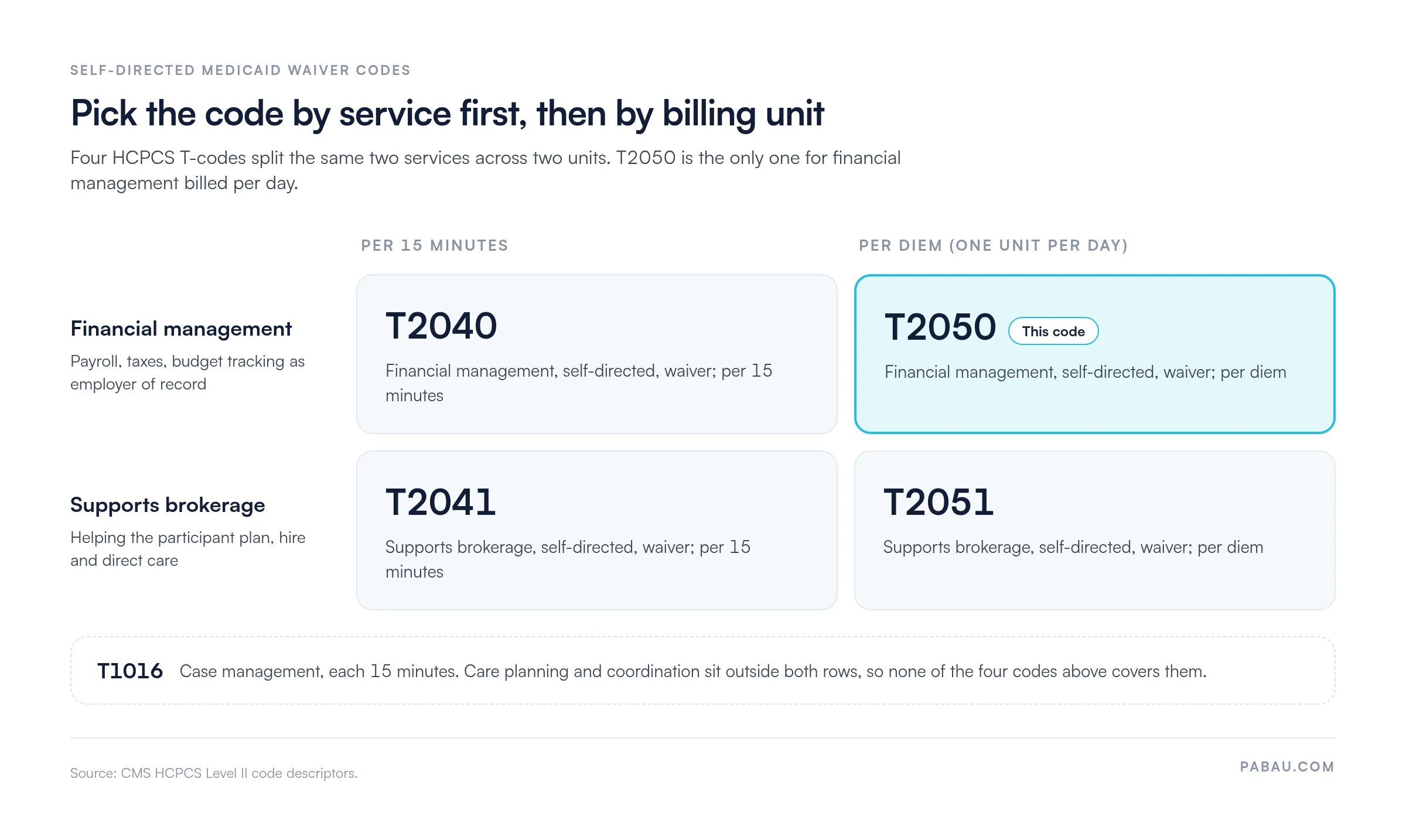
T2040 bills the same service per 15 minutes, while T2041 and T2051 cover supports brokerage.
Claims software such as Pabau tracks each case’s authorization code, dates and sessions and warns when one is missing.
HCPCS Code T2050 is the billing code for financial management, self-directed, waiver; per diem. It sits within HCPCS Level II, the code set kept by the Centers for Medicare & Medicaid Services (CMS) for items and services outside CPT. A fiscal intermediary bills one unit for each day it manages money for a waiver participant who directs their own care.
T-codes are national codes established for state Medicaid agencies. Medicare does not recognize or reimburse them. T2000-series codes include many self-directed waiver services, though the same block also holds unrelated services such as non-emergency transportation. Supplies sit in the same family too, such as T4530 for large pediatric disposable briefs.
T2050 covers the administrative and financial work that lets a Medicaid waiver participant direct their own care. The fiscal intermediary (FI) acts as the employer of record on the participant’s behalf. That way the participant can hire, schedule and supervise their own support workers without running payroll themselves.
Services that fall within T2050’s scope include:
Each of these is financial management work that keeps participant-directed care running on a given calendar day. If the FI performed any of them on a date, that date is billable.
T2050 is often confused with codes for direct care or case management. Billing the wrong code leads to a denial and, in an audit, possible overpayment recovery.
These services are explicitly outside T2050’s scope:
The clearest test: If the activity does not directly involve managing money on the participant’s behalf, it is not T2050.
T2050 is billed per diem. One unit equals one calendar day on which the FI performed financial management work for that participant. Billing more than one unit for a single date of service is a common denial trigger and a compliance risk.
Each state Medicaid agency sets its own T2050 rate and revises it periodically. No single national rate exists, so check the current state fee schedule before you submit claims.
Run a weekly audit of your per-diem billing log against each participant’s waiver authorization period. Claims for dates before the authorization starts or after it ends are denied, so catching them in the log before submission saves the rework.
Only Medicaid-enrolled fiscal intermediary organizations may submit T2050 claims. Enrollment rules vary by state, but the core test is the same everywhere. The state Medicaid agency must recognize the billing entity as an approved FMS provider under the applicable HCBS waiver.
Providers eligible to bill T2050:
Providers who may not bill T2050:
Enrollment requirements differ materially between states. An FI billing in several states must confirm its enrollment in each state’s MMIS separately before submitting claims.
Missing paperwork is a common reason T2050 claims are denied. Each billed date needs evidence that financial management services were delivered that day. Most state Medicaid agencies ask for the documents below, though exact names vary by state billing manual.
T2050 sits among Medicaid waiver codes that describe related but distinct services, and billing a neighbor by mistake leads straight to a denial. The table below covers the codes most often confused with T2050.
The most common mix-up is between the financial management and supports brokerage codes. T2050 is per diem financial management, and T2040 is its per-15-minute equivalent. T2041 and T2051 cover supports brokerage, per 15 minutes and per diem respectively. Residential care under the same waiver bills on its own codes, such as T2032 for a full month of support.
Billing one of these when you delivered another is a coding error, not a documentation error. It needs a corrected claim rather than a resubmission with extra records. The grid below sorts the four codes by service and billing unit.
T2050 reimbursement requires three things in place before the first claim date. The participant needs an active Medicaid waiver enrollment and a state-approved participant-directed services plan, and the billing organization needs FI enrollment.
Key policy considerations by state type:
Check the state’s medical billing compliance rules before you take on a new waiver program. The CMS HCBS waiver technical assistance pages and each state Medicaid agency’s billing manual are the primary sources for current policy.
T2050 claims are denied for a predictable set of reasons. Pre-submission checks prevent most of them.
Sorting your denials by CARC reason code shows which ones need a process fix and which are one-off errors. Our guide to denial management in healthcare covers that workflow across Medicaid programs.
Before billing a new participant’s first T2050 claim, check three things in order. Confirm the waiver authorization in the MMIS, your FMS enrollment in that state and an approved spending plan on file. Missing any one of these produces an automatic denial, and the check takes minutes compared with weeks of rework.
Submitting a T2050 claim follows the same seven steps in most states, with state-specific variations at the MMIS submission step.
If you are new to claims, how medical billing works walks through the path from claim to payment. When a T2050 claim comes back denied, medical billing denial codes explains the CARC codes on the remittance advice.
The T2050 billing workflow tends to break at three points:
Pabau’s FMS claims software handles the third point directly. The authorization code, start and end dates and session count sit on each case, and Pabau warns when one is missing. US claims go out through Claim.MD as CMS-1500/837P claims, with eligibility checks and ERA remittances in the same system.
Documentation and duplicate-unit checks stay with your billing team. Keep the daily service log and spending plan review as a fixed step before each claim run. With authorizations tracked on the case, fewer per-diem claims go out for dates the waiver does not cover.

Pabau tracks each case’s prior-authorization code, dates and sessions and warns when one is missing. Fewer per-diem claims go out against an expired authorization.

T2050 claims succeed or fail before the first claim date. Confirm the waiver authorization, your FMS enrollment in that state and an approved spending plan, and the per-diem rules that follow are simple to apply.
The trade-off is volume. One unit per participant per day means up to 365 claim lines a year for each participant. A spreadsheet that copes with ten participants starts missing expired authorizations at a few hundred.
Book a demo to see how Pabau keeps authorization dates and claims for every waiver participant in one place.

Billing the same service in 15-minute units? HCPCS code T2040 covers self-directed financial management billed per 15 minutes instead of per day.
Billing support broker time instead? HCPCS code T2041 explains the supports brokerage code most often confused with T2050.
Need a framework for managing Medicaid claim denials? Denial management in healthcare covers the full workflow for identifying, appealing, and preventing recurring denial patterns.
Looking for a reference on billing compliance? Medical billing compliance outlines the documentation and audit readiness requirements that apply across waiver billing programs.
Want to understand how claims flow from submission to payment? Revenue cycle management overview explains the end-to-end process from eligibility verification through remittance posting.
HCPCS Code T2050 is used to bill for participant-directed financial management services provided under Medicaid home and community-based services (HCBS) waiver programs. Fiscal intermediary organizations submit T2050 claims for Medicaid waiver participants who direct their own care. The code covers employer-of-record functions, payroll, budget tracking and participant financial counseling.
T2050 is billed per diem. One unit equals one calendar day on which the fiscal intermediary performed financial management activity for the participant. Billing more than one unit per participant per calendar day triggers an automatic duplicate denial.
Only Medicaid-enrolled fiscal intermediary (FI) organizations approved under the applicable state HCBS waiver may submit T2050 claims. Individual care workers, clinical providers, support brokers, and unenrolled agencies are not eligible billers for this code.
At minimum, a T2050 claim needs an active spending plan or participant budget for the billing period. It also needs a daily service log for each billed date and proof of an active waiver authorization covering those dates. Some states also require a signed participant attestation; check the applicable state Medicaid billing manual for state-specific attachments.
No. T2050 is a T-code, a national code established for state Medicaid agencies. Medicare does not reimburse T-codes under any circumstance. T2050 is exclusively a Medicaid waiver code.
Most T2050 denials trace to one of four causes. The billing organization is not enrolled as an FMS provider in that state’s MMIS, or the participant’s spending plan is missing or expired. The billed dates may fall outside the waiver authorization period, or duplicate units were submitted for one participant on one day. Each of these is preventable with a pre-submission checklist.