HCPCS code T2014: Prevocational habilitation billing guide
HCPCS code T2014 pays for one day of prevocational training HCPCS code T2014 car...

Last Updated: Oct 9, 2026
T1503 is the HCPCS Level II code for administration of medication, other than oral and/or injectable, by a health care agency/professional, per visit. State Medicaid programs use it when an agency nurse or other licensed professional gives eye drops, inhaled, topical or rectal medication.
The route on the visit note decides the code. Oral, intramuscular and subcutaneous doses go to T1502 instead, and each visit bills as one unit. Medicare fee-for-service does not pay T-codes, so your state program sets coverage, limits and rates. Getting the route wrong is the quickest way to a denied line, so the sections below follow the claim from order to payment.
Let Pabau's smart automation suggest the right codes, reduce claim denials, and keep your practice compliant—effortlessly.
Automate repetitive tasks and focus on what matters most—your patients.
Reduce coding errors and ensure compliance with the latest regulations.
Clean claims, fewer denials, and faster reimbursements.
Powerful insights and reporting to help your practice thrive.
HIPAA compliant SOC 2 certified GDPR-compliant Trusted by 4,000+ clinics worldwide

T1503 reports one visit in which a health care agency or professional gives medication by a route other than oral or injection.
T1502 covers oral, intramuscular and subcutaneous medication, so the route on the order and the visit note decides which code applies.
Both codes are billed per visit, not per hour. Each state Medicaid program sets eligible providers, visit limits and prior authorization rules.
Medicare fee-for-service does not recognize T-codes, so confirm the patient’s state Medicaid plan or managed care contract before you bill T1503.
HCPCS code T1503 reports one visit in which a health care agency or professional gives medication by a route other than oral or injectable. It belongs to the T series of HCPCS Level II codes. The Centers for Medicare and Medicaid Services (CMS) publishes T codes as national codes for state Medicaid agencies.
Medicare fee-for-service does not recognize T-codes, so it does not pay for T1503. Instead, each state Medicaid program decides whether it covers the code, who may bill it and what it pays. Medicaid managed care plans can then add rules of their own.
In practice, the code fits eye or ear drops, nasal sprays, inhaled medication, topical or transdermal products and rectal medication. The descriptor names none of these routes, though, so confirm how your state reads it.
The HCPCS file gives the official T1503 descriptor as Administration of medication, other than oral and/or injectable, by a health care agency/professional, per visit.
That wording ties the code to the route and the visit. The credential of the person giving the drug plays no part in it.
Check the descriptor against the current CMS release or the NLM HCPCS API. States adopt annual HCPCS changes on their own timelines, so a state fee schedule can lag the national file.
The descriptor names a “health care agency/professional” but no specific credential. As a result, each state Medicaid program defines which agencies and licensed professionals may enroll to bill it. Confirm your state’s eligible provider types before the first claim.
State claim edits can also tie T1503 to specific settings. A place-of-service code that does not match the visit note is a common reason for a rejected line.
T1502 and T1503 split medication visits by route, and the credential of the person giving the drug does not change the code. T1502 covers oral, intramuscular and subcutaneous medication. T1503 covers every route outside oral or injectable.
The diagram below sorts the common routes into the right column.
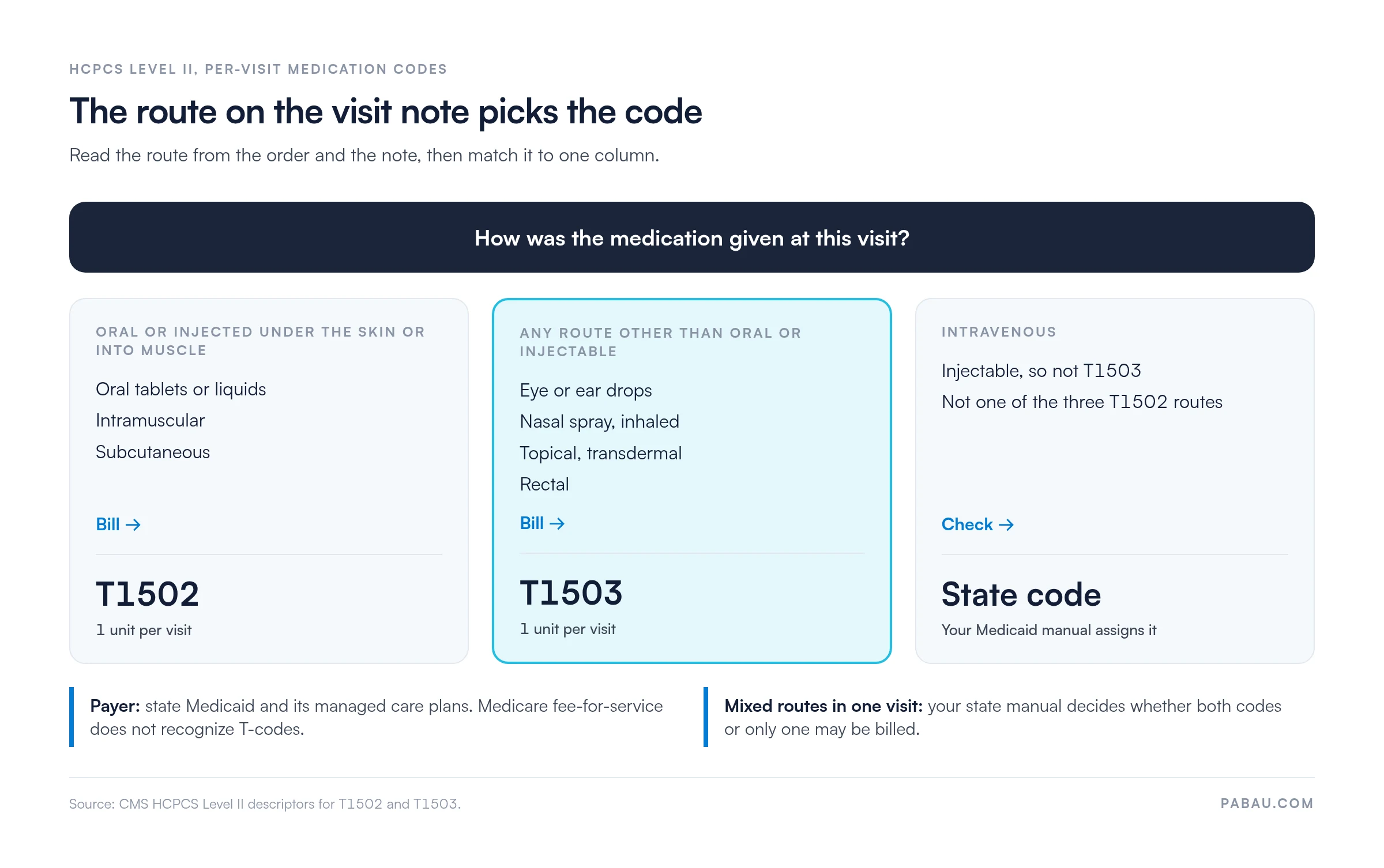
Here is how that plays out. A home health nurse instills prescribed eye drops on Monday and gives a subcutaneous injection on Thursday. Monday’s visit is T1503, Thursday’s is T1502, and each one bills as a single unit.
If one visit includes medication from both route groups, your state manual decides whether you may bill both codes or only one.
Intravenous medication is injectable, so it falls outside T1503. It is not one of the three routes T1502 names either. Check which code your state assigns to IV administration in the home.
Several nursing and medication codes sit close to T1503 in the T series. Picking the wrong one is a common source of Medicaid claim edits, so use this table to match the code to the service.
Some states pay licensed nursing time in 15-minute units rather than a medication visit. In that case, the claim belongs on T1000 instead of T1503.
T1500 and T1501 do not appear in the current HCPCS file, so a crosswalk or claim that lists them needs correcting. Descriptor wording can also change between releases, so verify each one against the CMS annual release.
A T1503 claim usually passes through six steps. Each one is also a place where the claim can stall.
State manuals differ on detail. Still, every T1503 note has to show the route, because the route separates it from T1502. Confirm each element below before the claim goes out.
Re-check the route on the note each time a prescription changes. If a patient moves from eye drops to an oral tablet, the visit moves from T1503 to T1502. A note template carried forward from the last visit leaves the claim on the wrong code.
The national HCPCS file requires no specific modifier on T1503. Some state Medicaid programs and managed care plans ask for state-defined modifiers, such as the U1 to U9 series. They use them to mark a program, waiver or provider type.
Those modifiers mean different things in different states. Take them from your state billing manual or plan contract, never from another state’s guidance. A modifier also does not change which of the two codes applies, because the documented route decides that.
T1503 is billed per visit. One visit is one unit, so a longer stay in the home does not add units.
States set their own limits on how many T1503 visits they pay per day, week or month. Some also require prior authorization above a set number of visits. None of these limits sits in the national descriptor, so read them from your state Medicaid manual or managed care contract.
Rates vary in the same way. The national file carries descriptors but not fee schedules, so check the current rate on your state Medicaid fee schedule.
A clean claim for T1503 carries one unit per documented visit, with a service date that matches the note. Billing several units for one visit, as if the code were timed, triggers an edit.
Prior authorization (PA) for T1503 is a state-level decision. Some state Medicaid programs waive PA for routine medication visits. Others require it for every episode of care, and managed care plans may add requirements on top of state policy.
For the wider workflow behind those requests, see our guide to the prior authorization process.
T1503 claims fail when the route, the unit and the payer details do not line up. Build your denial management workflows for T-codes around the errors below.
An appeal should include the visit note, the order, any authorization confirmation and a cover letter citing the denial reason. Each state program and plan sets its own appeal deadlines and timely filing limits, so check them before you start.
A short check before submission catches the denial reasons above before a payer does. Work through it for every T1503 line.
A T1503 claim depends on three details from the visit: the route, the date and the payer. When the note and the claim sit in separate systems, someone re-keys those details. That is where the route gets lost.
Pabau, the practice management and billing platform we build, creates the claim from the same patient record that holds the visit note.
Its error-checked claims management carries the HCPCS code attached to the service onto the claim line. It also holds the claim until required fields, such as member numbers and authorization codes, are complete.
For US practices, claims go out through Claim.MD, with eligibility checks, claim status tracking and remittance posting in the same workflow. Pabau does not pick the code or apply your state’s visit limits. Your team still checks the route and authorization, but it does so from one record.

Pabau builds each claim from the patient record and checks required fields before sending, so your T1503 claims carry the details payers ask for.

T1503 billing is settled long before anyone opens the claim form. When the order and the note both name the route, the code follows, and the payer has little left to question.
So start with the visit template. Make the route a required field, bill one unit per visit, and keep your state manual close for limits, modifiers and authorization. That adds a few seconds of charting at each visit, and it saves your billing team from reworking claims later.
Book a demo to see how Pabau keeps the visit note and the Medicaid claim in one record for your team.

Need to understand how denials get resolved? Denial management in healthcare covers the appeal process, CARC codes, and how to build a denial prevention workflow.
Waiting on a payer to approve visits? The prior authorization process explains how requests move from submission to a decision.
Does your state pay nursing time instead? HCPCS code T1000 covers licensed private duty nursing billed in 15-minute units.
Looking for a broader billing compliance reference? Medical billing compliance outlines the documentation standards and audit risks that apply across Medicaid code sets.
Want to improve first-pass claim acceptance rates? Clean claim submission explains the elements payers check before adjudicating any Medicaid claim.
No. The descriptor covers the administration visit, not the drug. States usually pay for the medication through the pharmacy benefit or a separate drug code, so check how your state manual handles it.
That depends on how your state enrolls your agency. Many programs take T-codes on the professional claim (CMS-1500 or 837P). Some home health programs use the institutional format instead, so follow your state billing manual.
Report the ICD-10-CM code for the condition the medication treats, as documented in the order and the visit note. The diagnosis on the claim should match the one on the order.
Only if your state lists that provider type for the code. The descriptor says “health care agency/professional,” and each state defines who qualifies. State nurse practice rules also limit which staff may give medication.
Only where your state allows more than one per day. Each visit needs its own note, times and route, and each one bills as a single unit. Check the daily limit in your state manual first.