CCSD code H4430: Examination of rectum under anaesthetic
CCSD code H4430 pays for the examination alone CCSD code H4430 is the UK private...

Last Updated: Oct 20, 2026
T1028 is the HCPCS Level II code for assessment of home, physical and family environment, to determine suitability to meet patient's medical needs.
The code sits in the HCPCS Level II T-code range (T1000-T9999). That range covers services tied to state Medicaid programs, the State Children's Health Insurance Program (SCHIP), and home health billing under waiver programs. The Centers for Medicare and Medicaid Services (CMS) maintains the HCPCS code set, and its full official descriptor for T1028 reads:
Assessment of home, physical and family environment to determine suitability to meet patient's medical needs.
Let Pabau's smart automation suggest the right codes, reduce claim denials, and keep your practice compliant—effortlessly.
Automate repetitive tasks and focus on what matters most—your patients.
Reduce coding errors and ensure compliance with the latest regulations.
Clean claims, fewer denials, and faster reimbursements.
Powerful insights and reporting to help your practice thrive.
HIPAA compliant SOC 2 certified GDPR-compliant Trusted by 4,000+ clinics worldwide

HCPCS code T1028 describes assessment of the home, physical and family environment to determine whether it can meet a patient’s medical needs.
It is a Medicaid T-code, reimbursed by state Medicaid and home and community-based services (HCBS) waiver programs rather than standard Medicare Part B.
Reimbursement rates vary widely by state Medicaid program, so verify your state fee schedule before billing. No single national rate applies.
Most T1028 denials come from documentation, not coding — usually a missing suitability determination, or no link between medical needs and environmental findings.
Practice management software like Pabau helps home health agencies track T-code documentation requirements and submit Medicaid claims accurately.
T1028 has been part of the HCPCS Level II T-code range since CMS established this category for Medicaid-specific services. The code has kept its current descriptor through the CMS HCPCS annual update process. Verify the code’s active status each calendar year in the CMS HCPCS annual release or your state Medicaid bulletin. States can modify or retire a T-code independently of the federal code set.
T1028 applies when a qualified provider physically assesses the patient’s home to determine whether it can safely accommodate their documented medical needs. The code is not a generic home visit code. It covers a specific, structured evaluation with a defined clinical purpose.
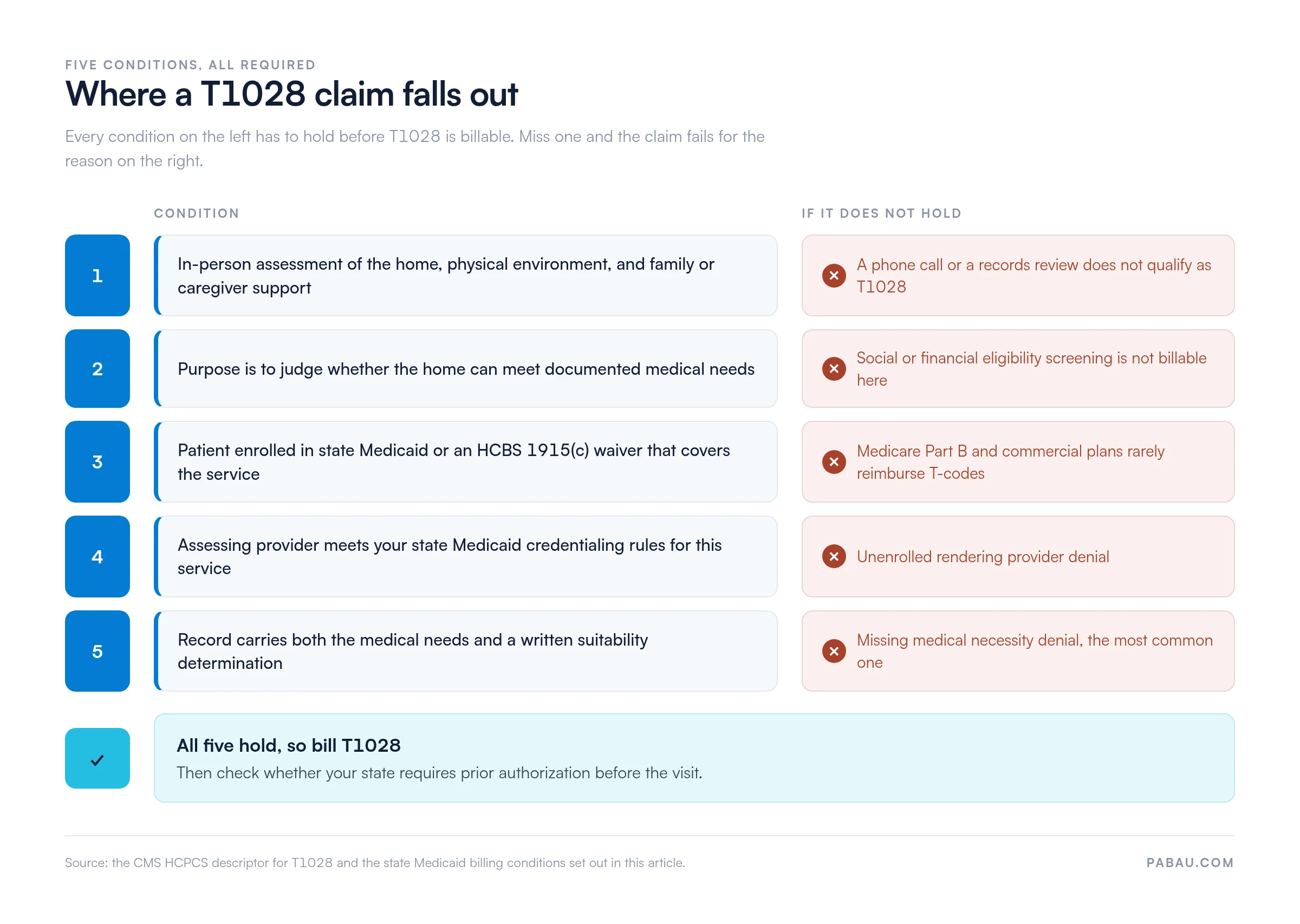
Bill T1028 when all of the following conditions are met:
Each condition is a point where a claim can fall out, and each one fails in its own way. The diagram below maps all five against the denial they produce.
Home health agencies should also distinguish T1028 from a standard home health initial assessment. T1028 focuses on environmental suitability for medical care delivery, not on clinical intake or skilled nursing assessment. Using T1028 for a routine intake visit without a documented environmental suitability determination is a billing error.
The skilled nursing that follows in the same home bills separately, under codes such as HCPCS code T1030 for per diem registered nurse care.
Coverage for HCPCS code T1028 depends almost entirely on the patient’s payer. Getting this wrong at pre-authorization costs time and generates avoidable denials. Confirm eligibility and the plan’s T-code policy before the assessment is scheduled.
State Medicaid agencies set T1028 coverage policies independently, so a service covered in one state may not be covered in another. Check your state Medicaid provider manual before assuming coverage applies. Medicaid.gov’s overview of 1915(c) waiver authorities explains how those programs are structured, which helps when you are working out which waiver a patient falls under.
No single national fee schedule rate applies to HCPCS code T1028. Unlike CPT codes reimbursed under the CMS Physician Fee Schedule, T-codes are governed by individual state Medicaid fee schedules. Rates reflect each state’s Medicaid budget, cost-of-living adjustments, and provider type classifications. Knowing your state’s T1028 rate before the assessment is scheduled is what keeps the visit from running at a loss.
Pull the current T1028 rate directly from your state Medicaid agency portal or provider manual. A dollar amount published here would mislead you, because rates update annually and vary widely across jurisdictions.
Most T1028 denials trace back to incomplete documentation, not incorrect coding. Medicaid auditors reviewing T1028 claims look for two distinct elements in the record. They want the environmental findings, and they want the patient’s medical needs. Providers who document one without the other face near-certain denial. Maintaining medical billing compliance for Medicaid T-codes means treating the documentation as the claim itself.
Required documentation elements for T1028:
Assessment records must be stored securely, and any identifying information shared during the claims process has to meet HIPAA minimum necessary standards. Capturing all eight elements above at the time of service prevents a last-minute scramble when a claim is audited.
Document the patient’s specific medical needs BEFORE the environmental assessment, not after. Medicaid auditors confirm that the documented medical needs logically required the home assessment. If the medical need documentation post-dates the assessment findings, auditors flag it as retrospective justification. That can trigger a broader review of your claims.
Provider eligibility to bill T1028 is set by your state Medicaid program or HCBS waiver, not by a federal standard. That said, the assessment services captured under T1028 usually fall within the scope of a defined set of provider types.
State Medicaid programs vary significantly on which provider types are authorized. Some states restrict T1028 to registered nurses. Others allow social workers or trained care coordinators. Check your state Medicaid provider enrollment agreement and provider manual before billing under a new provider type.
Home environment assessment codes sit inside a broader T-code family. Knowing the adjacent codes helps billers pick the most specific code for the service performed. It also avoids unbundling problems when several services happen in one visit.
One home visit may involve both an environmental assessment and another distinct service, such as case management. State Medicaid rules decide whether both codes can be billed on the same date. Review your state’s billing guidelines and modifier requirements before submitting multiple T-codes for one encounter. The AAPC HCPCS code lookup tool carries descriptor details and coverage notes for the full T-code range.
Prior authorization requirements for T1028 differ by state and by waiver program. Some state Medicaid agencies require authorization before the assessment is performed. Others let the provider conduct the assessment and seek reimbursement without upfront approval. Contact your state Medicaid agency or read your provider agreement before you schedule the visit.
Common denial reasons for T1028 claims and how to address them:
Audit your T1028 claims quarterly. Pull a sample of recently paid and recently denied claims, then compare their documentation side by side. The pattern in the paid claims is your benchmark. Denials usually reveal one or two recurring omissions, such as a missing suitability determination, that training can fix across the team quickly.
When a T1028 claim does come back denied, the remittance advice carries a reason code that tells you what to do next. Our reference on medical billing denial codes explains what the common ones mean, and whether to correct and resubmit or appeal.
Modifier usage for T1028 follows state Medicaid rules. Some programs want a modifier indicating the type of environment assessed, such as a rural or remote setting. Others use one to flag a reassessment rather than an initial assessment. Check your state’s modifier policy first, because an unrecognized modifier can make the claim deny or pend for manual review.
Most home health teams split this work across systems today. The assessment is written up in one place, the medical necessity notes live in another, and the claim is keyed into a third. When a Medicaid auditor asks for the record, someone has to reassemble it by hand.
Practice management software like Pabau keeps the assessment, the suitability determination, and the claim on one patient record. Digital intake and assessment forms capture the required elements during the visit, so the record does not have to be rebuilt from memory afterward. Our home health claims software then submits from that same record.
One record also keeps authorization status, documentation completeness, and submission deadlines visible in a single view. That matters most for agencies handling high volumes of Medicaid T-code claims. Provider credentialing records sit alongside it. You can check who is authorized to bill T1028 in your state before the visit is scheduled.

Pabau helps home health agencies and care management organizations track T-code documentation requirements and submit Medicaid claims accurately. Provider credentialing records stay organized in the same place.

T1028 denials almost always trace back to the documentation rather than the coding. The code itself is straightforward. What trips up home health agencies and HCBS waiver providers is the missing link between the patient’s documented medical needs and the environmental findings.
Make that link explicit in every T1028 chart note, and most payer objections disappear before the claim is submitted. The trade-off is a few extra minutes at the point of service, spent instead of a few weeks chasing an appeal.
Pabau captures the full T1028 documentation set during the visit and files the claim from the same record. Book a demo to see how that works across a Medicaid-heavy caseload.

Need guidance on Medicaid billing compliance standards? Medical billing compliance fundamentals covers the documentation and claim submission rules that apply across Medicaid programs.
Want to understand how HCPCS billing fits into the broader revenue cycle? Revenue cycle management for home health explains the end-to-end billing workflow from patient intake through payment posting.
Looking for practical denial prevention strategies? Managing claim denials in healthcare covers root cause analysis, appeal processes, and prevention frameworks that apply to Medicaid T-code claims.
Not sure what makes a T1028 claim clean on the first pass? What counts as a clean claim walks through the CMS-1500 fields that decide whether a claim pays or pends.
Want the documentation captured before the claim is keyed? How a superbill works shows how a structured charge sheet carries codes and supporting detail together.
HCPCS code T1028 covers the assessment of a patient’s home, physical, and family environment. The point of the assessment is to determine whether that environment can meet the patient’s identified medical needs. It is a Medicaid-specific HCPCS Level II T-code, used mainly by home health agencies and HCBS waiver program providers.
T1028 is covered by Medicaid and HCBS 1915(c) waiver programs, not standard Medicare Part B. Medicare Part B does not typically reimburse HCPCS T-codes. Some Medicare Advantage plans may cover home assessment services as a supplemental benefit, but you must verify coverage with the individual plan before billing.
Billing T1028 requires a specific set of documented elements. You need the patient’s medical needs, the environmental factors evaluated, and a suitability determination with clinical rationale. You also need provider credentials, the date and duration of the assessment, and the patient’s Medicaid enrollment details. Missing the suitability determination is the leading cause of T1028 claim denials.
There is no single national reimbursement rate for T1028. Rates are set by each state’s Medicaid fee schedule and vary significantly by state and by HCBS waiver program. Check your state Medicaid agency’s provider portal or fee schedule publication for the current year’s rate before billing. Managed care plan rates may also differ from the state fee-for-service rate.
Eligible billers for T1028 typically include Medicaid-enrolled home health agencies, HCBS waiver program providers, and authorized care management organizations. Individual clinicians generally bill through their enrolled agency rather than individually. Specific provider type eligibility is set by each state Medicaid program and should be confirmed in the state provider manual.
Prior authorization requirements for T1028 vary by state Medicaid program and by individual HCBS waiver. Some states require prior authorization before the assessment is performed. Others do not. Contact your state Medicaid agency or review your provider participation agreement to confirm the rules that apply. Do that before you schedule the assessment.
A home environment assessment is a structured professional evaluation of a patient’s living space, home safety features, and caregiver support system. Its purpose is to determine whether the home setting can accommodate the patient’s medical needs. Under HCPCS code T1028, the assessment must end in a documented professional determination of suitability. That determination is what separates it from a routine home visit or a standard intake assessment.