CPT Code 98981: RTM Treatment Management Billing Guide
CPT code 98981: Definition and official descriptor CPT code 98981 is an add-on c...

Last Updated: Nov 9, 2026
S0040 is the HCPCS Level II code for injection, ticarcillin disodium and clavulanate potassium, 3.1 grams. The product it describes is Timentin, an intravenous antibiotic that GlaxoSmithKline no longer makes for the US market.
The code is still listed in the CMS HCPCS file, so it appears on historical claims and payer files. When a practice gives a different antibiotic, the claim carries that drug's own code and NDC.
Let Pabau's smart automation suggest the right codes, reduce claim denials, and keep your practice compliant—effortlessly.
Automate repetitive tasks and focus on what matters most—your patients.
Reduce coding errors and ensure compliance with the latest regulations.
Clean claims, fewer denials, and faster reimbursements.
Powerful insights and reporting to help your practice thrive.
HIPAA compliant SOC 2 certified GDPR-compliant Trusted by 4,000+ clinics worldwide

HCPCS Code S0040 is injection, ticarcillin disodium and clavulanate potassium, 3.1 grams. That is the intravenous antibiotic sold as Timentin.
GlaxoSmithKline stopped making Timentin for the US market in 2015. No generic, import or compounding route replaced it.
The code is still listed in the CMS HCPCS Level II file, so it turns up on historical claims, payer files and audits.
When a practice gives a different antibiotic, the claim carries that drug’s own HCPCS code and NDC, never S0040.
Pabau’s claims management software builds each claim from the treatment record and tracks it from submission to remittance.
HCPCS Code S0040 is the Level II code for injection, ticarcillin disodium and clavulanate potassium, 3.1 grams. Each 3.1-gram unit pairs 3 grams of ticarcillin with 100 mg of clavulanic acid. The product it was written for is Timentin, the GlaxoSmithKline brand of this intravenous antibiotic.
Ticarcillin is an extended-spectrum penicillin, and clavulanate is a beta-lactamase inhibitor that protects it from bacterial enzymes. S0040 sits in the S0012-S0197 range of temporary national drug codes, one series in our HCPCS code library.
CMS lists S-codes in the HCPCS file, but Medicare does not pay them. They exist for commercial insurers and some state Medicaid programs.
The descriptor in the current CMS HCPCS Level II release is unchanged from the original. A code that stays in the file only means CMS has not retired it. It says nothing about whether the drug can still be bought.
No. GlaxoSmithKline announced on February 9, 2015 that it would stop making Timentin for the US market. The notice is posted on the FDA drug shortage pages. Drugs.com and Mayo Clinic now list both the brand and its generics as discontinued in the US.
No approved generic (ANDA) product took its place, and there is no import or compounding route for it. A US practice cannot buy or administer ticarcillin-clavulanate today. Any claim for S0040 with a recent date of service describes a drug the practice could not have stocked.
That changes what S0040 is useful for. Billers meet it when they work old claims, reconcile payer fee files, answer audit requests, or clean legacy codes out of a charge master. A new claim should never carry it. The chart below sorts an S0040 claim line by its payer and its date of service.
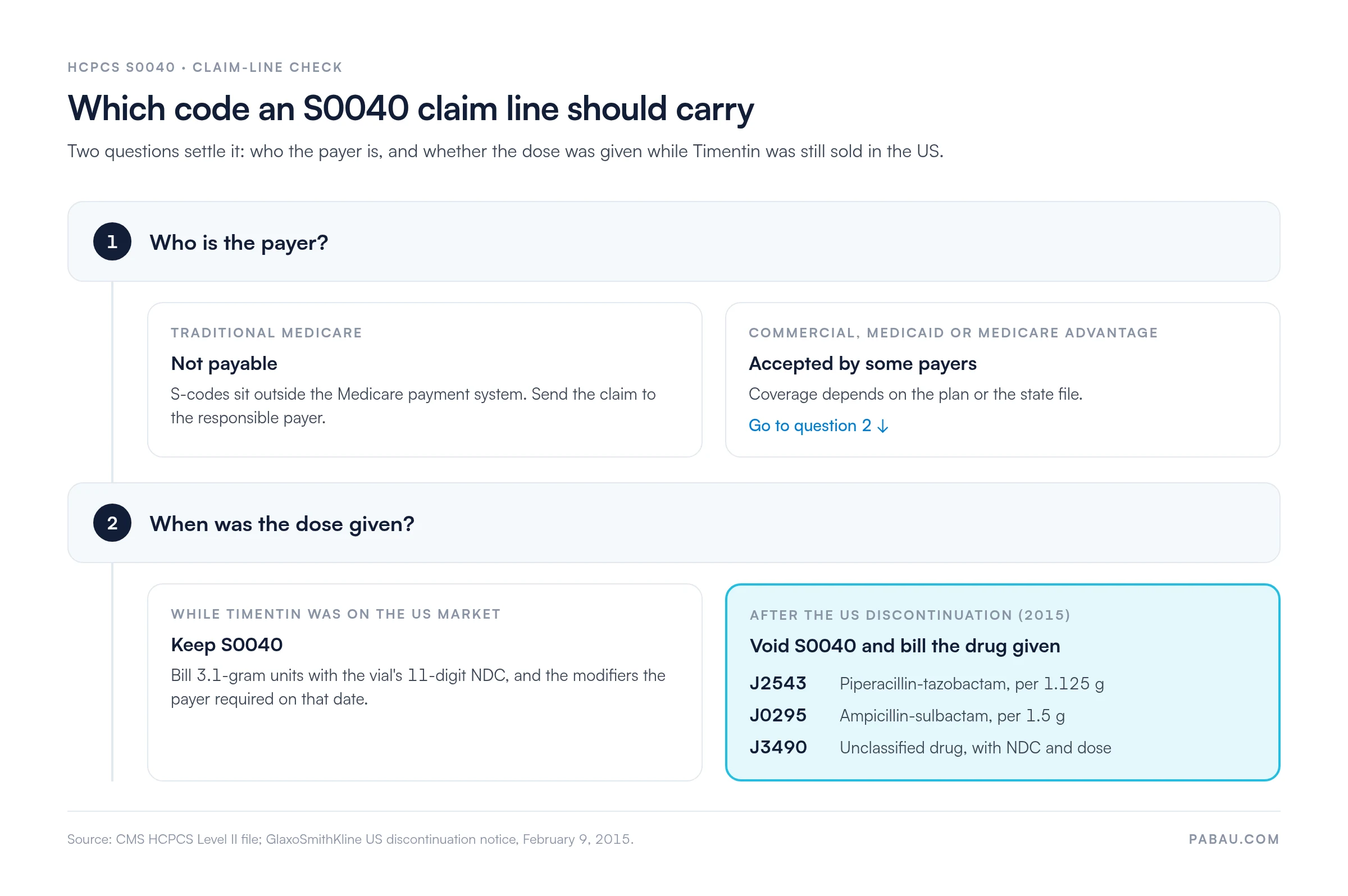
Bill the HCPCS code for the drug the patient received, with that product’s own NDC. The prescriber chooses the alternative antibiotic, and the code follows the drug. Reporting S0040 for a different product misstates the service on the claim.
The table shows common examples. They illustrate the coding step only and are not a recommendation on which drug to use.
Check the units against the new descriptor, because each code has its own billing unit. A 3.1-gram unit habit carried over from S0040 will miscount J2543 or J0295. Confirm the payer’s rules for the replacement code, including any prior authorization, before the date of service.
CMS has never published a payment rate for S0040, so there is no Medicare fee schedule figure to look up. Commercial payers and some state Medicaid programs once set their own allowed amounts for it. Some payer files still carry that row, because S0040 remains a listed code.
Treat an S0040 allowed amount in a payer file as a historical entry. It is not a benchmark for revenue planning, and it does not mean the payer expects new claims. When the substitute drug carries a J-code, the payer’s rate for that J-code is the figure that matters.
Timentin was labeled for serious infections caused by susceptible bacteria. A reviewer checking an old S0040 claim should see a diagnosis that matches one of those labeled uses. The categories below are the usual ICD-10-CM homes for them.
These pairings are for audits and appeals on past dates of service. For a current patient, the diagnosis pairs with the code of the antibiotic that was given. The coding rules are unchanged: use the most specific code the record supports, and make sure the clinical note states the indication.
No new prior authorization should be requested for S0040, because the drug cannot be supplied. If an open authorization for S0040 still sits in a payer portal, close it. Request a fresh authorization for the replacement drug, under its own code.
On a historical claim, modifiers follow the payer’s policy on the original date of service. The ones that appeared on S-series drug claims were few:
A corrected historical claim keeps the modifiers that fit that date of service. Apply the same payer rules to the replacement drug’s code on any current claim.
A payer reviewing a past S0040 claim checks the record against the claim line. Keep these elements together for every historical claim that carried the code:
For a current patient, record the substitute drug in the same way, with its own NDC and billing units. Keep records for at least seven years, or longer where state law or the payer contract requires it.
Denials on S0040 lines come from a short list of causes. Most appear when old claims are reworked or appealed. For a wider method, our guide to denial management in healthcare tracks patterns by code and payer.
The last row is the one to watch on recent dates of service. An S0040 line dated after the US discontinuation should be checked against the medication record before anyone defends it.
Retired drugs linger in charge masters and billing templates long after the product leaves the shelf. A biller who picks a code from habit can send S0040 for an antibiotic the practice never stocked. The fix is a claim built from what the record says was given.
Pabau, the practice management platform we build, keeps the clinical record and the claim in one system. Its claims management software handles submission, eligibility checks, claim status and remittance posting in that same place. The billing team works from the treatment note, not a re-keyed summary.
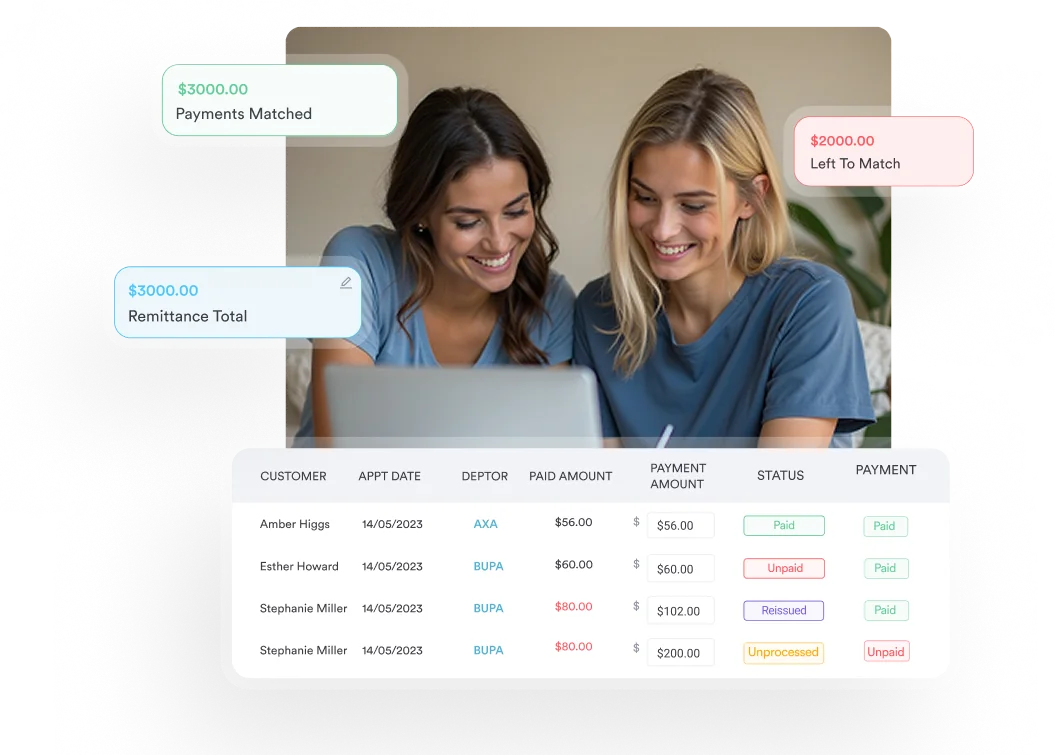
Claims route out through the Claim.MD clearinghouse, and remittance advice comes back against the same patient record. A denial on a reworked legacy claim shows up the day it arrives, next to the note that explains it.

Pabau’s claims management software builds claims from the treatment record and tracks them through the Claim.MD clearinghouse to remittance. See how it keeps drug coding accurate.

S0040 is a live code for a drug the US market no longer has. Leave it on historical claims, where it belongs, and keep it off current billing. When a patient needs an alternative to ticarcillin-clavulanate, the code and NDC follow the drug the prescriber chose.
The practical step is a charge-master check. Remove or flag S0040 so it cannot be picked by default, and point billers to the replacement codes. Book a demo to see how Pabau ties each drug claim to the treatment record behind it.

Want to understand how the billing workflow fits into broader practice operations? What is revenue cycle management explains the end-to-end process from eligibility through payment posting.
Looking for clean claim submission standards that apply to drug codes? Clean claim requirements details the data elements every commercial payer evaluates before adjudicating a drug code claim.
HCPCS Code S0040 describes injection, ticarcillin disodium and clavulanate potassium, 3.1 grams. That is the intravenous antibiotic sold as Timentin. It sits in the S0012-S0197 range of non-Medicare drug codes in the CMS HCPCS Level II file.
No. GlaxoSmithKline announced on February 9, 2015 that it would stop making Timentin for the US market. No generic, import or compounding route replaced it, so US practices cannot obtain or administer it.
Only for a dose that was given while the drug was available. S0040 is still listed in the CMS file, so it appears on historical claims and in audits. A current claim bills the code of the antibiotic the patient received.
No. Medicare does not pay S-codes, including S0040. Commercial insurers and some state Medicaid programs used S0040 when Timentin was on the market. Some Medicare Advantage plans accept S-codes, but that depends on the plan.
Bill the HCPCS code and NDC of the drug the patient received. Piperacillin-tazobactam is J2543 and ampicillin-sulbactam is J0295. A drug without its own code goes under J3490, unclassified drugs, with the NDC and dose.
No. CMS has never published a payment rate for S0040. Some commercial payer files still carry an allowed amount, but that is a legacy entry. Use it only to reconcile historical payments.