HCPCS code J2690: Procainamide units and billing guide
What HCPCS code J2690 covers, and what it does not HCPCS code J2690 reports R...

Last Updated: Oct 30, 2026
HCPCS code J2543 is the Level II code for injection, piperacillin sodium/tazobactam sodium, 1 gram/0.125 grams (1.125 grams). Each billing unit equals 1.125 g of the combined drug, so a 3.375 g dose is 3 units and a 4.5 g dose is 4.
To count units, divide the total grams given by 1.125 and round a partial unit up. Drug left in a single-dose vial goes on a separate JW line. Each line also carries the vial's 11-digit NDC, and the infusion is billed with its own CPT code.
Let Pabau's smart automation suggest the right codes, reduce claim denials, and keep your practice compliant—effortlessly.
Automate repetitive tasks and focus on what matters most—your patients.
Reduce coding errors and ensure compliance with the latest regulations.
Clean claims, fewer denials, and faster reimbursements.
Powerful insights and reporting to help your practice thrive.
HIPAA compliant SOC 2 certified GDPR-compliant Trusted by 4,000+ clinics worldwide

HCPCS code J2543 bills piperacillin-tazobactam per 1.125 g of combined drug, which is 1 g piperacillin plus 0.125 g tazobactam.
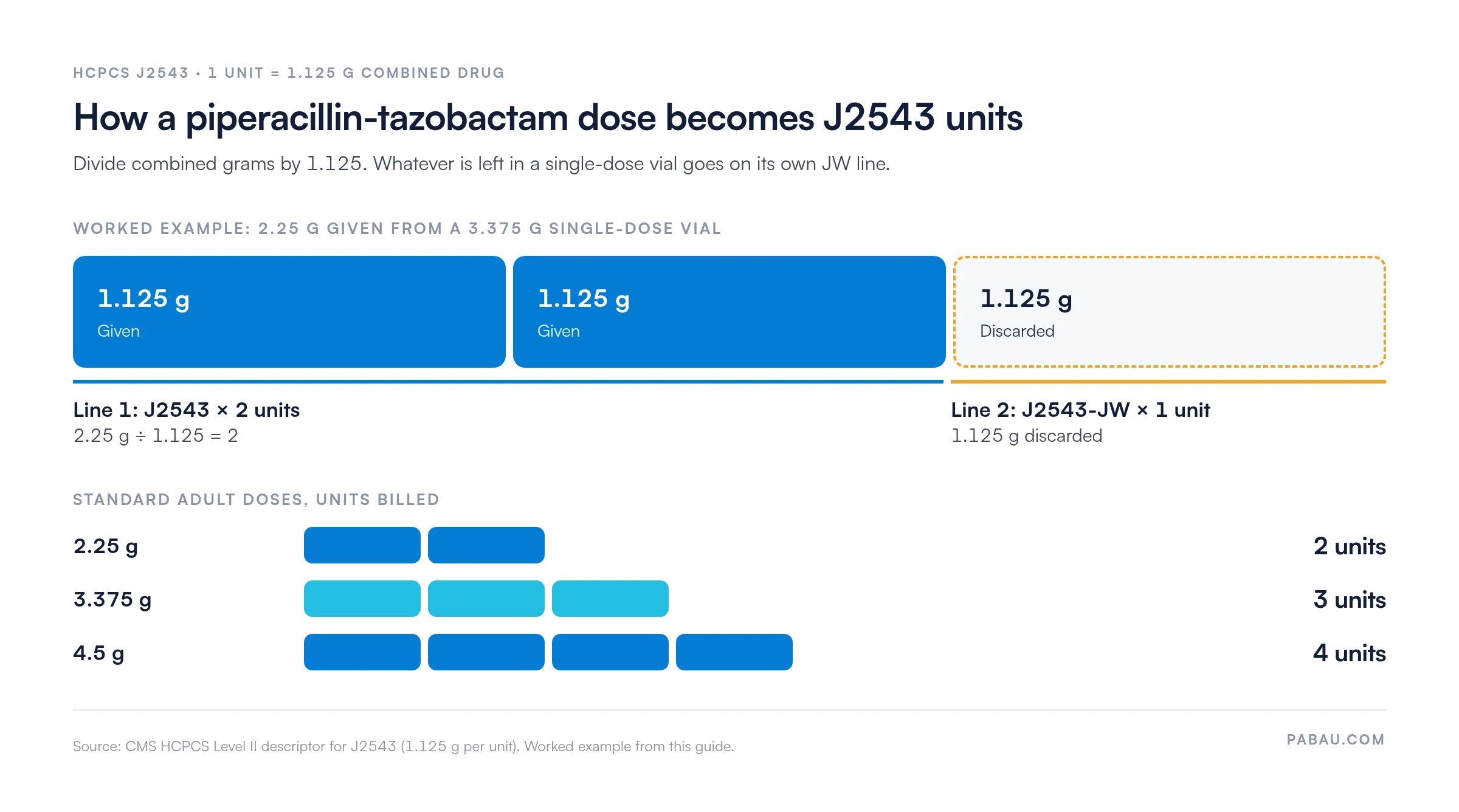
Divide the total grams given by 1.125 and round a partial unit up, so 2.25 g is 2 units and 4.5 g is 4.
Drug discarded from a single-dose vial goes on a separate JW line, and a claim with no waste carries JZ.
Report the vial’s 11-digit NDC without hyphens after the N4 qualifier, because Medicaid and many payers check it.
Bill CPT 96365 for the first hour of the first drug, and 96366 for each extra hour of that same drug.
HCPCS code J2543 is the Level II code for injection, piperacillin sodium/tazobactam sodium, 1 gram/0.125 grams (1.125 grams). One unit equals 1.125 g of the combined drug. That covers 1 g of piperacillin and 0.125 g of tazobactam. The Centers for Medicare and Medicaid Services (CMS) maintains the code.
Piperacillin-tazobactam is sold as Zosyn (Pfizer) and as several generics. It pairs a broad-spectrum penicillin with a beta-lactamase inhibitor. Prescribers use it for intra-abdominal infections, hospital-acquired pneumonia, and complicated skin or urinary tract infections. Each dose runs as an IV infusion, usually over 30 minutes or as an extended 4-hour infusion.
The unit math is short, so most errors come from using the wrong base number. Work from the combined strength on the vial label. Then follow these steps for every dose.
Standard adult doses divide evenly, so the common cases need no rounding at all.
Bill the dose the patient received, not a formulary default. If the prescriber orders a weight-based dose, the units follow that dose. A figure in the thousands means someone billed by milligrams, so stop and recount.
A patient with reduced kidney function is ordered 2.25 g. Your pharmacy has only 3.375 g single-dose vials. The nurse gives 2.25 g and discards the rest.
Laid out against the vial, the split looks like this, next to the three standard adult doses.
Medicare pays for drug discarded from a single-dose vial, but only when the claim says so. The rules below apply to every separately payable J2543 line.
Pharmacy bulk packages are not single-dose containers. Drug drawn from one doesn’t take JW or JZ, and leftover drug isn’t billed as waste. In short, check the vial type before you add either modifier.
The National Drug Code names the exact product, labeler and package you used. Medicaid requires it on physician-administered drug claims for rebate purposes. Many commercial plans and some Medicare contractors ask for it too. A missing or invalid NDC is a common rejection, so add it to every J2543 line.
Report it in the 11-digit 5-4-2 format, with no hyphens or spaces. A 10-digit label NDC needs a leading zero in the short segment. For example, 0409-1234-01 becomes 00409123401. Keep the vial’s NDC on the drug record, as part of your superbill documentation, so billers never copy it from memory.
Check that the NDC is current in the FDA NDC Directory before you submit. Generic piperacillin-tazobactam comes from several labelers. Each new supplier brings a new NDC, so update the drug record when stock changes.
Match the NDC on the claim to the vial in the administration record, not to the last box you ordered. A claim with the right drug and the wrong NDC still rejects.
Medicare pays J2543 at the Average Sales Price (ASP) plus 6 percent, the rate set in statute. After the 2 percent sequestration cut, the payment works out to about ASP plus 4.3 percent. CMS updates the ASP every quarter, so last quarter’s rate is already out of date.
To find the current figure, open the CMS Part B ASP pricing files and download the latest quarter. Search for J2543 and note the payment limit per unit. Then multiply it by your units to estimate the allowed amount. The patient owes 20 percent coinsurance once the Part B deductible is met.
Under buy-and-bill, the practice buys the drug, gives it, and bills both the drug and the infusion. If you pay more than ASP for the vial, the drug line can lose money. As a result, purchase price matters as much as coding accuracy.
J2543 covers the drug only, so the infusion needs its own CPT code on the same claim. Because the drug runs for 30 minutes or longer, it takes infusion codes, not push codes. The first hour goes on 96365, billed on the same date of service as the drug line.
Take a 4-hour extended infusion as the only drug of the visit. You bill 96365 once and 96366 for 3 units. In a physician office (POS 11), the practice bills both lines at the non-facility rate. In a hospital outpatient department (POS 19 or 22), the hospital usually bills the drug and infusion itself.
Unclassified drugs go on J3490, and unclassified biologics go on J3590. Both exist for drugs without their own code. Piperacillin-tazobactam has J2543, so neither unlisted code applies. Billing J3490 here counts as miscoding and invites payer review.
If a remittance shows payment on J3490 for this drug, correct the code and resubmit with J2543. Then note the correction in your billing log. Repeated J3490 claims for a coded drug can look like a pattern in an audit.
Traditional Medicare Part B rarely requires prior authorization for J2543. Other payers set their own rules, so check each plan before the first dose.
Without a required authorization, the claim will deny. A few payers accept a retroactive request after an emergency, but most don’t. Build a check into scheduling for every new patient and every new payer.
Most J2543 denials repeat a handful of mistakes. Watch for these before the claim leaves the building.
When a denial does arrive, the reason code points to the fix. Denial management in healthcare works best when each code routes to the same correction every time.
Review your denial codes in medical billing each month. Repeated CO-11 denials usually mean the chart names an unspecified infection. Ask the ordering physician for a specific diagnosis. A clean claim process catches most of these before submission.
Track J2543 denials by reason code over a rolling 90 days. If CO-50 keeps appearing, review documentation with your ordering physicians. The fix belongs in the chart note, which the billing team can’t change on its own.
Run through this list for every infusion encounter. It matches what payers ask for on review, and it supports your medical billing compliance program.
Fee-for-service Medicaid programs generally cover piperacillin-tazobactam, but they don’t always pay ASP. Some states pay a share of wholesale acquisition cost (WAC). Others use their own maximum allowable cost lists. Check your state’s HCPCS drug fee schedule before you assume Medicare rates.
Medicaid managed care plans set their own formularies and authorization rules. So a drug covered under fee-for-service may still need approval from the plan. Keep a short grid of each plan’s rules for J2543.
Commercial plans often pay a percentage of average wholesale price (AWP) or a contracted rate. That rate can sit above or below Medicare. Review it at each contract renewal.
Many J2543 errors start at a handoff. A nurse charts 2.25 g, and someone later retypes it onto a claim. Each retype is a chance to drop the JW line or miscount the units.
Pabau, the practice management and billing platform we build, keeps the charted dose and infusion times in the treatment record your biller works from. The claims management software then submits the claim. Your biller still counts the units and picks JW or JZ, but from the nurse’s chart rather than a handwritten note.
The payoff is fewer resubmissions and less time chasing missing details on drug claims.

Pabau keeps the charted dose and infusion times in the treatment record, so your billing team works from what was given at the chair.

Treat 1.125 g as the anchor for every J2543 line. Count units from the combined grams, put leftover vial drug on a JW line, and send the vial’s NDC after N4. Those three checks clear most of what payers reject.
If denials still cluster after that, look upstream. CO-11 and CO-50 point to the chart, so the fix sits with the ordering physician. Book a demo to see how Pabau keeps infusion records in front of your billing team.

Need to understand how remittance advice maps to denial reasons? Electronic remittance advice explained covers ERA transaction sets and how to read CARC denial codes in your 835 files.
Want to reduce the time between claim submission and payment? Pabau’s Claim.MD clearinghouse integration covers how eligibility checks and 837P validation catch errors before claims reach the payer.
Waiting on a payer before the first dose? The prior authorization process walks through each step, from request to approval number, so infusions start on time.
J2543 is piperacillin sodium/tazobactam sodium injection, including Zosyn and its generics. One unit equals 1.125 g of combined drug: 1 g piperacillin and 0.125 g tazobactam.
A 3.375 g dose is 3 units of J2543, because 3.375 divided by 1.125 equals 3. A 2.25 g dose is 2 units, and a 4.5 g dose is 4 units.
Part B covers J2543 when a clinician gives the drug in an office or hospital outpatient setting. Home IV antibiotics are usually billed through Part D by NDC, without a HCPCS code.
No. J2543 covers the fixed piperacillin-tazobactam combination as a single drug. Bill the combined dose on one line, and don’t split out the tazobactam.
Premixed frozen bags of piperacillin-tazobactam also use J2543. Count units the same way, from the combined grams in the bag divided by 1.125.