CCSD Code T7790: Excision of benign soft tissue tumour
CCSD Code T7790: Definition and procedure scope CCSD Code T7790 is defined in th...

Last Updated: Nov 20, 2026
S0012 is the HCPCS Level II code for butorphanol tartrate, nasal spray, 25 mg. One unit equals 25 mg, the contents of one 2.5 mL bottle of the 10 mg/mL spray.
S0012 is a temporary national S-code for non-Medicare payers, so Medicare does not pay it. Butorphanol is a Schedule IV opioid agonist-antagonist, and each payer that accepts the code sets its own coverage, quantity and authorization rules.
Let Pabau's smart automation suggest the right codes, reduce claim denials, and keep your practice compliant—effortlessly.
Automate repetitive tasks and focus on what matters most—your patients.
Reduce coding errors and ensure compliance with the latest regulations.
Clean claims, fewer denials, and faster reimbursements.
Powerful insights and reporting to help your practice thrive.
HIPAA compliant SOC 2 certified GDPR-compliant Trusted by 4,000+ clinics worldwide

HCPCS Code S0012 describes butorphanol tartrate nasal spray, 25 mg, which is one 2.5 mL bottle of the 10 mg/mL product.
S0012 is a temporary national S-code for non-Medicare payers, so Medicare does not pay it and each other payer sets its own rules.
Butorphanol is a Schedule IV mixed opioid agonist-antagonist, and its label indication is pain severe enough to need an opioid.
Bill one unit per 25 mg bottle supplied, never one unit per 1 mg spray.
Most S0012 denials trace back to billing Medicare, a missing NDC, a missing authorization, or a unit count built on sprays.
HCPCS Code S0012 is the Level II code for butorphanol tartrate, nasal spray, 25 mg. AAPC lists it in the non-Medicare drug code group, S0012 through S0197. Private insurers and Medicaid programs use S-codes, which the CMS HCPCS workgroup maintains. Medicare does not pay them.
Butorphanol is a synthetic opioid with mixed agonist-antagonist activity. The nasal spray was first sold under the brand name Stadol NS. Today, practices and pharmacies mostly supply generic butorphanol tartrate nasal spray USP.
The FDA-approved label lists one indication. That is pain severe enough to require an opioid analgesic and for which alternative treatments are inadequate. The label’s clinical trials covered postoperative pain, musculoskeletal pain and migraine headache pain.
The patient self-administers the spray, one metered spray into one nostril at a time. That detail shapes billing more than the drug itself, as the coverage sections below show.
The table below summarizes what billers need before they submit a claim for HCPCS Code S0012.
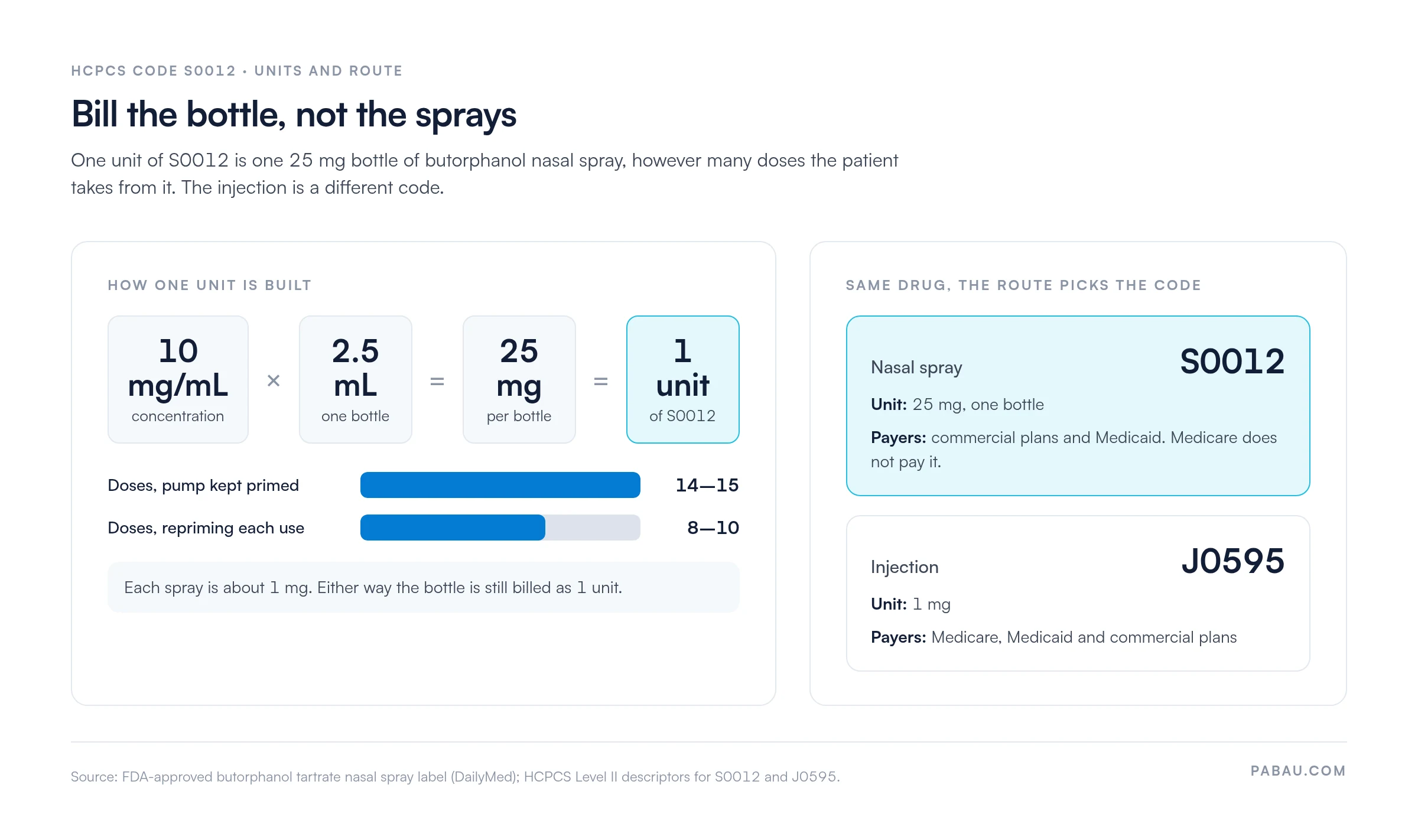
The 25 mg in the descriptor matches one full bottle. The label says a primed bottle delivers about 14 to 15 doses. With repriming between uses, it delivers about 8 to 10 doses.
S0012 reports the butorphanol nasal spray product itself, counted in 25 mg units. Outside that scope, a different code applies.
Reported with S0012: butorphanol tartrate nasal spray supplied to the patient, when the payer accepts S-codes for drugs.
Not reported with S0012:
One unit of HCPCS Code S0012 equals 25 mg of butorphanol tartrate, which is one 2.5 mL bottle. Count units by bottles supplied, not by sprays. A single 1 mg spray is not one unit.
The most common unit error is billing the number of doses. A bottle that delivers 14 sprays is still one unit. Checking each claim line against the descriptor is part of submitting a clean claim.
The diagram below shows how one unit is built from the label figures, and why the route, not the drug, decides the code.
Label dosing also explains why quantity limits matter. The usual first dose is 1 mg, one spray in one nostril. If pain relief is not adequate within 60 to 90 minutes, the label allows a second 1 mg dose. The sequence may repeat in 3 to 4 hours as required.
The diagnosis has to support opioid-level pain, because that is the label indication. Payers that cover S0012 usually expect the code that names the cause of the pain. Where the encounter is about pain control, a pain code from G89 or R52 may apply.
These codes are examples, not a coverage list. Each payer’s policy decides which diagnoses it accepts for an opioid nasal spray. Confirm current code status in the ICD-10-CM tabular list before you submit.
Traditional Medicare does not pay HCPCS Code S0012. Private insurers and Medicaid programs use S-codes, which the CMS HCPCS workgroup maintains. The HCPCS file marks them not payable by Medicare, so a claim to Medicare Part B with S0012 returns a denial.
A self-administered nasal spray also falls outside the usual Part B drug benefit. Two other routes can apply to Medicare patients:
Before you supply the spray to a Medicare patient, run an eligibility check. It tells you whether the patient has an Advantage plan and what that plan accepts.
State Medicaid programs and commercial plans decide for themselves whether to accept S0012. Rules for opioids vary widely by state and by plan. Insurance eligibility verification at scheduling shows which of those rules apply before the patient arrives.
Requirements to check with each payer:
Payer policies on opioids change often. Check the current policy before each authorization request rather than relying on last year’s answer.
Whether S0012 needs prior authorization depends on the payer. No blanket rule applies. These triggers commonly start an authorization request for an opioid analgesic:
When authorization is required, the package usually includes the diagnosis and its ICD-10 code. It also covers prior treatments and their results, the prescriber’s rationale, and the requested quantity. Keep the approval number on file and report it on the claim.
Confirm authorization and the quantity limit before the patient leaves with the spray. A missing authorization on an opioid claim takes far longer to fix after the fact than a call to the plan beforehand.
Solid documentation underpins billing compliance requirements. Butorphanol is a Schedule IV controlled substance, so the record has to satisfy both the payer and controlled-substance rules.
Each item above maps to a denial risk. A missing NDC draws a Medicaid rejection, and a missing authorization number holds a commercial claim.
Several codes get confused with HCPCS Code S0012 during claim preparation. The comparison below shows when each one applies.
The J0595 versus S0012 question causes the most mix-ups, because the drug is the same. The route decides the code: injection is J0595 per 1 mg, nasal spray is S0012 per 25 mg bottle.
Most S0012 denials are predictable. The table below maps common scenarios to their claim adjustment reason codes (CARC) and the fix. A broader guide to medical billing denial codes explains the CARC and RARC pairs behind them. Systematic denial management workflows catch these before they turn into write-offs.
S0012 claims fail when the supply record, the authorization and the claim live in different places. Someone retypes the NDC or the quantity, and the error reaches the payer. Pabau, a practice management platform, keeps those details on one patient record.
Pabau’s claims management software pulls what is already on the record into a pre-filled claim. In the US it submits through Claim.MD, runs eligibility checks, and tracks remittances. Stock in Pabau carries a batch number and expiry date, recorded against the patient and the appointment.
Pabau’s prescription management keeps the prescriber’s order in the same record. Your billers review a claim built from the chart instead of rebuilding it by hand.
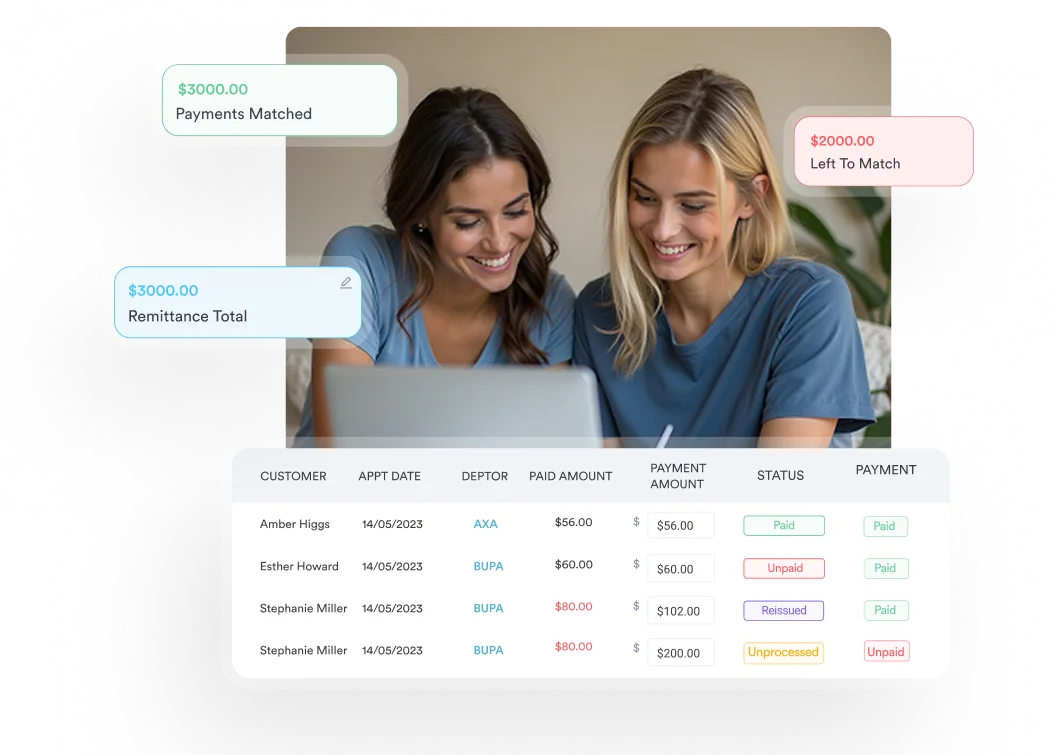

Pabau pulls the order, the lot and the patient’s coverage from one record into a pre-filled claim. Your team checks eligibility before the visit and tracks every remittance after it.

Treat S0012 as a payer question first and a coding question second. The descriptor is simple: one unit is one 25 mg bottle of butorphanol nasal spray. The hard part is knowing whether this patient’s plan accepts the code at all.
Settle that before the spray leaves the practice. Check the plan, the quantity limit and the authorization, and keep J0595 for the injection. Do that, and S0012 becomes a routine line rather than a recurring denial.
Book a demo to see how Pabau keeps drug code claims accurate from order to remittance.

Billing butorphanol as an injection instead? HCPCS Code J0595 covers the per-1 mg injection code for the same drug.
Need a denial resolution framework for drug codes? Denial codes in medical billing explains common CARC and RARC combinations and how to resolve them.
Want to understand the clearinghouse role in HCPCS claims? Medical claims clearinghouse covers how claims are routed, scrubbed, and adjudicated between providers and payers.
Building a revenue cycle checklist for drug billing? What is revenue cycle management walks through the process from eligibility to payment posting.
HCPCS Code S0012 covers butorphanol tartrate nasal spray, 25 mg. One unit is one 2.5 mL bottle of the 10 mg/mL spray. Butorphanol injection is a different code, J0595, and sumatriptan injection is J3030.
No. S0012 is a temporary national S-code for non-Medicare payers, and Medicare does not pay it. A Medicare Advantage plan may accept it under its own policy. A Part D plan may cover the spray as a pharmacy claim, subject to its formulary.
One unit equals 25 mg, which is one full bottle. Count units by bottles supplied, never by sprays. Each spray delivers about 1 mg, so billing one unit per spray overstates the quantity.
It depends on the payer. Butorphanol is a Schedule IV opioid, so many plans apply quantity limits or prior authorization. Common triggers include quantities over the limit, new long-term opioid therapy, and a non-preferred formulary status.
Yes. Each state Medicaid program decides whether it accepts S0012 and sets its own authorization and quantity rules. Many states also require the 11-digit NDC on drug lines. Check the state’s billing guidance before you submit.