CPT code 93503: Swan-Ganz catheter billing and modifiers
CPT code 93503: Official descriptor and procedure overview In the AMA CPT code s...

Last Updated: Oct 23, 2026
Q4167 is the HCPCS Level II code for Truskin, per square centimeter (add-on, list separately in addition to primary procedure). It covers the skin substitute itself, while a CPT application code from 15271-15278 covers the work of placing it.
Units matter most. One unit equals one square centimeter of Truskin applied, so the chart, the invoice and the claim must agree. Because skin substitutes are high-cost items, a small counting error can become a large refund request. Get the units, the CPT pairing and prior authorization right, and the claim has little left to trip on.
Let Pabau's smart automation suggest the right codes, reduce claim denials, and keep your practice compliant—effortlessly.
Automate repetitive tasks and focus on what matters most—your patients.
Reduce coding errors and ensure compliance with the latest regulations.
Clean claims, fewer denials, and faster reimbursements.
Powerful insights and reporting to help your practice thrive.
HIPAA compliant SOC 2 certified GDPR-compliant Trusted by 4,000+ clinics worldwide

HCPCS code Q4167 bills Truskin skin substitute per square centimeter, separately from the CPT code for applying it.
Wound site and total wound area decide the application code, and foot and toe wounds bill under 15275-15278.
Most Medicare Advantage and commercial plans want prior authorization on file before the product is applied.
Units must match the square centimeters in the chart and the lot number on the delivery invoice.
Vague diagnosis codes and missing standard-care notes cause many preventable Q4167 denials.
HCPCS code Q4167 is a temporary Level II Q-code for Truskin, a skin substitute used on chronic wounds. You bill one unit for each square centimeter applied. The work of applying it goes on the same claim under a separate CPT code.
The Centers for Medicare and Medicaid Services (CMS) issues Q-codes for products that don’t yet have a permanent code. It updates them every quarter, and a Q-code can be revised or retired along the way. Q4167 sits in the Q4101-Q4440 group of skin substitutes and biologicals, where each code belongs to one product.
Before you bill, check the descriptor against the latest CMS quarterly HCPCS file. Skin substitute descriptors do change, and billing against an old one can get the claim denied.
Q4167 is covered for chronic wounds that haven’t healed with standard wound care and that meet your MAC’s local coverage determination. Coverage isn’t automatic, though. The chart has to show the wound qualifies before the claim goes out.
What if the clinical team wants Q4167 for a wound the LCD doesn’t list? Write down the clinical reasoning in detail. Then check coverage with the payer before the product goes on, because off-label use invites both denials and audits.
Bill one unit of Q4167 for each square centimeter of Truskin applied. The unit count has to line up with the wound measurements in the note and the product on the invoice.
Here’s how a typical Q4167 claim moves from the treatment room to the payer:
Auditors compare the documented wound size with the units on the claim. So record the measurements on the date of service, and tie the lot number to the units billed.
Choose the application code by where the wound is and how large the total wound area is. Q4167 only covers the product, so the claim also needs one of CPT codes 15271-15278. Leave the application code off and the claim comes back incomplete.
The grid below puts those eight codes side by side, with a worked foot ulcer example.
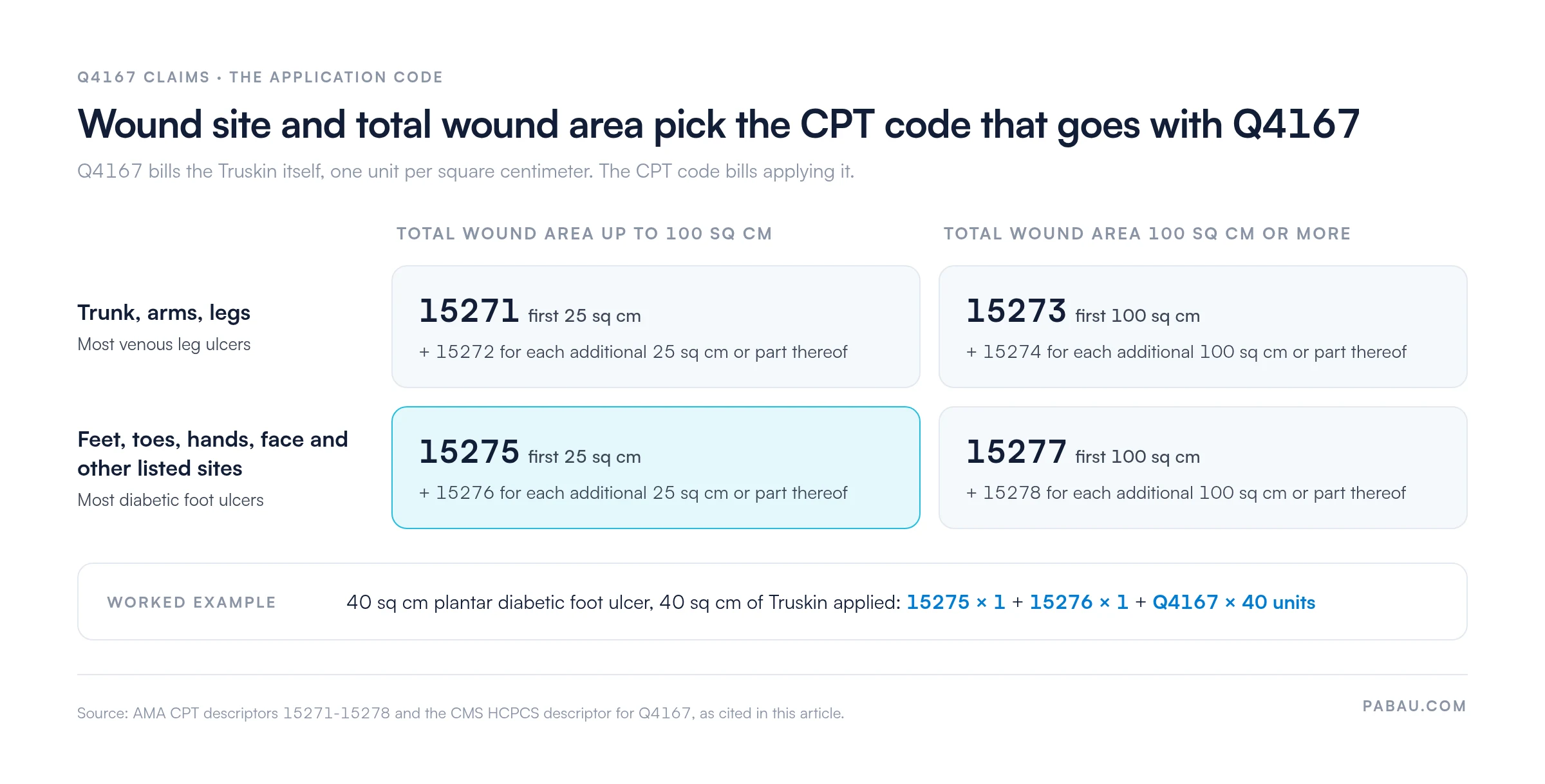
Take a 40 sq cm diabetic ulcer on the plantar foot, covered with 40 sq cm of Truskin. The claim carries 15275 for the first 25 sq cm and one unit of 15276 for the remaining 15. Q4167 then goes on as 40 units.
Mismatching the site and the CPT pair is an easy audit trigger. Lower-leg VLUs belong under 15271-15274, while foot and toe DFUs belong under 15275-15278. Our 15271 guide covers the application side in more depth.
Every Q4167 claim needs an ICD-10-CM code that satisfies the MAC’s LCD. It should describe both the wound and the condition behind it. Vague diagnosis codes are a common reason these claims get denied.
Code to the most specific level the note supports. An unspecified severity code only fits when the chart doesn’t record wound depth. If the note describes full-thickness tissue loss, the claim should say so as well.
Q4167 covers a single product, Truskin. The codes on either side of it belong to other manufacturers’ products, so they can’t be swapped in. Bill the wrong one and you get a product-mismatch denial that’s hard to appeal without proof of what was applied.
Q4166 in the first row is Cytal Wound Matrix, a porcine urinary bladder matrix made by ACell. Coders sometimes read Q4167 as a larger size of Cytal, and that mix-up bills the wrong manufacturer’s product.
Q4165 sits one step below Q4166 and covers Keramatrix and Kerasorb, two keratin-based skin substitutes. It bills per square centimeter with a CPT 15271-15278 application code, exactly as Q4167 does.
Match the Q-code to the product using the current CMS quarterly HCPCS file, or confirm it in the AAPC Codify HCPCS lookup. When a product moves to a new Q-code, billing the old one earns a retired-code denial.
Traditional Medicare doesn’t require formal prior authorization for Q4167, but most Medicare Advantage and commercial plans do. Skin substitutes are high-cost products, so these plans add their own approval step on top of the LCD criteria. A pass under the MAC’s rules doesn’t guarantee approval from a Medicare Advantage plan.
Keep a running list of which patients hold active authorization for Q4167 and when each approval expires. Product applied after approval lapses, or beyond the approved units, leads to a non-covered-charge denial. For Medicare beneficiaries, that charge can’t simply be passed on to the patient.
Medicare sets Q4167 payment through the OPPS Addendum B and the Physician Fee Schedule (PFS). OPPS rates update quarterly and the PFS updates yearly. Because the rate moves, this guide doesn’t quote a fixed dollar amount.
Instead, look up the current figure in the CMS Physician Fee Schedule search tool, or download the latest OPPS Addendum B file. In facility settings, the OPPS payment indicator shows whether Q4167 is paid separately or packaged into the APC payment.
The good news is that most Q4167 denials are preventable. A high-cost product, strict LCD criteria and frequent prior authorization rules mean small misses get caught. The table pairs each common cause with its fix.
When a denial does arrive, the remittance code tells you which of these causes you’re facing. Our guide to decoding denial codes maps each one to its next step.
Before each Q4167 application, capture three details in the note: wound measurements in centimeters, the product lot number and an active prior authorization number. Recording them at the point of care is far easier than rebuilding them after a denial.
Run through this list before a Q4167 claim leaves the practice. Each item is one that reviewers often find missing on denied skin substitute claims.
If an item is missing, fix it before the claim goes out. Rebuilding a record after a denial takes far longer than completing it on the day.
In many wound care practices, the biller builds each Q4167 claim by hand. Measurements come from the note, units from the invoice and the authorization number from an email. Every hand-off is another chance for those numbers to drift apart.
Pabau, the practice management platform we build, offers cleaner claims management by starting from the patient record. The code attached to the service lands on the charge line, and diagnosis codes come from the patient’s problem list. A HCPCS, CPT and ICD-10 lookup library sits beside each field.
The claim won’t send until required fields, such as the authorization number, are filled in. In the US, claims go out through Claim.MD, with eligibility checks and remittance posting built in. As a result, your biller spends less time chasing numbers, and fewer claims bounce for missing details.
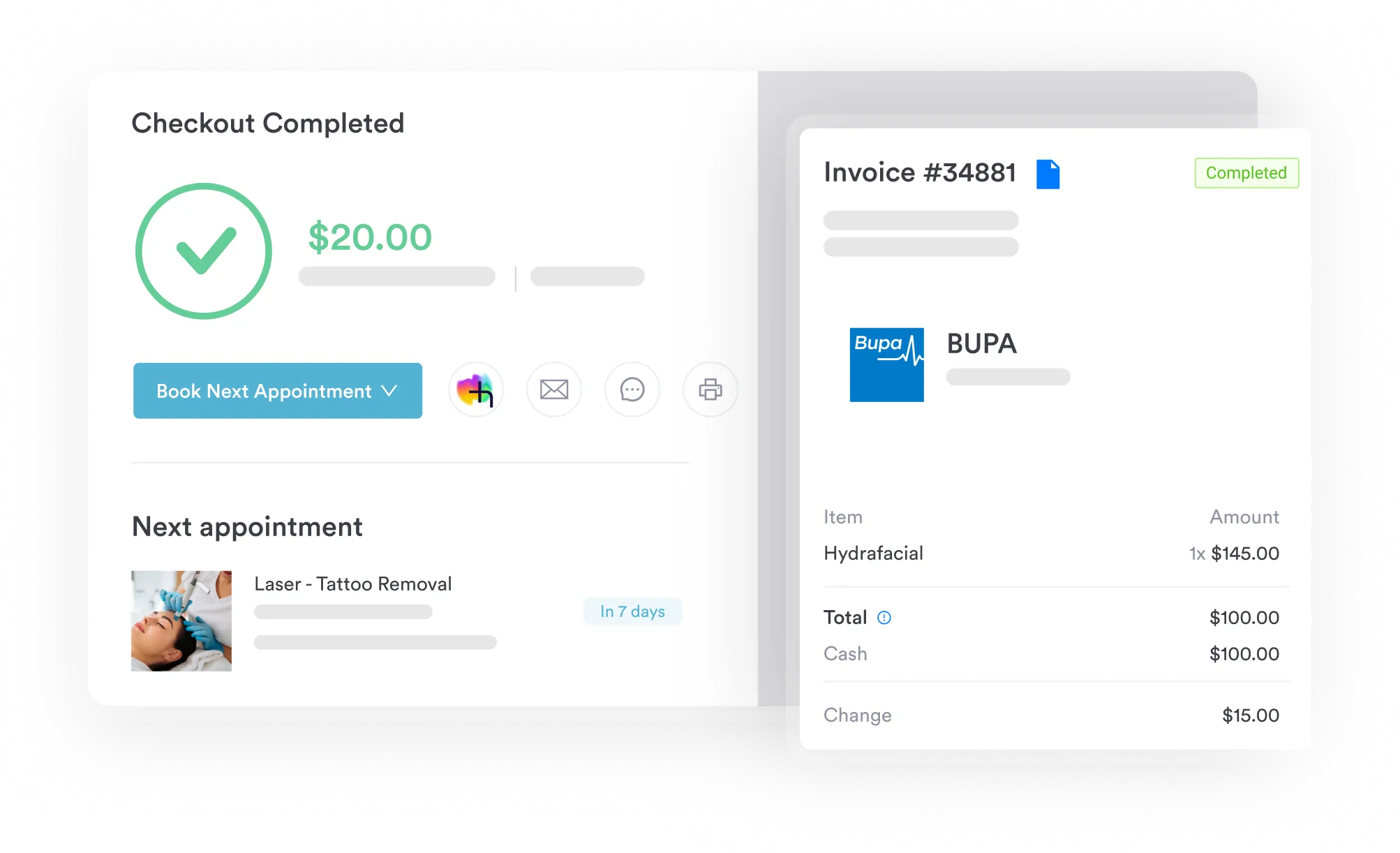

Pabau pre-fills each claim from the patient record and holds it until required fields like the authorization number are complete. That means fewer wound care claims come back for missing details.

A Q4167 claim is won or lost before anyone opens the billing screen. When the measurements, the lot number and the authorization are in the chart on the day of service, the claim is simple to build. When they’re missing, even a skilled coder can’t rebuild them later.
So make those three details a habit at the point of care, and audit a handful of claims each month against your MAC’s LCD. It costs a minute or two per visit, which is far less than working through refund requests and appeals.
Book a demo to see how Pabau carries skin substitute claims from the treatment note to the payer with every required field in place.

Dealing with repeat skin substitute denials? Denial management in healthcare sets out a workflow for investigating, appealing and preventing claim rejections.
Want the application side of the claim? CPT code 15271 explains how skin substitute graft application is billed on the trunk, arms and legs.
Billing another skin substitute? HCPCS code Q4127 walks through Talymed units, application codes and payment.
Need a refresher on the revenue cycle? What is medical billing? explains how a claim moves from visit to payment in US practices.
Worried about audit exposure? Medical billing compliance covers the rules and habits that keep claims audit-ready.
It depends on who bills the product. A physician office reports Q4167 on the CMS-1500 (or its 837P electronic version). A hospital outpatient department reports it on the UB-04 (837I), alongside its revenue codes.
Only if the patient signed a valid Advance Beneficiary Notice of Noncoverage (ABN) before the product was applied. Without an ABN, a medical-necessity denial generally can’t be shifted to the Medicare patient. Record the ABN with the GA modifier on the claim.
Yes, where state scope-of-practice rules and the payer allow nurse practitioners to apply skin substitutes. The NP reports the claim under their own NPI. Medicare generally pays the application code at 85% of the physician fee schedule rate.
Usually, yes. Most payers tie an approval to a specific wound, product, unit count and date range. A new wound, a switch in product or extra applications normally means a new or amended request.