CPT code 93503: Swan-Ganz catheter billing and modifiers
CPT code 93503: Official descriptor and procedure overview In the AMA CPT code s...

Last Updated: Oct 23, 2026
B2913 is the CCSD code for reconstruction of breast using latissimus dorsi including implantation of prosthesis (including delayed reconstruction). It covers the flap harvest, tunneling and implant placement as one surgical fee.
Use it when the reconstruction happens in its own operative episode, after the mastectomy. A mastectomy with immediate latissimus dorsi reconstruction in the same episode is billed under B2912 instead.
Let Pabau's smart automation suggest the right codes, reduce claim denials, and keep your practice compliant—effortlessly.
Automate repetitive tasks and focus on what matters most—your patients.
Reduce coding errors and ensure compliance with the latest regulations.
Clean claims, fewer denials, and faster reimbursements.
Powerful insights and reporting to help your practice thrive.
HIPAA compliant SOC 2 certified GDPR-compliant Trusted by 4,000+ clinics worldwide

CCSD code B2913 covers LD flap plus prosthesis breast reconstruction, including delayed reconstruction. Immediate reconstruction performed with a mastectomy is billed under B2912.
Both components, the flap and the prosthesis, must be confirmed in the operative note for the claim to be accepted.
Get pre-authorization from the insurer before the procedure. Claims without a valid pre-auth number are routinely rejected.
Pabau, the practice management platform we build, pre-fills CCSD claims from the patient record and sends them to Healthcode for UK private practices.
CCSD code B2913 is listed in the Classification of Surgical and Diagnostic Codes schedule. Its official descriptor reads: Reconstruction of breast using latissimus dorsi including implantation of prosthesis (including delayed reconstruction). The descriptor matters in three ways.
First, it bundles two surgical components into a single code. The surgeon harvests and transposes the latissimus dorsi muscle flap, then places a breast prosthesis at the reconstruction site.
Second, the parenthetical “including delayed reconstruction” confirms the code covers reconstruction in its own operative episode, weeks, months or years after the mastectomy. A mastectomy with immediate latissimus dorsi reconstruction in the same episode has its own code, B2912. In a delayed case the mastectomy was billed earlier, under a code such as B2743.
Third, the code sits in the CCSD schedule that major UK private medical insurers use for claim adjudication. Our Bupa CCSD codes guide shows how one of those insurers applies the schedule.
The table below summarizes the code’s key attributes as they appear in the CCSD schedule.
Codes in the CCSD schedule are updated periodically, so check you are working from the current release before submitting a claim. The searchable CCSD codes library lists the neighboring breast codes in the same reference layout.
The latissimus dorsi flap is a myocutaneous flap taken from the patient’s upper back. The surgeon harvests a paddle of skin and the underlying latissimus dorsi muscle, keeping the neurovascular pedicle intact. The flap is then tunneled under the skin to the front of the chest wall. A breast prosthesis is then placed beneath the transposed muscle to create volume. For B2913, the operative note must document all three stages: Flap harvest, flap tunneling and prosthesis placement.
The procedure is performed under general anesthesia and is typically managed as an inpatient stay. The CCSD descriptor does not set a length of stay, so confirm the insurer’s expectations at pre-authorization. A recognized post-operative complication is seroma formation at the donor site on the back, which may require aspiration during follow-up. British Association of Plastic, Reconstructive and Aesthetic Surgeons (BAPRAS) guidance documents this complication. Any post-operative aspiration or wound management is billed separately.
Timing decides the code. When the latissimus dorsi reconstruction happens in the same operative episode as the mastectomy, the combined procedure is billed under B2912. Its descriptor reads “Mastectomy and immediate reconstruction of breast using latissimus dorsi”. B2913 covers LD flap and prosthesis reconstruction without a same-episode mastectomy, which includes delayed reconstruction.
In staged reconstruction, a tissue expander is sometimes inserted at mastectomy and exchanged for a permanent prosthesis later. If the LD flap is then added at the definitive reconstruction stage, B2913 applies. The earlier expander episode is coded separately. When the expander went in at the mastectomy, that episode is usually billed as B3012.
Understanding the scope of B2913 prevents both under-billing and unbundling errors. The table below sets out what the code bundles and what must be billed separately or verified per insurer.
The prosthesis device cost is a common source of confusion. The descriptor confirms that prosthesis implantation is within B2913 scope. Whether the insurer reimburses the device cost under the same line or as a separate supply item varies by insurer. Check the applicable insurer’s provider guide before submitting.
Choosing B2913 correctly requires ruling out closely related CCSD codes. The table below compares B2913 with the most commonly confused adjacent codes. Specific adjacent code numbers should be verified against the current CCSD schedule release, as code numbers are periodically updated.
Three questions settle the code when you review an operative note. Was the latissimus dorsi muscle harvested and used for the reconstruction? Was a prosthesis implanted? Was the mastectomy done in an earlier, separate episode? Three yeses point to B2913, and the grid below maps the other answers.
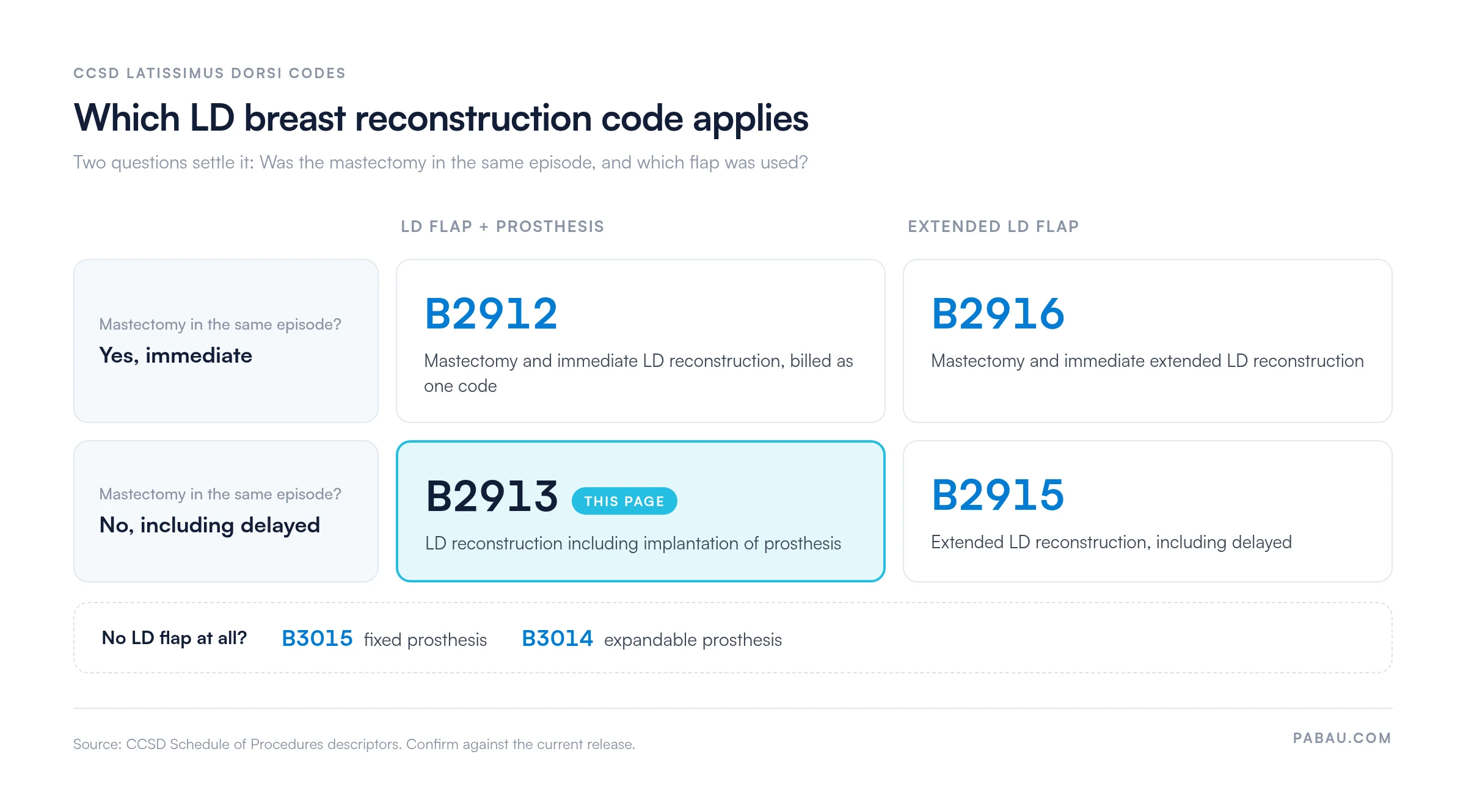
A prosthesis placed without any flap falls outside the LD family. It is coded as B3015 for a fixed implant or B3014 for an expandable one.
An abdominal free TRAM flap raised during the mastectomy is a different code family. That combined episode is billed under B2983.
A complete and valid B2913 claim requires specific documentation before submission via Healthcode or directly to the insurer. Missing any of these items is the most common cause of avoidable rejections.
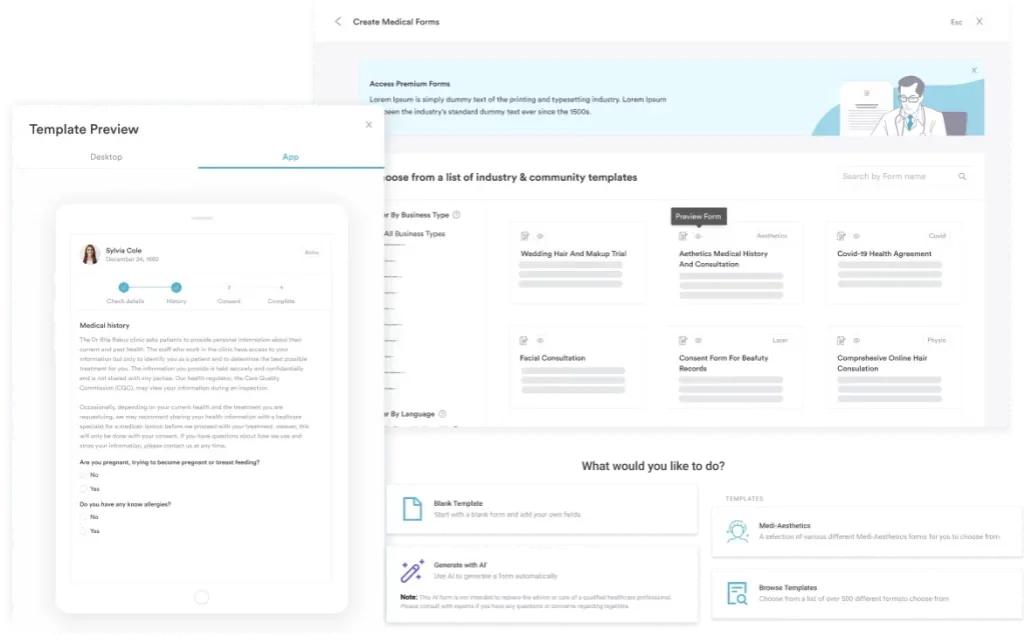
Practices using digital clinical forms can structure operative documentation to capture every required component at the point of care. That cuts the time spent chasing incomplete notes before claim submission.
Pre-authorization is a standard requirement for breast reconstruction across the major UK private medical insurers. Billing B2913 without a valid pre-authorization number will, in most cases, result in claim rejection. The process varies by insurer, so confirm requirements through each insurer’s provider portal before proceeding.
General guidance for the main UK private insurers:
Reconstruction following breast cancer treatment is generally considered clinically indicated by UK private insurers. Policy wording and exclusions, such as cosmetic enhancement beyond the reconstructed side, still need to be confirmed per policy. Insurers may also require the clinical justification letter from the consultant, particularly for delayed reconstruction performed some years after the mastectomy.
The reasons below cover the frequent B2913 rejections in standard UK private billing practice. Each one can be caught before the claim is sent.
Error-checking claims management software surfaces incomplete claim fields before submission. That catches the missing operative-note details and pre-auth references behind many of these denials.
Before submitting any B2913 claim, run a two-point check. Confirm the operative note explicitly names both the latissimus dorsi flap and the prosthesis implantation. Then confirm the pre-authorization number is still within its validity window. These two steps prevent most B2913 rejections at UK private insurers.
Healthcode is the primary electronic billing clearinghouse for UK private healthcare and the route through which most CCSD-coded claims reach insurers. For B2913, the submission process follows these steps.
B2913 covers the surgeon’s procedural fee only. The full billing picture for an LD flap reconstruction episode typically includes several associated codes. The table below sets out the most common additional billing elements and how they relate to B2913.
In a staged pathway, the B2913 claim should reference the earlier tissue expander episode where relevant. Some insurers will request the operative note from the expander insertion episode to confirm the staged pathway.
For staged reconstruction, keep a clear record linking the tissue expander insertion episode to the B2913 episode. Insurers reviewing delayed reconstruction claims often ask for the prior operative note to confirm the staged pathway was planned and clinically appropriate.
A typical billing team tracks pre-auth numbers in a spreadsheet and chases operative notes by email. The claim is keyed into Healthcode by hand, and a missing prosthesis line only surfaces when the insurer rejects it.
In Pabau, the operative note, the insurer details and the invoice sit in the same patient record. When the invoice is ready, Pabau pre-fills the claim and sends it to Healthcode, then tracks it from Pending to Paid.
For plastic and reconstructive surgery teams, that means fewer rejected claims to rework. It also leaves a clear record linking staged episodes, from the expander insertion to the definitive LD reconstruction.

Pabau keeps operative notes, insurer details and CCSD claims in one patient record, then sends the claim to Healthcode without re-keying.

Code the episode, not just the procedure. If the mastectomy happened in the same operation, the claim belongs under B2912. If the LD flap and prosthesis come in a later, separate episode, B2913 is the right call.
Once the code is settled, two checks decide whether the claim pays. The operative note has to name both the flap and the prosthesis, and the pre-authorization has to be valid on the day of surgery.
Get those right and a B2913 claim clears triage without a query. Book a demo to see how Pabau sends reconstruction claims to Healthcode straight from the patient record.

Need a broader guide to CCSD codes used by Bupa? Bupa CCSD codes guide covers the procedure codes, fee schedules, and submission requirements Bupa-recognized providers use most often.
Revising a reconstructed breast with fat transfer? CCSD code B3018 covers the documentation and pre-auth steps for a fat transfer revision.
Weighing an abdominal flap instead? CCSD code B2985 explains how free TRAM reconstruction is coded, including delayed cases.
Reconstructing with an implant alone? CCSD code B3015 covers fixed prosthesis reconstruction without a flap.
CCSD code B2913 covers breast reconstruction using the latissimus dorsi muscle flap plus implantation of a prosthesis, including delayed reconstruction. It bundles the flap harvest, tunneling and prosthesis placement into one billable unit. Anesthesia and contralateral symmetrization are billed separately. Immediate reconstruction with a same-episode mastectomy is billed under B2912 instead.
B2913 is used for delayed reconstruction, and for any LD flap and prosthesis reconstruction without a mastectomy in the same episode. When the LD reconstruction happens in the same operation as the mastectomy, the combined procedure is billed under B2912. For a delayed B2913 episode, get a new pre-authorization and reference the prior mastectomy in the claim.
The prosthesis implantation procedure is bundled within B2913, but whether the device cost itself is covered depends on the insurer’s policy. Some insurers include the implant as a hospital supply item within their fee schedule. Others require a separate supply line or treat it as a patient cost. Check the applicable insurer’s provider guide before submitting.
Yes. Major UK private insurers, including Bupa, AXA Health, Aviva and Vitality, require pre-authorization before a B2913 procedure is performed. Claims submitted without a valid pre-authorization number are rejected at triage. The pre-auth must cover the reconstruction episode itself, so a delayed reconstruction needs its own authorization.
The most frequent reasons are a missing or expired pre-authorization and an operative note that does not confirm both the LD flap and the prosthesis. Late submission, mismatched diagnosis codes and billing B2913 for a same-episode mastectomy also trigger rejections. Checking the note, the code and the insurer’s time limit before sending resolves most of them.
The CCSD descriptor does not specify laterality. Whether B2913 can be billed twice for a bilateral procedure, or needs a modifier or extra approval, depends on insurer policy. Confirm bilateral coding requirements with each insurer before submitting, as incorrect bilateral coding is a known denial trigger.