

CCSD code G5100: Bypass of duodenum billing guide
CCSD code G5100 bills a bypass that leaves the duodenum in place CCSD code G5100...

Last Updated: Oct 16, 2026
Q4127 is the HCPCS Level II code for Talymed, per square centimeter (add-on, list separately in addition to primary procedure). Talymed is a wound matrix made from poly-N-acetyl glucosamine, a polymer taken from marine microalgae. You report it beside a skin substitute application code from CPT 15271-15278.
Each unit is one square centimeter applied, so the unit count has to match the wound measurements in the chart. Most Q4127 denials trace back to that count, the choice of application code, or coverage rules that now differ by Medicare contractor.
Let Pabau's smart automation suggest the right codes, reduce claim denials, and keep your practice compliant—effortlessly.
Automate repetitive tasks and focus on what matters most—your patients.
Reduce coding errors and ensure compliance with the latest regulations.
Clean claims, fewer denials, and faster reimbursements.
Powerful insights and reporting to help your practice thrive.
HIPAA compliant SOC 2 certified GDPR-compliant Trusted by 4,000+ clinics worldwide

Q4127 reports Talymed per square centimeter and always sits beside an application code from CPT 15271-15278.
One unit equals one square centimeter, so a 4.2 cm by 3.8 cm wound bills as 16 units.
Wound location and total wound size choose the primary code, with 100 sq cm as the dividing line.
CMS withdrew the planned skin substitute LCDs before January 1, 2026, so coverage rules still differ by MAC.
From 2026, Medicare pays skin substitutes as incident-to supplies at a flat $127.14 per sq cm in the office setting.
HCPCS code Q4127 is the Level II supply code for Talymed, a skin substitute applied to chronic wounds. The Centers for Medicare and Medicaid Services (CMS) maintains it, and its official descriptor reads: Talymed, per square centimeter.
In practice, the code does one job. It tells the payer how much product went on the wound, while a separate CPT code covers applying it.
Q-series codes are temporary codes for products that don’t yet have a permanent HCPCS or CPT code. Even so, Q4127 has survived several update cycles. It appears in the 2026 HCPCS alpha-numeric file, so it’s valid for current-year claims.
Talymed is an acellular wound matrix made by Marine Polymer Technologies. Its base is poly-N-acetyl glucosamine (pGlcNAc), a polymer extracted from a marine diatom, which is a type of microalgae. That sets it apart from human amnion allografts, fish skin grafts and synthetic scaffolds.
Here’s what a biller needs to know about the product itself:
Because Q4127 names Talymed specifically, it can’t stand in for any other matrix. The product name in the chart has to match the product on the claim. If Truskin went on the wound instead, the supply line belongs under Q4167.
Q4127 never goes on a claim alone. It always follows a primary CPT code that describes applying the skin substitute. According to AAPC coding guidance, those primary codes are the AMA application codes 15271 through 15278.
Two facts pick the right one. First, where is the wound? Second, how large is the total wound area? The grid below maps both choices, then shows how the Q4127 line follows.
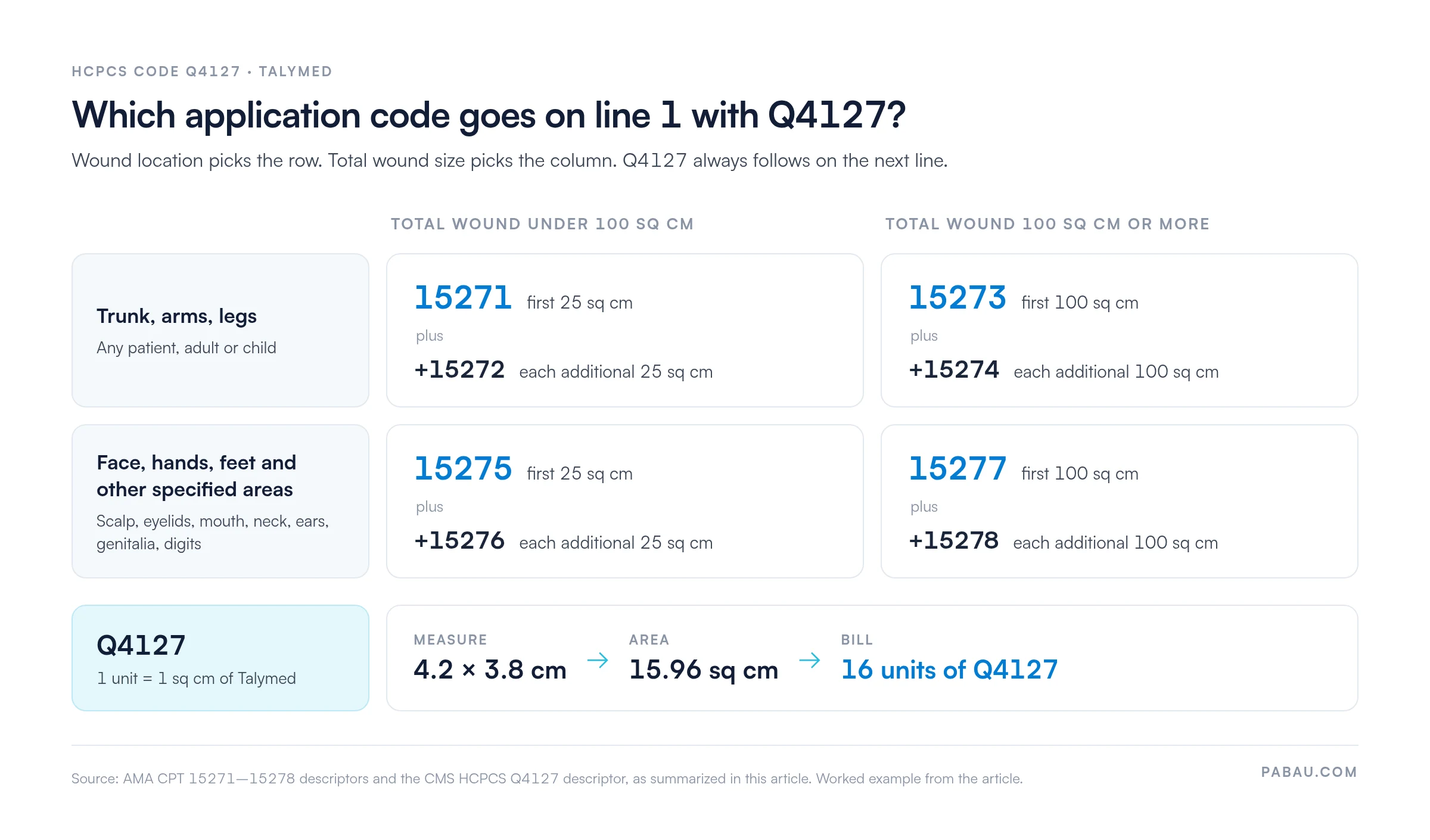
The most common application code is 15271, since many leg ulcers stay under 25 sq cm. Leaving it off the claim, or dating it differently from Q4127, is one of the fastest routes to a denial.
Once the code pair is settled, the claim itself takes four steps:
Each unit of Q4127 is one square centimeter of Talymed applied to the wound. So the unit count is only as good as the measurement behind it. Rounding errors and missing measurements are among the top reasons these claims fail review.
Worked example: a wound measuring 4.2 cm by 3.8 cm has an area of 15.96 sq cm. Rounded, that’s 16 units of Q4127 on the claim.
Record wound dimensions in centimeters every time Talymed goes on, not only at the first consultation. Payers compare the note against the units billed. A measurement from a previous visit won’t support today’s claim.
Talymed sits in a long run of skin substitute Q-codes, and the product names blur together on a busy billing screen.
A wrong code brings a technical denial, and you can’t appeal that on medical necessity grounds. The table compares Q4127 with two codes it’s often mixed up with.
The quickest way to tell them apart is the source material. Q4132 and most other skin substitute Q-codes describe human amnion or allograft products. Billing Q4132 when Talymed was applied misrepresents the claim, and that exposes the practice to audit risk under the False Claims Act.
Source material points to codes outside this table as well. A porcine small intestinal submucosa matrix, such as Oasis Ultra, bills under Q4124 instead.
Medicare has no single national coverage policy for Talymed. Coverage comes from local coverage determinations (LCDs) written by each Medicare Administrative Contractor (MAC), and those policies don’t match.
CMS had planned to replace them with uniform skin substitute LCDs, L39756 and L39764, the successors to L35041. Those were finalized, then withdrawn on December 24, 2025, before their January 1, 2026 start date.
As a result, only a few MACs, such as Novitas, CGS and First Coast, still run active legacy policies. Check your own MAC’s policy before the first application.
Where a legacy LCD applies, its criteria usually look like this:
Whether you need prior authorization (PA) depends on who pays. Traditional Medicare doesn’t require it everywhere, but MAC criteria often work like a documentation check before payment.
Medicare Advantage and commercial plans, on the other hand, usually want PA for any skin substitute. So it pays to add a PA check to intake.
Good documentation prevents more Q4127 denials than any other step. When a chart element is missing, the payer can deny on medical necessity instead of a technical error. Those denials are much harder to overturn. Capture these elements at every Talymed visit:
Run through these six checks before the claim leaves the building:
Most Q4127 denials trace back to a handful of causes. Once you know the pattern, you can catch each one before it reaches the remittance.
When a denial does land, the claim adjustment reason code (CARC) on the remittance tells you which row applies. Our guide to medical billing denial codes explains what each CARC means and how to respond.
Where Talymed is applied changes which fee schedule pays and whether the practice or the facility bills the product. It’s easy to overlook, and it’s a frequent audit finding.
For example, a hospital-affiliated wound care practice that bills with POS 11 is claiming the office rate for a facility visit. Auditors look for that mismatch, and it leads to recoupment.
From 2026, Medicare pays Q4127 at one flat rate. The CY2026 Physician Fee Schedule final rule reclassified skin substitute grafts as incident-to supplies.
In the non-facility setting, they now pay a flat $127.14 per sq cm, which replaces per-product average sales price (ASP) pricing.
Take the 16-unit worked example from earlier. At the flat rate, that line comes to about $2,034 before any locality adjustment or patient cost sharing. Under ASP pricing, the same wound could pay very differently from one product to the next.
To check your local figure, use the CMS Physician Fee Schedule lookup tool and search Q4127 for your MAC locality.
You can also cross-check with the PGM Billing HCPCS lookup tool, which mirrors CMS data. Then compare each remittance against the expected amount, so underpayments surface early.
Update your expected reimbursement amounts every January. CMS usually publishes the final Physician Fee Schedule rule in November, effective January 1. If the old rate stays in your system, underpayments can slip through without anyone noticing.
Many wound care practices still build skin substitute claims by hand. Someone copies the wound size from the note, works out the units and keys in two codes. Each of those steps is a chance for a mismatch.
Practice management software like Pabau shortens that route. Its claims management that pre-fills the CMS-1500 pulls codes and diagnoses straight from the patient record.
A built-in HCPCS and CPT lookup helps staff find Q4127 and its application code fast. The claim can’t be sent until required fields, such as authorization numbers, are complete.
For US practices, claims go out through Claim.MD, with eligibility checks up front and remittances posted back automatically. That means fewer rekeyed claims and an earlier warning when a Q4127 payment falls short.

Pabau pre-fills claims from the patient record and checks required fields before submission. See how it keeps Q4127 units and codes in step with the chart.

Q4127 is simple on paper and easy to get wrong in practice. The code itself rarely causes the trouble. Denials come from the steps around it. Think of a primary code that does not fit the wound size, a measurement from the wrong day, or a MAC-specific coverage rule.
The 2026 flat rate makes each unit easier to predict, which makes accurate units matter more. So build the measurement into every Talymed visit, and check your MAC’s policy whenever it changes.
Once that routine is in place, the claim mostly takes care of itself. Book a demo to see how Pabau carries wound measurements from the note onto the claim.

Billing a different skin substitute? HCPCS code Q4132 covers Grafix Core, the human amnion graft most often confused with Talymed.
Working with dehydrated amnion products? HCPCS code Q4150 explains AlloWrap billing, units and the ICD-10 codes that support it.
Need the procedure side of the claim? CPT code 15271 walks through the application code that sits on line 1 beside Q4127.
Comparing other wound matrices? HCPCS code Q4162 breaks down another per-sq-cm skin substitute and its billing rules.
Want fewer claims coming back? What is a clean claim lists the checks that get a claim paid on the first submission.
No. Talymed is made from poly-N-acetyl glucosamine taken from marine microalgae. Fish skin grafts, such as Kerecis Omega3, are intact fish skin and bill under their own code, Q4158. Code the product named on the package.
Code the wound, not the graft. A diabetic foot ulcer usually pairs E11.621 with an L97 code for the ulcer’s site and depth. A venous ulcer pairs an I83 or I87 code with L97. Check your MAC’s covered diagnosis list, too.
Only when the visit handles a significant, separately identifiable problem. The application codes carry a zero-day global period, so a routine wound check is part of the procedure. In that case, add modifier 25 to the E/M and document why it stood apart.
Talymed is cleared for surgical and traumatic wounds. However, Medicare’s legacy LCDs mostly cover diabetic foot ulcers and venous leg ulcers. Before applying it to another wound type, confirm your MAC’s policy and get PA from other payers.



