CPT code 93503: Swan-Ganz catheter billing and modifiers
CPT code 93503: Official descriptor and procedure overview In the AMA CPT code s...

Last Updated: Oct 23, 2026
59840 is the CPT code for induced abortion, by dilation and curettage. It covers cervical dilation and curettage of the uterus, including suction curettage (vacuum aspiration). The procedure is normally performed in the first trimester, under 14 weeks.
It is distinct from 59841 (dilation and evacuation), 59820 (missed abortion) and 58120 (non-obstetric D&C). Most elective claims pair it with Z33.2, and an O04 code applies only when a complication is documented.
Let Pabau's smart automation suggest the right codes, reduce claim denials, and keep your practice compliant—effortlessly.
Automate repetitive tasks and focus on what matters most—your patients.
Reduce coding errors and ensure compliance with the latest regulations.
Clean claims, fewer denials, and faster reimbursements.
Powerful insights and reporting to help your practice thrive.
HIPAA compliant SOC 2 certified GDPR-compliant Trusted by 4,000+ clinics worldwide

CPT 59840 covers induced abortion by dilation and curettage, including suction curettage, and is normally used in the first trimester (under 14 weeks).
ICD-10-CM Z33.2 is the primary diagnosis code for an elective termination encounter, and the O04 series applies only when complications are documented.
CMS assigns a 10-day global period to CPT 59840, so routine follow-up within 10 days is bundled and cannot be billed separately.
Pabau, the practice management platform we build, submits 59840 claims through Claim.MD, checks eligibility in real time, tracks claim status, and posts ERA remittances.
CPT code 59840 describes “induced abortion, by dilation and curettage.” The provider dilates the cervix and empties the uterus with a curette, and that includes suction curettage (vacuum aspiration). The procedure is usually performed in the first trimester, under 14 weeks, but the descriptor sets no trimester limit.
The American Medical Association maintains it in the maternity care and delivery subsection (59000-59899).
Key clinical components bundled within 59840:
The code is billable under standard AMA CPT coding rules for Part B professional services. Facility and non-facility settings each carry separate reimbursement rates from CMS.
These four codes share overlapping terminology but describe clinically and legally distinct procedures. Selecting the wrong one is the most common cause of payer rejections on obstetric D&C claims.
Key distinction: 59840 requires an active, ongoing pregnancy with documented intent to terminate. 59820 applies only when the fetus has already died (missed abortion). 59841 is for dilation and evacuation, which is usually a second-trimester procedure. 58120 applies to non-pregnant patients undergoing D&C for gynecologic indications such as abnormal uterine bleeding or polyps.
The chart below turns that choice into three questions, asked in the order a coder reads the operative note.
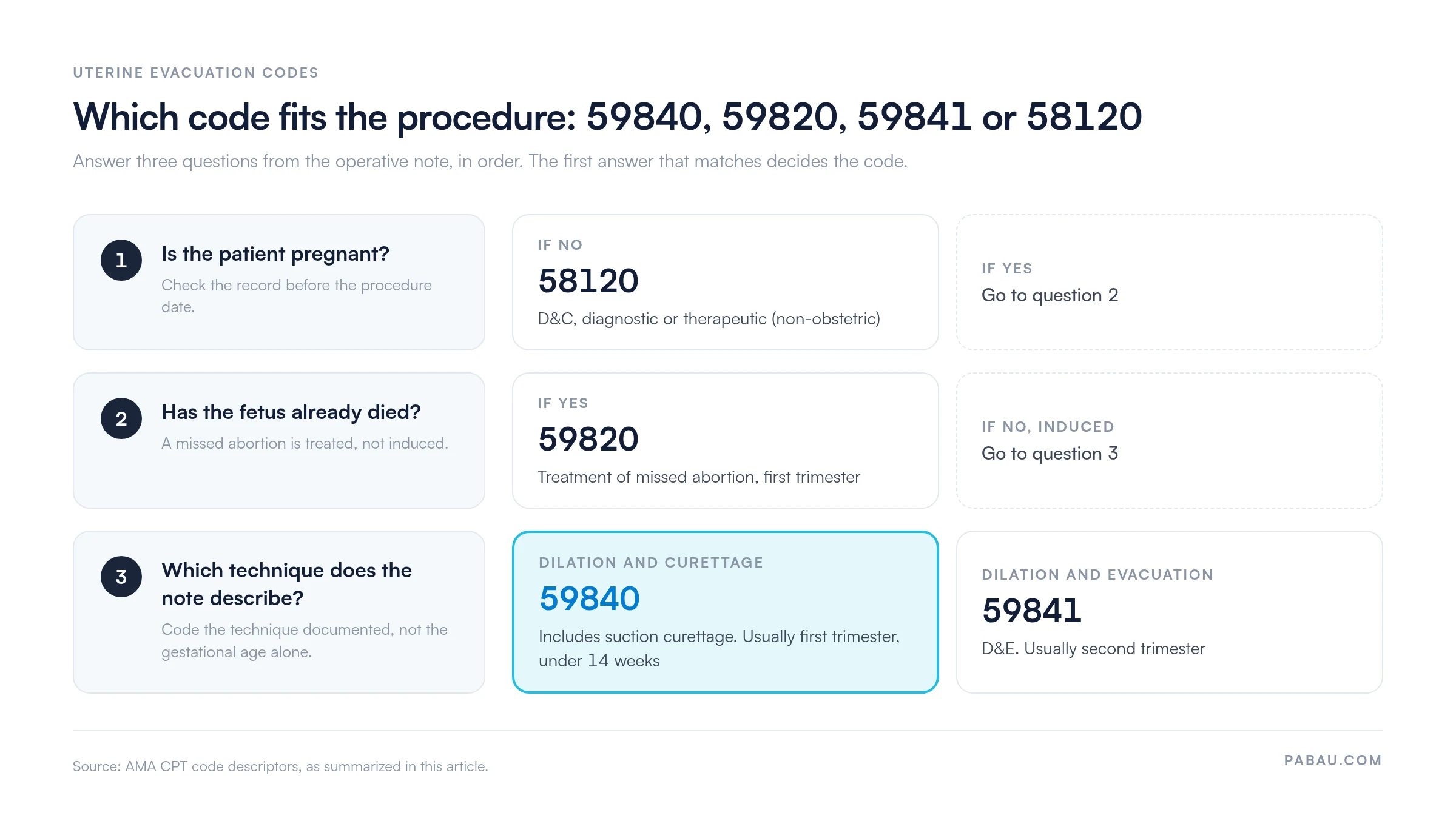
Every CPT 59840 claim requires a supporting ICD-10-CM diagnosis code. Payer systems run automated medical necessity edits against these pairings before adjudication.
Important: Several state Medicaid programs restrict which ICD-10-CM codes are reimbursable for induced abortion procedures and which need separate prior authorization. Check the payer’s accepted code list before submitting.
Z33.2 fits an uncomplicated elective procedure, while an O04 code belongs on a claim that documents a complication. Hemorrhage after the procedure is O04.6, not O04.81. Verify every code against the current tabular list in the CDC/NCHS ICD-10-CM web tool.
Modifiers change how CPT 59840 is adjudicated without altering the procedure code itself. Incorrect modifier use is a leading cause of payer downcoding and post-payment audits. Modifier -59 is checked against National Correct Coding Initiative (NCCI) edits, which flag code pairs that are normally bundled.
Modifier -22 requires a written addendum to the operative report explaining the specific factors that increased complexity. Without it, payers will process 59840 at the standard rate and deny the upcharge. Many commercial payers require a separate appeal with supporting documentation before paying any -22 increase.
CPT 59840 carries a 10-day global surgical period under the CMS Medicare Physician Fee Schedule. All routine follow-up care within 10 days of the procedure date is bundled into the 59840 payment and cannot be billed separately.
What the global package includes:
What can be billed separately during the global period:
Anesthesia billing: Anesthesia for CPT 59840 is not bundled into the surgical global package. The anesthesia provider reports it separately with 01966, the anesthesia code for induced abortion procedures. The surgeon’s 59840 claim and the anesthesiologist’s claim are adjudicated independently. Coordinate submission so payer systems don’t flag them as duplicate services.
Run your CPT 59840 claims through a pre-submission edit check that flags global period conflicts. If a follow-up E/M visit is submitted within 10 days without modifier -24 and a distinct diagnosis code, most commercial payers will auto-deny it. Catching this before submission saves the appeals cycle.
A complete operative report is the minimum documentation threshold for any 59840 claim. Missing or vague documentation is the second most common denial driver after incorrect diagnosis code pairing. A pre-submission checklist built on the elements below catches most of these errors before the claim goes out.
Required documentation elements:
A CPT 59840 claim submitted without gestational age documentation will be denied by most payers as underdocumented. Ultrasound confirmation is the cleanest supporting document because it provides objective dating.
Prior authorization requirements for CPT 59840 vary significantly by payer and by state, so this is where proactive checks prevent the most denials. OB/GYN practices billing this code also need to stay current on medical billing compliance rules for reproductive health.
Reimbursement for CPT 59840 under Medicare and Medicaid reflects the procedure’s relative value unit (RVU) weighting and geographic adjustment factors. Use the CMS Physician Fee Schedule look-up tool to retrieve current national facility and non-facility payment amounts for 59840. For detailed RVU component breakdowns, FastRVU’s 2026 RVU lookup provides work, practice expense, and malpractice RVU values by code.
State Medicaid rates for CPT 59840 are set independently by each state’s Medicaid agency and can differ substantially from Medicare rates. States that cover the procedure broadly, such as California and New Mexico, typically publish fee schedule amounts in their provider manuals. Practices serving high Medicaid volumes should pull current state-specific rates before setting patient estimates.
CPT 59840 generates denials across a predictable set of failure points. Structured denial management workflows that address each of these before submission cut the rework cycle significantly.
Submit CPT 59840 claims electronically through Claim.MD from Pabau. Real-time eligibility checks confirm coverage before the procedure date, and claim status tracking shows which claims need follow-up.
CPT 59840 billing concentrates several risk factors in one code. Payer-specific authorization, state Medicaid variation, ICD-10-CM pairing, the 10-day global period, and NCCI edits each need their own check. Without software that connects the clinical and billing sides, staff manage those checks by hand across different systems.
Pabau’s claims management software handles the submission side of that workflow. Claims go to payers electronically through the Claim.MD clearinghouse, so nobody re-keys 59840 into a separate portal. Real-time eligibility checks confirm the patient’s coverage before the procedure date, while there is still time to act.
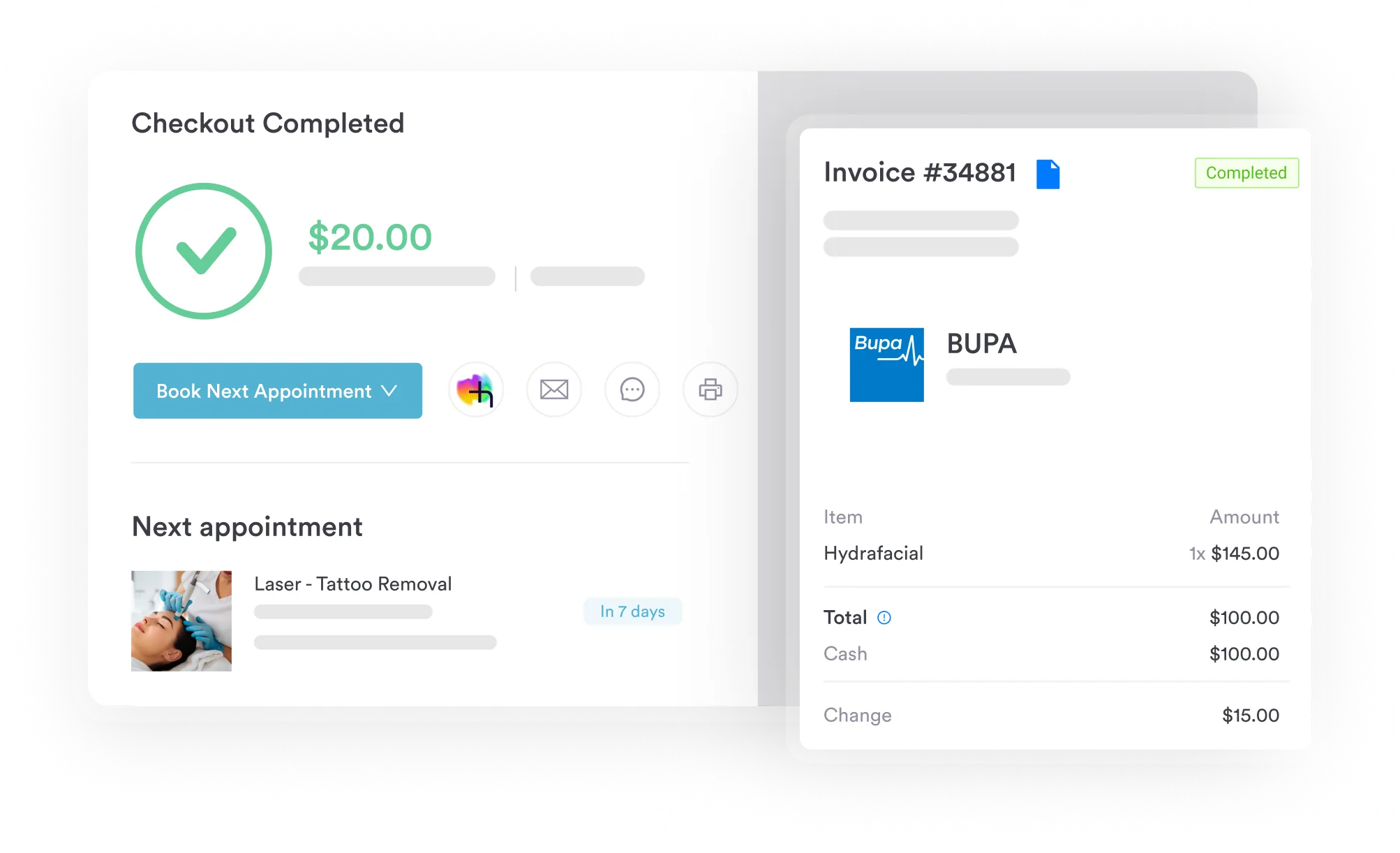
Claim status tracking shows where each submission stands after it leaves the practice. Payments arrive as electronic remittance advice (ERA), which Pabau posts against the claim. When a payer denies 59840, the ERA carries a claim adjustment reason code (CARC), and our guide to medical billing denial codes explains each one.

Pabau’s claims management submits CPT 59840 claims to payers through Claim.MD and checks patient eligibility in real time. Claim status tracking and ERA remittance posting show where every claim stands.

Claims for CPT 59840 rarely fail on the procedure itself. They fail when the record can’t show the technique, the gestational age, or the payer’s coverage terms.
So put the checks before the claim. Confirm coverage and any prior authorization at scheduling, code the technique the operative note describes, and save O04 codes for documented complications. That front-loaded work takes minutes per case, and it costs far less than reworking a denied claim.
Pabau handles the submission side, with electronic claims through Claim.MD, real-time eligibility checks, claim status tracking, and ERA posting in one place. Book a demo to see how Pabau keeps OB/GYN claims for codes like 59840 moving from submission to payment.

Want to see where CPT 59840 sits in the wider billing cycle? What is revenue cycle management explains how the billing pipeline connects clinical encounters to final payment, including where CPT code selection fits.
Treating an incomplete abortion rather than an induced one? CPT code 59812 covers surgical completion of an incomplete abortion, with its own diagnosis pairings and documentation.
Billing IVF or other reproductive health procedures as well? IVF CPT codes covers related reproductive health CPT codes with the same documentation and payer requirement framework.
Looking for denial reason code definitions to speed up 59840 appeals? Denial codes in medical billing breaks down the CARC and RARC codes that appear on remittance advice after a 59840 claim is rejected.
CPT code 59840 is the procedure code for induced abortion by dilation and curettage, including suction curettage (vacuum aspiration). It is normally used in the first trimester, under 14 weeks. Dilation and evacuation is reported separately with 59841.
CPT 59840 applies to an induced (intentional) termination of pregnancy by dilation and curettage. CPT 59820 applies to treatment of a missed abortion, where fetal demise has already occurred and the procedure removes retained products of conception. The deciding factor is pregnancy status at the time of the procedure.
Suction curettage and vacuum aspiration for an induced abortion are reported under CPT 59840, the same code as sharp curettage. If the procedure is a dilation and evacuation, usually in the second trimester, report 59841 instead.
Yes. CMS assigns a 10-day global period to CPT 59840, and routine follow-up visits within those 10 days are bundled into the payment. Bill a visit separately only when it is unrelated to the procedure (modifier -24). A return to the OR for a complication is billed with modifier -78.
Medicare covers CPT 59840 only in cases of rape or incest, or when continuing the pregnancy would endanger the mother’s life. Elective induced abortion is not covered under Medicare Part B, and billing Medicare for an elective procedure will result in a denial.
CPT 58120 covers dilation and curettage for non-obstetric gynecologic indications, such as abnormal uterine bleeding or diagnostic evaluation, in a non-pregnant patient. CPT 59840 covers an induced abortion by D&C in a pregnant patient, usually in the first trimester. The two codes are never interchangeable.