CPT Code 62284: Injection procedure for myelography
CPT Code 62284: official descriptor and procedure overview The American Medical ...

Last Updated: Oct 19, 2026
HCPCS code P9615 is the collection fee a laboratory bills when its trained technician catheterizes a patient to collect a urine specimen. Its official descriptor is "Catheterization for collection of specimen(s) (multiple patients)," and it pays $9.34 nationally in CY2026 under the Clinical Laboratory Fee Schedule.
The catch is eligibility. Medicare pays only when the patient is homebound or a non-hospital inpatient, and no qualified facility staff can collect the sample. For billers, that setting check decides whether the line pays or denies. The sections below walk through the payment conditions, the look-alike codes, and the travel add-ons, then finish with a pre-submit checklist.
Let Pabau's smart automation suggest the right codes, reduce claim denials, and keep your practice compliant—effortlessly.
Automate repetitive tasks and focus on what matters most—your patients.
Reduce coding errors and ensure compliance with the latest regulations.
Clean claims, fewer denials, and faster reimbursements.
Powerful insights and reporting to help your practice thrive.
HIPAA compliant SOC 2 certified GDPR-compliant Trusted by 4,000+ clinics worldwide

HCPCS code P9615 is a Clinical Laboratory Fee Schedule fee for catheterizing patients to collect urine specimens, with a CY2026 national rate of $9.34.
A laboratory’s trained technician bills it for homebound patients or non-hospital inpatients, and only when no qualified facility staff can collect the specimen.
Travel codes P9603 (per mile) and P9604 (flat rate) add a travel allowance, but only when a collection fee is payable for that patient.
P9615 is not a physician office code. CPT 51701 is paid under the Physician Fee Schedule and is billed by a different type of provider.
HCPCS code P9615 is a Level II code maintained by the Centers for Medicare and Medicaid Services (CMS). Its official descriptor is “Catheterization for collection of specimen(s) (multiple patients).” It sits in the P9612 to P9615 range, titled “Specimen collection, catheterization.”
In plain terms, it’s a collection fee. Medicare pays it under the Clinical Laboratory Fee Schedule (CLFS) for the skilled work of drawing urine through a catheter. It doesn’t pay for the test itself, and it isn’t a physician procedure.
The “multiple patients” wording is what separates P9615 from P9612, whose descriptor reads “single patient, all places of services.” Both codes pay the same CY2026 rate. So the choice comes down to how many patients the collection covered.
P9615 covers urine that a lab’s trained technician collects by catheter from a Medicare patient who can’t come to the lab.
CMS sets three conditions in the Medicare Claims Processing Manual, Chapter 16, section 60. A payable collection meets all of them.
The technician must collect the specimen personally. CMS uses “trained technician” for the staff who do this work, and the term carries no set educational requirement.
One more rule trips up billers. Only one collection fee is allowed per specimen type, per patient encounter, however many specimens are drawn. A series of specimens needed to complete one test still counts as a single encounter.
Because the conditions are so narrow, P9615 misses a lot of everyday catheter work. Each of these situations needs a different code, or no collection fee at all.
P9615 is often confused with CPT 51701, but the two codes sit in different payment systems. P9615 is a lab collection fee under the CLFS. CPT 51701 is a practitioner procedure paid under the Medicare Physician Fee Schedule.
The table below runs the decision in the order a biller should. Start with who collected the sample, then check where the patient was.
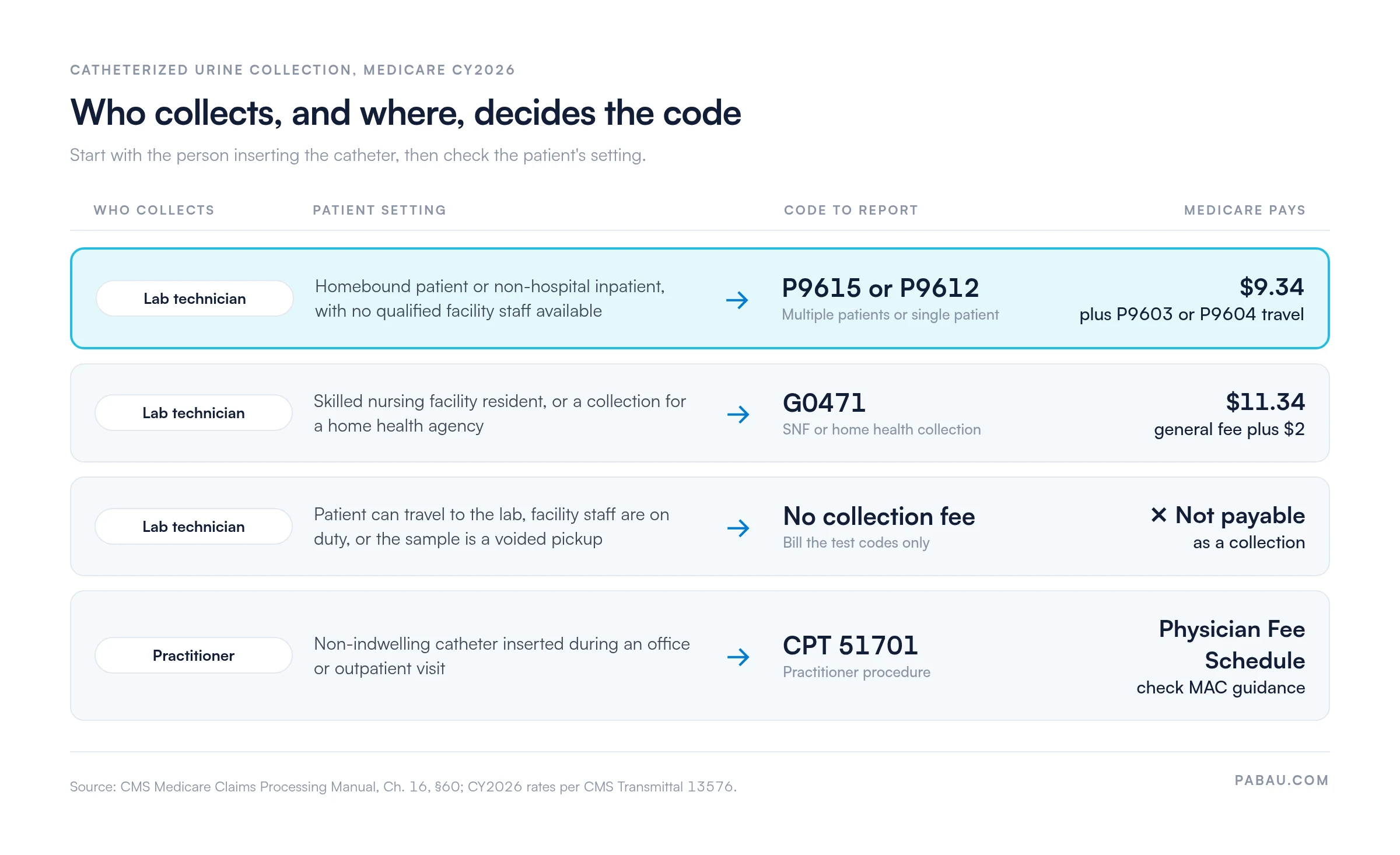
Here are the four codes side by side, with their descriptors and fee schedules.
Because a lab bills P9615 and a practitioner bills CPT 51701, the two rarely meet on one claim. Payer guidance varies for an office catheterization done only to obtain a specimen.
Check your Medicare Administrative Contractor (MAC) guidance before choosing between CPT 51701 and P9612 in that case.
Medicare adds a travel allowance to P9615 when the technician travels to the patient. It’s payable only when a specimen collection fee is also payable for that patient.
The CY2026 specimen collection and travel allowance update (Transmittal 13576) sets the CY2026 amounts.
The CY2026 mileage rate of $1.25 combines the IRS standard mileage rate ($0.725) with the phlebotomist wage component ($0.52), rounded up. The flat rate is the mileage rate multiplied by 10.
Eligible miles start and end at the lab, or at the technician’s starting and ending point. Miles driven for non-Medicare patients, personal errands, or stops with no collection don’t count.
A quick worked example: a technician drives a 30-mile round trip to catheterize two homebound Medicare patients at two addresses. The trip runs over 20 miles and covers two locations, so it bills as P9603. At $1.25 a mile, the trip is worth $37.50, and each patient’s share is $18.75.
Shorten that route to 16 miles and one address, and P9604 applies instead. The $12.50 flat fee is then split across the Medicare patients seen on that trip.
Medicare Part B pays P9615 at a CY2026 national rate of $9.34 when the collection meets the CMS conditions. The rate comes from the Clinical Laboratory Fee Schedule. So it has no facility and non-facility split, and no geographic practice cost adjustment.
Medicaid programs and commercial payers set their own rules for specimen collection fees. Check each payer’s fee schedule and policy rather than assuming Medicare’s homebound conditions apply.
Check the CLFS file each January. CMS updates the collection fee and the travel mileage rate every year, so last year’s amounts in your chargemaster will underbill or overbill.
A P9615 claim needs records explaining why a technician had to collect the specimen at the patient’s location. Keep these elements on file before you submit.
Labs may keep travel records electronically, including miles driven and the purpose of each trip. The records must be producible in a form CMS can review if it asks for them.
P9615 has no code-specific modifier. The lab reports it as its own line on the same claim as the CLFS test codes, with one unit per patient encounter. A clean claim usually builds in this order.
Most P9615 denials come from a collection that didn’t meet the CMS conditions. The table pairs each trigger with the step that prevents it. For the reason codes that come back on a rejected claim, see our guide to medical billing denial codes.
The table covers eligibility. These last checks catch the clerical slips that bounce an otherwise payable claim.
Labs and home collection teams bill P9615 alongside test codes and travel codes, often for several patients from one trip. Keeping each patient’s order, status, and claim together takes work when records sit in separate systems.
Practice management software like Pabau keeps patient records and billing in one place. Pabau’s claims software for billers pre-fills the claim form from the patient record, with a searchable HCPCS and CPT code library. It also checks that required claim fields are complete before you send the claim.
In the US, claims go through Claim.MD, with eligibility checks, claim status tracking, and remittance posting. Your team spends less time rekeying claims and more time on the ones that need follow-up.
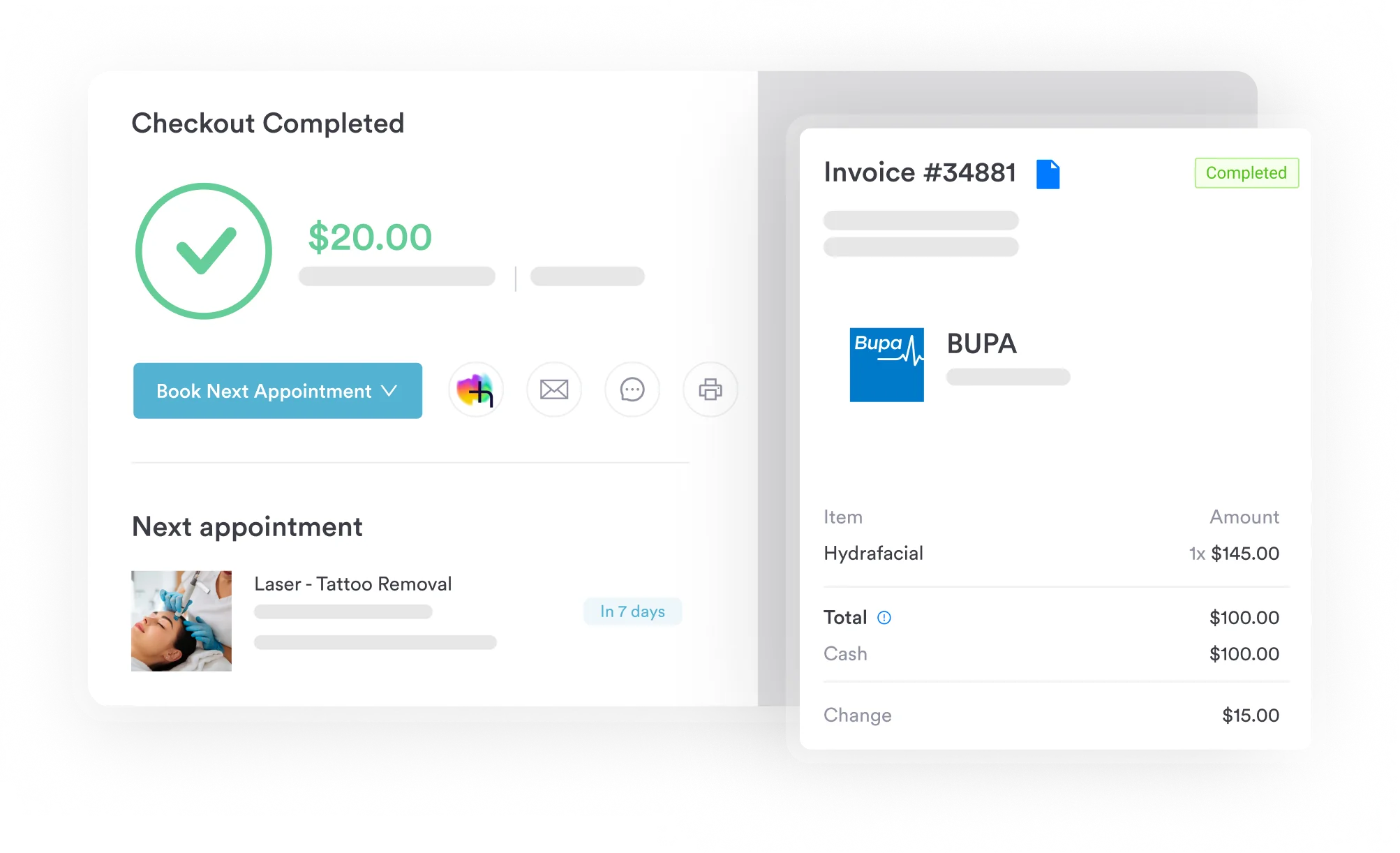

Pabau pre-fills claims from the patient record, checks required fields before submission, and tracks each claim through to payment.

P9615 is a small fee with strict gates. One denied $9.34 line barely registers, but the same slip repeated across a collection route adds up quickly. Each resubmission also costs more staff time than the fee is worth.
So put the setting check first. Confirm who collected the sample and where the patient was before anyone codes the line. Get that right, and the choice between P9615, G0471, and CPT 51701 mostly makes itself.
Book a demo to see how Pabau keeps test orders, patient status, and specimen collection claims together in one record.

Billing a short trip to one location? HCPCS code P9604 covers the flat-rate travel allowance that pairs with a payable collection fee.
Running a dipstick test on the specimen? CPT code 81003 explains how to bill automated urinalysis without microscopy.
Sending the sample for culture? CPT code 87086 covers the quantitative bacterial urine culture with colony count.
Collecting blood instead of urine? CPT code 36415 is the billing guide for routine venipuncture.
Need a complete picture of the medical billing process? Medical billing explained covers the end-to-end workflow from patient encounter to payment posting.
Yes. P9615 covers a straight, or in-and-out, catheter passed only to drain urine for testing and then removed. Placing an indwelling Foley catheter is a clinical procedure, so it never supports P9615.
No single diagnosis code belongs to P9615. Point the line to the diagnosis that supports the ordered test. That might be a symptom such as R30.0 (dysuria), or N39.0 (urinary tract infection, site not specified) once confirmed.
No. Medicare’s Part B deductible and 20% coinsurance don’t apply to specimen collection fees or to the travel allowance. The patient has no cost-sharing on the collection line.
No. A clean-catch sample is voided, so no catheterization took place. Picking up a voided sample counts as a messenger service, and Medicare doesn’t pay a collection fee for it.
Yes. P9615 is an active HCPCS Level II code, listed on the CY2026 Clinical Laboratory Fee Schedule at $9.34. CMS updates the rate every January, so confirm it each year.