



HCPCS code E0198: Water pressure pad billing guide
HCPCS code E0198 is a water pad for a standard mattress HCPCS code E0198 is the ...

Last Updated: Oct 13, 2026

CPT code 81003 covers urinalysis by dipstick, read on an automated analyzer, with no microscopic exam of the sediment.
Never bill 81003 and 81002 on the same date for one patient, because an NCCI edit bundles the pair.
Modifier QW applies only when your practice holds a CLIA Certificate of Waiver and the analyzer itself is waived.
Medicare prices 81003 on the Clinical Laboratory Fee Schedule, so the rate is small and MAC locality still moves it.
Pabau’s claims management software attaches CPT codes at the encounter level and submits claims through Claim.MD, our US clearinghouse partner.
CPT code 81003 covers a dipstick urinalysis read by an automated analyzer, with no microscopic exam attached. That one word, automated, is what separates it from CPT 81002 and decides which code you submit. Primary care, urgent care, and OB/GYN offices run the test several times a day.
Each one pays a few dollars, so the margin lives entirely in clean first-pass claims. Three details decide that. Did an instrument read the strip? Does Modifier QW belong on the line? And did 81002 land on the same claim by mistake? Get those right and 81003 stops showing up in your denial report.
CPT code 81003 sits in the Pathology and Laboratory chapter of the AMA CPT code set. Within that chapter it belongs to the Urinalysis Procedures range, codes 81000 to 81099.
The American Medical Association maintains the code set, and it prints 81003 in two parts. First comes the text shared across the family:
Urinalysis, by dip stick or tablet reagent for bilirubin, glucose, hemoglobin, ketones, leukocytes, nitrite, pH, protein, specific gravity, urobilinogen, any number of these constituents;
Then comes the part that belongs to 81003 alone, after the semicolon:
automated, without microscopy.
Two phrases in there do the work. “Automated” means an instrument read the reagent pad, not a person. “Without microscopy” means nobody examined the sediment under a lens.
Add a microscopic exam to the same specimen and the encounter moves to a different code.
That single row is the easy part. The trouble starts when you line 81003 up against its neighbors.
The difference is the analyzer. If an instrument reads the reagent strip, bill 81003. When a staff member reads the color change by eye, the code is 81002.
The rest of the two descriptors match, which is exactly why they get mixed up. Automation also drives CLIA waiver status and what the payer allows, so the choice is not cosmetic.
The urinalysis codes closest to 81003 sit between 81000 and 81005:
Two questions settle the choice faster than a five-row table does, and the grid below shows how they fall out.
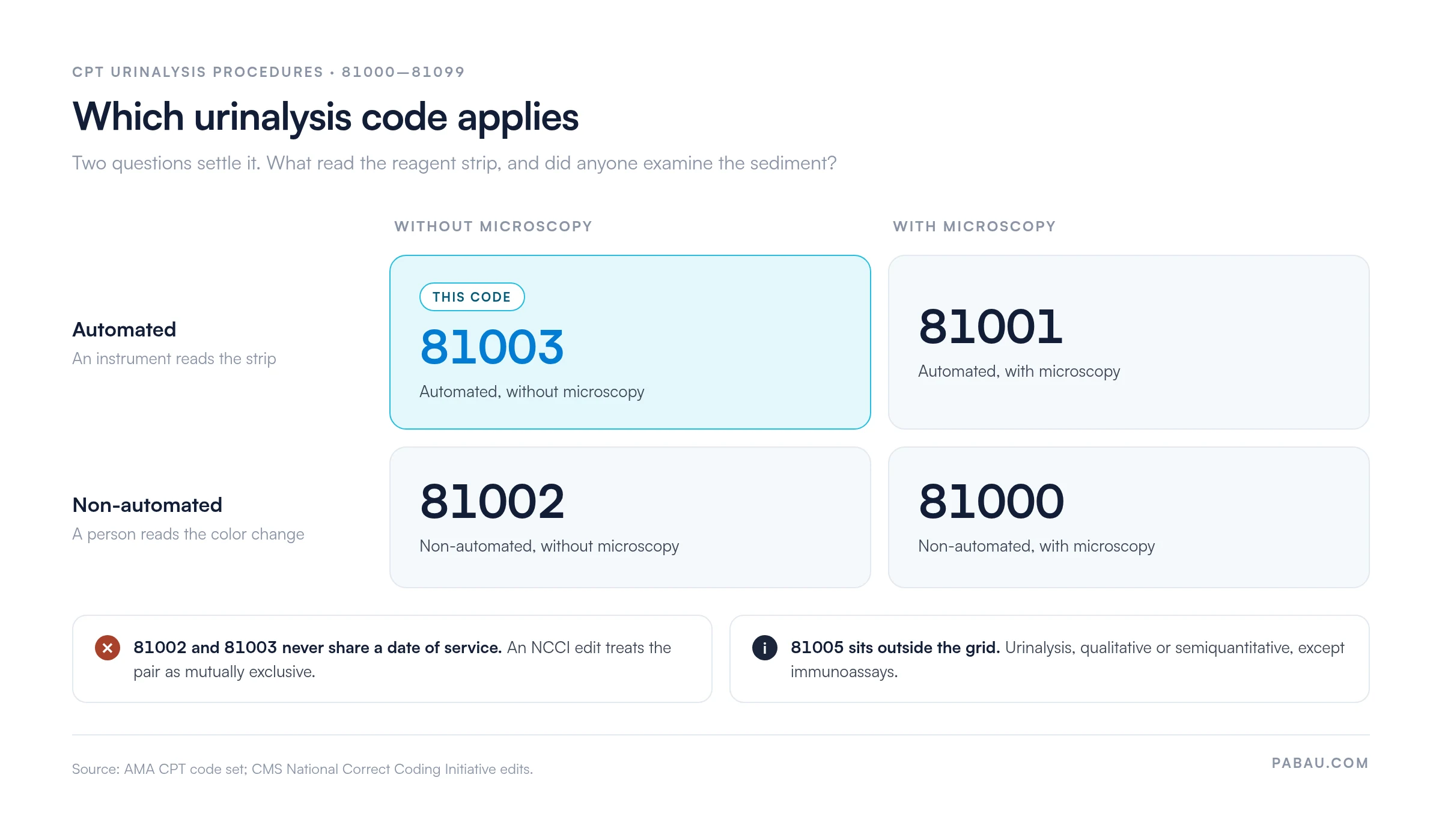
One pairing is off limits. CPT 81002 and CPT 81003 cannot go on the same date of service for the same patient. EmblemHealth’s published coding policy states it plainly, and it matches National Correct Coding Initiative (NCCI) edit logic. Submitting both bundles the lower-value code into the higher-value one. Catch it during charge review, not in the denial queue.
Use 81003 when the practice runs a dipstick on an automated analyzer and nobody orders a microscopic exam. These six visits account for most of the 81003 charges a physician office posts:
One qualifier overrides all six. The instrument has to produce the result. A handheld strip read by eye is 81002, whatever the analyzer in the next room can do.
A urinalysis claim needs a diagnosis that explains why the test happened. Payers publish Local Coverage Determinations, or LCDs, naming which diagnoses support a urinalysis.
The codes below come up most often, though coverage shifts by payer and by MAC jurisdiction.
No diagnosis guarantees payment. Each payer’s LCD names the indications that support a urinalysis, and the list is not the same everywhere.
When a claim comes back denied for medical necessity, pull the LCD for your MAC first. If the visit ended in a confirmed infection, N39.0 is usually the cleanest link to the lab line.
Medicare pays 81003 under the Clinical Laboratory Fee Schedule, or CLFS. The Physician Fee Schedule does not price it, so a PFS lookup will not find it.
CMS updates CLFS rates every year, and MAC locality still moves the final number. Check the current amount on the CMS Clinical Laboratory Fee Schedule page before you quote a rate.
Because 81003 lives on the CLFS, it carries no Work, Practice Expense, or Malpractice RVUs. An RVU calculator built for E&M or surgical codes will not model it. Pull the CLFS payment file from CMS instead, then compare it against what your MAC paid last quarter.
Run 81003 through your MAC’s fee schedule lookup once a quarter. The CLFS updates annually, and some localities land 10 to 20% away from the national amount. Knowing your expected payment stops staff from chasing correctly paid claims as underpayments.
Five elements have to be in the record before the claim goes out. Miss one and you get a medical necessity denial, or a request for records that delays payment by weeks.
One workflow step can capture all five. Practices running claims management software set this up on the encounter template.
The ordering provider, CLIA number, CPT code, and diagnosis link then travel with the charge, so billing staff review exceptions instead of every line.
The most common 81003 error is billing it next to 81002 on the same date. NCCI reads that as unbundling. If the analyzer produced the result, submit 81003 alone. Do not add 81002 for the visual check somebody did while the instrument ran.
Frequency is a payer-by-payer question. Medicare publishes no universal annual limit for 81003, but individual MACs cap how often they pay it for a given diagnosis. Check the LCD before you bill repeat urinalysis for monitoring.
When the line does deny, two codes come up most. CO-97 means the service bundled into another, and CO-4 means the modifier does not fit the code. Our guide to medical billing denial codes walks through both. The second one, CO-4, almost always points back at Modifier QW.
Modifier QW tells the payer the test ran under a CLIA Certificate of Waiver. Waiver status attaches to the device, not to the CPT code.
Most automated dipstick analyzers in physician offices are waived, but yours has to appear on the CMS list of waived tests. Look it up by manufacturer and model before you assume 81003 qualifies.
Append QW when all three of these are true:
Leave it off in these situations:
Getting the certificate itself is a paperwork job. Send Form CMS-116 to your State Survey Agency. The certificate runs two years and costs $180 under the current fee schedule. Do not bill as a waived test until it is active, and put the renewal date somewhere your team will see it.
Yes, 81003 is generally payable alongside an E&M code on the same date. The urinalysis just has to be separately ordered, performed, and documented. It is a clinical lab code, so Modifier 25 on the E&M does not apply. That modifier belongs on procedures.
Payers still differ on the detail:
Split the claim properly and the lab line survives. Put the E&M and 81003 on separate lines, each pointed at its own diagnosis.
If the visit was problem-focused and the urinalysis was a screening order, do not route both to the same ICD-10 code. Shared diagnosis pointers are what invite the bundling denial.
Six questions at charge review cover all of it. The pass takes half a minute, and it catches the errors that cost most to fix:
A question you cannot answer is a hold, not a submit. Build the list into your charge review rules once, and the check stops being a memory exercise.
Most offices run this as three separate steps. The provider orders the test in the chart. A biller posts the charge in a separate screen. Someone else checks the CLIA number and the diagnosis link before submission. Each handoff gives the 81003 line another chance to drift out of step with the record.
Practice management software like Pabau keeps those steps on one encounter. The order, the result, the CPT code, and the linked diagnosis sit on the same patient record. Billing staff work from what the clinician documented, rather than rebuilding it in a second system.
From there the claim goes out through Claim.MD, Pabau’s US clearinghouse partner. The status comes back attached to the same encounter. When a urinalysis line denies, the order, the result, and the diagnosis are already in front of whoever works it.
For a high-volume, low-value code like 81003, the payoff is volume. Posting 40 clean charges a day beats reworking six of them next week.

Attach CPT codes like 81003 directly to encounters, handle Modifier QW configuration, and submit claims through Claim.MD without leaving your practice management workflow.

81003 will never be a code you win one claim at a time. It pays a few dollars, and the only lever you control is how many go out right the first time.
So treat the three failure points as settings, not as judgment calls. Settle the automated-versus-manual question at the analyzer. Let the certificate level decide Modifier QW. Put the 81002 collision into your charge review rules. Once those are decided, the code stops needing a decision.
Pabau supports that setup, with CPT code attachment at the encounter level, Modifier QW configuration for waived tests, and claim submission through Claim.MD. Book a demo to see a day of urinalysis charges move from chart to clearinghouse.

Need to understand how clean claims are built? Clean claim submission guide covers every element a lab claim needs to pass first-pass adjudication.
Working denials after a billing error? Denial management in healthcare explains how to work claim denials systematically and recover revenue.
Want the full revenue cycle for lab services? Revenue cycle management guide covers the process from charge capture to payment posting.
It covers a dipstick urinalysis read by an automated analyzer, with no microscopic exam of the sediment. Physician offices bill it for UTI workups, diabetes and hypertension monitoring, prenatal visits, and pre-op screening.
An instrument reads the strip for 81003, and a person reads it for 81002. Never put both on the same date of service, because an NCCI edit bundles the pair.
Yes. A CLIA Certificate of Waiver sets no personnel qualification requirements, so trained staff can run the test if they follow the manufacturer’s instructions exactly.
QW belongs on the claim only when both conditions hold. Your practice holds a CLIA Certificate of Waiver, and the analyzer appears on the CMS waived test list. A Certificate of Compliance or Accreditation means QW stays off.
Issue an Advance Beneficiary Notice when you expect Medicare to deny the test for frequency or medical necessity. Append modifier GA to the 81003 line once the patient signs it.
One unit per specimen, per date of service. A medically necessary repeat on the same day takes modifier 91, and the chart has to say why the test was repeated.
A urine culture with colony count is 87086, a microbiology code rather than a urinalysis code. Practices often order it after 81003 returns positive leukocytes or nitrite.



