HCPCS Code G0163: Skilled nursing observation and assessment
What is HCPCS Code G0163? HCPCS Code G0163 is a deleted Level II code for skille...

Last Updated: Oct 15, 2026
P9604 is the HCPCS Level II code for the flat-rate travel allowance in laboratory specimen collection. It is paid when a trained technician collects a specimen from a homebound or nursing home bound patient. The descriptor ends with prorated trip charge, which is what marks the flat-rate basis.
Medicare applies this basis when the technician travels 20 eligible miles or less to and from one location. The flat amount is prorated across the Medicare patients whose specimen collection fee is payable, and each patient is billed a separate claim. Longer round trips, and trips to more than one location, are billed per mile under P9603 instead.
Let Pabau's smart automation suggest the right codes, reduce claim denials, and keep your practice compliant—effortlessly.
Automate repetitive tasks and focus on what matters most—your patients.
Reduce coding errors and ensure compliance with the latest regulations.
Clean claims, fewer denials, and faster reimbursements.
Powerful insights and reporting to help your practice thrive.
HIPAA compliant SOC 2 certified GDPR-compliant Trusted by 4,000+ clinics worldwide

HCPCS code P9604 is the flat-rate travel allowance for medically necessary laboratory specimen collection from a homebound or nursing home bound patient.
P9603 and P9604 open with the same one-way descriptor, so direction is not what separates them. The separator is the payment basis: P9603 pays per eligible mile, P9604 pays a flat, prorated trip charge.
Use P9604 when the trained technician travels 20 eligible miles or less to and from one location. Longer round trips, and trips to more than one location, belong on P9603.
For CY 2026 the flat rate is $12.50 per trip and the per-mile rate is $1.25. Both amounts are prorated across the Medicare patients whose specimen collection fee is payable.
A travel allowance is payable only when a specimen collection fee is payable for that patient, so the collection code carries the travel claim.
Practice management software like Pabau keeps homebound documentation, mileage records, and claim status on one patient record. Lab billing teams can then evidence a trip months later.
HCPCS code P9604 is the Medicare travel allowance code billed on a flat-rate basis. Its official descriptor covers one-way travel for medically necessary laboratory specimen collection from a homebound or nursing home bound patient. The descriptor then ends with the words prorated trip charge.
The code sits in the HCPCS Level II P-series, which covers pathology and laboratory services. Payment comes under the Clinical Laboratory Fee Schedule (CLFS).
Which basis applies is decided by the trip itself, not by the laboratory. CMS sets the rule in the Medicare Claims Processing Manual, Chapter 16, section 60.2, as revised for CY 2026 by Change Request 14345.
P9604 covers the transportation and personnel cost of sending a trained technician out to collect a specimen. Three conditions have to hold before the code is payable at all.
Eligible miles start at the laboratory, or wherever the technician’s collection travel begins, and end where that travel ends. Miles driven for any other purpose are excluded, including miles to a non-Medicare patient and miles to a stop where no specimen was collected. Since January 1, 2022, laboratories may keep that mileage evidence electronically.
Four situations fall outside the code.
The choice between P9603 and P9604 is a choice of payment basis, not a choice of direction. A widely repeated version of this rule calls P9603 the round-trip code and P9604 the one-way code.
Two units of P9604 are then said to stand in for one unit of P9603. That framing does not survive a reading of either descriptor, because both of them say “one way”.
CMS decides the basis from two facts about the trip. Those are how many eligible miles it ran, and how many locations the technician visited. Working through them in that order settles the code before the claim is built.
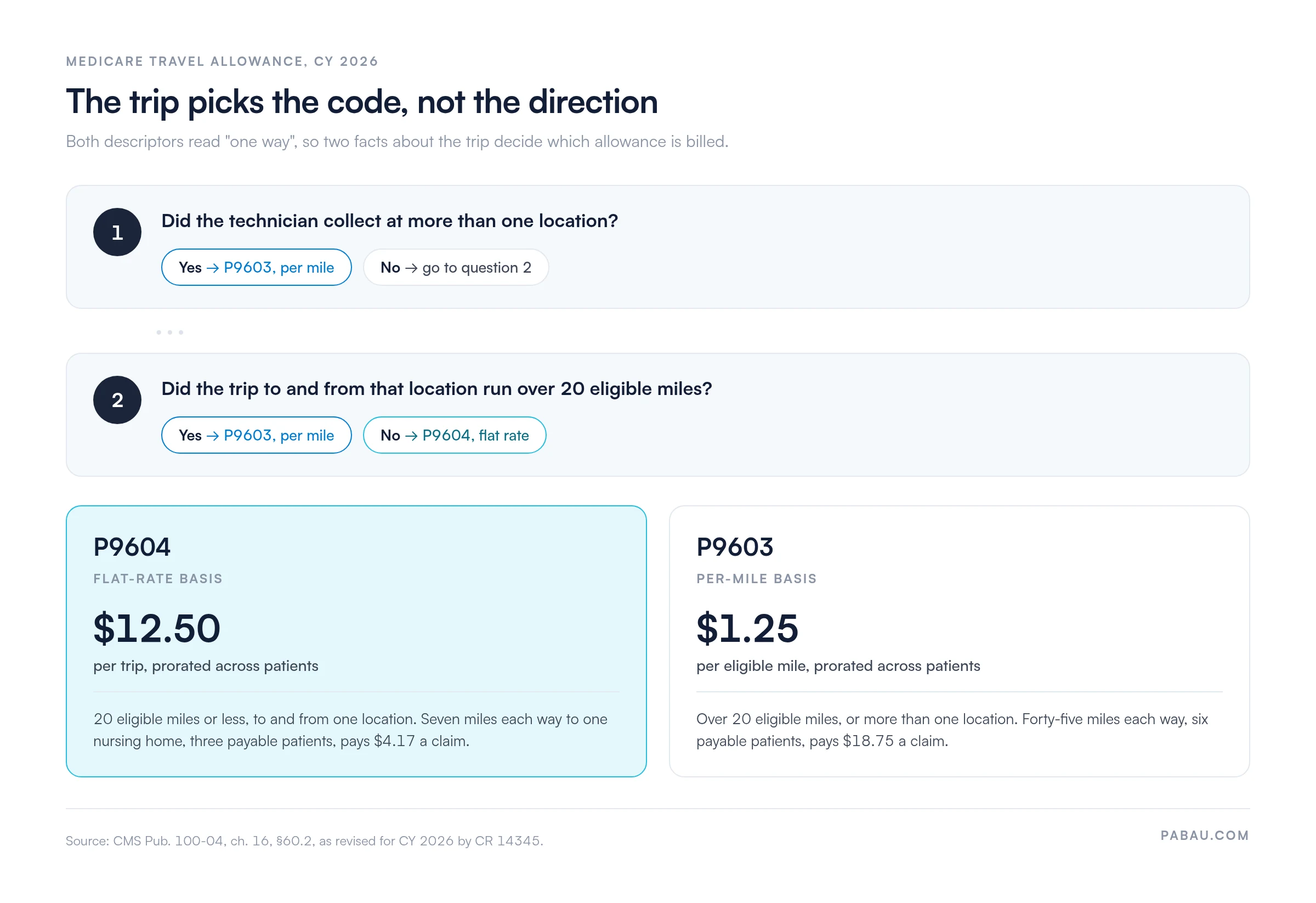
CMS works this example in the CY 2026 manual revision. A technician drives 7 miles from the laboratory to a nursing home and collects specimens there. The same 7 miles are driven back, with no other stops. Five patients are seen, but a collection fee is payable for only three of them.
The trip ran 14 eligible miles to and from one location, so the flat-rate basis applies. The laboratory divides the $12.50 flat rate by those three patients, which gives $4.17 each. It then submits one claim per patient under P9604, alongside each patient’s collection fee.
CMS works a matching example on the per-mile side. A technician drives 45 miles from a city laboratory to a rural skilled nursing facility. Blood is drawn from six Medicare patients, and the technician drives the same 45 miles back.
The round trip to one location comes to 90 eligible miles, which is more than 20, so the per-mile basis applies.
Ninety eligible miles at $1.25 gives $112.50 for the trip. Divided across six patients, each claim carries $18.75 under P9603. Notice that the whole round trip is paid inside one code, because the return miles are eligible miles.
Travel allowance amounts are national, and CMS updates them every January through its change request process. The CY 2026 figures come from CR 14345, published as MLN Matters article MM14345 and implemented by transmittal R13576CP, effective January 1, 2026.
Two further points shape what a laboratory can expect to collect on these codes.
For a laboratory running several home-draw routes a day, the travel allowance is small per claim but constant in volume. Modeling it alongside collection volume is what turns a stack of $4.17 lines into a number worth forecasting.
Rebuild your travel allowance rate table every January, when CMS issues the annual change request. Do it again in April 2026, when decimal mileage takes effect on P9603. Keep the dated MLN Matters article with the table. If a post-payment review lands two years later, the saved article shows which rate was in force on the date of service.
Eligibility rests on the patient’s situation, not on preference. Medicare pays the collection fee and the travel allowance when a trained technician must go to the patient. That applies where the patient is homebound, or is an inpatient somewhere other than a hospital.
CMS describes homebound by reference to 42 CFR 424.22(a)(1)(ii), and notes that a patient need not be bedridden to meet it.
The specimen type matters as much as the patient. A collection fee is payable for blood drawn by venipuncture and for urine collected by catheterization. It is not payable for specimens whose collection cost is minimal, such as a throat culture or a routine capillary puncture.
Confirming the specimen type and the setting before dispatch saves a claim that would otherwise be denied.
Billing this code correctly is mostly a matter of recording the trip while it happens. The steps below follow one visit from order to submission.
Codes G0471, P9612, and P9615 also describe specimen collection, so the code on the claim depends on the setting and the method. Whichever one applies, it is the collection fee that makes the travel allowance payable, which is why the two lines are prepared together.
Travel allowance claims are small, repetitive, and easy to review in bulk, which is what makes the trip record worth keeping properly. Four elements carry most of the weight in a review.
These records answer the two questions a reviewer asks about a travel allowance: was a collection fee payable, and was the right basis used. Holding them in the billing record rather than in a courier spreadsheet is what keeps a year of routes reviewable.
Denials on these lines cluster around a short list of causes, most tracing back to the trip record rather than the code. The denial codes guide maps each remittance message onto the cause below.
The amounts and the choice of basis are national, and no contractor sets its own travel allowance rate for CY 2026. What varies is the claim handling around them. Each MAC sets how it wants mileage evidence submitted, which billing articles it publishes, and what its reviewers examine after payment.
The manual text in force before 2026 asked claimants to identify round-trip travel with modifier LR. Some contractor billing articles still carry that instruction.
A laboratory that crosses jurisdictions should keep one page per MAC. Record the billing article, the date it was read, and the claim conventions it asks for. Claims go to the MAC for the jurisdiction where the patient is, which matters most when routes run across a state line.
Save each MAC billing article as a dated PDF rather than a bookmark. Contractor pages are edited without notice. A saved copy shows which instruction you followed on a date of service two years ago.
P9604 is a Medicare construct, and commercial payers are not bound to it. Some plans recognize the code and pay their own amount. Others fold travel into the collection fee, and some do not cover home collection at all. Medicaid managed care plans vary in the same way.
Reconciling remittances across Medicare and commercial payers is what surfaces these differences quickly. Posting every remittance to the same patient record shows which payers pay the travel line, which bundle it, and which deny it every time.
Most laboratories reconstruct these trips after the fact. The mileage sits with the courier, the homebound note sits in the patient chart, and the proration count sits in someone’s head. When a reviewer asks about a $4.17 line from eighteen months ago, assembling the answer costs more than the claim ever paid.
Practice management software like Pabau keeps the visit, the documentation, and the billing record on the same patient file. The order, the homebound note, the visit date, and the codes submitted all sit together. The evidence for a travel allowance line is assembled while the visit is fresh, not months later.
Pabau’s software for billing teams then tracks what was submitted and what came back. Repeated denials on travel lines surface as one trend, instead of as scattered small write-offs. For teams working across several locations, that is the difference between fixing a basis error once and repeating it for a year.

Pabau keeps orders, clinical documentation, and billing records on one patient file. Travel allowance and specimen collection claims can then be evidenced long after the trip. See how it works for your laboratory.

P9604 pays a flat, prorated trip charge for medically necessary specimen collection travel, and P9603 pays for the eligible miles driven. Neither code is the round-trip version of the other. The trip itself decides which one applies.
Twenty eligible miles or less, to and from one location, is the flat-rate basis. A longer round trip, or a route with more than one stop, is the per-mile basis.
Get the mileage, the location count, and the patient count onto the visit record, and the rest of the claim follows from them.
The CY 2026 amounts are $12.50 per flat-rate trip and $1.25 per eligible mile, both prorated and both updated each January. To see how Pabau keeps that evidence attached to the visit it came from, book a demo.

Need to understand how claim denials are categorized and appealed? Denial management in healthcare walks through the full denial lifecycle from identification to resubmission.
Looking for a reference on how medical billing runs end to end? Medical billing fundamentals covers the full claims submission cycle from patient encounter to payment posting.
Want to reduce remittance reconciliation time across payers? Electronic remittance advice explains ERA file formats, 835 transactions, and how to automate payment posting.
HCPCS code P9604 is the Medicare travel allowance code billed on a flat-rate basis for medically necessary laboratory specimen collection. It applies when a trained technician travels 20 eligible miles or less to and from one location. The laboratory that drew the specimen bills the code, and the amount is prorated across the patients whose collection fee is payable.
Yes. Medicare Part B pays a travel allowance when a trained technician draws a specimen from a homebound patient or a non-hospital inpatient. The allowance is payable only where a specimen collection fee is also payable. The laboratory bills P9604 or P9603, depending on the eligible miles and the number of locations visited.
The patient has to meet the criteria on each date of service, so the documentation is expected to cover each visit. A standing order alone rarely satisfies a reviewer looking at a series of home draws. Keeping a contemporaneous note for every collection date is the simplest way to answer that question later.
No, and the two codes are not interchangeable in any ratio. Before CY 2026 the flat rate was a one-way amount that laboratories doubled to cover the return leg, which is where the idea comes from. CMS now sets one trip amount for the flat-rate basis, prorated across patients. The eligible miles and the number of locations decide which basis applies.