CPT Code 62284: Injection procedure for myelography
CPT Code 62284: official descriptor and procedure overview The American Medical ...

Last Updated: Oct 19, 2026
P9073 is the HCPCS Level II code for platelets, pheresis, pathogen reduced, each unit. You report it once for every single-donor apheresis unit treated with an FDA-approved pathogen reduction system before transfusion. In the US today, that means the INTERCEPT Blood System.
The most important check is the product label. P9073 applies only when the label names the pathogen reduction process. Leukocytes-reduced, irradiated and bacteria-tested platelets all have their own codes. Below, we cover what qualifies, the neighboring codes, how the claim moves and the denials to watch for.
Let Pabau's smart automation suggest the right codes, reduce claim denials, and keep your practice compliant—effortlessly.
Automate repetitive tasks and focus on what matters most—your patients.
Reduce coding errors and ensure compliance with the latest regulations.
Clean claims, fewer denials, and faster reimbursements.
Powerful insights and reporting to help your practice thrive.
HIPAA compliant SOC 2 certified GDPR-compliant Trusted by 4,000+ clinics worldwide

HCPCS code P9073 reports one unit of single-donor apheresis platelets treated with FDA-approved pathogen reduction.
INTERCEPT is the only FDA-approved pathogen reduction system for platelets in the US, so the label should name it.
Bacterial testing such as LVDS finds contamination, but it never qualifies a unit for P9073.
Whole-blood-derived platelets never bill as P9073, even when they’re leukocytes reduced or irradiated.
Medicare pays blood products separately under OPPS, so every unit needs its own accurate claim line.
HCPCS code P9073 is the Level II code for platelets, pheresis, pathogen reduced, each unit. You report it once for every apheresis unit transfused after pathogen reduction. The Centers for Medicare and Medicaid Services (CMS) maintains it alongside the other HCPCS Level II codes for blood products.
The code replaced temporary code Q9988 on January 1, 2018. CMS deleted P9072 on the same date. Pathogen-reduced units moved to P9073, and bacterially tested units now bill as a base code plus P9100. Here are the reference details coders check most often.
A platelet unit qualifies for P9073 only when two things are true. First, it came from a single donor by apheresis. Second, it went through an FDA-approved pathogen reduction process before transfusion.
That second test has just one answer in the US today. The FDA approval listing shows the INTERCEPT Blood System from Cerus Corporation is the only approved platform for platelets. It uses amotosalen and UVA light to stop pathogens from replicating.
Mirasol, from Terumo BCT, is used in other countries. However, it isn’t FDA-approved for platelets, so it can’t support a US P9073 claim.
The diagram below turns those two questions into a quick code choice.
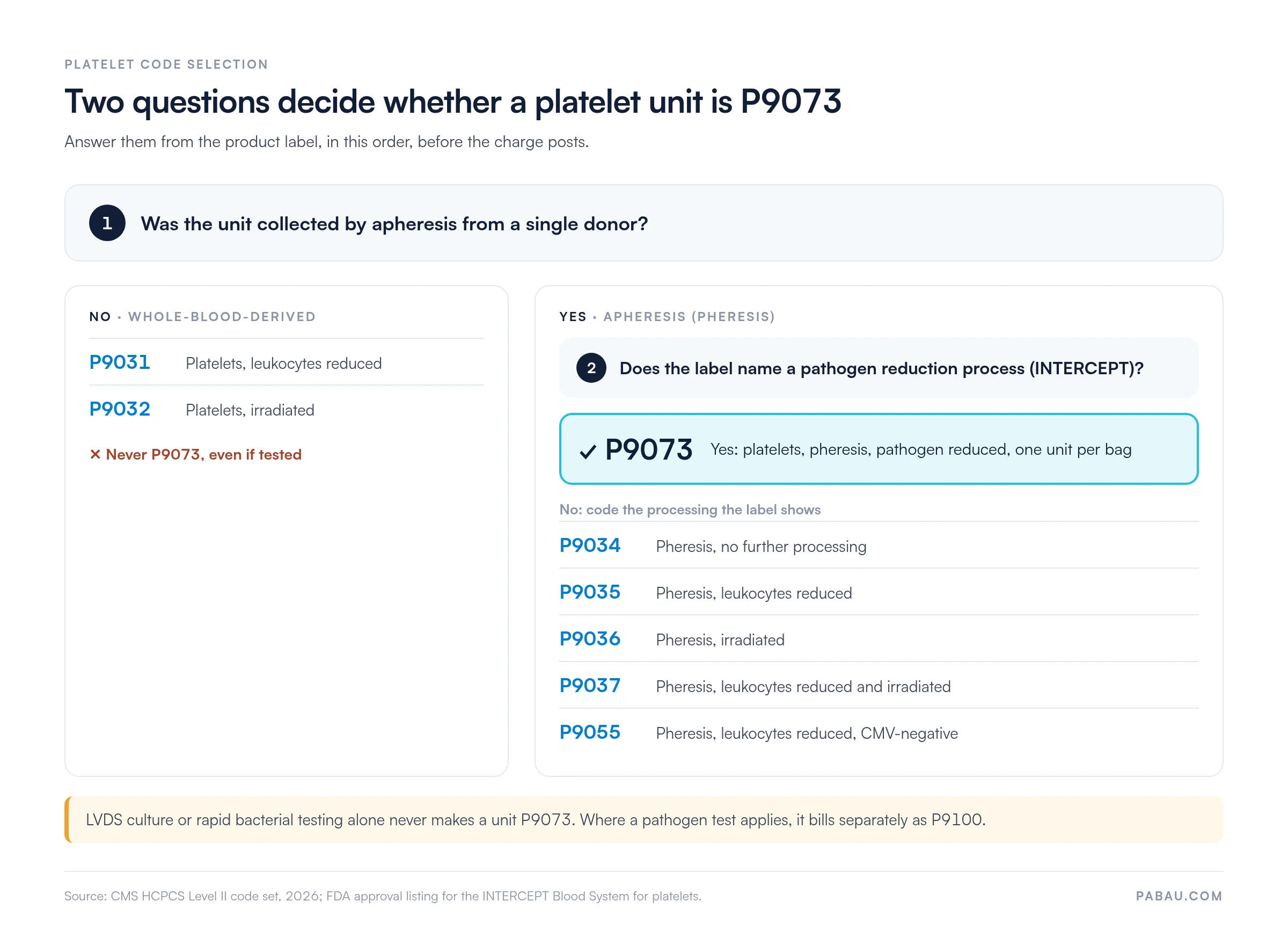
On the other hand, these units don’t qualify for P9073:
LVDS never qualifies a unit for P9073. Large volume delayed sampling (LVDS) is a bacterial culture method, often run on systems like BacT/ALERT. It detects contamination after collection, but it leaves the product itself unchanged.
Pathogen reduction works on the whole unit instead. It treats the platelets so bacteria, viruses and parasites can’t multiply. As a result, a leukocytes-reduced apheresis unit screened with LVDS still bills as P9035. Reporting it as P9073 would describe processing the product never received.
Where testing is billable, it has a code of its own. HCPCS code P9100 reports a pathogen test for platelets, separate from the product line.
Most P9073 errors are code-selection errors, so it helps to see the neighbors side by side. Each code reflects one mix of collection method and processing. For example, P9031 is whole-blood-derived, which surprises coders who assume every platelet code means apheresis.
A clean P9073 claim starts at the blood bank, long before billing sees it. Here’s how the charge usually moves through a hospital outpatient department.
These rules come from section 231 of the Medicare Claims Processing Manual, chapter 4. Check it each year, since CMS updates the chapter through transmittals.
Add a hard stop for P9073 in your blood bank system. The charge shouldn’t post until someone confirms the label’s pathogen reduction statement. That one-minute check prevents the most common P9073 denial.
What about a unit that’s both pathogen reduced and irradiated? Report P9073 alone.
FDA labeling allows INTERCEPT treatment as an alternative to gamma irradiation for preventing transfusion-associated graft-versus-host disease (TA-GvHD). So a second irradiation step is usually unnecessary, and each unit only takes one product code anyway.
Auditors check blood product claims against the label first. So keep these records together and easy to pull:
Each of these records holds protected health information (PHI). Keep them under the same HIPAA access controls as the rest of the chart.
Medicare covers P9073 when the transfusion is medically necessary, and it pays the product as its own line. Under the Outpatient Prospective Payment System (OPPS), blood products get status indicator R for separate payment.
Each unit earns its own Ambulatory Payment Classification (APC) payment, rather than being packaged into the transfusion.
Rates change every year, though. Rather than copying last year’s figure, check the current OPPS Addendum B from CMS for the P9073 rate. Review your chargemaster price at the same time, because an outdated charge can leave money on the table.
Commercial payers set their own rules. Some treat pathogen-reduced platelets as a higher-cost product and expect a clear clinical reason in the record. Check each major payer’s blood product policy before you assume the Medicare approach applies.
When a P9073 claim comes back denied, the cause usually traces to the label or the chargemaster. The table below pairs each common pattern with its fix.
It’s worth reviewing P9073 denials by reason code every month. Then, if “missing documentation” denials spike, look at labeling and charge capture before you recode anything.
A quick review at submission catches most of the patterns above. Before a P9073 line goes out, confirm that:
Blood product claims pass through several hands. The blood bank logs the unit, nursing records the transfusion, and billing builds the claim. Each handoff is a chance for a unit number or order to go missing.
Practice management software like Pabau keeps those details in one patient record. Its automated claims management pre-fills claims from that record and lets coders search the full HCPCS library. It also checks that required claim fields are complete before a claim can be sent.
In the US, claims go out through Claim.MD, with eligibility checks, claim status tracking and remittance posting built in. That way, your team spends less time chasing denials and more time preventing them.
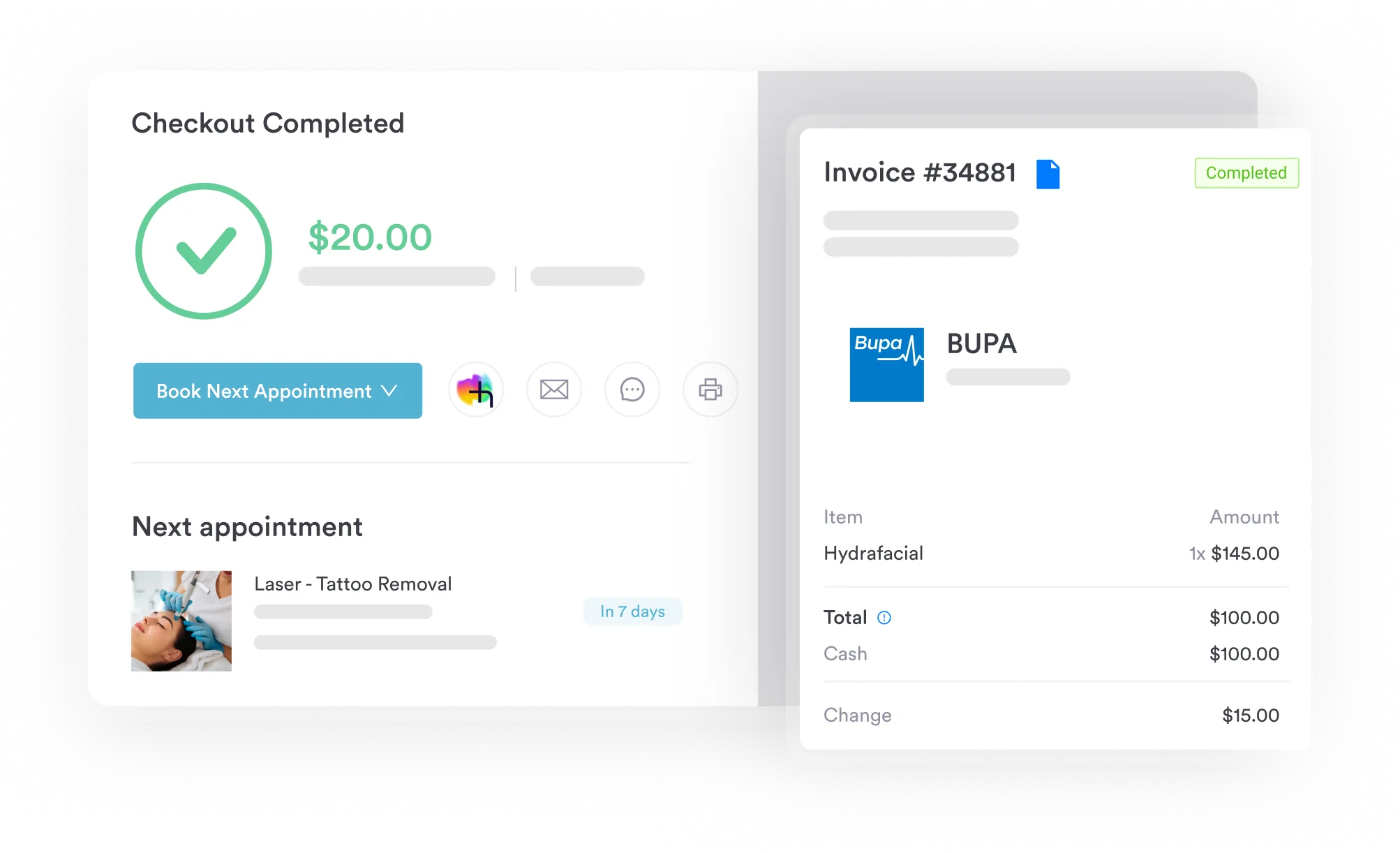

Pabau pre-fills claims from the patient record and checks required fields before submission. You can then track each claim through to payment in one place.

P9073 rewards discipline at the blood bank more than effort in the billing office. If the unit came by apheresis and the label names pathogen reduction, the code choice is simple. If either fact is missing, the unit belongs to another code.
So build the label check into charge capture, and review denials by reason each month. That habit takes minutes per claim, which is far less than an appeal costs. Book a demo to see how Pabau keeps claim details together from the patient record to payment.

Coding a whole-blood platelet unit instead? HCPCS code P9031 covers leukocytes-reduced platelets that weren’t collected by apheresis.
Billing pathogen-reduced plasma too? HCPCS code P9070 explains the pooled plasma code that’s often confused with platelets.
Seeing the same denial reasons every month? Denial management in healthcare shows how to sort, appeal and prevent recurring denials by root cause.
Want more claims paid on the first pass? Clean claims in medical billing breaks down the fields and checks that get a claim accepted first time.
Preparing for a billing audit? Medical billing compliance outlines the documentation controls that hold up under payer review.
P9073 took effect on January 1, 2018. It replaced temporary code Q9988 for pathogen-reduced pheresis platelets. At the same time, P9100 replaced Q9987 for pathogen testing of platelets.
No. The Medicare blood deductible applies only to whole blood and packed red cells. Platelets, including pathogen-reduced units, don’t count toward it, so a P9073 line needs no blood deductible handling.
CPT code 36430 reports the transfusion of blood or blood components. It covers the administration service, while P9073 covers the product. Report 36430 once per transfusion encounter, not once per unit.
Yes. P9071 reports single-donor plasma that’s pathogen reduced and frozen, billed per unit. Pooled pathogen-reduced plasma uses P9070 instead, and neither code applies to platelets.