CCSD code G5100: Bypass of duodenum billing guide
CCSD code G5100 bills a bypass that leaves the duodenum in place CCSD code G5100...

Last Updated: Oct 16, 2026
P9070 is the HCPCS Level II code for plasma, pooled multiple donor, pathogen reduced, frozen, each unit.
That descriptor matters because P9070 is widely miscited as a platelet rich plasma code. It is not one, and the confusion is easy to disprove. A pooled multiple donor product comes from other people's blood, which makes it the definitional opposite of an autologous preparation.
Let Pabau's smart automation suggest the right codes, reduce claim denials, and keep your practice compliant—effortlessly.
Automate repetitive tasks and focus on what matters most—your patients.
Reduce coding errors and ensure compliance with the latest regulations.
Clean claims, fewer denials, and faster reimbursements.
Powerful insights and reporting to help your practice thrive.
HIPAA compliant SOC 2 certified GDPR-compliant Trusted by 4,000+ clinics worldwide

HCPCS code P9070 describes plasma, pooled multiple donor, pathogen reduced, frozen, each unit, effective January 1, 2016.
P9070 is not a platelet rich plasma code, and a pooled multiple donor product is the opposite of an autologous one.
Medicare pays P9070 under the hospital outpatient system with status indicator R and APC 9534, at $55.78 per unit for CY 2026.
The Part B blood deductible applies to whole blood and packed red cells only, so it never touches a plasma line.
Pabau’s claims management software helps billing teams keep P-code lines, units, and transfusion records consistent before a claim goes out.
P9070 sits in the P-series of HCPCS Level II. The Centers for Medicare and Medicaid Services (CMS) reserves that range for blood and blood products. CMS created the code effective January 1, 2016, and no revision since has changed what it describes.
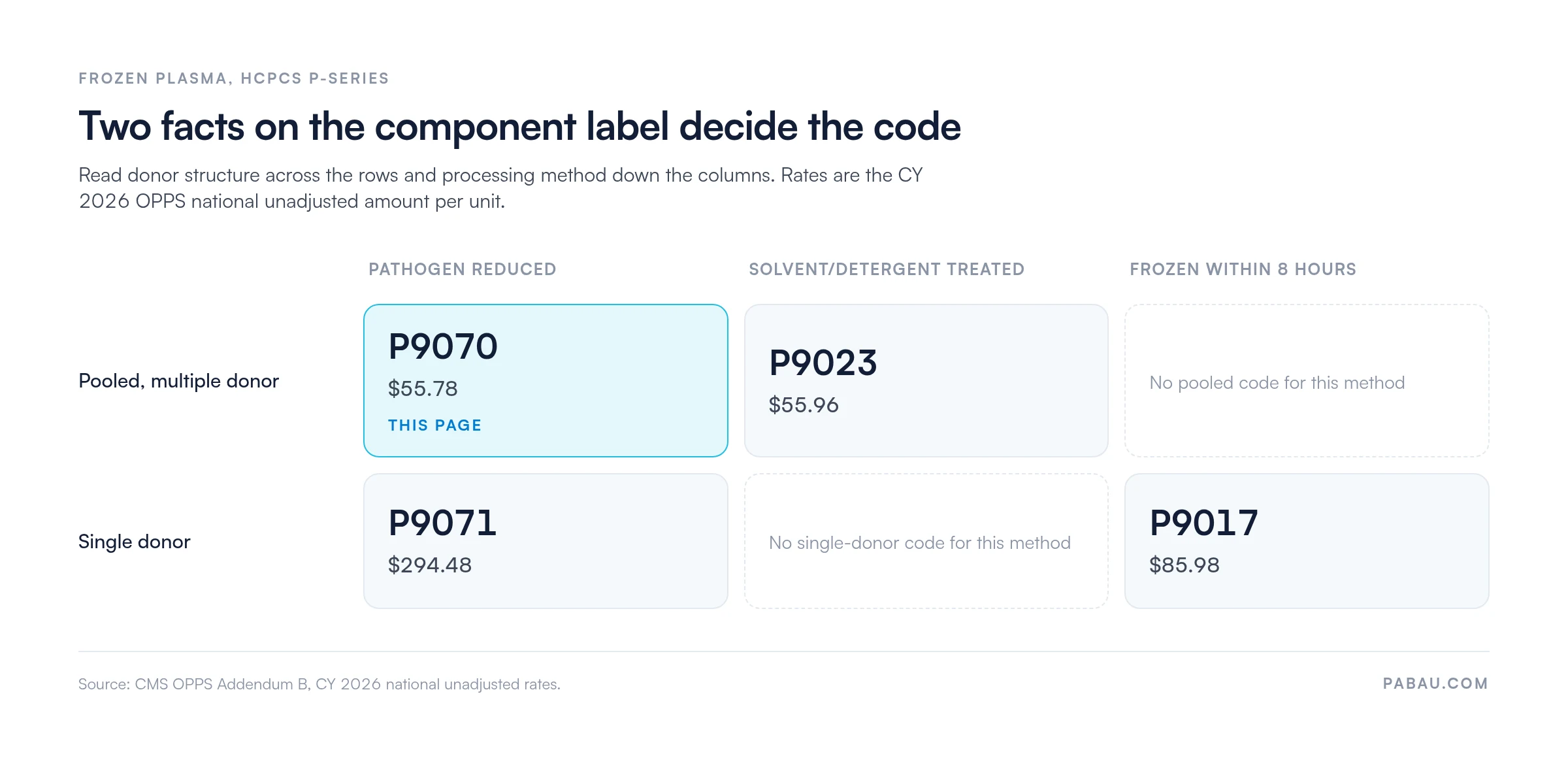
Two things define the product and separate it from its neighbors in the P-series. The first is donor structure, meaning pooled from multiple donors rather than drawn from one. The second is the processing method, which here is pathogen reduction rather than solvent and detergent treatment.
Both facts live on the component label and in the blood bank issue record. Coders should read the label rather than infer the code from the clinical order. An order for “frozen plasma” does not say which product the transfusion service released.
The same label check separates the single donor products in the range. A unit held in quarantine until the same donor retested negative bills as P9060, not P9070.
P9070 does not describe platelet rich plasma (PRP), and no revision of the code has ever carried a PRP descriptor. The mistake circulates widely enough that it is worth stating plainly, because it sends regenerative medicine claims to a transfusion product code.
Two clues settle it. Platelet rich plasma is a platelet concentrate, while P9070 describes plasma. PRP as practices use it is autologous, while P9070 is explicitly pooled from multiple donors.
Platelet rich plasma is coded elsewhere in the code set. The table below shows where those claims belong.
Anyone billing for a PRP injection in an orthopedic, wound care, or aesthetic setting should be looking at that table, not at P9070. Verify current coverage for those codes with the payer before the appointment, since PRP coverage remains narrow. P9020 covers the PRP product itself, billed per unit.
If your practice does not run a transfusion service, P9070 almost certainly does not belong on your claims. The code bills a blood component that a hospital blood bank or transfusion service issues. A regenerative medicine or aesthetic practice reaching for P9070 has usually mistaken it for a PRP code. The fix is to move the claim to P9020, G0465, or 0232T, depending on the service performed.
Pooled pathogen reduced plasma is transfused for the same reasons as any other frozen plasma product. It replaces multiple coagulation factors at once, which is what separates plasma from a targeted factor concentrate.
Typical indications in the transfusion record include:
Plasma is not indicated for volume expansion or for nutritional support. A claim that pairs P9070 with a diagnosis suggesting either use invites a medical necessity review, even where the product itself was correctly identified. When the record documents volume expansion, a colloid such as 25% albumin under P9047 fits that indication.
Medicare pays P9070 separately under the hospital Outpatient Prospective Payment System. The code carries status indicator R, the indicator reserved for blood and blood products. It sits in ambulatory payment classification (APC) 9534. For CY 2026 the national unadjusted payment rate is $55.78 per unit.
CMS sets blood product rates using a blood-specific cost-to-charge ratio that has been in place since 2005. That method converts hospital charges into estimated costs using ratios from recent cost reports. CY 2026 rates were built from CY 2024 claims and cost report data.
The two-year lag is worth remembering when a rate moves. A swing in the published amount reflects hospital charging behavior two years earlier, not a change in coverage or in the product itself.
Rates above are national unadjusted OPPS amounts for CY 2026, effective January 1, 2026. Your paid amount is adjusted by wage index and by any applicable outlier or copayment rules. Confirm the current figure in CMS Addendum B for the calendar year you are billing.
Status indicator R does not guarantee a separate payment on every claim. When a blood product appears on the same claim as a comprehensive APC service, its cost is folded into the single C-APC payment. The P9070 line still belongs on the claim, but no separate amount is paid for it.
This is a common source of confusion in remittance review. A zero-paid P9070 line next to a C-APC procedure is usually correct packaging, not a denial, so it does not need an appeal.
Medicare’s blood deductible covers the first three units of whole blood or packed red cells a beneficiary receives in a calendar year. It does not extend to other components. Plasma, platelets, fibrinogen, gamma globulin, and serum albumin all sit outside it, as does the cost of processing, storing, and administering blood.
A P9070 line should therefore never carry a blood deductible amount. If one appears on the remittance, treat it as a claim setup error worth checking rather than a patient balance to bill.
P9070 is reported on the institutional claim by the facility whose transfusion service issued the product. Report one unit of P9070 for each unit of plasma issued and transfused, matching the blood bank record exactly.
The product line and the administration line are separate. Good medical billing workflows keep them aligned. A product billed without its administration line is one of the easier errors for a reviewer to spot.
The modifier rows above are there because both pairs get attached to P-codes by habit. JA and JB describe how a drug was given, and P9070 is not a drug. JW and JZ describe wastage from a single-dose vial, which a plasma unit is not.
Check your Medicare Administrative Contractor (MAC) billing guide for blood products before adding any modifier to a P-code line. Requirements are local, and an unnecessary modifier can turn a payable line into a rejected one.
Reconcile the P9070 unit count against the blood bank issue record before the claim is released, not after the remittance arrives. Units issued, units transfused, and units billed should be the same number, and the transfusion record is the only document that proves it. Practices that build this into a pre-submission check catch quantity mismatches while the encounter is still open and easy to correct.
Medical necessity for a plasma transfusion rests on the diagnosis that explains the bleeding or the coagulopathy. The codes below reflect common indications for frozen plasma. Confirm each one against the payer’s own policy before you submit.
One recent change catches transfusion services out. ICD-10-CM expanded M31.1 into M31.10, M31.11, and M31.19, which left the old M31.1 as a non-billable parent code.
Plasma exchange claims still carrying M31.1 from an older charge template will reject for specificity. The fix is a template update rather than an appeal, so it is worth checking the stored code before the next rejection cycle.
Most P-series miscoding comes from one of two variables. Either the donor structure is wrong, or the processing method is. The table below lines up the codes closest to P9070 with their official descriptors.
Two rows in that table are worth flagging, because incorrect descriptors for both circulate online. P9035 carries no irradiation in its descriptor, and P9073 carries no CMV-negative or irradiated qualifier. The CMV-negative and irradiated platelet product is P9053.
The closest call in practice is P9070 against P9023. Both are pooled multiple donor frozen plasma, and only the processing method separates them. Read the component label to see which method the supplier used. The grid below plots the two label facts against each other.
A plasma product line is supported by the transfusion record, not by the clinical note alone. Payers reviewing a P9070 claim want to see that the unit was ordered, issued, and given, and that the product matches the code.
Blood bank records are already subject to their own retention rules under transfusion service standards. Keep the billing documentation aligned with those records so that a payer audit and an accreditation review reach the same conclusion.
Most P9070 problems are identification problems rather than coverage problems. The product is usually covered, so the denial tends to come from a mismatch between the code, the unit count, and the record.
Knowing which of these applies saves the work of drafting an appeal that was never going to land:
Reading the denial codes on the remittance against that list turns it into a short diagnosis. A specificity rejection points at the diagnosis template. A quantity denial points at the issue record.
Run a quarterly audit of every P-series line your facility bills, comparing each code against the component labels the blood bank issued that quarter. Descriptor drift is the quiet failure mode here. A charge master row set up years ago keeps firing long after the transfusion service changed suppliers or processing methods. A sample of twenty lines is usually enough to reveal whether the charge master still matches the shelf.
P-series billing fails quietly. A charge master row keeps producing a familiar code while the product on the shelf has changed. Nobody notices until a batch of remittances comes back short.
Practice management software like Pabau keeps the clinical record and the billing record on one system. The codes attached to an encounter stay tied to what was documented. Charges, invoices, and payments sit against the same patient record instead of in separate spreadsheets.
Pabau’s claims management software tracks what was submitted, what was paid, and what came back rejected. Billing teams can see denial patterns by code rather than reconstructing them from individual remittances at month end.
Every Pabau subscription includes the full feature set, so reporting and claims tools are available from day one rather than unlocked at a higher tier. Onboarding is structured, with your existing records and codes migrated before you go live.

Pabau keeps clinical documentation, charges, and claim outcomes on one system. Billing teams can trace any HCPCS line back to the record that supports it. You spend less time reconstructing evidence for a payer review.

P9070 is a straightforward code once the product is identified correctly. It bills a unit of pooled multiple donor, pathogen reduced, frozen plasma. Medicare pays it separately under OPPS unless the claim carries a comprehensive APC service.
The risk sits upstream of the claim. Say your charge master maps P9070 to platelet rich plasma, or fails to distinguish it from P9023 and P9071. Every line it produces is then wrong before anyone reviews it. Check the mapping against the component label once, and the recurring denials stop.
The trade-off worth remembering is that plasma codes reward precision over volume. A single correct descriptor mapping saves more revenue than any appeal you write afterward. Book a demo to see how Pabau keeps coding, documentation, and claim outcomes on one record.

Need a framework for managing claim denials? Denial management in healthcare walks through tracking, appealing, and preventing the denials that repeat across HCPCS and CPT claims.
Want the revenue cycle context for HCPCS billing? What is revenue cycle management explains how a code line fits into the workflow from patient intake to payment posting.
Chasing first-pass acceptance on your claims? What is a clean claim covers the checks that get a claim paid on submission instead of sending it into an appeals cycle.
HCPCS code P9070 describes plasma, pooled multiple donor, pathogen reduced, frozen, each unit. It is a Level II HCPCS code in the P-series that CMS reserves for blood and blood products. The code took effect on January 1, 2016. The code bills the plasma component itself, which a hospital blood bank or transfusion service issues for transfusion.
No. P9070 describes pooled multiple donor plasma, which is the opposite of an autologous platelet rich plasma preparation. No revision of the code has ever carried a PRP descriptor. Platelet rich plasma is billed with P9020 for the product itself. Under Medicare NCD 270.3, autologous PRP in chronic wound care uses G0460 or G0465. A PRP injection uses CPT Category III code 0232T.
For CY 2026 the national unadjusted OPPS payment rate for P9070 is $55.78 per unit. The code sits in APC 9534 with status indicator R for blood products. Your paid amount is then adjusted by wage index and by any applicable copayment rules. CMS sets blood product rates with a blood-specific cost-to-charge ratio, and the CY 2026 rates were built from CY 2024 claims data.
Both codes describe pooled multiple donor frozen plasma, and only the processing method separates them. P9070 covers plasma that has been pathogen reduced, while P9023 covers plasma that has been solvent and detergent treated. The component label and the blood bank issue record show which method the supplier used. Read the label rather than infer the code from the clinical order.
Report one unit of P9070 for each unit of plasma the blood bank issued and the patient received. The billed quantity must match the transfusion service issue record exactly, since quantity mismatches are a routine audit finding on blood product lines. The transfusion procedure code is separate and most payers expect it once per encounter rather than once per unit.
No. The Part B blood deductible covers only the first three units of whole blood or packed red cells each calendar year. It does not extend to plasma, platelets, fibrinogen, gamma globulin, or serum albumin. Nor does it apply to the cost of processing, storing, or administering blood. A blood deductible amount on a P9070 line is a claim setup error worth investigating.
A zero-paid P9070 line is often correct packaging rather than a denial. When a blood product appears on the same claim as a comprehensive APC service, its cost is folded into the single C-APC payment. No separate amount is paid for that line. Check whether a comprehensive APC service sits on the same claim before you draft an appeal.