CCSD code H4430: Examination of rectum under anaesthetic
CCSD code H4430 pays for the examination alone CCSD code H4430 is the UK private...

Last Updated: Oct 20, 2026
P9031 is the HCPCS Level II code for platelets, leukocytes reduced, each unit.
Let Pabau's smart automation suggest the right codes, reduce claim denials, and keep your practice compliant—effortlessly.
Automate repetitive tasks and focus on what matters most—your patients.
Reduce coding errors and ensure compliance with the latest regulations.
Clean claims, fewer denials, and faster reimbursements.
Powerful insights and reporting to help your practice thrive.
HIPAA compliant SOC 2 certified GDPR-compliant Trusted by 4,000+ clinics worldwide

HCPCS code P9031 describes platelets, leukocytes reduced, each unit, an active Level II blood product code effective since 2001.
Bill P9031 per unit administered, so each platelet unit transfused gets its own line on the claim.
Pair P9031 with revenue code 0384 (platelets) on the UB-04 rather than the general 0380 or 0389 catch-all codes.
P9031 differs from P9032 (irradiated platelets), and billing the wrong one is the most common platelet coding error.
Practice management software like Pabau tracks units administered, HCPCS assignments, and UB-04 claim preparation.
P9031 reports one unit of leukocyte-reduced platelets administered to a patient. The full official descriptor is: Platelets, leukocytes reduced, each unit. It belongs to the P-series of HCPCS Level II.
That coding system is maintained by the Centers for Medicare and Medicaid Services (CMS) for supplies and services not covered by CPT.
P9031 falls under the blood products category of HCPCS Level II codes, which covers pathology and laboratory blood components. It has been an active code since 2001 with no termination date.
Leukoreduction is the process of filtering white blood cells (leukocytes) out of a blood component before transfusion. Standard platelet products contain residual leukocytes from the donor.
Those leukocytes can trigger febrile non-hemolytic transfusion reactions, cytomegalovirus (CMV) transmission, and platelet refractoriness in sensitized patients.
Removing them reduces these risks. The AABB (formerly American Association of Blood Banks) names these patient groups among the indications for leukoreduction.
For billing purposes, the key distinction is this: leukoreduction changes the code. A standard platelet unit uses a different HCPCS descriptor. P9031 applies specifically when leukoreduction has been performed and documented before transfusion.
Leukoreduction and irradiation are two separate processes. A blood bank can perform either one on its own or both on the same unit, and each combination has its own HCPCS code. Donor CMV status splits the codes further. For apheresis platelets that are leukoreduced and CMV-negative, the correct code is P9055.
P9031 is billed per unit administered. Each platelet unit given to the patient during a transfusion episode requires a separate line item on the claim. If a patient receives three units of leukoreduced platelets, bill P9031 with a quantity of three (or three separate lines, depending on payer requirements).
Verify unit counts against the transfusion record before the claim goes out. Discrepancies between documented units and billed units are a leading cause of audits in blood product billing.
P9031 is used mainly in hospital outpatient settings, where it is reimbursed under the Hospital Outpatient Prospective Payment System (OPPS). It can also appear on inpatient claims, but the reimbursement rules differ.
Under inpatient PPS, blood products are usually bundled into the DRG payment rather than reimbursed separately. Do not assume OPPS unit-based logic carries over to an inpatient claim.
Hospital outpatient claims use the UB-04 institutional claim form, where P9031 has to carry a revenue code. Submitting a clean claim requires the HCPCS code and the revenue code to appear correctly on the same claim line. Blood products sit in the 038x revenue code series.
Revenue code 0384 is the specific code for platelet components, so pair P9031 with 0384 rather than the general 0380 or the 0389 catch-all. CMS and MAC guidance direct facilities to report the specific component code wherever one exists.
Verify the pairing against current CMS OPPS transmittals and your Medicare Administrative Contractor (MAC) guidelines. Payer-specific requirements still vary by jurisdiction.
P9031 is a Medicare payable code under OPPS. CMS reimburses leukoreduced platelet units as separately payable blood products in the hospital outpatient setting.
Payment amounts are updated annually in the OPPS final rule, so check the current rate on the CMS hospital outpatient payment page before billing. Rates from a prior year do not carry forward.
Software built for billing teams stays current with OPPS payment classifications. That cuts manual fee schedule lookups and surfaces payment variances before a claim is submitted.
Medicare coverage for leukoreduced platelets is generally established through national and local coverage determinations. Coverage may be subject to Local Coverage Determinations (LCDs) issued by individual MACs. Some MACs require documented clinical justification for leukoreduction when it is not a facility-wide universal leukoreduction program.
Medicaid coverage for P9031 varies by state. Each state Medicaid program sets its own blood product reimbursement policy. Contact your state Medicaid agency or managed care organization for current coverage rules. Tracking remittance advice from each payer shows coverage patterns and denial trends over time.
Check your MAC’s LCD for blood products before billing P9031 under Medicare. Some MACs require a documented clinical indication for leukoreduction, such as a transplant history or a prior febrile reaction. That applies when your facility has no universal leukoreduction program. Missing this documentation is one of the top reasons blood product claims are flagged during post-payment audits.
The revenue code on a UB-04 line comes from the chargemaster entry behind the charge, not from the coder working the claim. If the P9031 charge code is mapped to a general 038x entry, every claim inherits that mapping until someone corrects the master file.
Audit the mapping for each blood product charge code at least once a year, and again after any MAC guidance update. Confirm that the HCPCS code, the revenue code, and the unit of measure agree on the chargemaster line. Do that before the first claim of the year goes out.
Payers require specific documentation to support a P9031 claim. Missing or incomplete records are the main driver of post-payment recoupment in blood product billing. The transfusion record has to be complete before the claim is generated, not reconstructed after a payer asks for it.
A complete transfusion record protects the facility during an audit and supports the medical necessity of every unit billed. Each unit billed under P9031 needs its own documentation trail.
The P-series contains several closely related platelet codes. Three processing steps decide which one applies: apheresis collection, leukoreduction, and irradiation.
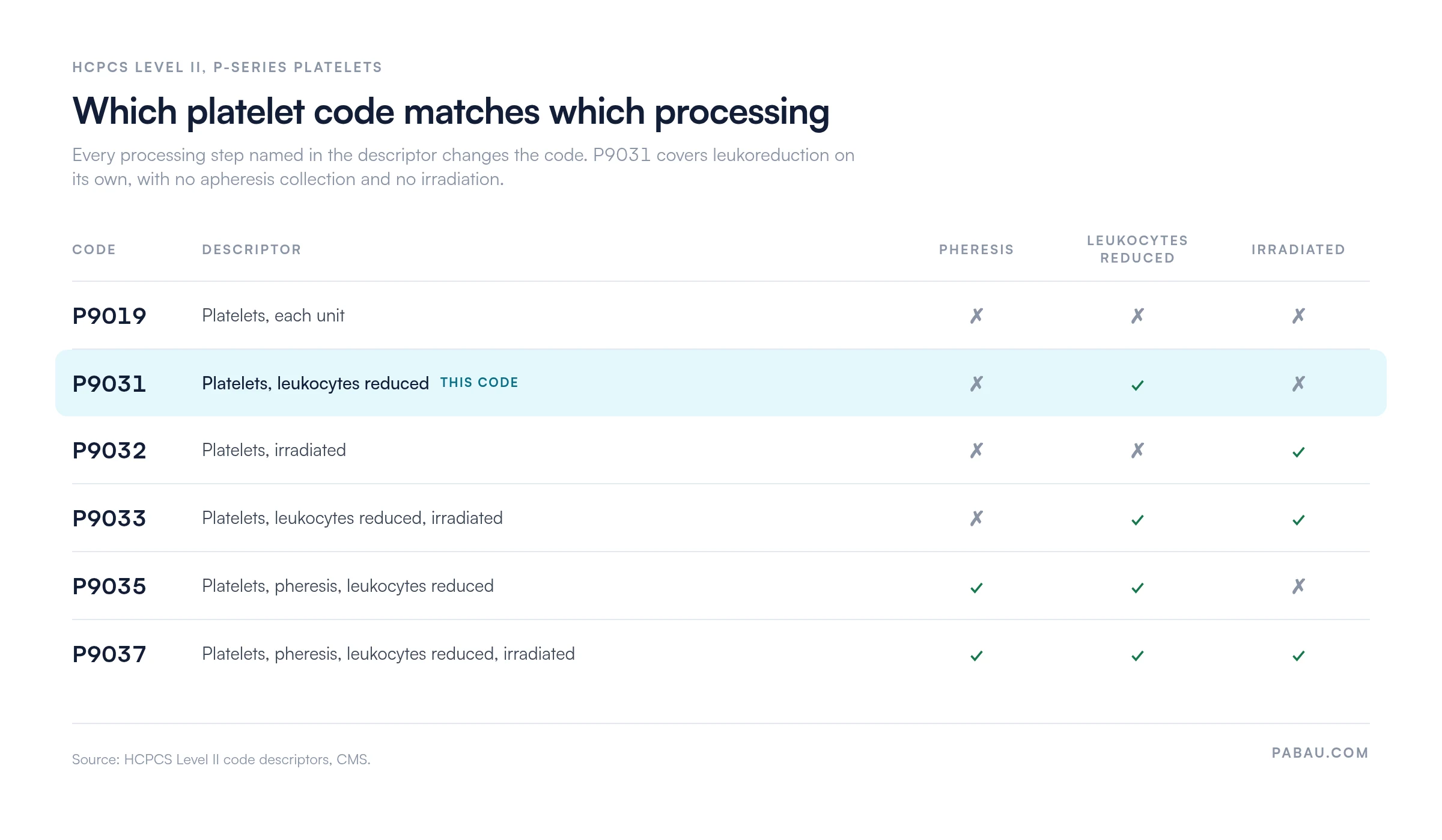
According to the AAPC HCPCS code reference, the adjacent codes most often confused with P9031 are P9032, P9035, and P9037. Their full descriptors and the rule for choosing between them are below.
The distinction between P9031 and P9032 matters most for billing accuracy. A unit can be leukoreduced but not irradiated, which is P9031, or irradiated but not leukoreduced, which is P9032.
A unit that has had both needs a code naming both processes. That is P9033 for a non-pheresis unit, or P9037 for a pheresis unit. Never substitute one code for another based on assumed processing.
Pathogen reduction is a separate processing step that none of these codes covers. The pheresis platelet code that once named it, P9072, was retired on January 1, 2018.
The P-series sits inside a much larger Level II set, and our HCPCS code library covers the other families a transfusion service bills.
Denied blood product claims are expensive for hospital transfusion services, and the same five errors recur across facilities. Each one has a fix that sits in the billing workflow rather than in the clinical record.
Billing P9032 when the unit was only leukoreduced is the most common error in this code set. P9032 may carry a higher payment rate in some payer contracts, because irradiation is an extra processing step. Billing it without documented irradiation is upcoding, whatever the intent. The transfusion record has to confirm the processing performed on every unit billed.
P9031 is billed per unit. A claim that bills a single line for P9031 regardless of how many units were transfused will be underpaid. Conversely, billing more units than the transfusion record documents is overbilling. The unit count on the claim must match the transfusion record exactly.
Hospital outpatient claims for blood products require both the HCPCS code and the revenue code. Submitting P9031 without a 038x revenue code on the UB-04 triggers a claim rejection. Pairing it with 0380 or 0389 when 0384 applies can draw a rejection too, from any MAC that enforces specific component coding.
Billing P9031 requires evidence that leukoreduction actually occurred. If the blood supplier delivered a standard platelet unit and bedside filtration was not performed, P9031 cannot be billed. The unit’s processing status must be traceable through the blood bank record. Facilities operating universal leukoreduction programs should record that policy in their billing procedures to support retrospective audits.
Blood products administered during a single transfusion episode should appear on one claim. Billing the same unit across multiple claims or dates of service without clinical justification triggers duplicate claim edits. Confirm that each unit identifier appears only once across the billing cycle for that patient.
Run a monthly audit of your P9031 claims against transfusion records. Compare billed unit counts to documented units, verify revenue code pairings, and check that every line has a corresponding unit identification number. This 30-minute audit catches most common errors before they become post-payment recoupment demands.
In most transfusion services the units are tracked in the blood bank system and the claim is built somewhere else. The unit count gets rekeyed, and the revenue code comes off a chargemaster nobody has audited this year. The mismatch only surfaces when the remittance arrives.
Practice management software like Pabau keeps the billing detail attached to the record that produced it. Insurer details live on the patient record, and each administered unit carries its own line with the HCPCS code and the supporting documentation. The claim is then assembled from the transfusion record instead of a re-entry.
Pabau also checks a claim for missing detail before it is sent. A line without a revenue code or a unit identifier gets caught rather than rejected. US practices submit through Claim.MD without leaving the system, which keeps the billing ledger and the claim history in step. That leaves your team working the units that were genuinely miscoded rather than reconstructing why a claim came back.

Pabau’s claims management tools help hospital revenue cycle teams track units administered, assign correct HCPCS codes, and submit cleaner UB-04 claims with fewer denials.

Accurate P9031 billing rests on three habits. Pick the code that matches the processing actually performed. Bill one line per unit, and pair each line with revenue code 0384. The transfusion record is what proves all three.
What keeps a facility out of recoupment is agreement between its systems. The chargemaster, the blood bank record, and the claim all have to describe the same unit the same way. Align those three and most of the audit exposure goes away.
Pabau gives revenue cycle teams claim tracking, HCPCS code management, and insurer detail held on the patient record. Book a demo to see how it fits your transfusion service’s billing process.

Need to understand how clean claims reduce blood product denials? What makes a clean claim walks through the key components payers check before processing an institutional claim.
Want a broader view of how revenue cycle management connects to blood product billing? Revenue cycle management explained covers the full financial workflow from patient registration through remittance.
Seeing repeated denials on HCPCS blood product claims? Denial management in healthcare outlines systematic approaches to tracking, appealing, and preventing claim denials.
HCPCS code P9031 is used to bill for one unit of leukocyte-reduced platelets administered to a patient. It applies when the platelet component has undergone leukoreduction. That filtration step removes white blood cells, which lowers the risk of febrile transfusion reactions, CMV transmission, and platelet refractoriness. Each unit transfused is billed as a separate line item.
P9031 describes platelets that have been leukoreduced (white blood cells removed). P9032 describes platelets that have been irradiated (treated with gamma or X-ray radiation to prevent transfusion-associated graft-versus-host disease). These are two different processes. A unit that is leukoreduced but not irradiated is P9031. A unit that is irradiated but not leukoreduced is P9032. Billing P9032 for a leukoreduced-only unit is upcoding.
Yes, P9031 is a Medicare payable code under the Hospital Outpatient Prospective Payment System (OPPS). Reimbursement amounts are updated annually and should be verified against the current CMS OPPS fee schedule. Coverage may be subject to Local Coverage Determinations from your Medicare Administrative Contractor, which may require documented clinical justification for leukoreduction.
P9031 is paired with the 038x revenue code series on the UB-04 claim form. Revenue code 0384 (platelets) is the specific code for platelet components, so use it rather than the general 0380 or the 0389 catch-all. CMS and MAC guidance direct facilities to report the specific component code wherever one exists. Confirm the assignment against current CMS OPPS transmittals for your jurisdiction.
Required documentation includes a signed physician order for the platelet transfusion, with either the leukoreduction indication or the facility’s universal program policy. It also includes a completed transfusion record with the unit identifier, patient consent, and the clinical indication with supporting ICD-10-CM codes. Payers want confirmation that leukoreduction was performed on the specific unit billed. Each unit must have its own complete documentation trail.
Leukoreduction is the removal of white blood cells (leukocytes) from a blood component through filtration before transfusion. It changes the billing code because it represents additional processing of the blood product beyond a standard platelet unit. HCPCS Level II carries a specific descriptor for each type of processed blood component. Leukoreduced platelets therefore use P9031 rather than the standard platelet code, which reflects the cost difference in the product supplied.