CCSD code H4430: Examination of rectum under anaesthetic
CCSD code H4430 pays for the examination alone CCSD code H4430 is the UK private...

Last Updated: Oct 20, 2026
P9012 is the HCPCS Level II code for cryoprecipitate, each unit.
One unit means one bag. Six bags transfused in a session is six units on the claim, not one line for the session. That unit rule, plus a diagnosis code specific enough to justify the transfusion, decides whether the claim pays.
Let Pabau's smart automation suggest the right codes, reduce claim denials, and keep your practice compliant—effortlessly.
Automate repetitive tasks and focus on what matters most—your patients.
Reduce coding errors and ensure compliance with the latest regulations.
Clean claims, fewer denials, and faster reimbursements.
Powerful insights and reporting to help your practice thrive.
HIPAA compliant SOC 2 certified GDPR-compliant Trusted by 4,000+ clinics worldwide

HCPCS code P9012 bills cryoprecipitate at one unit per bag, in hospital outpatient and physician office settings.
Report each bag on its own claim line. Six bags transfused means six units, not one line for the session.
A missing or unspecific ICD-10 diagnosis code is the most common reason P9012 claims deny.
Link the transfusion to a qualifying condition such as DIC, fibrinogen deficiency, or hemophilia A.
Practice management software like Pabau keeps the unit count and the diagnosis code with the transfusion record.
P9012 is the billing code for cryoprecipitate, each unit. It belongs to the HCPCS Level II code set maintained by the Centers for Medicare and Medicaid Services (CMS). The P-series covers pathology and laboratory services, including blood and blood-derived products supplied to patients.
The code is active for 2026 billing. HCPCS designations can change with each annual CMS release. Verify the current status against the CMS Physician Fee Schedule lookup tool before you submit.
Cryoprecipitate is a frozen blood product derived from fresh frozen plasma. It is prepared by slowly thawing plasma and collecting the precipitate that forms. Understanding what the product contains helps coders confirm that the clinical indication matches the billing code.
Each unit of cryoprecipitate carries concentrated amounts of four clotting factors. Transfusion guidance from the Association for the Advancement of Blood and Biotherapies names the same four:
In current practice, P9012 transfusions are most often driven by fibrinogen deficiency or disseminated intravascular coagulation (DIC). Massive hemorrhage protocols are the third common setting, where clotting factors need replacing fast. Record which condition drove the transfusion. That choice decides which ICD-10 code supports medical necessity on the claim.
Every P9012 claim needs a linked ICD-10 diagnosis code that establishes medical necessity. A claim submitted without a qualifying diagnosis will typically deny. The codes below are the ones that most often support a cryoprecipitate transfusion, and each is drawn from the ICD-10-CM code set.
Always code to the highest level of specificity. D68.9, coagulation defect unspecified, is a last resort. Local Coverage Determinations (LCDs) issued by Medicare Administrative Contractors (MACs) can restrict covered diagnoses further. Check the LCD policies for your jurisdiction before submitting.
P9012 is reimbursed under Medicare Part B as a blood product supply. Rates are set by CMS annually and vary by geographic location. The electronic remittance advice (ERA) returned after adjudication confirms the allowed amount applied to each claim.
Blood product reimbursement rates change annually. Confirm current figures through the CMS fee schedule lookup tool rather than a prior-year rate sheet. Commercial payer rates vary under individual payer contracts, so verify with each payer before assuming Medicare rates apply.
Run an insurance eligibility verification before every planned cryoprecipitate transfusion. Confirming Part B coverage and deductible status heads off balance-billing disputes later. It also helps the billing team post the claim correctly from the start.
Each claim line represents one unit of cryoprecipitate, and one unit means one bag. If six bags are transfused in a single session, report P9012 six times or use the quantity field. Do not bill the session as a single line.
Conflating total volume with unit count is the most frequent error on these claims. The number on the claim has to match the number of bags the blood bank issued.
P9012 is billed under Medicare Part B for transfusions in hospital outpatient departments and physician offices. The transfusion itself is billed separately, using the applicable transfusion administration CPT code. P9012 covers the blood product supply, not the service of administering it.
Practices using claims management software can automate the modifier check and the unit count before submission. That leaves billing staff reviewing exceptions rather than every line.
Modifiers signal specific clinical or billing circumstances to the payer. The following modifiers are commonly appended to P9012 claims depending on the situation:
Verify modifier applicability against National Correct Coding Initiative (NCCI) edits before submission. Incorrect modifier usage can result in claim rejection, overpayment liability, or audit flags. When in doubt, consult the applicable MAC’s Local Coverage Determination.
Incomplete documentation causes a large share of P9012 denials that have nothing to do with diagnosis coding. The medical record has to support every element of the claim before it goes out.
The following documentation is required to support a P9012 claim:
Pull this documentation before the claim goes out, not reactively during an audit. A pre-submission checklist specific to blood product claims is worth building into the billing workflow.
P9012 sits in a family of HCPCS P-series codes covering blood and blood-derived products. Coders often need to tell P9012 apart from adjacent codes when several products go into the same encounter. Use the AAPC code lookup to verify the current description for any code below.
When a patient receives both cryoprecipitate and fresh frozen plasma in the same encounter, both codes may be billed. Document each product separately in the transfusion record and link each code to the appropriate clinical indication.
Pooled plasma treated with a solvent/detergent process has its own code. Report P9023 for that product, and keep the cryoprecipitate units on a separate P9012 line.
P9012 denials cluster around a predictable set of mistakes. Each one is a failure of a single claim element, so it helps to see the whole set at once.
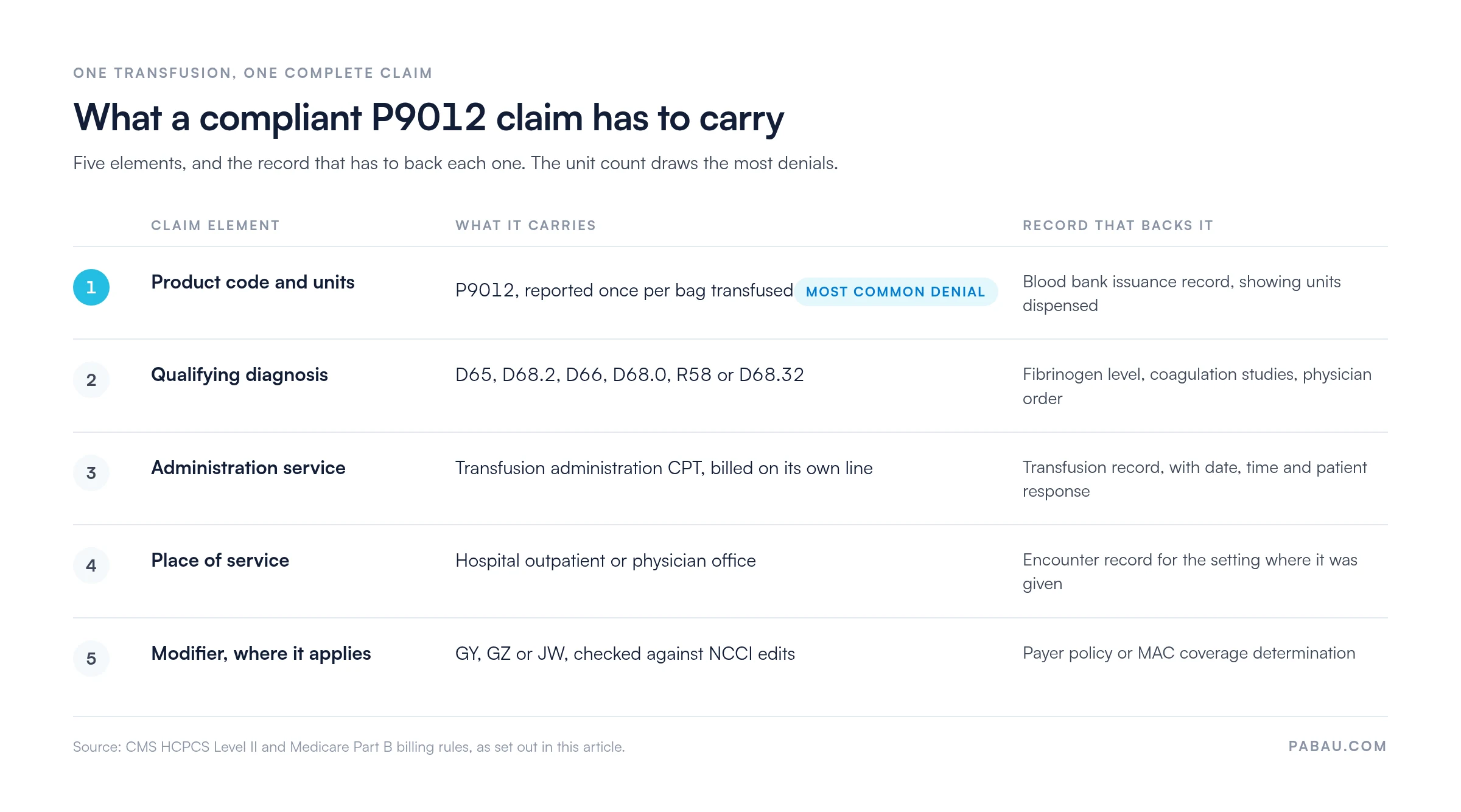
These six errors generate the most rejections on cryoprecipitate claims:
A pre-submission claim scrub catches most of these. Check the unit count against the transfusion record, confirm the ICD-10 code is specific, and confirm any modifier is present. Fixing a claim at that stage costs far less than denial management after the fact.
Keep a blood product billing checklist next to your cryoprecipitate order set. Check four items: units against the blood bank record, a documented qualifying ICD-10 code, the transfusion administration CPT, and the place of service. A 60-second review before submission prevents most P9012 denials.
Most blood product billing still runs on a paper trail. The billing team pulls the blood bank slip, counts the bags, checks the physician order, then types the units into the claim by hand. Every hop is a chance for the count to drift.
Practice management software like Pabau keeps the claim next to the record it came from. The transfusion note, the physician order, and the qualifying diagnosis code sit in the same client file. Billing staff work from one screen instead of three.
Pabau’s claims management tools then scrub the claim before it leaves the practice. A missing modifier, an unspecific diagnosis code, or a unit count that doesn’t match the documentation gets flagged while the claim is still editable. Fewer P9012 lines come back.

Pabau keeps the transfusion record, the diagnosis code, and the unit count in one client file. Claims get scrubbed for missing modifiers before submission.

P9012 is a simple code with an unforgiving claim. One bag, one unit, one line, and a diagnosis specific enough for the payer to see why the transfusion happened.
Put the check next to the order set rather than in the appeal queue. A minute spent matching the claim to the blood bank record costs far less than a resubmission. It also keeps reimbursement on the original payment cycle.
Blood product claims will always carry more moving parts than a routine office visit. What you can change is where the checking happens. Book a demo to see how Pabau keeps P9012 units, diagnosis codes, and documentation together before the claim goes out.

Need to understand how claims move through the revenue cycle? Revenue cycle management workflows explains each stage from charge capture to remittance posting.
Want to catch coverage problems before you submit? Insurance eligibility verification covers how to confirm coverage before blood product claims are submitted.
Want a cleaner claims workflow for blood products? Superbill documentation outlines what must appear on the billing record to support HCPCS code submissions.
HCPCS code P9012 is used to bill for cryoprecipitate, each unit, a frozen blood product containing fibrinogen, Factor VIII, Factor XIII, and von Willebrand factor. It is billed in hospital outpatient and physician office settings. Qualifying indications include DIC, fibrinogen deficiency, and von Willebrand disease.
Bill P9012 once per unit of cryoprecipitate transfused under Medicare Part B. Each bag equals one unit. Report the code with a qualifying ICD-10 diagnosis code, and include the transfusion administration CPT code on the same claim. Use the place of service code that matches where the transfusion happened.
The strongest ICD-10 codes for P9012 are D65 for disseminated intravascular coagulation and D68.2 for hereditary clotting factor deficiency. D66 covers hemophilia A and D68.0 covers von Willebrand disease. Always select the most specific code supported by laboratory results and physician documentation.
Yes, HCPCS code P9012 is covered under Medicare Part B for blood product transfusions administered in hospital outpatient departments and qualifying physician office settings. Coverage is subject to medical necessity documentation, applicable Local Coverage Determinations from the MAC, and a qualifying ICD-10 diagnosis linked to the transfusion.
P9012 describes cryoprecipitate, a concentrated blood product extracted from frozen plasma and rich in fibrinogen and clotting factors. P9017 describes fresh frozen plasma (FFP), which is whole plasma containing all clotting factors at lower concentrations. The two products serve different clinical purposes and are not interchangeable for billing.
You need a physician order specifying cryoprecipitate and the number of units, plus a transfusion record with units administered and lot numbers. Add laboratory results supporting the indication, such as fibrinogen levels or coagulation studies. The record also needs an ICD-10 diagnosis linked to the transfusion, and blood bank issuance records matching units billed to units dispensed.