CPT Code 62284: Injection procedure for myelography
CPT Code 62284: official descriptor and procedure overview The American Medical ...

Last Updated: Oct 19, 2026
P9016 is the HCPCS Level II code for red blood cells, leukocytes reduced, each unit. It bills the leukoreduced red cell product itself, one unit per bag, while the transfusion is billed separately under CPT codes such as 36430.
Choosing P9016 turns on the processing recorded by the blood bank. Plain red cells are P9021, irradiated red cells are P9038, and cells that are both leukoreduced and irradiated are P9040.
Let Pabau's smart automation suggest the right codes, reduce claim denials, and keep your practice compliant—effortlessly.
Automate repetitive tasks and focus on what matters most—your patients.
Reduce coding errors and ensure compliance with the latest regulations.
Clean claims, fewer denials, and faster reimbursements.
Powerful insights and reporting to help your practice thrive.
HIPAA compliant SOC 2 certified GDPR-compliant Trusted by 4,000+ clinics worldwide

P9016 describes red blood cells, leukocytes reduced, each unit, and you bill one unit per bag rather than per transfusion episode.
P9016 covers leukoreduced red cells that are not irradiated. Irradiated red cells take P9038, washed red cells P9022, and plain red cells P9021.
Hospital outpatient departments are paid for P9016 under OPPS, so the Physician Fee Schedule lookup returns no rate for it.
Medicare Part B covers P9016 for outpatient transfusions, and the record must document why the transfusion was medically necessary.
Practice management software like Pabau tracks denial codes and resubmissions, so blood product claim errors get fixed at the source.
HCPCS code P9016 identifies “red blood cells, leukocytes reduced, each unit.” It’s a Level II HCPCS code maintained by the Centers for Medicare and Medicaid Services (CMS) in the blood and blood products range (P9010-P9100). The “each unit” in the descriptor is the billing unit, so one bag of leukoreduced red cells equals one claim unit.
Level II codes are alphanumeric (one letter followed by four digits) and are maintained separately from CPT codes. CMS updates the P-series with the HCPCS code set. Check the code’s active status in the current AAPC HCPCS code directory before each January update.
P-series codes bill the blood product itself. The transfusion is billed separately under a CPT code. Most outpatient transfusions use 36430, and a push transfusion for a patient 2 years or younger uses 36440. P9016 never covers the administration service.
P9016 covers only leukoreduced red blood cells that have not been irradiated or washed. Leukoreduction filters out most of the white blood cells (leukocytes), bringing the residual count below 5×10^6 per unit under FDA quality standards. P9016 captures that product type, not the infusion service.
Coders often apply P9016 to blood products that need a different code. The exclusions matter as much as the inclusions.
Billing P9016 for a product that doesn’t meet leukoreduction standards is upcoding. It exposes the facility to audit findings and repayment demands.
The most common P9016 coding error is using it for irradiated red blood cells, which take P9038. Both start as red cells, but irradiation inactivates donor T-lymphocytes to prevent transfusion-associated graft-versus-host disease (TA-GvHD). Payers treat them as distinct products with distinct coverage rules, so the wrong code gets denied. Two processing steps, leukoreduction and irradiation, decide most red cell codes.
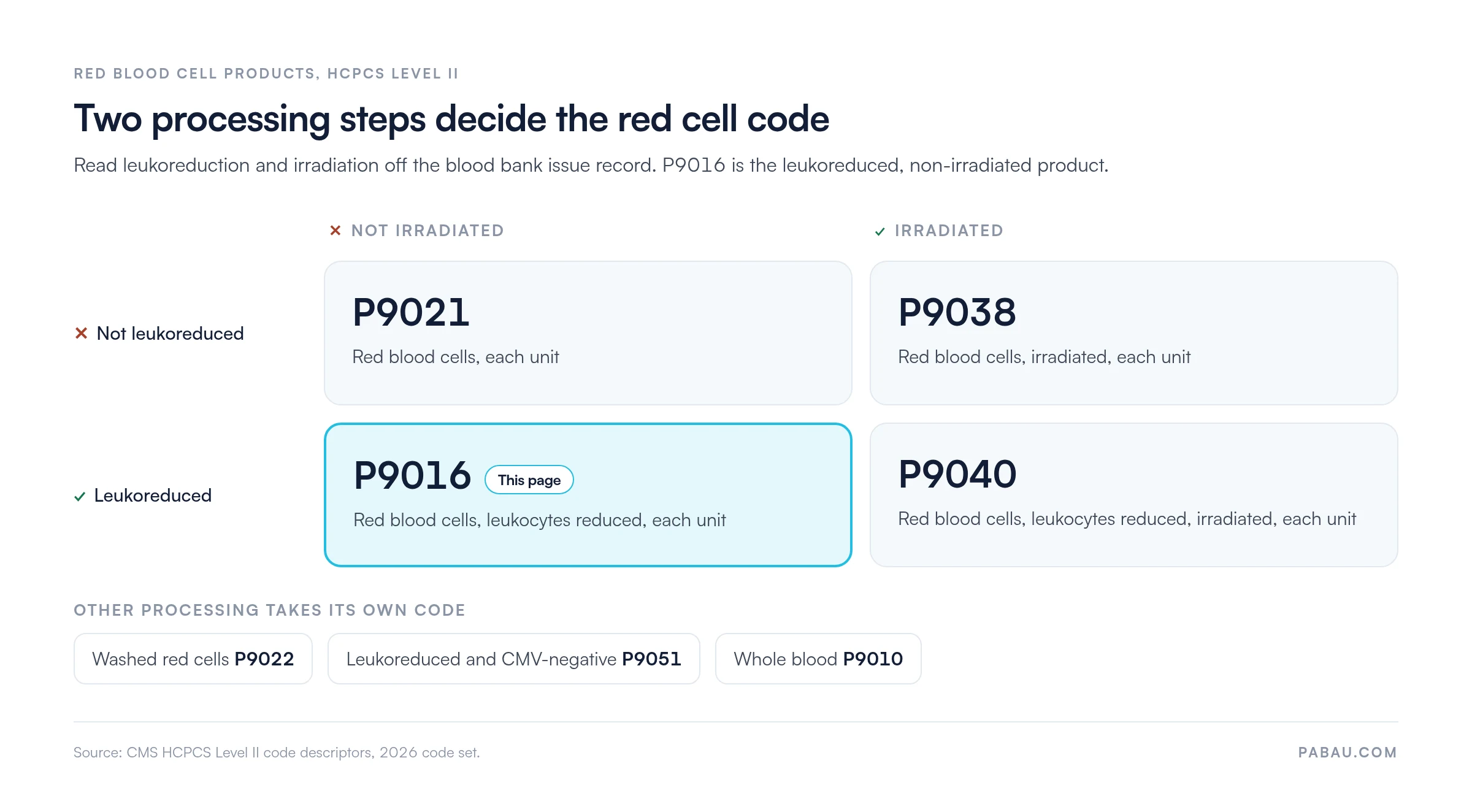
A unit that is both leukoreduced and irradiated doesn’t take P9016 plus a modifier or a second code. It has its own code, P9040. Code-selection slips like this sit behind many of the medical billing denial codes that blood product claims attract.
Leukoreduction alone doesn’t settle the code, because platelets are leukoreduced too. Apheresis platelets that have been leukoreduced bill as P9035, and P9016 stays with red cells.
Medicare Part B covers HCPCS code P9016 for outpatient blood transfusions when medical necessity is established. Part B doesn’t pay for blood products during inpatient hospital stays, because those costs are bundled into the Part A DRG payment. Outpatient claims need an ICD-10-CM diagnosis that justifies the transfusion. Where payer policy demands it, they also need a physician’s attestation of medical necessity for the leukoreduced product.
Commercial payer coverage varies. UnitedHealthcare and Molina Healthcare publish outpatient hospital blood products policies that reference P9016. Medi-Cal (California Medicaid) has a dedicated blood and blood derivatives billing manual. Before billing a payer for the first time, pull its current blood products policy from the provider portal. An eligibility check before each transfusion episode also confirms whether the plan covers outpatient blood products at your place of service.
P9016 is not on the Medicare Physician Fee Schedule, so the MPFS lookup tool returns no rate for it. In hospital outpatient departments, Medicare pays P9016 under the Outpatient Prospective Payment System (OPPS). It carries status indicator R and its own ambulatory payment classification, APC 9512.
The CY2024 OPPS payment was about $181 per unit. Rates change every January 1, so check the current figure in the OPPS Addendum B files before you update your chargemaster.
Outside the OPPS setting, the Medicare administrative contractor (MAC) prices P9016. Commercial payer rates are negotiated in each payer contract and aren’t published. If your facility has an active contract, the blood product rates usually sit in its fee schedule exhibit.
The P9016 payment covers the product only. Administration, crossmatch, and setup are reimbursed under separate CPT codes. Billing P9016 alone and expecting it to cover the service is a common cause of underpayment.
Run a quarterly audit on your P9016 payment posting. Compare the per-unit allowable on each electronic remittance advice (ERA) against your current rate table. A posted payment below the allowable points to a contractual adjustment, a unit count error, or a posting mistake. Send any discrepancy above 10% for manual review before writing it off.
A clean P9016 claim depends on five elements. They are the unit count, diagnosis code, place of service, modifiers, and the medical record behind each choice. A denial on any one of them sends the claim back for rework, so set each element up before the first P9016 claim goes out.
Each bag of leukoreduced red blood cells is one unit. A patient who receives two bags in one transfusion episode gets two units on the claim (P9016 x 2). Never roll several transfusion episodes into one claim line with an inflated unit count. Bill each encounter with its own date of service and a unit count that matches the blood bank issue record.
Every P9016 claim needs at least one ICD-10-CM diagnosis code that explains why the transfusion was medically necessary. Common supporting diagnoses include:
US ICD-10-CM has no encounter code for a blood transfusion, so the claim can’t lean on a Z-code. The condition that made the transfusion necessary carries the medical necessity instead.
Some payers also want a diagnosis that supports leukoreduction specifically, not just transfusion in general. This comes up most for immunocompromised patients, such as transplant recipients and oncology patients. For them, the documentation should state the clinical indication for the leukoreduced product.
P9016 is billed under Place of Service (POS) 22 for outpatient hospital settings. Modifier use is payer-specific. Modifier JW (drug amount discarded) is not a CMS requirement for P-series blood products, though some payers ask for waste documentation. Some facilities append modifier 91 (repeat clinical diagnostic laboratory test) in error, but it applies to lab services, not blood products. When a payer requires a modifier, confirm it against that payer’s current coverage policy rather than from memory.
P9016 denials follow recognizable patterns. Track which adjustment reason codes appear on your blood product remittances, then fix root causes by code rather than claim by claim.
The electronic remittance advice (ERA) is your fastest tool for spotting denial patterns, so filter remittances by CARC code for P9016 claims each month. A cluster of CO-50 denials usually means medical necessity documentation broke down at the physician order stage, not in billing. Fixing it takes a process change upstream.
The Association for the Advancement of Blood and Biotherapies (AABB) publishes a billing guide for blood products and related services. It’s the closest thing transfusion billing has to a standards document. The guide covers P-series HCPCS codes, including P9016, and the documentation that supports medical necessity for leukoreduced products. CMS transmittals and Chapter 4 of the Medicare Claims Processing Manual govern how Medicare processes outpatient P9016 claims.
Key quality standards that affect whether a unit qualifies for P9016:
Linking the blood bank’s issue records to the billing system is where most P9016 revenue slips through. The encounter should capture both the product code (P9016) and the administration CPT code, so neither one is missed.
A P9016 denial usually starts before anyone opens the billing system. The physician order, the blood bank issue record, and the claim line each describe the product, and payers reject the claim when those three disagree.
With practice management software like Pabau, the claim draws on details already saved to the patient record instead of being retyped. Pabau’s claims management software submits and tracks claims through Claim.MD in the US and posts remittances back against each claim.
When a CO-4 or CO-50 lands, your team sees which claims it hit and resubmits from the same record. That way the fix happens once in the workflow, and the same wrong-code denial doesn’t come back next month.

Pabau builds claims from the patient record, then tracks denials and resubmissions, so blood product billing errors get fixed at the source.

Treat the blood bank issue record as the source of truth for P9016. If the record says leukoreduced and nothing else, P9016 is the code. Any other processing step points to a different code, and irradiated units need P9038, not P9021.
The trade-off is some setup work. Mapping each blood product label to its billing code is a one-time job, and it stops the same wrong-code denial from repeating every month.
Book a demo to see how Pabau keeps blood product claims tied to the record they came from.

Need a framework for managing claim denials systematically? Denial management in healthcare covers root-cause analysis and resubmission workflows for outpatient billing teams.
Want to understand how ERA data feeds back into denial tracking? Electronic remittance advice explains how to read 835 files and extract actionable denial intelligence.
Looking for a billing compliance checklist for your coding team? Medical billing compliance outlines the documentation and process standards that reduce audit exposure across all HCPCS claim types.
Billing plain red cells instead? HCPCS code P9021 covers red blood cells with no leukoreduction, irradiation, or washing.
Working with washed units? HCPCS code P9022 explains when washed red cells apply and how to bill them.
HCPCS code P9016 is the Level II billing code for red blood cells, leukocytes reduced, each unit. Outpatient facilities use it to bill Medicare and commercial payers for leukoreduced red cell transfusions. Each bag transfused equals one unit on the claim.
P9016 covers red blood cells that have been leukoreduced but not irradiated. P9021 covers plain red blood cells with no leukoreduction, irradiation, or washing. Irradiated red cells take P9038, or P9040 when they are also leukoreduced.
Yes. Medicare Part B covers P9016 for outpatient blood transfusions when medical necessity is documented. Inpatient transfusions are covered under Medicare Part A within the DRG payment and are not billed separately using P-series codes.
Bill one unit of P9016 for each bag of leukoreduced RBCs administered. A patient receiving two bags on the same date of service gets two units (P9016 x 2) on the claim. The unit count must match the blood bank issue record exactly.
Medicare does not require prior authorization for P9016. Some commercial payers (including certain Molina Healthcare state plans) do require prior authorization for outpatient blood products. Verify each payer’s current blood products policy before billing, as PA requirements change by plan year.
You need a physician order specifying the leukoreduced product and an ICD-10-CM diagnosis supporting medical necessity. You also need the blood bank issue record showing product type and unit count. Some payers want a clinical note on why leukoreduction was indicated.