

HCPCS code E0198: Water pressure pad billing guide
HCPCS code E0198 is a water pad for a standard mattress HCPCS code E0198 is the ...

Last Updated: Oct 13, 2026
P9022 is the HCPCS Level II code for red blood cells, washed, each unit. It reports the product itself, one unit per claim line, not the transfusion that delivers it.
Washing rinses a unit of packed red cells in saline to remove plasma proteins, particularly IgA. Because the step is done only for specific clinical reasons, payers look for the indication in the chart. They also look for the blood bank's processing record before they pay the line.
Let Pabau's smart automation suggest the right codes, reduce claim denials, and keep your practice compliant—effortlessly.
Automate repetitive tasks and focus on what matters most—your patients.
Reduce coding errors and ensure compliance with the latest regulations.
Clean claims, fewer denials, and faster reimbursements.
Powerful insights and reporting to help your practice thrive.
HIPAA compliant SOC 2 certified GDPR-compliant Trusted by 4,000+ clinics worldwide

HCPCS code P9022 covers one unit of washed red blood cells, billed as a single line per unit transfused.
Washing strips plasma proteins, so payers expect an indication such as IgA deficiency, a severe allergic reaction, PNH, or neonatal transfusion.
Payers ask for two documents most often, a physician order naming washed RBCs and the blood bank record confirming the wash.
P9022 pays for washing only, so irradiation, leukoreduction, and deglycerolization each carry their own P-series code.
Practice management software like Pabau connects clinical documentation to billing workflows, so the record behind a code travels with the claim.
HCPCS code P9022 covers red blood cells, washed, each unit. It is a Level II code maintained by the Centers for Medicare and Medicaid Services (CMS). The code sits in the P-series, which covers pathology and laboratory products. One washed unit equals one billed line.
The code reports the product, not the act of giving it. P9022 also sits in the same block as the other blood product codes, running from P9021 through P9039.
The AAPC HCPCS code lookup confirms P9022 as an active, non-deleted code. P-series codes are reviewed every year, so check the current CMS HCPCS update file before you bill.
Washing is reserved for patients who react to plasma. Washed red blood cells are packed RBCs rinsed with isotonic saline to remove residual plasma, platelets, and white cell debris. The process cuts plasma protein content by roughly 99%.
Standards from the Association for the Advancement of Blood and Biotherapies (AABB) point to five situations where washed RBCs are clinically indicated:
Whichever reason applies, the chart has to name it. A payer reading the claim sees only the diagnosis and the order, so the indication is what turns a washed unit into a payable line.
Pick the code from the processing step, not from the patient. P9021 covers red blood cells, each unit, with no additional processing. P9022 covers the same base product after saline washing by the blood bank. If the unit was not washed, P9021 is correct.
Billing P9021 on a unit the blood bank washed costs the hospital money. The facility absorbs a processing step it performed and never charged for. Repeat that pattern often enough and it also invites a compliance review.
P9022 covers the washing step and nothing else. Irradiation, leukoreduction, CMV-negative selection, and antigen-negative selection all fall outside it. Each of those steps may carry its own P-series code when it is performed.
Check these adjacent codes before you default to P9022:
P9038 is the code when irradiation is the only step performed. A unit logged as both leukoreduced and irradiated bills under P9040, not P9022. For a unit that was both washed and irradiated, check current CMS guidance and your payer policy.
Some payers allow both codes on one unit and some treat one as inclusive of the other. Our other HCPCS code guides break down the neighboring P-series entries in the same detail.
Missing paperwork is the top denial trigger for P9022. Payer audits flag the same two records again and again. One is a physician order that says “washed.” The other is a blood bank processing record confirming the wash.
Notice that four of the five records are created by someone other than the biller. That is the whole problem with P9022. The claim is assembled from a lab system, a chart, and a charge master, and it only holds together when those three agree.
Audit your blood bank’s charge capture form. If the technologist selects a processing type (washed, irradiated, leukoreduced) during product release, that selection should populate the HCPCS code in your billing system automatically. Where a coder has to interpret the blood bank record by hand instead, P9022 denials tend to cluster.
Payment depends on the care setting. Hospital outpatient departments are paid under the Outpatient Prospective Payment System (OPPS), where blood products are assigned to Ambulatory Payment Classification (APC) groups. The APC that covers washed RBCs reflects the processing cost that P9021 does not carry.
Inpatient claims work differently. Blood product costs are generally bundled into the Diagnosis-Related Group (DRG) payment, so they are not separately billable there.
Confirm your facility’s cost reporting approach with the revenue cycle team. For current outpatient rates, pull the OPPS Addendum B file, which lists the APC rate for every payable code.
Commercial payers vary widely. Some mirror the Medicare OPPS rates. Others pay cost-based or negotiated amounts tied to what the hospital spends on acquiring and processing blood.
Review each contracted payer’s blood product schedule once a year, because the washed-versus-unwashed differential is not recognized uniformly.
Medicare requires no prior authorization for inpatient blood product transfusions under standard DRG payment. Most acute hospital outpatient transfusions escape it too. Commercial payers are far less consistent.
Three situations are the ones that usually trigger a commercial authorization requirement:
Send the clinical documentation with the request when authorization is needed. That means the confirmed diagnosis, the order specifying washed RBCs, and any prior transfusion reaction records. Lab confirmation of IgA deficiency belongs in the packet too.
P9022 rejections cluster around a short list of root causes. Reading the pattern before you submit beats appealing afterward, and the table below pairs each cause with the fix that clears it.
Sorting rejections by claim adjustment reason code (CARC) turns single denials into a pattern you can act on. A run of CARC 50 denials points at medical necessity, which usually means the washing indication never reached the chart. CARC 197 points at a missing authorization.
CARC 4 is worth reading carefully, because it reports a modifier problem rather than a wrong code choice. Structured denial management workflows make those groupings visible quarterly instead of annually.
Follow one washed unit through the building and the failure points become obvious. Each stage below creates a record, and the claim only survives if that record reaches the next stage.
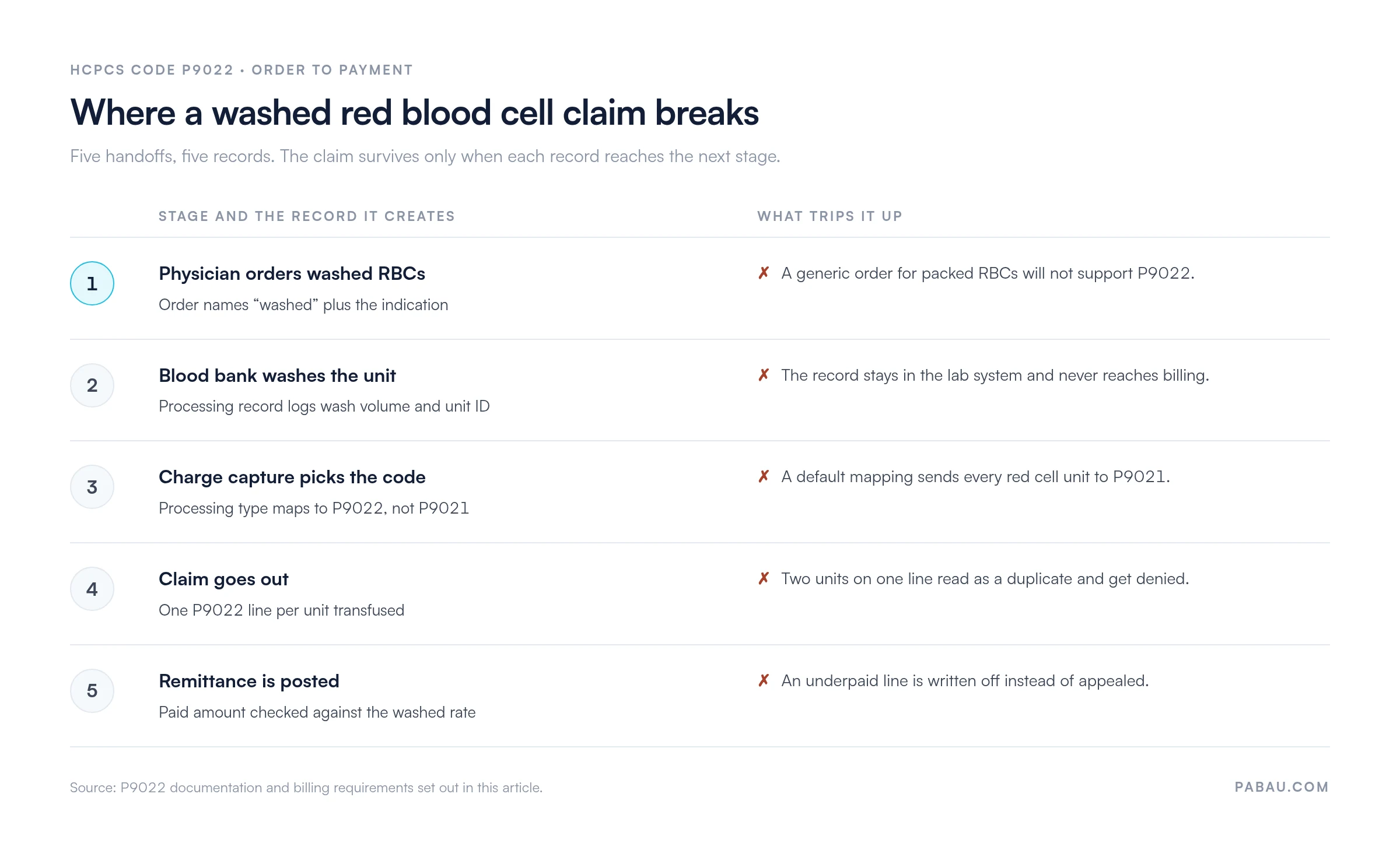
Two stages deserve extra attention. Stage three is where a default charge master mapping quietly sends every red cell unit to P9021. Stage five is where an underpaid line gets written off instead of appealed, because nobody compared the paid amount to the washed rate.
Five checks catch almost every P9022 problem while the claim is still yours to fix:
Teams building their own charge capture rules can pull descriptors from the NLM HCPCS Level II API. It is free, and it updates with the annual file.
Run a quarterly reconciliation between your blood bank’s unit processing log and your billed P9022 claims. Every washed unit the blood bank issued should match exactly one billed P9022 line. A mismatch is either lost revenue from a missed charge, or a compliance risk from a line billed without processing confirmation.
Most billing teams work across at least two systems. The documentation that justifies a code lives in one. The claim that uses it is built in another. Those two only meet when a payer sends something back. That is the handoff P9022 exposes, and it is the same handoff that costs private practices money on far more routine codes.
Practice management software like Pabau closes that distance by keeping patient records, treatment notes, invoices, and claims software for practices in one place. When a charge is raised, the note behind it is already on the same patient record. Nobody has to reconstruct the supporting documentation weeks later.
For a practice, the payoff is fewer claims held up while somebody hunts for a record. Coding decisions still belong to your coders and your clinical teams. What changes is how quickly the evidence behind each decision can be found and sent.

Pabau connects clinical documentation to billing workflows, so the record supporting a charge sits with the claim that uses it. See how practices submit cleaner claims without chasing paperwork between systems.

P9022 is an easy code to bill and an easy one to lose. The washing happened, the product was given, and the money still disappears because the order said “RBCs” or the processing record never left the lab. Neither of those is a coding problem.
So fix the two handoffs rather than the code sheet. Get the ordering physicians writing “washed,” and get the blood bank’s processing entry into the billing system automatically. Do that and the appeals queue thins out on its own.
The wider lesson holds well beyond blood products. Claims fail where records are handed between systems, so the fewer handoffs you keep, the fewer denials you work. Book a demo to see how Pabau keeps documentation and claim submission on one record.

Need to understand denial patterns across blood product codes? Denial management in healthcare covers how to categorize and resolve systematic claim rejections by CARC code.
Want to tighten your pre-submission claim review? Clean claim submission outlines the checks that cut first-pass denial rates across every code type.
Looking for a primer on where blood product billing sits in the revenue cycle? What is revenue cycle management explains the path from charge capture to payment posting.
No. P9022 pays for the product only. The act of transfusing it is reported separately, usually with CPT code 36430 for transfusion of blood or blood components. A facility that bills the product alone leaves the administration unpaid.
No routine modifier applies to P9022. Blood product codes are driven by the processing step, not by a modifier. If a payer returns CARC 4, look for a modifier their own policy requires rather than assuming the code was wrong.
Washed red cells sit in the 038X blood and blood components revenue series on a UB-04. The subcategory your facility reports should match its charge master. Confirm it against each payer’s billing guide, because revenue code edits differ between plans.
D80.2 is the ICD-10-CM code for selective deficiency of immunoglobulin A. Pair it with documented anti-IgA antibodies or a prior severe reaction. The diagnosis rarely carries the claim on its own if the order never says washed.
The blood bank decides it in practice, because its processing entry is what tells billing the unit was washed. Coders can only confirm that choice. A charge capture map that never leaves the lab system is where P9022 revenue quietly goes.



