

CCSD code G5100: Bypass of duodenum billing guide
CCSD code G5100 bills a bypass that leaves the duodenum in place CCSD code G5100...

Last Updated: Oct 16, 2026
40812 is the CPT code for excision of lesion of mucosa and submucosa, vestibule of mouth; with simple repair. It covers removing a fibroma, mucocele or similar lesion from the vestibule, then closing the wound by primary suture.
The simple repair is what separates 40812 from 40810, which covers the same excision with no closure. The operative note decides between them, so it must state the closure type explicitly.
Let Pabau's smart automation suggest the right codes, reduce claim denials, and keep your practice compliant—effortlessly.
Automate repetitive tasks and focus on what matters most—your patients.
Reduce coding errors and ensure compliance with the latest regulations.
Clean claims, fewer denials, and faster reimbursements.
Powerful insights and reporting to help your practice thrive.
HIPAA compliant SOC 2 certified GDPR-compliant Trusted by 4,000+ clinics worldwide

CPT code 40812 covers excision of a lesion from the vestibule of the mouth, closed with simple (primary) repair.
The operative note decides the level: no repair is 40810, simple repair is 40812, and complex repair moves the claim to 40814 or 40816.
Misclassifying simple repair as complex repair is a leading audit trigger, so the note must state the closure type and the lesion size.
Practice management software like Pabau supports accurate 40812 documentation and sends claims electronically through its Claim.MD clearinghouse integration.
CPT code 40812 describes excision of lesion of mucosa and submucosa, vestibule of mouth; with simple repair. The American Medical Association maintains the CPT code set and publishes this descriptor. The code applies when the excised tissue is mucosal or submucosal and the wound is closed by primary closure.
The vestibule of mouth is the horseshoe-shaped space between the lips and cheeks on one side and the gums and teeth on the other. It is bounded anteriorly by the lips, laterally by the cheeks, and posteriorly by the alveolar ridge mucosa. A biopsy taken from the lip itself, rather than the vestibule, is coded as CPT 40490.
Lesions here include fibromas, mucoceles, hyperplastic tissue and benign neoplasms. They sit in the mucosa and, when deeper, extend into the submucosa. Both tissue layers must be involved for 40812 to apply. A purely surface destruction by laser or electrocautery is coded as a destruction, not an excision.
“Simple repair” in the CPT context means primary closure. The wound edges are approximated and sutured directly, without undermining, tissue advancement, or rotation flaps. This bundled component distinguishes 40812 from CPT 40810, and billers must verify it in the operative report before assigning the code.
The operative sequence documented in the record must reflect these steps for CPT 40812 to hold on audit:
If the record omits the closure type or uses vague language (“wound closed”), the claim is vulnerable to downcoding to 40810 on review. Ask providers to spell it out, for example: “Wound closed primarily with [suture type] in simple interrupted fashion.”
CPT 40812 bundles the excision, the simple repair and local anesthesia into a single billable service. Knowing what sits inside the bundle prevents the most common unbundling errors, and the same bundling logic applies across the 408xx range.
The 408xx family is a graduated hierarchy based on repair complexity. Picking the wrong level is one of the most audited selection errors in vestibular excision billing. Excision of a labial or buccal frenum falls outside this hierarchy and bills as CPT 40819. Use this table as the first check before assigning any code in this family.
If the provider documents “undermining” but no flap, the correct code is 40814. If the operative report describes local tissue advancement or rotation, move to 40816. A primary closure with no undermining stays at 40812.
The wrong modifier on a CPT code 40812 claim is a common cause of denial. Review billing compliance requirements for surgical modifiers before you submit claims for same-day encounters. The table below covers the modifiers that apply most often.
Modifier -25 carries the highest audit risk of any in this list, because payers routinely flag same-day E&M plus surgical procedure claims. The E&M note must document a problem separate from the lesion being excised, such as a new symptom or an unrelated diagnosis. It must also be a fully developed note in its own right.
Medical necessity for CPT code 40812 is established by pairing it with a diagnosis code that supports mucosal or submucosal lesion excision. Choosing the most specific ICD-10-CM code available, and linking it clearly to the procedure, reduces denials on first submission. The table below lists the diagnosis codes most often used for this procedure.
Always use the most specific code the clinical documentation supports. Defaulting to K13.79 for every claim when a more specific diagnosis is documented invites medical necessity reviews. If pathology results are still pending when you submit the claim, note the preliminary clinical impression. Amend the claim if pathology returns a more specific or malignant diagnosis.
The CMS Physician Fee Schedule sets the national payment rates for CPT code 40812. Rates adjust annually and vary by geographic locality through the Geographic Practice Cost Index (GPCI). The table below shows how each RVU component behaves by setting. Verify current locality-adjusted amounts in the CMS lookup tool before quoting reimbursement to providers.
Use the FastRVU 2026 RVU lookup to pull current Work, Practice Expense, and Malpractice RVU values for CPT 40812 by locality. Commercial payers typically reimburse at a percentage of the Medicare fee schedule or at their own contracted rates. For this type of minor surgical code, that is often 110-130% of Medicare, though rates are contract-dependent.
The global period designation governs post-operative billing. A 10-day global (010) means routine follow-up visits within 10 days are included in the surgical payment. A 0-day global (000) covers the day of service only. Confirm CPT 40812’s current global period via the CMS MPFS before billing any post-operative visits.
Submitting a separate E&M within the global period without modifier -24 (unrelated evaluation and management) triggers automatic denial. Practices that submit through the Claim.MD clearinghouse can build eligibility checks and global-period flags into the pre-submission workflow, so these errors never reach the payer.
An operative note that supports CPT 40812 must contain specific elements. Missing any one of them is enough for a payer to downcode or deny on audit. The requirements apply equally to oral surgeons billing commercially and to ENT or general medicine practices billing Medicare. The record must justify the code on its own, without inference.
The site, the tissue depth and the closure type settle the code between them. Check them in the order shown below.
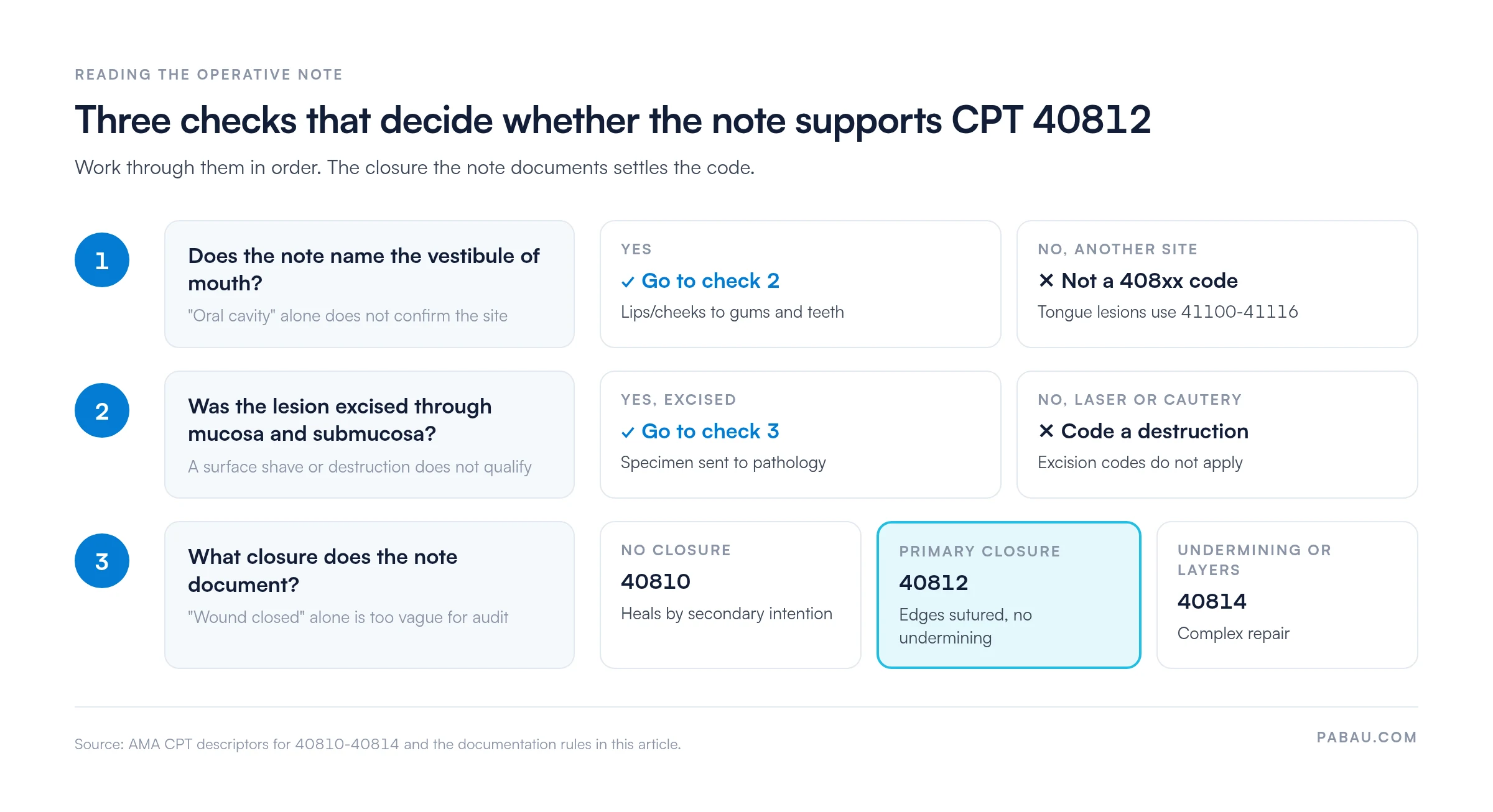
Most denials on CPT code 40812 fall into a small set of repeating patterns. Denial management workflows that catch these before submission save rework and protect cash flow. The table below maps each denial reason to its corrective action.
A clean claim on first pass needs a pre-submission check that does three jobs:
Every rework cycle costs an average of $25-$30 in administrative time, according to industry billing benchmarks. Catching these errors before submission is always cheaper than working denials after the fact.
Before submitting a CPT 40812 claim, run a three-point check on the operative note. (1) Does it explicitly name the vestibule of mouth as the site? (2) Does it state ‘primary closure’ or ‘simple suture’, and not just ‘wound closed’? (3) Is the ICD-10 diagnosis code specific to the type of lesion pathology confirmed? All three must be present. Missing any one reduces first-pass acceptance and opens the claim to downcode or denial.
Accurate billing for CPT code 40812 depends on complete operative documentation and a claim workflow that catches coding errors before submission. Pabau’s denial-reducing claims management connects procedure documentation directly to claim preparation. The fields payers audit, such as site, tissue depth and closure type, are captured at the point of care.
For practices performing vestibular excisions regularly, Pabau’s Claim.MD clearinghouse integration connects to thousands of US payers and supports CMS-1500 and 837P claim formats. Real-time eligibility checks, available for 400+ payers, can confirm coverage before the patient leaves the chair.
Denial data feeds back into the workflow. Repeat denials, such as the wrong repair level, an unbundled closure code or a missing modifier -25, become pre-submission checks you configure. Your team catches them before the claim goes out instead of finding them weeks later on an electronic remittance advice (ERA).

Pabau’s claims management and Claim.MD clearinghouse connection help oral surgery and ENT practices submit CPT 40812 claims accurately. Track denials and resubmit faster from one system.

CPT code 40812 pays reliably when the operative note settles the repair level before billing ever sees it. Train providers to name the vestibule, the tissue layers and the closure type in every note, and downcodes to 40810 become rare.
The trade-off is a few extra seconds of dictation per case, which costs far less than working a single denial. Book a demo to see how Pabau captures those fields at the point of care and checks each 40812 claim before the payer sees it.

Need to verify denial codes on a rejected 40812 claim? Denial codes in medical billing covers the most common CARC and RARC reason codes and how to act on them.
Want to streamline pre-submission eligibility checks? Insurance eligibility verification explains real-time benefit checks and how they reduce claim rejections before submission.
Billing multiple procedure codes from the same encounter? Superbill documentation covers how to structure multi-code encounters for clean submission and audit readiness.
CPT code 40812 covers excision of a lesion of the mucosa and submucosa of the vestibule of mouth, with simple repair. The lesion is removed from the space between the inner lips or cheeks and the outer gums, and the wound is closed by primary suture. The code bundles the excision and the simple closure into a single billable service. Pathology processing is not included and may be billed separately, subject to NCCI edits.
CPT 40810 covers the same excision without any repair, and the wound is left to heal by secondary intention. CPT 40812 adds simple primary closure, where the wound edges are sutured directly. The operative note’s documentation of closure type is the sole determinant. If the record states “wound closed primarily” or describes suture placement, use 40812. If the record is silent on closure or explicitly states no repair, use 40810.
Simple repair means primary closure, where the wound edges are approximated and sutured directly without tissue undermining, layered closure, or flap mobilization. Absorbable or non-absorbable sutures placed in a single layer constitute simple repair. Any technique that undermines the wound edges upgrades the closure to complex repair (CPT 40814). Tissue advancement or rotation flaps further upgrade it to CPT 40816.
The most common modifiers are -25, -59, -22 and -LT/-RT, with -50 (bilateral) applying rarely. Use -25 when a significant, separately identifiable E&M is billed on the same day for a distinct problem. Use -59 for a distinct procedural service at a different session or anatomical site. Use -22 for unusually large or difficult lesions, and -LT/-RT when the payer requires laterality. Modifier -25 carries the highest audit risk and requires a fully documented E&M note for an unrelated problem.
Yes, but only with modifier -25 appended to the E&M code, and only when the E&M documents a problem distinct from the lesion being excised. The E&M note must be a complete, separately documented encounter for the unrelated condition. Payers routinely flag these combinations for review, so the E&M note must stand on its own. Billing the E&M without -25 will result in bundling and denial of the E&M charge.
Most denials come from five errors. The operative note does not document the closure type, so the claim is downcoded to 40810. The ICD-10 code does not support vestibular lesion excision. A separate repair code was billed alongside 40812, which is unbundling. A same-day E&M went out without modifier -25, or a post-operative visit was billed within the global period without modifier -24. Reviewing the note for site, closure type and diagnosis linkage before submission prevents most of these.
When a fibroma involves the vestibular mucosa and submucosa and is removed with primary closure, CPT 40812 is the appropriate code. Pair it with ICD-10 K13.79 (other lesions of oral mucosa) or K13.0 (diseases of lips), depending on the exact site. Fibroma excision on the lip straddles medical and dental insurance. Whether the claim routes to medical or dental coverage depends on the payer’s policy, so verify it before submission. The operative note must confirm the vestibular site to support 40812 rather than a lip-specific code.



