

CCSD code G5100: Bypass of duodenum billing guide
CCSD code G5100 bills a bypass that leaves the duodenum in place CCSD code G5100...

Last Updated: Oct 16, 2026
S0510 is the HCPCS Level II code for a non-prescription lens (safety, athletic, or sunglass), billed per lens. It's a temporary national S code, so Medicare doesn't pay it and coverage depends on each commercial payer's contract.
Most S0510 denials trace back to three errors. Practices bill one unit for a pair or submit to a payer that doesn't accept S codes. Others confuse S0510 with S0512, the specialty contact lens code.
Let Pabau's smart automation suggest the right codes, reduce claim denials, and keep your practice compliant—effortlessly.
Automate repetitive tasks and focus on what matters most—your patients.
Reduce coding errors and ensure compliance with the latest regulations.
Clean claims, fewer denials, and faster reimbursements.
Powerful insights and reporting to help your practice thrive.
HIPAA compliant SOC 2 certified GDPR-compliant Trusted by 4,000+ clinics worldwide

HCPCS code S0510 covers non-prescription safety, athletic, and sunglass lenses, while prescription spectacle lenses use V2100-V2499 codes.
The billing unit is one lens, so a pair dispensed means two units on the claim.
S codes have no Medicare payment rate, so coverage depends on each commercial payer’s contract.
Coders often confuse S0510 with S0512, a specialty contact lens code, so confirm the lens sits in a frame before coding.
Practice management software like Pabau keeps the dispensing note, the invoice, and the claim on one patient record.
HCPCS code S0510 is a Level II temporary national code for a non-prescription safety, athletic, or sunglass lens, billed per lens. It sits in the S-code series (S0012 to S9999). The Blue Cross Blue Shield Association and other private payers created these codes for their own reporting, and Medicare doesn’t use them. S codes carry no Medicare national payment rate, so coverage depends entirely on each commercial payer’s contract.
The official descriptor reads: Non-prescription lens (safety, athletic, or sunglass), per lens. Two terms decide how it bills. Non-prescription means the lens has no refractive correction, so it’s a plano lens with no prescribed power. Per lens means each lens is one billable unit, so dispensing a pair puts two units on the claim.
HCPCS Level II splits into permanent national codes and temporary codes. The S series is temporary, so its codes can be added, revised, or deleted in any annual update. Payer acceptance isn’t universal either, so verify it with each payer before you submit. Some regional commercial plans list S0510 in their vision supply fee schedules, while others exclude it or require prior authorization.
According to the CMS HCPCS overview, Level II codes identify products, supplies, and services that the CPT code set doesn’t cover. Lenses, frames, and other optical supplies all sit on the Level II side.
Misapplying S0510 is the fastest path to a denial. The code covers non-prescription safety, athletic, and sunglass lenses, billed one lens at a time. Prescription lenses, contact lenses, and frames each take a different code.
Per-unit billing is the rule most often broken. One lens dispensed, as in a monocular dispense or a single replacement, is one unit. A left and right pair is two units. Report S0510 on two line items or with a units field of 2, depending on the payer. Billing a pair as one unit underbills the claim and can prompt a payer review.
The S05xx range covers several vision supplies that look alike but bill differently. Coders often swap S0510 and S0512 because both bill per lens, yet the lens type decides the code. Two questions settle it, as the decision tree below shows.
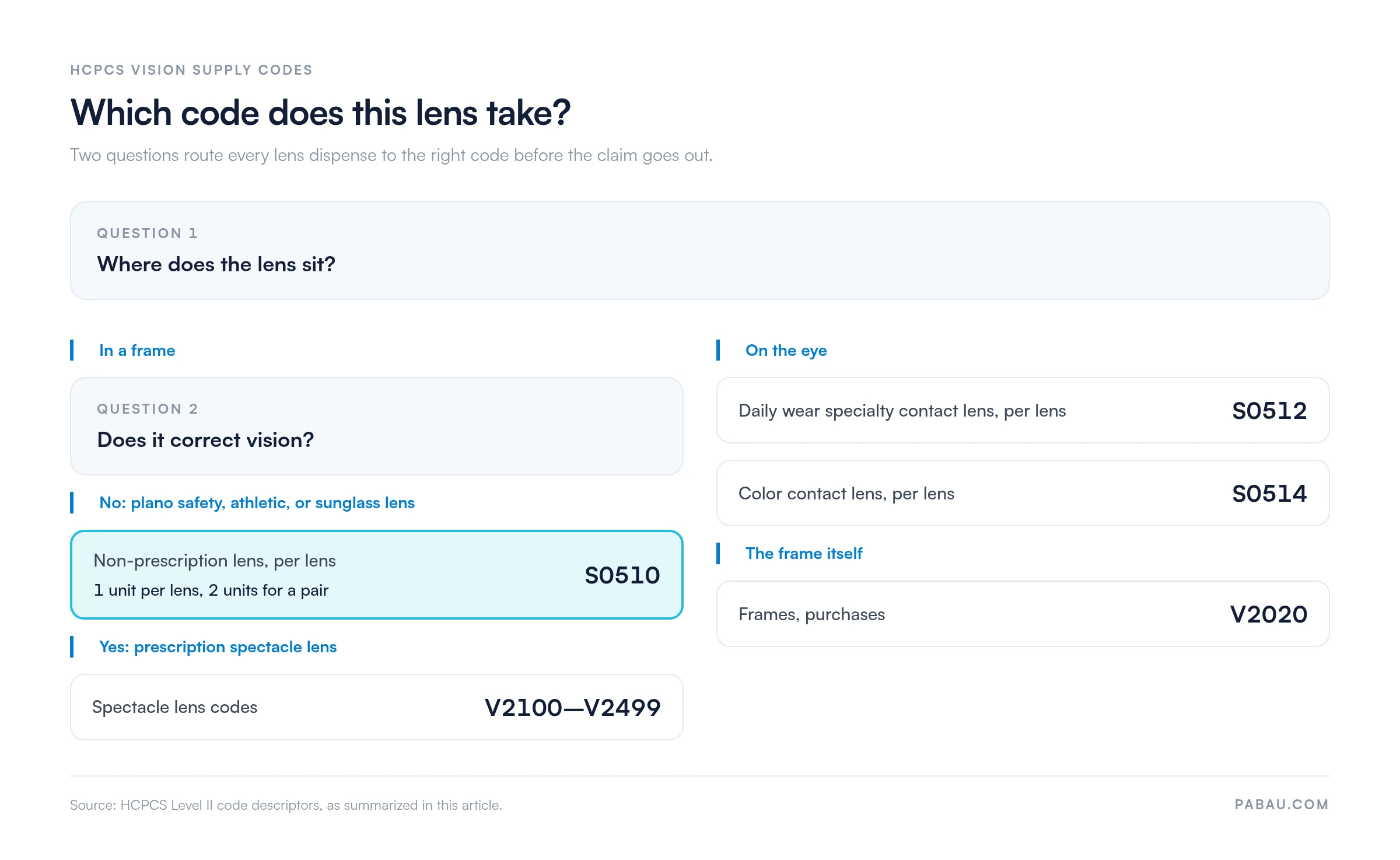
Mixing up S0510 and S0512 is the most common miscoding in this series. S0510 is a non-prescription lens that sits in a frame, and it’s never a contact lens. S0512 is a contact lens fitted for specialty indications. If the patient receives a contact lens of any kind, S0512 or S0514 applies. Submitting S0510 for a contact lens usually triggers a code mismatch edit or a medical-necessity denial.
A disposable contact lens goes to S0500 instead, billed one unit per lens.
Check the dispensing record before coding. S0510 applies only to lenses that sit in a frame, not on the eye. If the record shows a contact lens trial, fitting, or dispense, route the claim to S0512 or S0514 by lens type. Auditing coders should flag any S0510 claim that doesn’t reference a frame or frame receipt.
S0510 is not covered by Medicare. As a temporary national S code, it has no Medicare payment rate and isn’t listed on the CMS Physician Fee Schedule. Medicare denies it automatically as a non-covered benefit. Medicaid coverage varies by state, and most state programs don’t reimburse S codes for vision supplies unless they’ve added them to their fee schedule.
Commercial payer coverage is what decides payment. Many Blue Cross Blue Shield plans, regional carriers, and employer-sponsored vision plans accept S0510 for occupational safety eyewear. No published national rate exists for S0510, so each payer sets its own allowed amount by contract. Check your contracted rate before quoting patients.
Confirming eligibility and benefits before dispensing is the most reliable way to avoid surprise denials. Running insurance eligibility verification at scheduling confirms the benefit before the lenses are ordered.
Some payers require prior authorization for vision supply codes, including S0510. It’s most common when the dispense is part of a workplace safety or occupational health program. Check each payer’s medical policy or vision benefit policy rather than assuming it applies. After payment, review the electronic remittance advice to confirm the allowed amount and any adjustments.
Solid documentation is the first defense against an S0510 denial. The record must show the lens was non-prescription and name its type: safety, athletic, or sunglass. That match between the record and the claim is what survives a payer audit. For optical supplies, keep a dispensing record that mirrors the claim line by line.
A defensible S0510 claim typically rests on these documentation elements:
Modifiers for S0510 follow standard optical billing conventions. Which ones a claim needs depends on the payer and the clinical scenario.
The RT/LT approach is usually preferred over two units on one line without modifiers, because it leaves a clear per-eye audit trail. Most commercial vision plans state in their billing manual which approach they expect.
Capture the modifier fields on the superbill at the point of care, rather than reconstructing them during billing.
Most S0510 denials are preventable. The patterns below repeat across commercial payers, and each maps to a specific fix rather than a generic appeal. Spotting them before submission saves the rework.
Understanding medical billing denial codes helps coders read the reason code on the explanation of benefits (EOB) before responding. A CO-96 (non-covered charge) denial for S0510 from Medicare needs no appeal, because it confirms the non-coverage. A CO-97 (benefit included in another service’s allowance) points to a bundling issue.
Misreading the denial code is how appeals get misdirected and claims age past the filing limit.
Run a monthly S0510 denial audit. Pull every denied claim for this code, group them by reason code, and count. If CO-96 (non-covered) tops the list, the fix sits upstream at eligibility verification rather than with the billing team. If CO-50 (not medically necessary) dominates, update the dispensing documentation template. Fixing the pattern clears more denials than working claims one at a time.
A pre-submission review takes two minutes and prevents most of the denial patterns above. Run through this checklist before submitting any S0510 claim.
These checks turn S0510 claims into clean claims that process without intervention. Payers often auto-adjudicate vision supply codes, so a documentation mismatch becomes a denial before anyone reviews it. Running the checks inside automated claims management keeps the audit trail intact without extra manual steps.
Many optical practices record the dispense in one system and build the claim in another. The lens type, the per-lens count, and the RT/LT modifiers get retyped along the way. Each retype is another chance for a denial.
Practice management software like Pabau keeps the dispensing note, the invoice, and the claim on the same patient record. Your billing team codes from the record the dispensing note already sits in, so the lens type and unit count match what left the practice.
Pabau’s claims management also tracks each submission’s status and flags denials early. That turns the monthly S0510 denial audit into a report you pull, instead of a spreadsheet you build by hand.

Pabau’s claims management tools help optical and vision practices manage per-unit billing, track payer submission status, and flag denials before they age into write-offs. See how it works for your practice.

Start every S0510 dispense with the payer. Confirming S code acceptance before the lenses leave the practice turns a likely write-off into a self-pay conversation the patient expects.
The trade-off is a slower front desk on dispensing days. A two-minute benefit check still costs far less than an appeal on a code Medicare never pays.
Once payer checks are routine, the per-lens count and a clear lens-type note keep the rest of your S0510 claims moving. Book a demo to see how Pabau keeps lens dispensing, per-lens claims, and denial tracking on one patient record.

Need to map denial reason codes to resolution steps? Denial codes in medical billing explains CARC and RARC codes with resolution guidance for common optical and vision supply denials.
Want claims that pay on first submission? What makes a clean claim breaks down the fields and checks that keep a claim out of manual review.
Checking the allowed amount on a paid claim? Electronic remittance advice shows how to read the ERA and reconcile adjustments after payment.
Want to reduce claim rework across your billing team? Medical billing compliance requirements covers the documentation standards that keep claims defensible through payer audits.
Billing optical supplies as part of a broader practice? Medical billing fundamentals walks through the billing cycle from code selection to payment posting.
HCPCS code S0510 covers a non-prescription lens for safety, athletic, or sunglass use, billed per lens. It applies to plano (non-corrective) lenses dispensed in a frame, such as occupational safety glasses, sports eyewear, and non-prescription sunglasses. It doesn’t cover prescription lenses, contact lenses, or eyeglass frames.
No. S0510 is a temporary national S code with no Medicare national payment rate, so traditional Medicare denies it as a non-covered benefit. Some Medicare Advantage plans with supplemental vision benefits may cover it, so verify with the specific plan before submitting.
S0510 describes a non-prescription lens that sits in a frame, while S0512 describes a daily-wear specialty contact lens. Both are per-lens codes, but the lens type determines which applies. If the lens touches the eye, use S0512 or S0514. If it sits in a frame, use S0510.
The most common modifiers are RT (right side) and LT (left side), which show which eye is being billed. Some payers accept modifier -50 (bilateral) for a pair on a single line. Modifier -GY flags a Medicare claim for a statutorily excluded item, so the denial can pass to a secondary payer.
The most frequent reason is a payer that doesn’t accept S codes. Other common causes are billing one unit for a pair, submitting S0512 or S0514 in error, and missing prior authorization. A dispensing record that doesn’t confirm a non-prescription lens and its type also triggers denials.
Many regional Blue Cross Blue Shield plans and employer-sponsored vision plans on VSP, EyeMed, or Davis Vision networks accept S0510. Workers’ compensation carriers also accept it for occupational safety eyewear. Medicare, most Medicaid programs, and some commercial plans don’t. Always verify payer-specific acceptance before dispensing.



