

CCSD code G5100: Bypass of duodenum billing guide
CCSD code G5100 bills a bypass that leaves the duodenum in place CCSD code G5100...

Last Updated: Oct 16, 2026
Billable Code Specific Code
70336 is the CPT code for magnetic resonance (eg, proton) imaging, temporomandibular joint(s). It covers MRI of one or both jaw joints in a single session. The study usually includes open- and closed-mouth sequences to assess disc position and joint effusion.
The code sits in the Diagnostic Radiology (Diagnostic Imaging) section of CPT, within the head and neck range. Anatomical focus decides assignment. A study ordered and read as a TMJ evaluation is 70336, while a brain-focused MRI is billed under its own code.
Let Pabau's smart automation suggest the right codes, reduce claim denials, and keep your practice compliant—effortlessly.
Automate repetitive tasks and focus on what matters most—your patients.
Reduce coding errors and ensure compliance with the latest regulations.
Clean claims, fewer denials, and faster reimbursements.
Powerful insights and reporting to help your practice thrive.
HIPAA compliant SOC 2 certified GDPR-compliant Trusted by 4,000+ clinics worldwide

CPT code 70336 covers MRI of one or both TMJs, typically in open- and closed-mouth positions, within the CPT diagnostic radiology section 70010-76499.
Modifier 26 (professional component) and modifier TC (technical component) split the global service. Modifier 50 or LT/RT handles bilateral billing, depending on payer rules.
Most commercial payers require prior authorization (PA) for TMJ MRI. Medicare doesn’t, but the record must satisfy your Medicare Administrative Contractor’s local coverage determination (LCD).
Report TMJ diagnoses at full specificity, because parent codes such as M26.60 and M26.62 are rejected without their final character.
Practice management software like Pabau supports clean claim submission and real-time eligibility checks, so fewer 70336 claims come back denied.
CPT code 70336 is defined by the American Medical Association (AMA) as “Magnetic resonance (eg, proton) imaging, temporomandibular joint(s).” It sits in the Diagnostic Radiology (Diagnostic Imaging) subsection of the CPT code set (70010-76499), within the head and neck range 70010-70559.
The code captures MRI of one or both TMJs in a single session. By AMA CPT Assistant guidance (July 1999), a complete 70336 study includes sequences in both the open- and closed-mouth positions. Together they show disc position, condylar morphology, and joint effusion. Contrast is not part of the code descriptor. If contrast is administered, it is documented and reported separately.
Payers evaluate every 70336 claim against the linked diagnosis code. A mismatch between the ICD-10 code and the payer’s local coverage determination (LCD) is one of the fastest routes to denial. The ordering provider’s clinical note must document the indication that justifies the imaging request.
Common clinical scenarios include jaw pain with limited opening and clicking or locking of the joint. Suspected disc displacement on physical examination and pre-surgical planning for TMJ procedures also qualify. Use the CDC/NCHS ICD-10-CM lookup tool to verify code validity for the current fiscal year before submitting. Report every diagnosis at its most specific level, since a parent code without its final character is invalid on a claim.
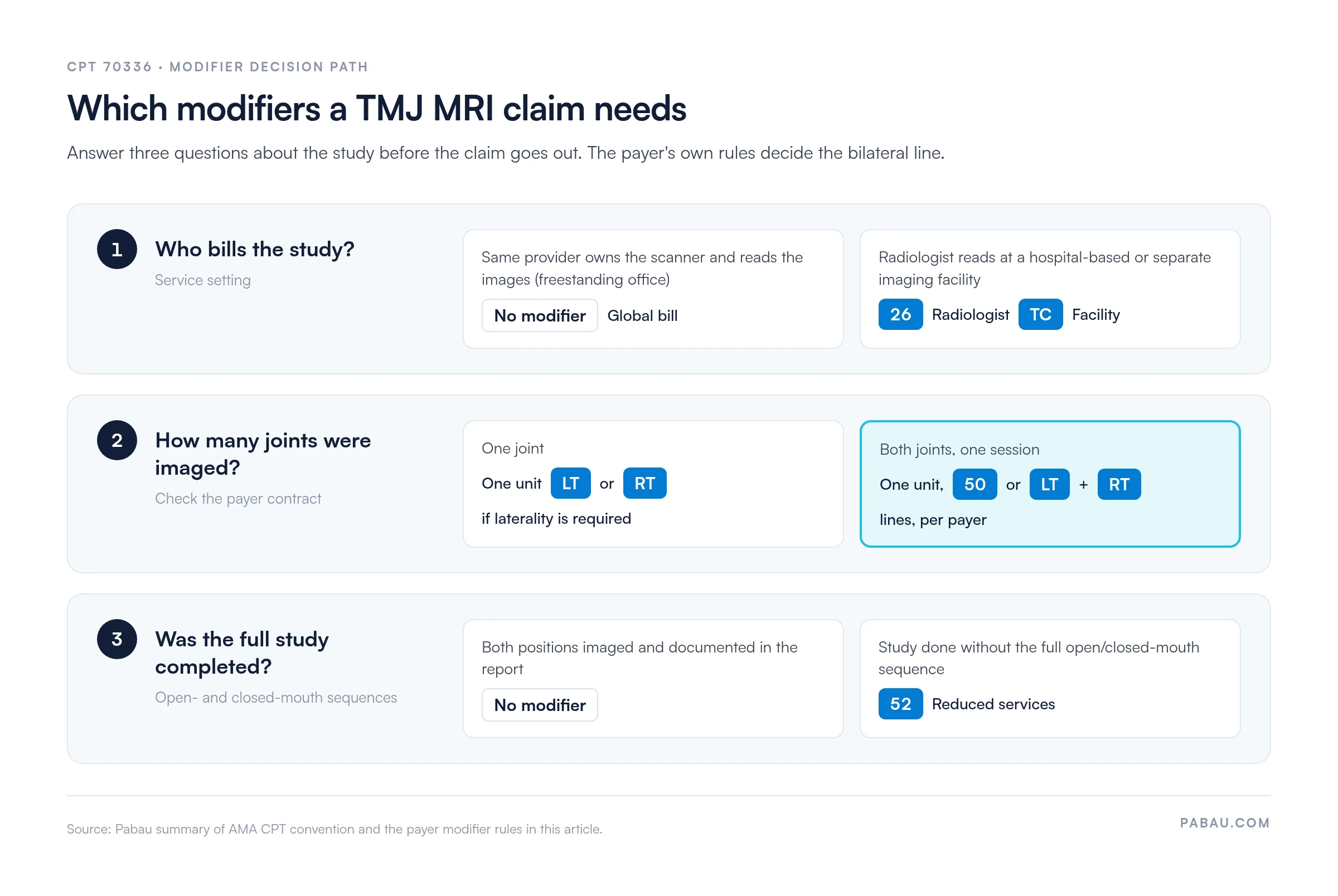
Modifier selection for CPT code 70336 depends on the service setting and payer contract terms. Three questions determine which modifiers apply: Is the radiologist billing the interpretation separately from the facility? Does the payer require explicit laterality? Was one or both joints imaged?
When a radiologist provides the interpretation at a hospital-based outpatient imaging center, the global bill does not apply. The radiologist appends Modifier 26, and the facility bills the TC. In a freestanding office where the same provider owns both the equipment and interprets the study, the global bill (no modifier) applies.
By AMA convention, CPT code 70336 describes imaging of one or both TMJs in a single session, so the code is not inherently bilateral. Some payers accept one unit to cover both joints; others require Modifier 50 or separate LT/RT line items. Always check the payer’s bilateral surgery indicator before submitting, and confirm the radiologist’s report documents both joints when both are imaged.
The decision path below puts the setting, laterality, and completeness questions in the order a coder answers them.
Medicare reimbursement for CPT code 70336 is set annually through the Physician Fee Schedule and varies by Medicare Administrative Contractor (MAC) locality. National rates differ between the non-facility setting (office or freestanding imaging center) and the facility setting (hospital outpatient). Private payers typically benchmark to Medicare, often paying 110-130% of the Medicare rate, though contracts vary widely.
Use the CMS Physician Fee Schedule Look-Up Tool to retrieve the current global, TC, and professional-component rates by locality. Rates listed in any reference article are snapshots; they change each January 1 under the annual fee schedule update.
Dental-specific payers handle TMJ MRI differently from medical insurance carriers. Some dental plans exclude it entirely, while others share coverage with medical benefits after coordination. Verify coverage under both the patient’s medical and dental benefits before the imaging appointment. Confirming the payer pathway at scheduling prevents a denial that would otherwise surface only after the claim is processed.
After adjudication, the electronic remittance advice (ERA) shows whether a partial payment is a contractual adjustment or an underpayment worth a follow-up inquiry. Subscribing to your MAC’s LCD update notices also flags policy changes for 70336 before they affect your next claim run.
Run an eligibility check for both the patient’s medical and dental benefits before scheduling a TMJ MRI. Confirming the correct insurance pathway at booking prevents the coordination-of-benefits denial that accounts for a disproportionate share of 70336 rejections.
Most commercial payers classify TMJ MRI as specialty imaging and require prior authorization before the study is performed. Medicare does not require prior authorization for CPT code 70336. The MAC’s local coverage determination (LCD) criteria still apply, so the clinical record must document medical necessity at the time of service.
Run insurance eligibility verification early to confirm whether the patient’s plan requires PA and which clinical criteria apply. For commercial plans, a standard PA submission typically includes:
For Medicare, review the relevant MAC’s LCD for TMJ disorders. CGS, Novitas, WPS, and Palmetto each publish their own criteria. A claim whose documentation doesn’t meet the LCD’s coverage conditions is denied as a non-covered service. That makes documentation detail as important as the authorization itself.
CPT code 70336 is frequently confused with adjacent head imaging codes because the TMJ sits near the skull base. Anatomical focus decides the code. A study capturing brain parenchyma is not 70336 regardless of how close the scanner comes to the jaw. Use the AAPC Codify CPT lookup to verify the current descriptor and any official guidance for each code before submitting.
70553 and 70336 are not interchangeable under any circumstances. The scanner’s field of view may take in the skull base and the jaw joint. Even so, 70553 applies only when the brain is the primary imaging target. Billing 70553 for a study ordered and performed as a TMJ evaluation constitutes upcoding.
A compliant 70336 claim rests on documentation that existed at the time of service. Reconstructed or amended notes reviewed post-denial carry less weight in appeals and raise audit flags. For imaging codes, the record needs these elements in place before the claim is submitted.
The AMA CPT Assistant Q&A from July 1999 remains the authoritative source for what constitutes a complete 70336 study. Radiologists should confirm their report language matches it. The study name should reference the joint(s) by laterality, and the report should note both positions (open and closed mouth). Checking the claim against these elements before it leaves the practice is the cleanest path to first-pass acceptance.
CPT code 70336 denials cluster around a predictable set of root causes, and each one can be caught at intake rather than on the remittance. Knowing the medical billing denial codes radiology payers return also speeds up the appeal when a claim does come back.
For appeal submissions, attach the ordering provider’s original clinical note, the radiologist’s report, conservative treatment documentation, and any applicable LCD coverage criteria the record satisfies. Frame the appeal around the LCD language, since that is the framework the payer’s reviewer decides against. Submitting a clean claim the first time prevents most of these scenarios from reaching the payer at all.
Flag every 70336 claim in your billing system for a pre-submission modifier audit. Confirm TC/26 split vs global based on the service setting, laterality modifier if the payer contract requires it, and PA number presence. A five-minute pre-submission check is faster than a 60-day appeal cycle.
Most 70336 denials trace back to checks that happen too late. Eligibility gets confirmed after the scan, the PA number never reaches the claim, or the payer wanted LT/RT and received a single unit.
Practice management software like Pabau builds denial-preventing claims management into the same system that books the scan. Real-time eligibility checks run before the appointment, and claims go out electronically through Claim.MD, Pabau’s US clearinghouse partner.
Remittance data comes back through ERA processing, so your billing team can see which claims were paid in full and which need a follow-up. Imaging and oral surgery practices spend less time on appeals and more time on the next patient.


Pabau’s claims management tools connect to Claim.MD, supporting real-time eligibility verification, clean claim submission, and ERA processing for imaging practices across the US.

The descriptor for CPT code 70336 is simple, so a denied claim almost always traces to the paperwork around the scan. That puts the fix in your hands before the patient ever reaches the scanner.
Move your checks to the scheduling step. Confirm medical and dental coverage, the PA requirement, and the payer’s bilateral rule at booking. The trade-off is a few extra minutes per patient, which costs far less than a 60-day appeal cycle.
Book a demo to see how Pabau catches 70336 eligibility and modifier errors before the claim leaves your practice.

Need a clearinghouse for US radiology claims? How a medical claims clearinghouse works explains the claim scrubbing and payer routing process that reduces first-pass denials.
Submitting imaging claims electronically? Understanding the 837 claim file format covers the EDI transaction structure used for electronic claim submission.
Reading a short payment after adjudication? Electronic remittance advice explained shows how to read an ERA and separate contractual adjustments from underpayments.
Building a repeatable appeals process? Denial management in healthcare walks through tracking, correcting, and preventing denied claims.
Want to benchmark your denial rate? What is revenue cycle management outlines the KPIs practices use to measure claim performance across imaging and specialty codes.
CPT code 70336 is the billing code for magnetic resonance imaging of one or both temporomandibular joints in a single session. The study evaluates disc displacement, condylar morphology, joint effusion, and other TMJ pathology. It sits in the Diagnostic Radiology section of the CPT code set (70010-76499).
CPT 70336 covers one or both TMJs in a single session by AMA convention, so it is not inherently bilateral. Some payers accept one unit for both joints. Others require Modifier 50 or separate LT/RT line items. Verify the payer’s bilateral billing policy before submitting, and confirm the radiologist’s report documents all imaged joints.
CPT 70553 covers MRI of the brain with and without contrast, targeting neurological structures. CPT 70336 covers MRI of the temporomandibular joint(s) only. The two codes are never interchangeable. Billing 70553 for a study ordered as a TMJ evaluation is upcoding, even when the joint sits inside the scanner’s field of view.
Yes, most commercial health plans and some Medicaid managed care plans require prior authorization for TMJ MRI. Medicare does not require prior authorization for CPT 70336. The record must still document the applicable MAC’s local coverage determination criteria to establish medical necessity before the claim is submitted.
The most common reasons are missing or expired prior authorization and an ICD-10 diagnosis that the payer’s LCD doesn’t cover. Modifier errors follow, such as a missing TC or 26 when split billing is required, or no LT/RT when the contract requires it. Thin documentation of medical necessity, including conservative treatment history, rounds out the list.
Yes. CPT 70336 (MRI TMJ) and CPT 70450 (CT head without contrast) use different imaging modalities. They can be billed together when both studies are clinically distinct, separately ordered, and documented with their own radiologist reports. Payers may question concurrent billing, so keep clear documentation of why both modalities were medically necessary for the same encounter.



