CCSD code H4430: Examination of rectum under anaesthetic
CCSD code H4430 pays for the examination alone CCSD code H4430 is the UK private...

Last Updated: Oct 20, 2026
L1850 is the HCPCS Level II code for knee orthosis, swedish type, prefabricated, off-the-shelf.
Let Pabau's smart automation suggest the right codes, reduce claim denials, and keep your practice compliant—effortlessly.
Automate repetitive tasks and focus on what matters most—your patients.
Reduce coding errors and ensure compliance with the latest regulations.
Clean claims, fewer denials, and faster reimbursements.
Powerful insights and reporting to help your practice thrive.
HIPAA compliant SOC 2 certified GDPR-compliant Trusted by 4,000+ clinics worldwide

HCPCS Code L1850 describes a knee orthosis (KO), Swedish type, prefabricated, off-the-shelf. It has been an active Level II code since 1982.
Medicare covers L1850 only for an ambulatory beneficiary with knee instability caused by genu recurvatum, congenital or acquired.
Osteoarthritis, ligament sprain, chronic instability and post-surgical aftercare belong to other knee orthosis L-codes and will deny under L1850.
The detailed written order must be signed and dated before the device is dispensed. A missing or late order is the most common denial trigger.
Only NU, RR and UE apply to L1850. The capped-rental modifiers KH, KI and KJ do not, because the code pays as a lump-sum purchase.
Pabau’s claims management software brings documentation checklists and claim status tracking into one place, so L1850 claims leave the practice complete.
HCPCS Code L1850 is a Level II HCPCS code maintained by CMS for durable medical equipment, prosthetics, orthotics, and supplies. It describes a knee orthosis (KO) of the Swedish type, prefabricated and dispensed off-the-shelf, without custom fabrication or significant modification.
A Swedish knee cage is a prefabricated, off-the-shelf knee orthosis. It is also called a Swedish knee brace or KO Swedish type. The device gives the knee joint medial and lateral stability without custom fabrication. It usually consists of metal uprights, hinges, and a padded framework that fits over the knee, rather than being molded to one patient’s anatomy.
The “off-the-shelf” classification is what decides the code. Under HCPCS Level II coding guidelines, an OTS orthosis comes in standard sizes.
It can be handed to the patient with minimal adjustment, and it is not fabricated to a cast or model. That separates L1850 from the custom-fabricated knee orthosis codes, and it changes both the reimbursement rate and the documentation a payer expects.
A device fabricated to a cast or model for derotation and ACL control bills under L1840 instead.
L1850 has one qualifying clinical picture, not a broad set of knee problems. CMS Local Coverage Determination L33318 and Policy Article A52465 name the covered indication. It is knee instability caused by genu recurvatum in an ambulatory beneficiary.
Genu recurvatum is a hyperextended knee, and it may be congenital or acquired. The prescribing physician has to document the diagnosis and support it with a Group 5 ICD-10-CM code from A52465.
Diagnoses that point to a different knee orthosis code will deny under L1850. Chronic knee instability and spontaneous ligament disruption (M23.5-, M23.6-) sit with other L-codes. So do tibiofemoral osteoarthritis (M17.1-), knee ligament sprain (S83.4-) and post-surgical or aftercare status (Z96.65-, Z47.89).
Those include the L1830 to L1834, L1843 to L1846 and L1851 to L1852 ranges. The split between the one code that pays and the four families that deny is the whole coverage rule:
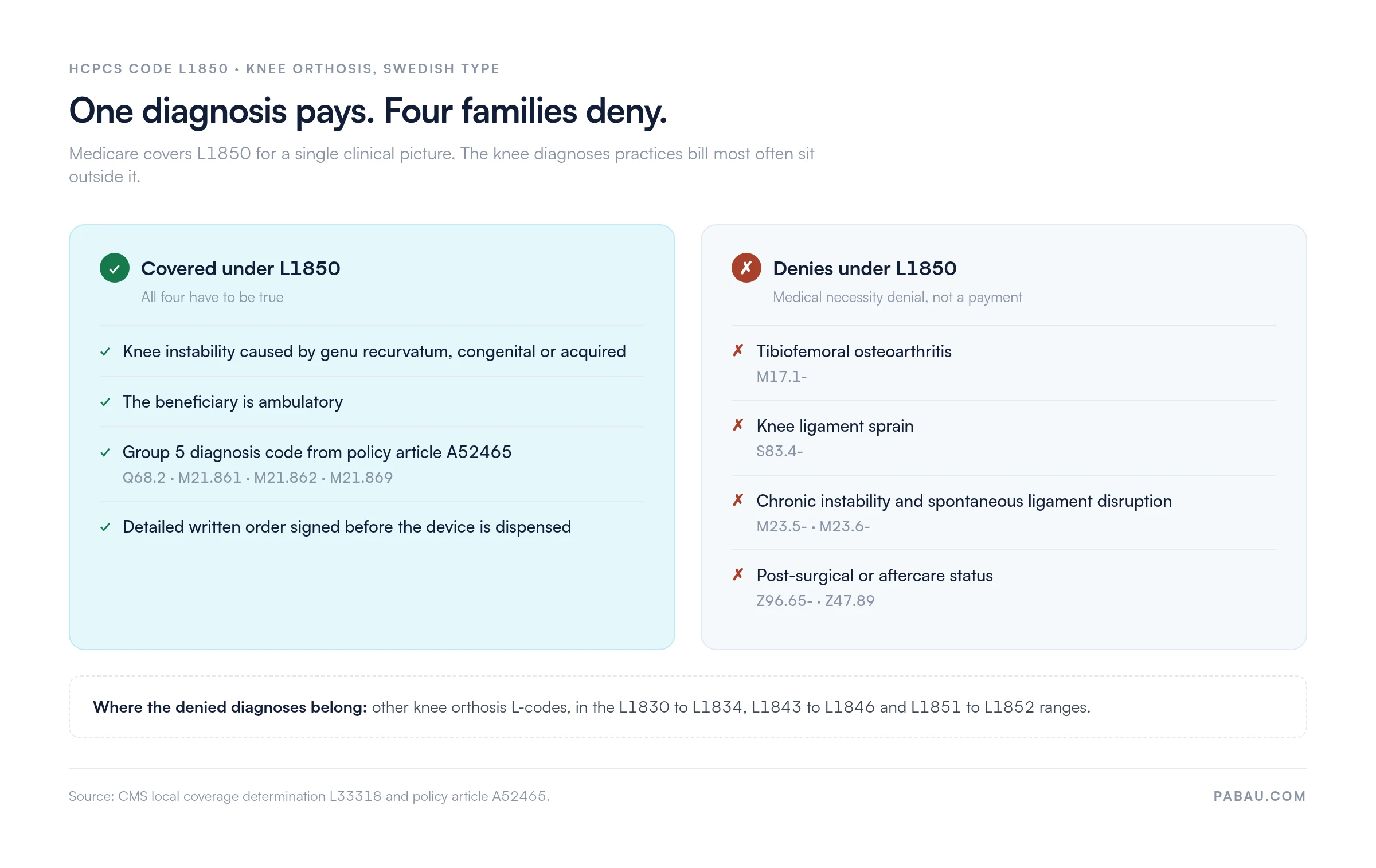
Cross-reference every diagnosis against the current Group 5 list before billing, because covered codes are updated annually.
If you need the descriptor behind one of those diagnosis families, the ICD-10-CM codes library covers them one code at a time. Payers may also apply criteria more restrictive than the national LCD, so confirm coverage with the relevant Medicare Administrative Contractor before you supply the device.
Medicare Part B covers HCPCS Code L1850 as durable medical equipment, but coverage is not automatic. The beneficiary must be enrolled in Medicare Part B, and the device must be medically necessary. The supplier must also be enrolled as a Medicare DME supplier.
CMS applies all of the following criteria to L1850 under LCD L33318 and Policy Article A52465:
Medicare reimburses L1850 as a purchase rather than a rental. The beneficiary pays the standard 20% coinsurance after the deductible. A supplier who expects Medicare to deny coverage must issue an Advance Beneficiary Notice of Noncoverage (ABN). The ABN goes to the beneficiary before the device is supplied.
CMS audits of orthotic claims name missing documentation as the leading cause of recoupment. The following checklist reflects CMS Detailed Written Order standards for HCPCS Code L1850.
Keep all documentation for a minimum of seven years from the date of service. The CGS Medicare coding verification process confirms PDAC classification for a specific HCPCS product. Run it before you stock a device you intend to bill as L1850. Compliance reviews routinely check whether the DWO date precedes the delivery date, and any reversal is an automatic denial.
Check the DWO date before submitting every L1850 claim. If the detailed written order is dated on or after the delivery date, the claim will deny on audit. Documented medical necessity will not save it. Build a pre-submission checklist into your intake workflow to catch this before claims go out.
Incorrect or missing modifiers are the leading cause of L1850 claim rejections. Medicare requires the appropriate modifier on every HCPCS Code L1850 claim. The modifier tells the payer whether the device was purchased new, purchased used, or rented.
For most L1850 transactions, NU is the correct modifier. The device is purchased outright and delivered to the patient.
The capped-rental modifiers KH, KI and KJ do not belong on an L1850 claim. Medicare pays L1850 as a lump-sum purchase rather than a capped rental, so there is no rental month to report. Appending one of them describes a payment sequence this code never enters.
Verify modifier requirements against current CMS guidance, because payer-specific rules may differ from Medicare. Build a modifier validation step into the claim scrubbing workflow before submission.
Medicare reimburses L1850 from the CMS DMEPOS fee schedule, which publishes national and locality-specific allowed amounts. Rates vary by competitive bidding area (CBA) status and by geographic pricing region.
Do not rely on prior-year rates or third-party sources for submitted amounts. CMS publishes the annual DMEPOS fee schedule update each December for the following calendar year, and the CY2026 rates were released on December 19, 2025.
The October file is a quarterly update to the current year, not the next year’s release. Billing at the previous year’s rate when rates rise costs the practice revenue, and billing above the allowed amount triggers a payer adjustment.
L1850 denials follow predictable patterns. Practices that track denial reason codes can eliminate most rejections with process changes rather than appeals. The table below covers the errors that come up most often in HCPCS orthotic billing audits.
Systematic denial management for DME orthotic claims starts with pre-claim scrubbing rather than post-denial appeals. Build eligibility verification, DWO date checks, and modifier validation into the dispensing workflow. Catching these errors before the claim leaves the practice is what removes the rework.
Run a quarterly audit of your L1850 denial reason codes. If more than 10% of denials cite CO-4 (modifier missing or invalid) or CO-57 (prior authorization required), your intake workflow is the problem. Fix the checklist rather than the billing team.
Selecting the correct HCPCS code within the knee orthosis L-code range matters as much as the diagnosis. Billing L1850 for a device that qualifies for a different code creates compliance exposure. So does billing a custom-fabrication code for an OTS device. The table below covers the most clinically adjacent codes.
L1850 and L1851 are frequently confused because both describe prefabricated, off-the-shelf knee orthoses. The distinction lies in the upright design and structural support level.
When in doubt, use the PDAC verification process to confirm the correct HCPCS code for a specific product before billing. PDAC coding verifications are product-specific, so they give the most reliable code assignment for OTS orthoses.
An L1850 claim is a sequence of dated documents. The order has to be signed before delivery, the diagnosis has to sit in Group 5, and the modifier has to say purchase. Most DME and orthotics practices track that sequence in a spreadsheet, or in whatever the biller remembers to check.
Practice management software like Pabau keeps it inside the patient record instead. Pabau’s claims management software holds the documentation checklist against the patient, and follows every submitted claim through its status stages.
So the DWO date, the delivery receipt and the fitting note are visible before the claim goes out. And you learn that a claim has stalled from the dashboard, rather than from a remittance advice six weeks later.

Pabau’s claims management software pairs documentation checklists with claim status tracking. Every L1850 claim leaves the practice complete, and you can see where it is.

HCPCS Code L1850 claims fail on process far more often than on coding knowledge. A detailed written order dated after delivery will deny automatically. So will a capped-rental modifier on a purchase claim, or a diagnosis outside the Group 5 genu recurvatum list. Recourse after that point is limited.
So the work sits upstream. Put DWO verification, modifier validation and a diagnosis cross-check into the dispensing workflow, before the device leaves the practice. That costs a few minutes per patient and removes most of your appeal volume.
That upstream checking is what software should carry rather than a person. Book a demo to see how Pabau tracks L1850 documentation and claim status for DME and orthotics practices.

Need to understand how DME claims move through the system? How medical billing works covers the full claims lifecycle from order to payment reconciliation.
Want to reduce claim rejections before they happen? Clean claim submission standards outlines the pre-submission checks that eliminate the most common denial triggers.
Looking to tighten up your overall billing compliance posture? Denial management strategies covers how to build a systematic appeals and prevention workflow.
Wondering what a post-payment review will ask you for? Medical billing compliance sets out the records an auditor expects a supplier to hold.
Checking Part B status before you dispense a device? Insurance eligibility verification explains the checks that catch a coverage problem before delivery.
HCPCS Code L1850 is used to bill for a knee orthosis (KO) of the Swedish type, prefabricated and dispensed off-the-shelf, without custom fabrication. DME suppliers and orthotists use it to claim Medicare Part B and commercial insurance reimbursement for this specific style of prefabricated knee brace.
A Swedish knee cage is a prefabricated knee orthosis with a bilateral metal upright frame and hinged joints. It gives the knee medial and lateral stability. It is dispensed off-the-shelf in standard sizes without custom casting or fitting, making it eligible for the L1850 billing code.
L1850 describes a Swedish-type bilateral-frame knee orthosis, prefabricated and off-the-shelf. L1851 describes a single-upright thigh-and-calf knee orthosis, also prefabricated and off-the-shelf. The structural design of the specific device determines which code applies. When uncertain, use the PDAC verification tool to confirm the correct code for a specific product.
Yes, but only for an ambulatory beneficiary with knee instability caused by genu recurvatum, congenital or acquired. The physician’s examination must objectively describe joint laxity, and the supplier must obtain a detailed written order before dispensing. The supplier also has to be enrolled as a Medicare DME supplier.
NU (new equipment) appears on most L1850 claims, because the device is purchased outright. RR (rental) and UE (used equipment) cover the other two supply scenarios. The capped-rental modifiers KH, KI and KJ do not apply, since L1850 pays as a lump-sum purchase rather than a capped rental. Verify the modifier against current CMS DMEPOS guidance before each submission.
Billing L1850 requires a detailed written order signed before the device is dispensed. It also requires physician notes documenting medical necessity. Add a signed proof of delivery from the beneficiary plus fitting documentation from the dispensing provider. An Advance Beneficiary Notice (ABN) is required if Medicare coverage is uncertain before dispensing.
The 2026 Medicare allowed amount for L1850 varies by geographic pricing region and competitive bidding area status. Always verify the current allowed amount using the CMS DMEPOS fee schedule lookup for the specific service location. Rates update annually on January 1. They also differ between competitive bidding and non-competitive bidding areas.
One diagnosis qualifies: knee instability caused by genu recurvatum, the hyperextended knee, congenital or acquired. The beneficiary must also be ambulatory, and the exam must objectively describe joint laxity. The claim needs a Group 5 ICD-10-CM code from Policy Article A52465. Knee osteoarthritis, ligament sprain, chronic instability and post-surgical aftercare belong to other L-codes and will deny under L1850.