








CPT Code 59510: Routine obstetric care, cesarean and postpartum billing guide
CPT Code 59510: definition and global package overview Most OB-GYN denials on ce...

July 6, 2026


HCPCS code L1846 describes a custom-fabricated knee orthosis with double upright, thigh and calf support, adjustable flexion/extension joint, and medial-lateral and rotation control.
Medicare covers the knee orthosis (KO) code family through three base pathways: recent injury or surgery, documented knee instability, or (effective January 25, 2026) tibiofemoral osteoarthritis. Custom-fabricated L1846 must also meet the general custom-fabrication necessity criterion.
L1845 is the prefabricated equivalent of L1846 – billing the wrong code is one of the most common denial triggers for knee orthosis claims.
Pabau’s claims management software helps orthotists and DME billers track documentation requirements, manage claim submissions, and reduce denial rates across orthotics billing workflows.
HCPCS code L1846 is the billing code for a custom-fabricated, double-upright knee orthosis with an adjustable flexion and extension joint and medial-lateral and rotation control. Medicare classifies it as durable medical equipment and applies coverage criteria that differ meaningfully from the prefabricated equivalent, L1845.
This guide covers the code description, Medicare coverage pathways, documentation requirements, related codes, and the denial patterns that cost orthotics practices the most revenue.
Orthotists, DME billers, and ordering clinicians working with physical therapy and rehabilitation practices will find this reference useful for both initial claim submission and audit preparation.
The official full descriptor for HCPCS code L1846 is: Knee orthosis (KO), double upright, thigh and calf, with adjustable flexion and extension joint (unicentric or polycentric), medial-lateral and rotation control, with or without varus/valgus adjustment, custom fabricated.
Breaking that down into its clinical components matters for billing accuracy. Each element in the descriptor defines a required characteristic of the device being provided.
| Component | What it means for billing |
|---|---|
| Double upright | The orthosis has bilateral structural uprights on both medial and lateral sides of the knee |
| Thigh and calf | The device extends both above and below the knee joint, engaging the full limb segment |
| Adjustable flexion/extension joint | The joint mechanism allows clinician-controlled range-of-motion settings (unicentric = single pivot; polycentric = multi-axis) |
| Medial-lateral and rotation control | The orthosis provides coronal plane stability and controls tibial rotation |
| Varus/valgus adjustment | Optional feature – presence or absence does not change the code |
| Custom fabricated | Device is constructed from raw materials to fit a specific patient’s measurements – not a prefabricated item modified at fitting |
L1846 falls under the HCPCS Level II L-code range, which covers orthotic and prosthetic procedures and devices. According to CMS’s HCPCS overview, Level II codes are maintained by CMS and are used for products and services not covered by CPT. L-codes specifically address orthotic and prosthetic appliances billed as lump-sum DME purchases.
Medicare coverage for L1846 is governed by Local Coverage Determination (LCD) L33318 – Knee Orthoses – and Policy Article A52465. These documents define three base coverage pathways for the knee orthosis (KO) code family, and a claim that doesn’t clearly meet at least one of them will be denied as not reasonable and necessary.
A DME MAC final revision published December 11, 2025 added the third pathway, effective January 25, 2026.
The beneficiary’s medical record must document a recent injury to, or a surgical procedure on, the knee. The ordering clinician’s documentation must establish medical necessity for the orthosis in the context of that acute event.
CGS Medicare and Noridian – the two DME MAC contractors that administer all four DME MAC jurisdictions (A-D), covering the entire US – apply this path identically.
Key documentation anchors for path 1 include the operative report or emergency/urgent care notes – for example, following a total knee arthroplasty (CPT code 27447) – a physician order specifying the orthosis type, and clinical notes confirming the device is appropriate for the patient’s current functional status.
The beneficiary must be ambulatory and have objective, physician-documented evidence of knee instability. Medicare requires a specific clinical test result in the record – for example a varus/valgus stress test or a Drawer test showing ligamentous laxity – rather than a general statement that the knee feels unstable.
A DME MAC final revision to LCD L33318 and Policy Article A52465, published December 11, 2025 and effective January 25, 2026, added this third base pathway. The beneficiary must be ambulatory and have medial or lateral tibiofemoral compartment osteoarthritis causing pain and loss of mobility.
The orthosis must include a varus/valgus adjustment to unload the affected compartment, and the medical record must document the patient’s willingness to wear the device. Unlike path 2, this pathway does not require an objective joint-laxity test.
For custom-fabricated L1846 specifically, meeting one of the three base pathways above is not enough on its own. The claim must also satisfy the general Medicare criterion for custom fabrication: a documented physical characteristic – for example a leg or knee deformity, an unusual thigh or calf size, or insufficient muscle mass – that makes a prefabricated device clinically inadequate for that patient.
This is not a standalone alternate coverage path; it layers on top of whichever base pathway (1, 2, or 3) applies to the beneficiary.
If an L1846 orthosis is provided and both the applicable base pathway and the custom-fabrication necessity criterion are not satisfied, Medicare will deny the claim. Practices managing complex orthotics cases can use compliance management workflows to track coverage criteria checklists before submission.
Medicare draws a hard line between custom fabricated and prefabricated items. A custom-fabricated orthosis is one constructed from raw materials based on measurements, a mold, or a scan of the specific patient.
Policy Article A52465 makes clear that a prefabricated item that is trimmed, bent, or adjusted at fitting – even significantly – does not qualify as custom fabricated. That device would be L1845, not L1846.
Document the fabrication process explicitly in the medical record. Note that measurements or a cast/scan were taken, that the device was constructed to those patient-specific dimensions, and that no prefabricated base was used. Vague language like ‘custom knee brace provided’ will not satisfy Medicare’s custom fabrication standard.
L1845 is the prefabricated equivalent of L1846. Both codes describe a double-upright knee orthosis with adjustable flexion/extension joint, medial-lateral and rotation control. The only difference is how the device is produced.
| Feature | L1845 (prefabricated) | L1846 (custom fabricated) |
|---|---|---|
| Device origin | Manufactured in standard sizes; customized at fitting | Constructed from raw materials to patient measurements |
| Fitting process | Trimming, bending, molding, assembling by a qualified individual | Full fabrication based on cast, scan, or measurements |
| Medicare reimbursement | Lower; reflects device cost plus fitting labor | Higher; reflects fabrication labor and materials |
| Coverage path | One of three base pathways under LCD L33318 (injury/surgery, instability, or osteoarthritis) | Same three base pathways, plus the custom-fabrication necessity criterion |
| Common audit risk | Providing L1846 and billing as L1845 (underbilling) or vice versa (overbilling) | Insufficient fabrication documentation; using prefab base and billing L1846 |
Billing L1846 when L1845 is clinically appropriate – or when the device was actually prefabricated – is the most common compliance risk in knee orthosis billing. Accurate code selection protects both the practice and the ordering clinician from audit exposure. Coders working across physiotherapy and orthotics practices should build L1845/L1846 determination into their pre-submission workflow.
Insufficient documentation is the primary reason L1846 claims fail post-payment review. Medicare’s DME MAC documentation checklists – maintained by CGS Medicare and Noridian – identify specific elements that must be present in the medical record. Missing any of them can trigger a full denial or repayment demand.
The CGS Medicare Documentation Checklist for Knee Orthoses states clearly that documentation must be “sufficiently detailed to include a detailed description of why the modifications are necessary and what modifications were performed at the time of fitting the orthosis to the beneficiary.” General statements are not adequate.
Practices using digital forms and structured clinical documentation can build this specificity into intake and fitting workflows from the outset.
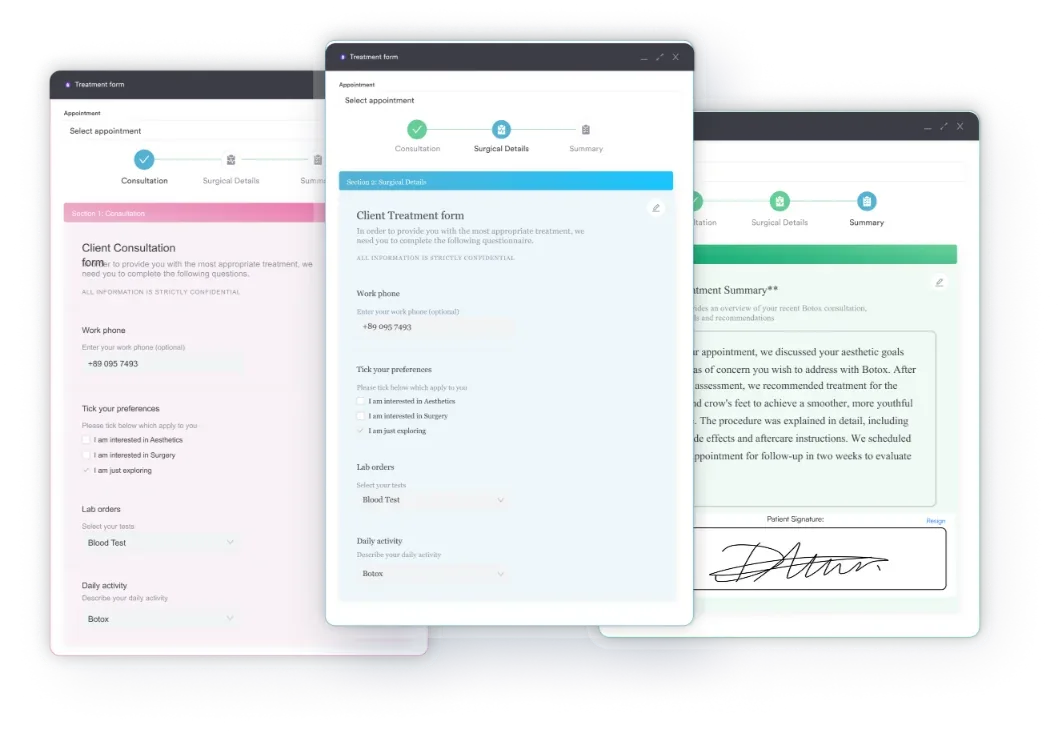

Pabau helps DME and orthotics practices build structured documentation workflows, manage claim submissions, and track compliance requirements so fewer claims come back denied.

Medicare requires an ICD-10-CM diagnosis code that supports the medical necessity of the knee orthosis. The diagnosis must align with the clinical reason for ordering the device and must appear on the approved code group list in Policy Article A52465. Billing L1846 with a diagnosis code outside the approved group will result in a claim denial.
Common ICD-10-CM diagnosis categories that support L1846 medical necessity include ligament injuries and instability of the knee (such as a medial meniscus tear), post-surgical knee conditions, fractures involving the femur or tibia, osteoarthritis of the knee with functional impairment, and neuromuscular conditions causing knee instability.
Orthotics billers should confirm the specific approved code groups in the current version of Policy Article A52465 via the CMS fee schedule and coverage database, as code groups are updated annually.
For practices that also manage physical therapy documentation workflows, aligning the therapy plan of care with the orthosis order diagnosis code helps ensure consistency across the medical record during audits.
L1846 does not exist in isolation. Orthotics billers regularly need to distinguish it from adjacent codes in the L18xx range. Using the wrong code – even by one digit – can mean the difference between a paid claim and a recoupment demand.
The same construction-method logic (custom fabricated vs. prefabricated vs. off-the-shelf) applies across other orthosis code families, including ankle-foot orthoses (L1906) and lumbar orthoses (L0642).
| Code | Description | Key distinction from L1846 |
|---|---|---|
| L1843 | Single-upright knee orthosis with adjustable flexion/extension joint (unicentric or polycentric), medial-lateral and rotation control, with or without varus/valgus adjustment; prefabricated item trimmed, bent, molded, or assembled to fit the patient by an individual with fitting expertise | Single upright and prefabricated (fitter-customized); L1846 is double upright and custom fabricated from raw materials |
| L1844 | Custom-fabricated KO, single upright, with adjustable flexion/extension, medial-lateral and rotation control | Single upright (vs. double upright for L1846); otherwise same descriptor |
| L1845 | Prefabricated version of L1846 – same descriptor but item customized at fitting | Prefabricated base; lower reimbursement |
| L1847 | Prefabricated KO, double upright, with inflatable air support chambers | Prefabricated; adds air support; different clinical application |
| L1851 | Prefabricated, off-the-shelf KO, single upright, with adjustable flexion/extension joint, medial-lateral and rotation control, with or without varus/valgus adjustment (OTS counterpart to L1843) | Single upright and off-the-shelf (patient self-fits, no individual fitting expertise required); L1846 is double upright and custom fabricated |
| L1852 | Prefabricated, off-the-shelf KO, double upright, with adjustable flexion/extension joint, medial-lateral and rotation control, with or without varus/valgus adjustment (OTS counterpart to L1845) | Double upright like L1846, but off-the-shelf and not custom fabricated; no individual fitting expertise required |
| L1834 | Custom-fabricated KO, without joint | Custom fabricated but no joint mechanism |
| L1840 | Custom-fabricated KO, derotation, medial-lateral, anterior cruciate ligament | Custom fabricated but focuses on derotation/ACL; different clinical use |
Practices managing high volumes of DME and orthotics billing benefit from a systematic code-selection protocol. The AAPC Codify HCPCS lookup provides full descriptors and coding notes for each L-code, which can support coder training and pre-submission audits. For practices also handling other specialty procedure codes, a centralized coding reference system reduces the risk of cross-code errors.
Build a decision tree into your orthotics intake process. The question sequence is: (1) Is the device custom fabricated from raw materials? If no, use L1845 (double upright) or L1843 (single upright) – or their off-the-shelf counterparts, L1852 and L1851. (2) Is it single or double upright? Single upright = L1844 (custom) or L1843 (prefabricated); double upright = L1846 (custom) or L1845 (prefabricated). The differentiator between L1844 and L1846 is single vs. double upright, not rotation control – both include rotation control.
L1846 is billed as a lump-sum purchase – a single claim line covering the full device cost. Reimbursement rates vary by DME MAC jurisdiction, contract year, and whether the claim is for a Medicare beneficiary, Medicaid enrollee, or commercial plan member.
For Medicare, the fee schedule amount is published in the annual DMEPOS fee schedule. Rates differ between rural and non-rural areas, and competitive bidding program rules may apply in certain markets. Practitioners should verify current reimbursement amounts directly through their DME MAC’s fee schedule publication before quoting patients or projecting practice revenue.
State Medicaid programs, including Medi-Cal in California, maintain separate fee schedules and coverage policies for orthotics. L1846 coverage and reimbursement under Medicaid varies significantly by state, the same way it does for other DME categories such as diabetic depth-inlay shoes (A5500). Practices billing across multiple states should maintain jurisdiction-specific coverage summaries rather than assuming Medicare rules apply to Medicaid claims.
Understanding why L1846 claims are denied is as important as knowing the coverage criteria. The most frequently cited denial triggers include:
Practices that use integrated claims management software to build coverage criteria checklists into their pre-authorization workflow catch most of these errors before submission. The structured intake and clinical documentation approach also helps establish a clean paper trail that holds up during post-payment audits.
HCPCS code L1846 is one of the more documentation-intensive codes in the orthotics billing landscape. The three-pathway Medicare coverage structure, the hard distinction from L1845, and the specificity required in fabrication documentation create multiple points where claims can fail.
Most denials are preventable when the ordering clinician’s notes, the orthotist’s fabrication records, and the ICD-10 diagnosis code all align with the applicable coverage pathway before the claim is submitted.
For practices looking to reduce L1846 denial rates, Pabau’s claims management tools support structured pre-submission documentation workflows that catch common errors early. To see how Pabau supports orthotics and DME billing practices, book a demo.

Need a structured compliance framework for your orthotics practice? Pabau’s HIPAA compliance resources help practices build coverage criteria checklists and audit-ready documentation workflows.
Managing billing across multiple therapy specialties? HIPAA compliance for medical offices covers the documentation and data security requirements that DME and orthotics practices need to meet alongside their billing obligations.
Need the bigger picture on physical therapy billing? Physical therapy billing: CPT codes, units and Medicare rules covers the CPT and Medicare fundamentals that pair with orthosis billing in rehab settings.
HCPCS code L1846 is used to bill for a custom-fabricated knee orthosis with a double upright, thigh and calf support, an adjustable flexion and extension joint, and medial-lateral and rotation control. It is classified as durable medical equipment (DME) and is billed as a lump-sum purchase under Medicare and most payers. The code applies specifically to devices constructed from raw materials to fit a specific patient, not to prefabricated devices modified at the time of fitting.
L1845 is the prefabricated version of the same knee orthosis described by L1846. Both codes share the same clinical descriptor (double upright, adjustable flexion/extension joint, medial-lateral and rotation control), but L1845 covers a device that was manufactured in standard sizes and customized at the time of fitting, while L1846 covers a device constructed from scratch to the patient’s specific measurements. Using L1846 when the device was actually prefabricated is a common audit finding and claim denial trigger.
Billing L1846 requires a written physician order, clinical notes establishing medical necessity, an ICD-10-CM diagnosis code from the approved group in Policy Article A52465, evidence that the device was custom fabricated (measurements, cast, or scan records and a fabrication log), a detailed description of any modifications made and why they were necessary, delivery confirmation signed by the beneficiary, and documentation meeting the applicable Medicare coverage pathway (recent injury/surgery, documented knee instability, or tibiofemoral osteoarthritis), plus the custom-fabrication necessity criterion for custom-fabricated devices.
Medicare covers the knee orthosis (KO) code family, including L1846, through three base pathways under LCD L33318 and Policy Article A52465: recent injury or surgical procedure on the knee (path 1); ambulatory status with objectively documented knee instability, shown by a test such as a varus/valgus stress test or Drawer test (path 2); and, effective January 25, 2026, ambulatory status with medial or lateral tibiofemoral osteoarthritis causing pain and mobility loss, a device with varus/valgus adjustment, and documented patient willingness to wear it, with no laxity test required (path 3). Custom-fabricated L1846 must also meet the general custom-fabrication necessity criterion – a documented physical characteristic that makes a prefabricated device clinically inadequate – layered on top of whichever base pathway applies.
Yes, L1846 is covered by Medicare when the claim meets one of the coverage pathways defined in LCD L33318 and Policy Article A52465, the diagnosis code falls within the approved ICD-10-CM code groups, and the documentation package satisfies DME MAC requirements. Claims that lack sufficient fabrication documentation, use a diagnosis code outside the approved group, or fail to clearly establish the applicable coverage path will be denied as not reasonable and necessary.
The ICD-10-CM codes that support L1846 medical necessity are defined in the Group 3 section of Policy Article A52465. Common categories include knee ligament injuries and instability, post-surgical knee conditions, tibia and femur fractures, osteoarthritis with functional impairment, and neuromuscular conditions causing knee instability. Practices should verify the current approved code list directly in the CMS Medicare Coverage Database, as the approved groups are updated with each annual HCPCS revision.