CPT Code 62284: Injection procedure for myelography
CPT Code 62284: official descriptor and procedure overview The American Medical ...

Last Updated: Oct 19, 2026
L1080 is the HCPCS Level II code for addition to ctlso or scoliosis orthosis, outrigger.
One point is worth settling before you build the claim. L1000 is the base code in the L1000 to L1120 range, and every code above it is an addition. Pairing L1080 with L1010 or L1020 therefore leaves the claim without a base code at all.
Let Pabau's smart automation suggest the right codes, reduce claim denials, and keep your practice compliant—effortlessly.
Automate repetitive tasks and focus on what matters most—your patients.
Reduce coding errors and ensure compliance with the latest regulations.
Clean claims, fewer denials, and faster reimbursements.
Powerful insights and reporting to help your practice thrive.
HIPAA compliant SOC 2 certified GDPR-compliant Trusted by 4,000+ clinics worldwide

HCPCS Code L1080 describes an addition to a cervical-thoracic-lumbar-sacral orthosis (CTLSO) or scoliosis orthosis, specifically an outrigger component
L1080 is a DMEPOS addition code, so it bills alongside a base orthosis code and never as a standalone claim
In the L1000 to L1120 range, L1000 is the base code, and every code above it, L1080 included, is an addition
Modifiers 96, 97, and KX may apply to L1080, and modifier 99 only when the line needs five or more modifiers
Practice management software like Pabau runs validation checks before a claim is sent and tracks every L-code claim in one status view
HCPCS Code L1080 is a Level II code maintained by the Centers for Medicare and Medicaid Services (CMS). Its official long description is: Addition to cervical-thoracic-lumbar-sacral orthosis (CTLSO) or scoliosis orthosis, outrigger.
The code sits in the Orthotic Procedures and Devices category, the L-code range L0100 to L4999. It is a DMEPOS code, so it applies to durable medical equipment, prosthetics, orthotics, and supplies billed to Medicare Part B or an equivalent payer. Code status for 2026: Active.
An outrigger is a structural extension attached to the main frame of a CTLSO or scoliosis orthosis. It applies corrective lateral forces at specific vertebral levels, creating a three-point pressure system that counteracts the curve of the spine. Orthotists fit outriggers when the base orthosis alone cannot achieve the corrective vectors a patient’s curve pattern needs.
Outriggers appear most often on Milwaukee braces and Boston-style CTLSO variants, used in adolescent idiopathic scoliosis. They also appear in neuromuscular cases that need custom correction angles.
The outrigger is a discrete component rather than part of the base device. That is why it takes a separate addition code instead of being bundled into the base orthosis code. In the L1000 to L1120 range, L1000 is the base code, and every code above it is an addition.
The other additions in that range work the same way, so L1020 is billed on its own line rather than inside the base orthosis code.
Coverage for HCPCS Code L1080 rests on two conditions. The patient has to meet Medicare’s medical necessity criteria for the underlying scoliosis orthosis. The outrigger addition also has to be clinically warranted on its own. The outrigger is reimbursable only where it provides a corrective function the base device cannot deliver.
Verify the patient’s benefits before the device is ordered. Medicare Advantage plans apply their own coverage determinations, and those can differ from traditional Medicare on both the base orthosis and its additions.
CGS Medicare’s revised scoliosis brace guidance (COPE18172) sets out how the L1000 to L1120 codes are coded and bundled, L1080 included. It does not set coverage policy. Coverage and any prior-authorization requirement come from the local coverage determination (LCD) in the patient’s DME MAC jurisdiction, so check that LCD before you bill.
Check the Medicare Coverage Database (MCD) for the LCD governing scoliosis orthoses in your DME MAC jurisdiction before the device is ordered. LCDs for orthotics vary by contractor, and some carry prior-authorization requirements that apply to additions as well as base devices.
HCPCS Code L1080 falls under the CMS DMEPOS fee schedule, which sets allowed amounts for Medicare Part B DME claims. Rates for L-codes are updated annually and vary by the DME MAC jurisdiction covering the supplier’s location.
Confirm current amounts against the official CMS DMEPOS fee schedule file for the applicable year and region.
L1080 is a “by report” addition code. The DME MAC decides the allowed amount case by case, weighing the complexity of the outrigger component against the documentation submitted. Rates published commercially are estimates, and they do not replace the amount CMS adjudicates for a specific claim.
Insufficient documentation is the most common reason L1080 claims are denied or recouped on audit. Every element of the claim has to be supported before submission, not reconstructed afterward. The DME MAC will look for the following in both the claim and the patient’s medical record:
DMEPOS claims for L1080 go to the applicable DME MAC, not to the physician MAC or the local carrier. The submission rules differ meaningfully from physician fee schedule billing. The CMS HCPCS program governs code assignment and the annual updates for all L-codes. Follow these steps for a clean L1080 claim:
A DMEPOS item’s billing methodology sets how many claims one delivery produces. HCPCS code K0854 is billed as a capped rental, which runs up to 13 monthly claims before ownership transfers to the beneficiary.
An L1080 line clears on the first pass when the base code, the order date, the modifier and the product description all agree. The clean claim checklist covers the field-level requirements that apply across claim types, DMEPOS submissions included.
Modifier usage on L1080 claims is a source of frequent errors. Which modifiers apply depends on the nature of the service and on how many modifiers the line needs. These are the ones commonly applied to DMEPOS orthotic addition codes, L1080 included:
Check modifier 96 and 97 applicability against current CMS DMEPOS modifier policy and the applicable LCD. Not every DME MAC requires them on an orthotic claim. Confirm the requirements with the AAPC’s HCPCS Level II code reference and the relevant DME MAC policy before submission.
L1080 sits in a series of addition codes for scoliosis and CTLSO orthoses. Selecting the wrong adjacent code is a common cause of upcoding allegations and payer audits. The table below shows how L1080 differs from its closest neighbors:
Key crosswalk distinction: L1085 is the code most frequently confused with L1080. L1080 covers a single outrigger, while L1085 applies only where a bilateral outrigger system with vertical extensions is fabricated. Billing L1085 for a single outrigger constitutes upcoding. The decision below turns on the component itself rather than on the patient’s curve.
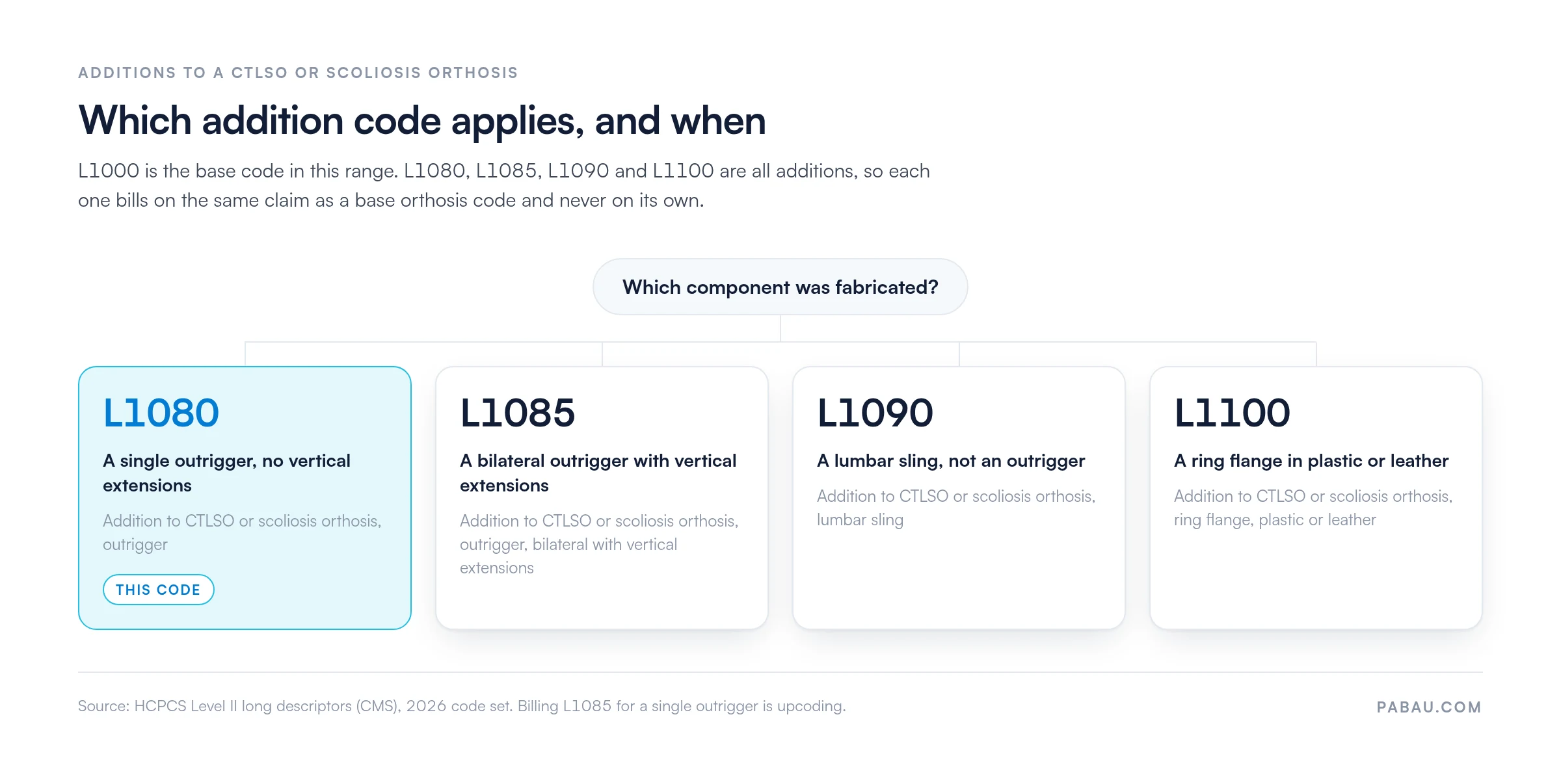
L1080 appears regularly in DMEPOS probe audits because addition codes carry a heavier documentation burden than the base orthosis codes. Practices that know the denial codes to expect on DMEPOS claims correct and resubmit faster, though prevention costs far less than correction. These are the errors most likely to trigger a denial or a recoupment demand:
A pre-billing audit checklist covering all six error categories above catches most of them before submission. That reduces rework and protects against post-payment audits from the DME MAC.
Run a pre-billing audit on every L1080 claim. Confirm the base code is present and the KX modifier is applied. Check that the physician order date precedes the date of service, and that a detailed product description is attached. A five-minute check before submission prevents weeks of appeals work.
DMEPOS billing has more moving parts than a physician fee schedule claim:
A manual process leaves too much room for error.
Pabau, our practice management software, takes over the steps that follow the coding decision. Practices that want cleaner claims management submit electronically through our Claim.MD integration. That integration also runs real-time eligibility checks against the payer before the device is ordered.
Validation checks run in the background each time a claim is sent. A line missing the details the payer needs gets flagged before it leaves the practice. Every claim then sits in one view at a named stage: pending, submitted, processing, paid, or error.
For an orthotics supplier, that view answers the question a spreadsheet cannot. A biller filtering by insurer or invoice ID can see which L-code lines stalled, and where. That happens the same day they error, rather than three weeks later on a remittance.
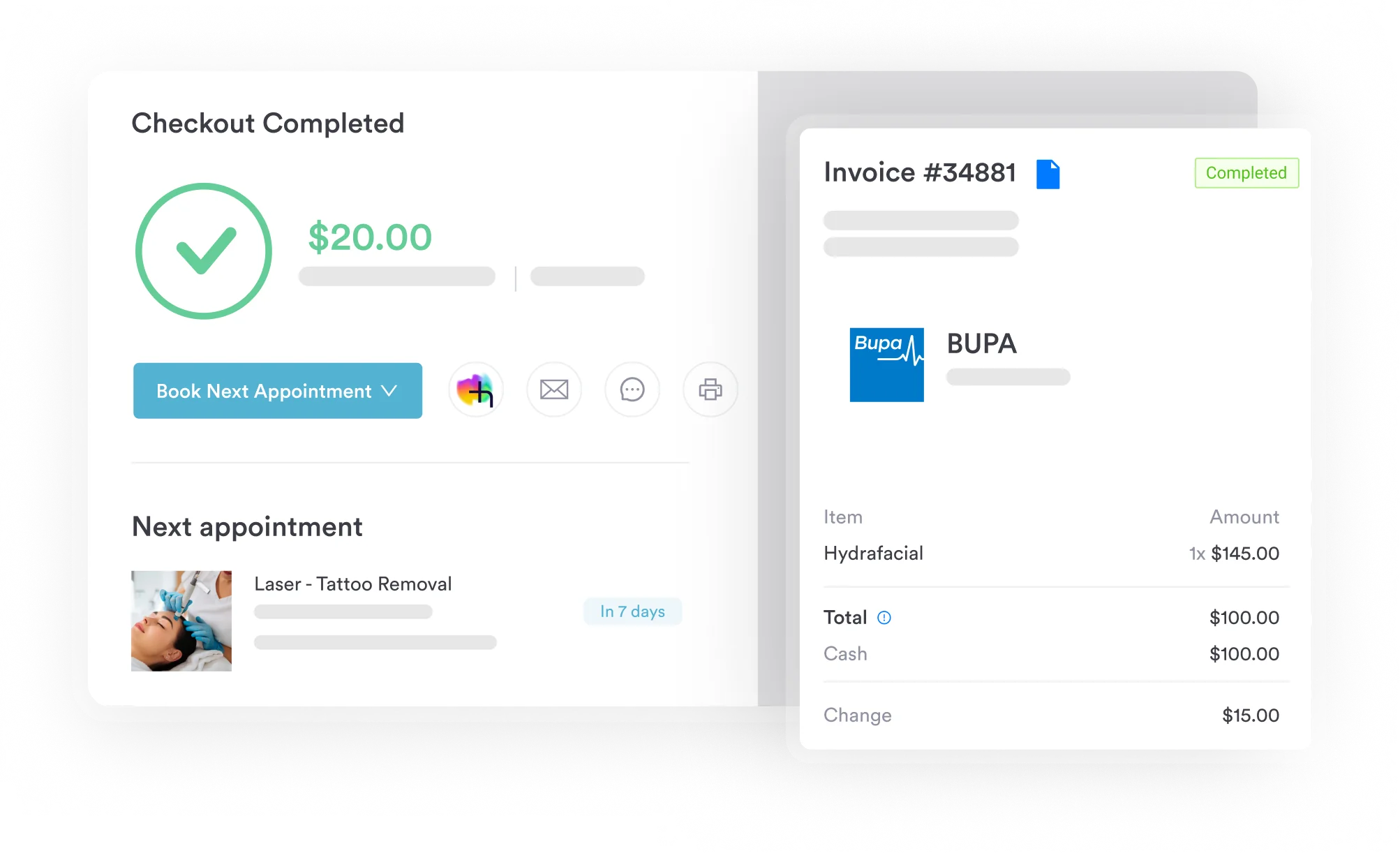

Pabau submits claims electronically, runs validation checks before they go out, and tracks every one through a single status view. Your billers see a stalled L-code line the same day.

The billing risk on L1080 sits in the pairing, not in the code itself. When the base code, the order date, the modifier and the product description all agree, the line clears on the first pass. Miss one of them and the claim comes back.
The trade-off worth remembering is that L1085 describes a costlier device than L1080. Reaching for it when a single outrigger was fabricated is exactly what a probe audit looks for. Bill the component you supplied, document why the patient needed it, and the audit exposure stays where it belongs.
Pabau puts the validation check in front of the biller and keeps every submitted claim in one status view. Book a demo to see how it handles DMEPOS claim lines.

Need to understand how billing denials flow back into your practice? Denial management in healthcare covers the full appeals and resubmission workflow for DMEPOS and physician claims.
Want a clean claims checklist for your billing team? Submitting a clean claim breaks down every field requirement across claim types, including DMEPOS submissions.
Looking to benchmark your billing compliance posture? Medical billing compliance covers the audit risk factors, documentation standards, and DMEPOS-specific requirements that protect practices from recoupment.
HCPCS Code L1080 is a Level II DMEPOS code describing an addition to a cervical-thoracic-lumbar-sacral orthosis (CTLSO) or scoliosis orthosis, specifically an outrigger component. Suppliers use it to bill Medicare and other payers for the outrigger extension arm. The arm applies lateral corrective force to the spine in scoliosis management.
Modifier 96 (Habilitative Services) applies where the outrigger supports developing a function the patient has not previously had. Modifier 97 (Rehabilitative Services) applies where it restores a prior function. Modifier 99 applies only when the line needs five or more modifiers. Modifier KX is frequently required by DME MACs to confirm LCD coverage requirements are satisfied. Verify the requirements with the applicable DME MAC before submission.
L1080 is a “by report” code, so there is no fixed national rate. The DME MAC sets the allowed amount individually, based on the documentation submitted. Verify the applicable amount for your region in the CMS DMEPOS fee schedule file at cms.gov. Rates are updated annually and vary by DME MAC jurisdiction.
L1000 is the base code in the L1000 to L1120 range, and every code above it is an addition. L1010, L1020 and L1080 are all additions, so none of them establishes the base device on a claim. Pairing L1080 with L1010 leaves the claim without a base orthosis code, which is a common cause of an unprocessable denial.
L1080 covers a single outrigger addition to a CTLSO or scoliosis orthosis. L1085 applies only where a bilateral outrigger system with vertical extensions is fabricated, which is a more complex and costlier device. Billing L1085 when only a single outrigger was provided constitutes upcoding, and it is a common audit trigger for DME MAC probe reviews.
Required documentation starts with a written physician order, signed before the device is dispensed. Add a detailed product description for this “by report” code. Include clinical notes with the Cobb angle measurement and the rationale for the outrigger. Proof of delivery and evidence of DMEPOS supplier accreditation complete the file. Some DME MACs also require a Certificate of Medical Necessity (CMN).
Coverage under Medicare Advantage is plan-specific and not guaranteed to match traditional Medicare. Plans apply their own coverage determinations and may require prior authorization for CTLSO addition codes, L1080 included. Verify coverage with the specific plan before the device is ordered, so you avoid a post-service denial.