CPT Code 62284: Injection procedure for myelography
CPT Code 62284: official descriptor and procedure overview The American Medical ...

Last Updated: Oct 19, 2026
L0460 is the HCPCS Level II code for tlso, triplanar control, modular segmented spinal system, two rigid plastic shells, posterior extends from the sacrococcygeal junction and terminates just inferior to the scapular spine, anterior extends from the symphysis pubis to the sternal notch, soft liner, restricts gross trunk motion in the sagittal, coronal, and transverse planes, lateral strength is provided by overlapping plastic and stabilizing closures, includes straps and closures, prefabricated item that has been trimmed, bent, molded, assembled, or otherwise customized to fit a specific patient by an individual with expertise.
HCPCS code L0460 bills a prefabricated thoracic-lumbar-sacral orthosis (TLSO) with triplanar control and two rigid plastic shells. A qualified fitter customizes the stock brace for one patient at delivery.
L0460 is prefabricated, not custom fabricated. That single fact drives the code choice, the documentation, and whether the claim survives review. Plenty of suppliers read it the other way around, because L0460 sits a few lines away from a block of custom-fabricated shell codes.
Two rules decide most L0460 claims. Only products published on the PDAC Product Classification List may be billed under the code. A brace handed over without expert fitting goes on L1499 instead.
Let Pabau's smart automation suggest the right codes, reduce claim denials, and keep your practice compliant—effortlessly.
Automate repetitive tasks and focus on what matters most—your patients.
Reduce coding errors and ensure compliance with the latest regulations.
Clean claims, fewer denials, and faster reimbursements.
Powerful insights and reporting to help your practice thrive.
HIPAA compliant SOC 2 certified GDPR-compliant Trusted by 4,000+ clinics worldwide

HCPCS code L0460 describes a prefabricated TLSO with triplanar control and two rigid plastic shells, custom-fitted to one patient by a qualified fitter.
L0460 is not the prefabricated version of L0480. L0480 is a custom-fabricated one-piece rigid shell built over a carved plaster or CAD-CAM model.
The custom-fabricated TLSO codes are L0452, L0480, L0482, L0484, and L0486. The rest of the L0450 to L0492 range is prefabricated.
Only products published on the PDAC Product Classification List may be billed as L0460. Off-list products are denied as incorrect coding.
Practice management software like Pabau keeps the order, the fitting note, and the proof of delivery attached to the patient record.
L0460 is a HCPCS Level II code maintained by the Centers for Medicare and Medicaid Services (CMS). The long descriptor is dense, so read it as a set of separate requirements. Each element below has to be true of the device before L0460 is the correct code.
The official short descriptor is Tlso 2 shl symphys-stern cst. That trailing cst abbreviates custom-fitted, not custom-fabricated. Compare it with the short descriptor for L0480, which reads Tlso rigid plastic custom fa. Two similar abbreviations sit two codes apart and mean the opposite of each other.
Two descriptor phrases carry most of the coding weight. Modular segmented spinal system, two rigid plastic shells describes a stock brace assembled from separate anterior and posterior components. Overlapping plastic and stabilizing closures is how the device gets its lateral strength, and CMS requires the whole circumference to be the same rigid material.
Spinal orthosis codes sort into three fabrication tiers, not two. Treating the choice as stock versus custom-made is where the L0460 error starts, because L0460 sits in the middle tier.
Policy Article A52500 names L0460 in its list of custom-fitted codes. It names L0452, L0480, L0482, L0484, and L0486 as the custom-fabricated spinal orthoses. No code appears on both lists, so the tier is settled before the claim is built.
Two consequences follow from that middle position. First, L0460 needs evidence of fitting work in the record, because the descriptor requires it. Second, L0460 has no corresponding off-the-shelf code, so there is nowhere to downcode a brace that was handed over with minimal adjustment.
A52500 is explicit about that second point. Where a custom-fitted code has no OTS partner, a device supplied without custom fitting is billed with the miscellaneous spinal orthosis code L1499 instead. Billing L0460 anyway is a coding error, not a rounding decision.
Write the fitting note the same day you dispense. Name the fitter, their qualification, and exactly what was trimmed, bent, molded, or assembled for this patient. A52500 asks why the modifications were necessary and what was modified, so a note that says fitted and adjusted does not answer either question.
Most L0460 miscoding comes from three confusions, and each has a clean rule behind it. The decision path below asks the three questions in the order a coder should reach them.
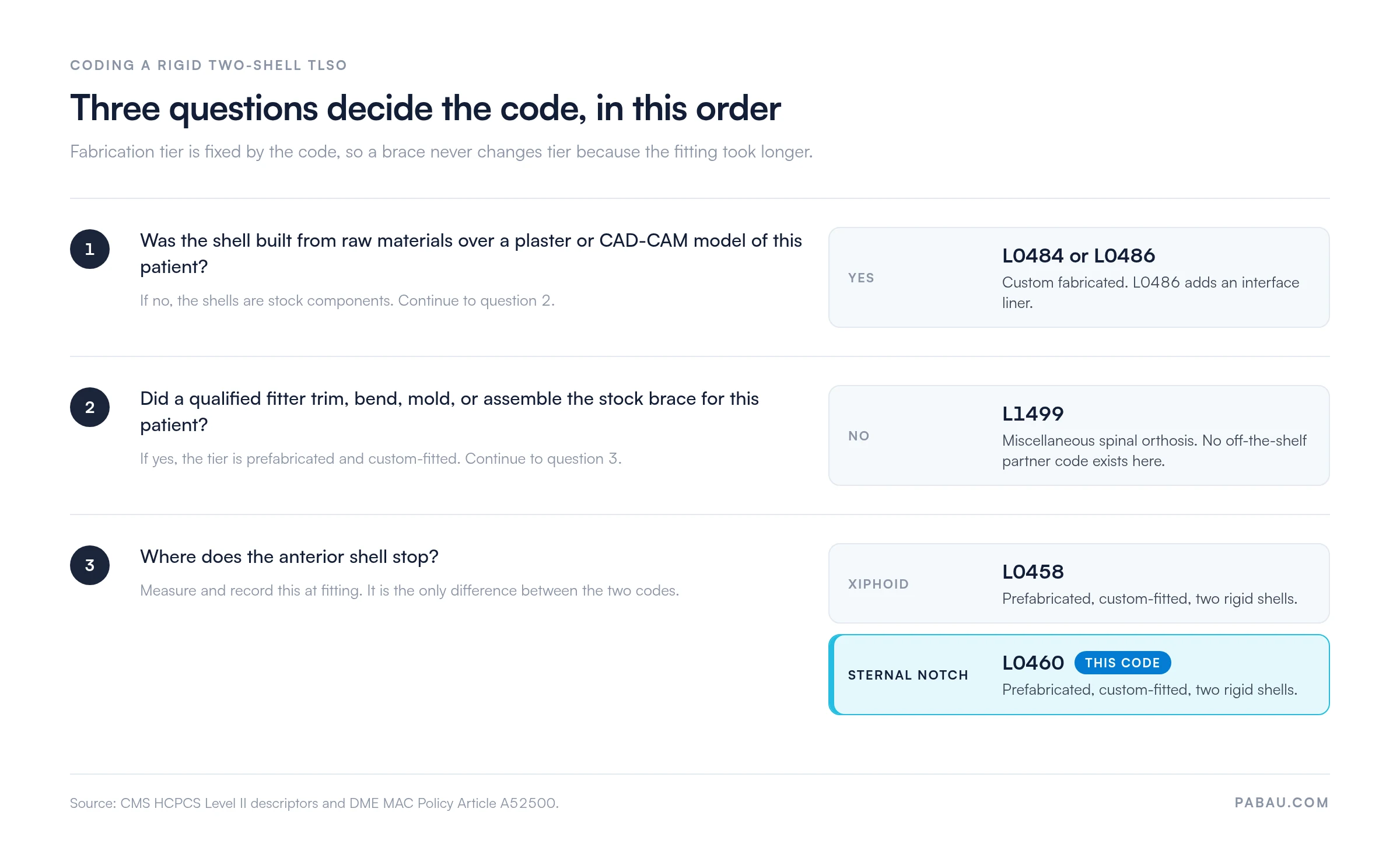
These two codes describe different devices, so neither is a version of the other. L0480 is a one-piece rigid plastic shell with no interface liner, custom fabricated over a carved plaster or CAD-CAM model. L0460 is a modular segmented system built from two prefabricated shells with a soft liner.
The nearest custom-fabricated equivalent to a two-shell design is L0484, or L0486 when an interface liner is included. Even those are not straight substitutions. A custom-fabricated two-piece shell is built from raw materials over a model of the patient, not assembled from stock components.
L0458 is also a prefabricated, two-shell modular segmented TLSO with triplanar control. The one difference is where the front of the brace stops. L0458 extends anteriorly to the xiphoid, while L0460 extends to the sternal notch.
Measure and record the anterior height at fitting. On a two-shell body jacket, that measurement is what separates two codes with different allowables.
L0450 is a flexible TLSO that supports the upper thoracic region only. It uses rigid stays or panels to produce intracavitary pressure, and it is prefabricated and off-the-shelf. It is not a rigid shell, and it is not custom fabricated.
L0452 is the custom-fabricated counterpart to L0450, and the descriptors are otherwise identical. A52500 also limits L0450 to orthoses made primarily of nonelastic material, such as canvas, cotton, or nylon.
The L0450 to L0492 range covers every TLSO configuration Medicare recognizes. Codes differ by control planes, shell design, anatomical coverage, and fabrication tier. The table below reads across all four.
Read the table in one direction only. Fabrication tier is fixed by the code, so a device never moves tiers because of how much work the fitting took. Suppliers can cross-check any descriptor against the NLM HCPCS API or the AAPC HCPCS code reference before billing.
L0460 uses two modular shells, but the same prefabricated tier also holds a one-piece design. L0488 covers that single rigid shell with an interface liner, and L0482 is its custom-fabricated counterpart.
Medicare Part B covers L0460 as durable medical equipment. Coverage runs through LCD L33790 and Policy Article A52500, and claims go to the DME MAC for the beneficiary’s state. The physician’s carrier does not process them.
LCD L33790 covers a spinal orthosis when it is ordered for one of four indications:
A Standard Written Order must reach the supplier before the claim is submitted. Some DMEPOS base items also require a Written Order Prior to Delivery, under Final Rule 1713. Check the current Face-to-Face Encounter and WOPD list before dispensing, because delivering ahead of a required WOPD cannot be fixed afterward.
An orthosis dispensed during a hospital or covered SNF stay can still be paid by the DME MAC. It has to be medically necessary after discharge, provided within two days of discharge home, and not used for inpatient care.
Confirm the ICD-10 diagnosis against your own jurisdiction’s LCD before you order the brace from the manufacturer. A TLSO that arrives against an uncovered diagnosis becomes a write-off, because medical necessity cannot be created retroactively in the treating practitioner’s notes.
L0460 carries a product-level requirement that is unrelated to the patient. Only products that have passed a written coding verification review may be billed under the code.
The review is performed by the Pricing, Data Analysis and Coding (PDAC) contractor. Verified products are published on the Product Classification List (PCL). For L0460 the requirement applies to dates of service on or after July 1, 2010.
A52500 states the consequence plainly. A code that requires coding verification only pays for products listed on its PCL. An off-list product is denied as incorrect coding, and documentation quality does not rescue it.
The rule works differently on the custom-fabricated side. A brace built by a central fabrication facility and shipped to the supplier must appear on the PCL. A brace fabricated from raw materials and handed directly to the patient does not. The supplier must still produce the materials list and fabrication description on request.
Check the PCL when you add a TLSO to inventory, not when a denial arrives. A single unverified product can put every L0460 claim from that stock line at risk.
Medicare reimbursement for L0460 comes from the annual DMEPOS fee schedule published by CMS. Amounts are locality-adjusted, so the allowable varies by the patient’s state and county. Pull current figures from the CMS fee schedule and DMEPOS pricing tools rather than a commercial database.
Fixed dollar figures are left out on purpose. A published allowable goes stale at the next CMS update, and a stale number produces the billing error it was meant to prevent. Track allowables at code level in your own reporting and refresh them each January.
L0460 claims go to the DME MAC on a CMS-1500 form, and the supplier needs an active DMEPOS supplier number in PECOS. Modifier selection then signals coverage status rather than device detail.
Append KX when the record meets the coverage criteria in LCD L33790. It tells the DME MAC that the medical necessity documentation is on file. An L0460 claim that meets criteria but omits KX is denied automatically.
Use GA when you expect a denial and hold a signed Advance Beneficiary Notice of Noncoverage. GA preserves your ability to bill the patient. Get the ABN signed before dispensing, not after the denial lands.
GZ applies when you expect a denial and no ABN was obtained. The claim is denied and the balance is not billable to the patient. Repeated GZ lines also flag a supplier for review, so treat each one as a workflow failure.
A52500 restricts the CG modifier to L0450, L0454, L0455, L0621, L0625, and L0628. It marks a garment made primarily of nonelastic material, or one with a rigid posterior panel. L0460 is already a rigid shell body jacket, so CG has no role on the claim.
Medicare needs a covered diagnosis before it pays for a TLSO. The diagnoses below are commonly accepted for thoracic and thoracolumbar bracing. Confirm the list in your own jurisdiction’s LCD before submitting, because DME MACs can differ.
Match the diagnosis to the device, not only to the covered list. A thoracic brace ordered against a purely lumbar diagnosis reads as the wrong device, even when both codes appear in the LCD.
Thin documentation is the main reason L-code claims are denied or recouped on audit. Build the package before the claim goes out, not after a denial arrives.
Note what is not on that list. A cast, mold, or CAD-CAM model is not required for L0460, and producing one does not support the code. Those records belong to the custom-fabricated codes L0452 and L0480 through L0486.
Documentation written by the orthotist counts. Section 1834(h)(5) of the Social Security Act treats the orthotist’s records as part of the patient’s medical record. A strong fitting note therefore supports the treating practitioner’s order rather than standing apart from it.
Spinal orthoses carry a five-year reasonable useful lifetime under the Medicare Benefit Policy Manual, chapter 15, section 110.2. Medicare expects one billed brace per anatomical site inside that window.
A second brace during the lifetime is denied unless the record explains it. Loss, theft, irreparable damage, and a documented change in the patient’s condition are the accepted reasons.
Check device history before dispensing a replacement. The Noridian Medicare Portal and myCGS both show same-or-similar equipment already on file, depending on your jurisdiction. Where a replacement is justified, put the reason in the claim narrative and attach the support up front.
TLSO claims draw a disproportionate share of DMEPOS audits. Orthotic denials trace back to a short list of preventable mistakes, and the same denial codes repeat from claim to claim.
Systematic denial management means tracking denial reasons by code. When L0460 denials cluster on one reason, the process is at fault rather than the individual claim. Fix the process and the appeals stop repeating.
Run a monthly denial audit filtered to L0460 and its neighbors in the L0450 to L0492 range. Group the results by CO and PR reason code. Three denials for the same reason across different patients in one month points at a process fault, not three unlucky claims.
An L0460 claim has more checkpoints than a standard procedure code. It needs a Standard Written Order, a covered diagnosis, a fitting note, PDAC confirmation, and a signed proof of delivery. All five have to be retrievable during a DME MAC audit, often years later.
Practice management software like Pabau keeps those records attached to the patient rather than scattered across folders and inboxes. Pabau’s claims management software reads from the patient record, so nobody reconciles clinical notes against the claim form by hand.
The weak point in orthotic billing is the handoff. What the fitter documented and what reaches the claim form are produced by different people at different times. That distance is where the custom-fitting note goes missing.
Pabau’s digital forms capture structured data at the point of care, including the device dispensed, the modifications made, and the patient signature. The evidence lands in the record as it is created, so the documentation trail for a DME claim builds itself.
Practices that dispense braces alongside treatment can run both in one system. Visit notes and DME documentation sit in the same patient record, so an audit request pulls one file instead of three.

Pabau links the order, the fitting note, and proof of delivery to the patient record. Orthotic claims leave the practice complete, and audits find what they ask for.

L0460 is a prefabricated TLSO, custom-fitted to one patient by a qualified fitter. It is a two-shell modular segmented body jacket reaching the sternal notch at the front. It is not the stock version of L0480, and L0480 is not its custom-made twin.
Get four details right and most denials disappear. Confirm the product sits on the PDAC list and record the anterior height. Write a fitting note that says what changed and why, then collect a signed proof of delivery on the day.
Pabau holds that documentation structure together for orthotics and physical therapy practices. To see how it works on DME claims, book a demo with the team.

Need a framework for managing medical billing denials? Denial management in healthcare covers systematic approaches to tracking, appealing, and preventing claim denials across DME and clinical billing.
Want to understand how revenue cycle performance is measured? What is revenue cycle management explains the end-to-end process from patient registration through payment posting, including DME-specific considerations.
Looking for guidance on medical billing compliance obligations? Medical billing compliance outlines the key regulatory requirements, audit risks, and documentation standards relevant to DMEPOS suppliers.
Coding a custom-fitted lumbar brace instead? HCPCS code L0627 covers the rigid-panel lumbar orthosis, its modifiers, and the codes it competes with.
HCPCS code L0460 bills a prefabricated, custom-fitted TLSO with triplanar control and two rigid plastic shells. Posteriorly it runs from the sacrococcygeal junction to just below the scapular spine. Anteriorly it extends from the symphysis pubis to the sternal notch. Suppliers bill it when a documented spinal condition needs that level of trunk immobilization. The code also requires that a qualified fitter customized the stock brace for this patient at delivery.
L0460 is prefabricated. The descriptor ends with the phrase customized to fit a specific patient by an individual with expertise. That phrase marks a stock brace which a fitter trimmed, bent, molded, or assembled for one patient. Medicare calls the tier custom-fitted, and it is not the same as custom fabricated. The custom-fabricated TLSO codes are L0452, L0480, L0482, L0484, and L0486.
No. L0480 is a custom-fabricated, one-piece rigid plastic shell built over a carved plaster or CAD-CAM model. L0460 is a prefabricated, two-shell modular segmented system with a soft liner. They are different devices with different fabrication methods, not a matched pair. L0460 has no off-the-shelf or custom-fabricated twin in the code set. The nearest custom-fabricated two-piece designs are L0484 and L0486.
You need a Standard Written Order, medical records that justify the brace, a covered ICD-10 diagnosis, and a signed proof of delivery. Because L0460 is a custom-fitted code, the record must also describe why the modifications were necessary and what was modified at fitting. A cast or CAD-CAM model is not required, and it is not evidence for this code. Models belong to the custom-fabricated codes L0452 and L0480 through L0486.
Yes. Medicare Part B covers L0460 as durable medical equipment under LCD L33790 and Policy Article A52500. Coverage requires one of four ordered purposes. Those are pain reduction through restricted trunk mobility, healing after spinal injury, healing after spinal surgery, or support for weak or deformed spinal muscles. Medicare pays 80% of the fee schedule allowable once the annual Part B deductible is met. The claim goes to the DME MAC for the patient’s state.
The most common cause is a product that is not on the PDAC Product Classification List for L0460. Since July 1, 2010, only products with a written coding verification review may be billed under this code. Claims for off-list products are denied as incorrect coding, even when the diagnosis and the documentation are sound. Check the list before you stock a brace, not after the denial arrives.