

CCSD code G5100: Bypass of duodenum billing guide
CCSD code G5100 bills a bypass that leaves the duodenum in place CCSD code G5100...

Last Updated: Oct 16, 2026
L0627 is the HCPCS Level II code for lumbar orthosis, sagittal control, with rigid anterior and posterior panels, posterior extends from l-1 to below l-5 vertebra, produces intracavitary pressure to reduce load on the intervertebral discs, includes straps, closures, may include padding, shoulder straps, pendulous abdomen design, prefabricated item that has been trimmed, bent, molded, assembled, or otherwise customized to fit a specific patient by an individual with expertise.
That fitting work is the whole code decision. The same brace handed over with no fitting is L0642, not L0627. Most L0627 denials trace back to that one distinction, or to a diagnosis the Local Coverage Determination does not cover.
Let Pabau's smart automation suggest the right codes, reduce claim denials, and keep your practice compliant—effortlessly.
Automate repetitive tasks and focus on what matters most—your patients.
Reduce coding errors and ensure compliance with the latest regulations.
Clean claims, fewer denials, and faster reimbursements.
Powerful insights and reporting to help your practice thrive.
HIPAA compliant SOC 2 certified GDPR-compliant Trusted by 4,000+ clinics worldwide

HCPCS code L0627 is a lumbar orthosis with sagittal control and rigid anterior and posterior panels, classified as prefabricated and custom-fitted.
Custom-fitted means a person with expertise trimmed, bent, molded, or assembled the brace for that patient. With no fitting work, the code is L0642.
L0628 is a flexible off-the-shelf lumbar-sacral orthosis, not the custom version of L0627, and it shares neither the panels nor the fabrication method.
No custom-fabricated code exists in the L0625 to L0627 lumbar range. L0632 is the closest match, and it is a lumbar-sacral orthosis.
Append KX when the LCD L33790 coverage criteria are met. The KV and J5 competitive bidding modifiers apply to off-the-shelf codes, not to L0627.
Practice management software like Pabau links the fitting note, the order, and the proof of delivery to one claim, so audits find a complete record.
The official long descriptor is dense, so it helps to read it as a set of separate requirements. Each element below has to be true of the device before L0627 is the correct code.
The short descriptor is LO sag ri an/pos pnl pre cst. The cst at the end abbreviates custom-fitted, not custom-fabricated. Reading it as custom-fabricated is one of the ways practices talk themselves into the wrong code.
The phrase “produces intracavitary pressure” carries clinical weight. The rigid panels press against the abdominal cavity, and the resulting intra-abdominal pressure offloads force from the lumbar discs. That mechanism is part of the medical necessity rationale, so the clinical note should describe the loading problem the brace is meant to relieve.
Spinal orthosis codes sort into three fabrication tiers, not two. Treating the choice as prefabricated versus custom-made is where most coding errors start, because L0627 sits in the middle tier.
Two consequences follow from that middle position. First, L0627 needs evidence of fitting work in the record, because the descriptor requires it. Second, there is no custom-fabricated lumbar orthosis to escalate to inside the L0625 to L0627 range.
If a patient genuinely needs a custom-fabricated rigid brace, the coding moves out of the LO range and into the LSO range at L0632. That is a different device with different coverage. L0632 extends from the sacrococcygeal junction to T-9, so it is not a straight substitution for L0627.
Write the fitting note the same day you dispense. Name who performed the fitting, their qualification, and what was trimmed, bent, molded, or assembled for this patient. A note that says only fitted and adjusted does not evidence the custom-fitted requirement in the L0627 descriptor.
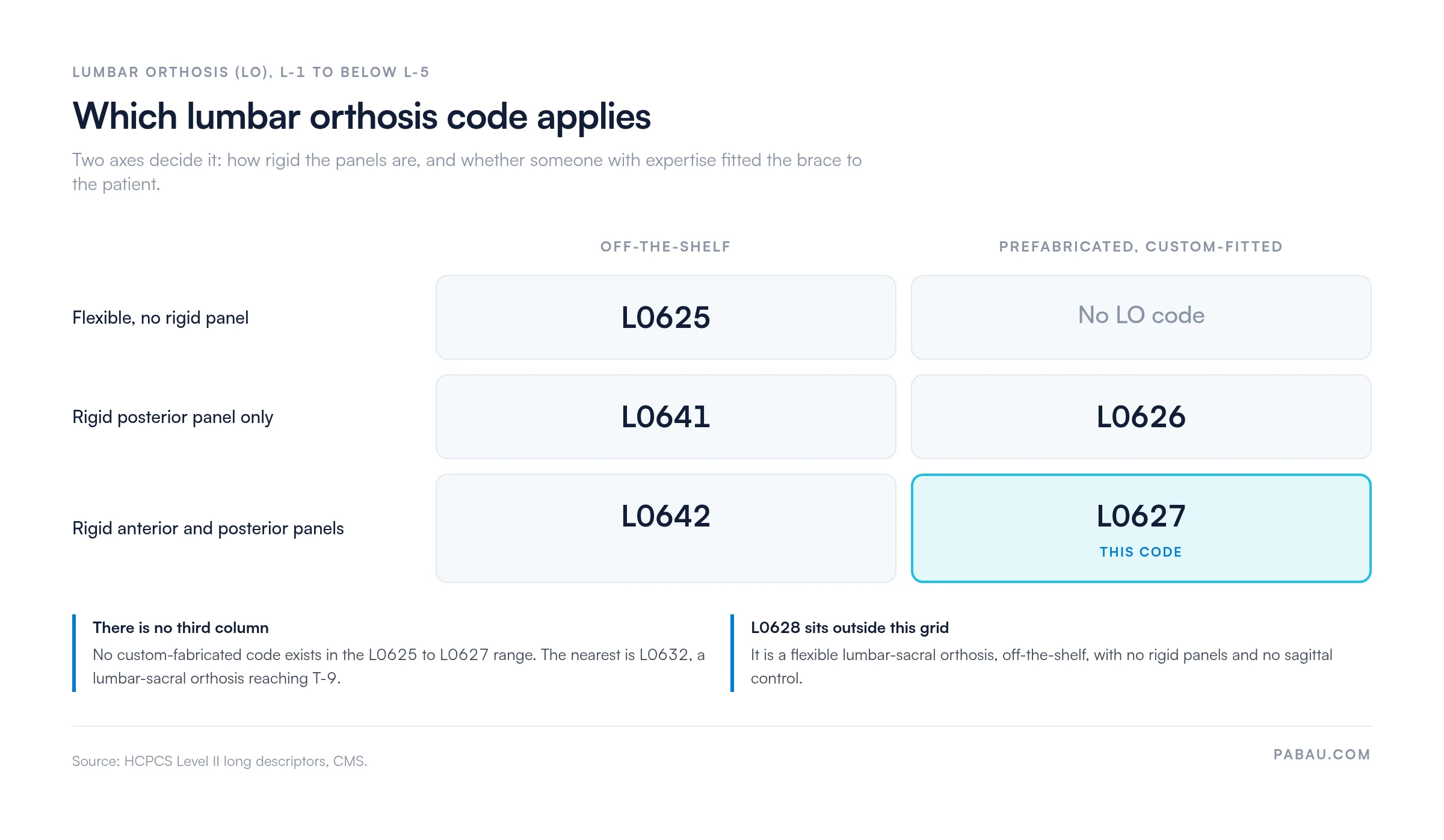
These five codes are the full lumbar orthosis set that L0627 competes with. They all cover the same anatomy, from L-1 to below L-5. They differ on panel rigidity and on fabrication tier, and picking across those two axes is where DME claim denials come from.
The L0627 versus L0642 call is the one that matters. The device descriptions are word-for-word the same. Only the fabrication tier separates them, and the record has to show the fitting work that justifies L0627. Billing L0627 for a brace pulled off a shelf and handed over is upcoding.
The L0626 boundary catches practices ordering from supplier catalogs. If the anterior panel is a separate add-on rather than part of the device, the base brace may only support L0626. Check the manufacturer specification sheet against the descriptor before you choose the code.
Adjacent L-codes look interchangeable in a dropdown and are not. Panel rigidity and fabrication tier place each one in a different cell of the same grid. Three pairings come up repeatedly on rejected lumbar orthosis claims.
This is the most common misreading of the range, and it is wrong on every axis. L0628 is a flexible lumbar-sacral orthosis. Its posterior runs from the sacrococcygeal junction to the T-9 vertebra, not from L-1 to L-5.
The descriptor has no rigid panels and no sagittal control. It is also prefabricated and off-the-shelf, so it sits below L0627 on the fabrication ladder rather than above it. L0628 and L0627 are not two versions of one device.
L0631 and L0632 do share L0627’s rigid anterior and posterior panel configuration with sagittal control. L0631 is the custom-fitted version and L0632 is the custom-fabricated one. Both are lumbar-sacral orthoses, so both cover more of the spine than L0627 does.
Use them when the ordered device actually extends to T-9 and the clinical need supports that coverage. Reaching for L0632 simply because a custom-fabricated code pays more is a documentation problem waiting for an audit.
When a claim reviewer questions an L0627, the code they have in mind is L0642. Same anatomy, same panels, no fitting requirement. Decide between the two on what the record shows about the fitting, not on which one reimburses better.
HCPCS code L0627 is paid under Medicare Part B as durable medical equipment. Payment follows the CMS DMEPOS fee schedule, which sets a national limitation amount and then adjusts it by locality.
CMS updates that fee schedule every January, and rates differ by DME MAC jurisdiction. Noridian, CGS, Palmetto GBA, and First Coast Service Options each publish their own fee schedule area files. Verify dollar figures there rather than trusting a third-party listing.
Border-area practices feel that variation most. Serving beneficiaries from two jurisdictions can mean two allowables for the same brace.
Cross-reference tools such as the AAPC HCPCS lookup help confirm descriptor wording quickly. Neither that tool nor any commercial lookup replaces the CMS DMEPOS fee schedule for an authoritative Medicare rate.
Pull the fee schedule area file for your DME MAC every January, not just the national limitation amount. Store the locality-adjusted L0627 and L0642 rates side by side. Seeing both figures next to each other keeps the fabrication decision clinical rather than financial.
Modifier selection on a spinal orthosis claim signals coverage status, not device detail. Choosing the wrong one produces a denial even when the code and diagnosis are correct.
Append KX when the record meets the coverage criteria in LCD L33790. It tells the DME MAC that the documentation supporting medical necessity is on file. An L0627 claim submitted without KX, where criteria are met, is denied automatically.
Use GA when you expect a denial and hold a signed Advance Beneficiary Notice of Noncoverage. GA preserves your ability to bill the patient. Get the ABN signed before dispensing, not after the denial arrives.
GZ applies when you expect a denial and no ABN was obtained. The claim is denied and the balance is not billable to the patient. Repeated GZ lines also mark a supplier for review, so treat them as a workflow failure.
The KV and J5 modifiers exist for non-contract suppliers billing off-the-shelf back braces under competitive bidding. That category listed codes such as L0625, L0628, L0641, and L0642. Custom-fitted codes, L0626 and L0627 among them, were never included.
Round 2021 contracts for off-the-shelf back braces ran through December 31, 2023, and a temporary gap period has applied since. Confirm the current program status with your DME MAC before you rely on either modifier for a related off-the-shelf claim.
Medicare requires a covered diagnosis before it pays for L0627. LCD L33790 names the ICD-10-CM codes that support coverage, and the list can differ by DME MAC. The diagnoses below are commonly accepted, but confirm the list in your own jurisdiction’s LCD before submitting.
Watch M54.5. It was retired on October 1, 2021, and claims carrying it are rejected. Use M54.50 for unspecified low back pain, M54.51 for vertebrogenic, or M54.59 for other, based on the documented etiology.
Practices with a stale ICD-10 crosswalk still submit it years later. Pull your covered diagnosis list from the current LCD each time the policy is revised, because jurisdictions add and restrict codes.
L0627 is covered under Medicare Part B when LCD L33790 criteria are met. The brace has to be ordered to restrict trunk motion, support healing after injury or surgery, or support weak or deformed spinal muscles. Checking eligibility before dispensing prevents most coverage surprises.
Missing one item is enough for a DME MAC to deny or recoup. A clean claim for a custom-fitted lumbar orthosis carries all of the following.
Auditors reach for the proof of delivery first. CMS requires a signed POD on every DMEPOS claim. A missing or unsigned one supports full recoupment, even when the rest of the file is complete.
The fitting note runs a close second on L0627 specifically. It is the only document that separates the code you billed from L0642.
Spinal orthoses carry a five-year reasonable useful lifetime under the Medicare Benefit Policy Manual, chapter 15, section 110.2. Medicare expects one billed brace per patient per anatomical site inside that window.
The national DMEPOS Recovery Audit Contractor reviews claims showing more than one spinal orthosis at the same site within 180 days. L0627 appears on that review list alongside L0631, L0637, L0642, L0648, and L0650.
A second brace inside the lifetime is denied unless the record explains it. Loss, theft, irreparable damage, or a documented change in the patient’s condition are the accepted reasons.
Check device history before dispensing a replacement. The Noridian Medicare Portal and myCGS both show same-or-similar equipment on file, depending on your jurisdiction. If a replacement is justified, put the reason in the claim narrative and attach the support up front.
L0627 denials cluster around a handful of causes, and the code’s near-identical neighbors drive several of them. The denial codes that show up most often on rejected L0627 claims map to the root causes below.
Run a five-point scrub on every lumbar orthosis claim before it goes out. Confirm the fabrication tier against the fitting note. Then check the ICD-10 code against the current LCD, the signed order, the exam date, and the signed proof of delivery. Catching these five removes most L0627 denials.
An L0627 claim has more checkpoints than a standard procedure code. It needs a valid order, a face-to-face exam, a covered diagnosis, a fitting note, and a signed proof of delivery. All five have to be retrievable during a DME MAC audit, often years later.
Practice management software like Pabau keeps those records attached to the patient rather than scattered across folders. Audit-ready claims management reads from the patient record, which removes the manual reconciliation between clinical notes and the claim form.
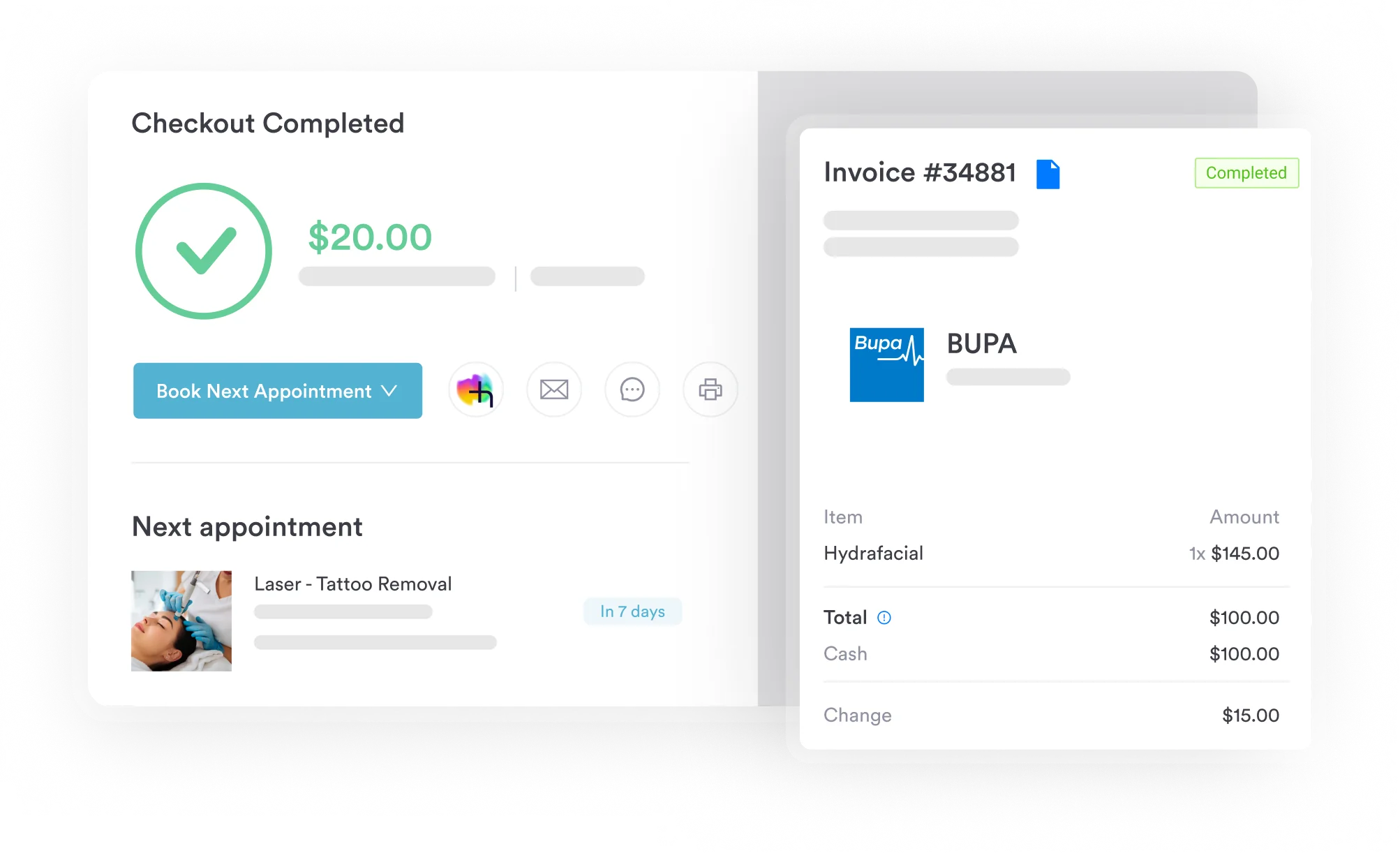
The weak point in most orthotic billing is the handoff. What the clinician documented and what reaches the claim form are produced by different people at different times. That distance is where the fitting note goes missing.
Pabau’s digital forms capture structured data at the point of care, including device specifications, fitting details, and the patient signature. That evidence lands in the record as it is created, so the documentation trail for a DME claim builds itself.
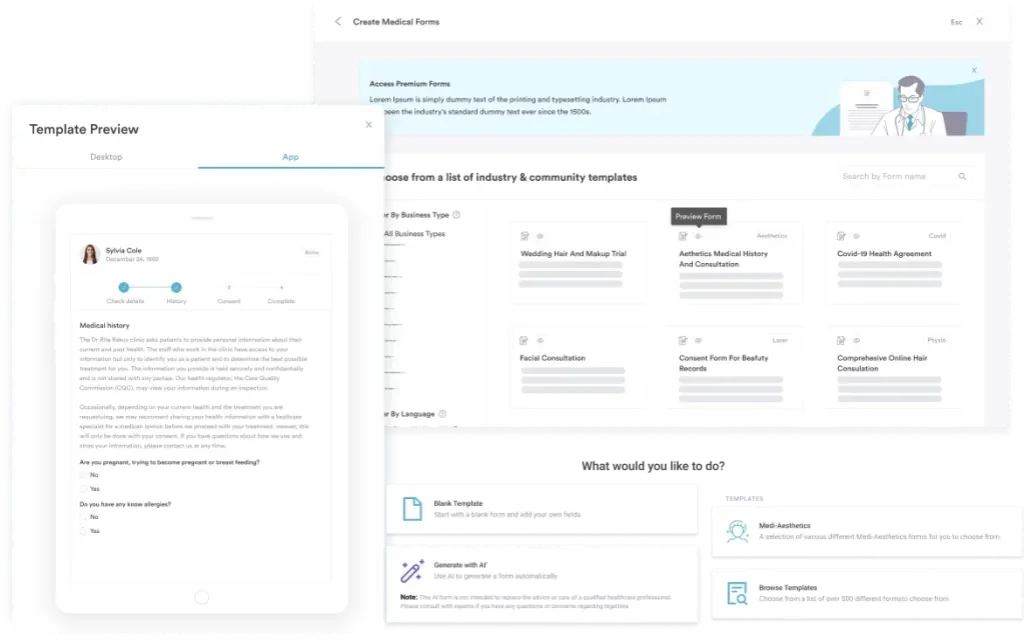
Practices that dispense lumbar orthoses alongside treatment can run both in one system. Visit notes and DME documentation sit in the same patient record, so an audit request pulls one file instead of three.

Pabau links orders, fitting notes, and proof of delivery to the patient record. Orthotic claims leave the practice complete, and audits find what they ask for.

L0627 is a precise code sitting in a crowded neighborhood. It is a lumbar orthosis with rigid anterior and posterior panels, prefabricated and then custom-fitted to one patient. The code it competes with is L0642, not L0628.
Get three details right and most denials disappear. Document the fitting work, pull the diagnosis from the current LCD, and collect a signed proof of delivery on the delivery date.
Pabau holds that documentation structure together for orthopedic and physical therapy practices. To see how it works on DME claims, book a demo with the team.

Need a framework for managing DME claim denials? Denial management in healthcare covers how to identify, appeal, and prevent claim rejections.
Want to know what makes a claim clean before submission? Clean claim submission outlines the requirements that stop a claim being returned unprocessed.
Looking for guidance on billing compliance? Medical billing compliance covers the regulatory and documentation standards that govern orthotic billing.
Coding a flexible lumbar support instead? HCPCS code L0625 covers the corset-style brace with no rigid panel.
Dispensing a brace that reaches the thoracic spine? HCPCS code L1200 covers TLSO billing, its modifiers, and the add-on codes.
HCPCS code L0627 is a lumbar orthosis with sagittal control and rigid anterior and posterior panels. The posterior panel runs from L-1 to below L-5. The brace is prefabricated, then custom-fitted to the patient by an individual with expertise. It is billed under Medicare Part B as durable medical equipment.
No. L0628 is a flexible lumbar-sacral orthosis, prefabricated and off-the-shelf. Its posterior runs from the sacrococcygeal junction to T-9, and the descriptor has no rigid panels and no sagittal control. The two codes describe different devices, so they are not alternatives for the same brace.
The device descriptions are identical. L0627 is prefabricated and custom-fitted, meaning someone with expertise trimmed, bent, molded, or assembled it for that patient. L0642 is the same brace supplied off-the-shelf, needing only minimal self-adjustment. Bill L0642 when no fitting work was performed.
Not in the lumbar orthosis range. No custom-fabricated code exists between L0625 and L0627. The closest custom-fabricated descriptor with rigid anterior and posterior panels is L0632, which is a lumbar-sacral orthosis. It extends to T-9, so it is not a direct swap for L0627.
L0625 is a flexible lumbar support with no rigid panel, supplied off-the-shelf. L0627 adds rigid anterior and posterior panels with sagittal control, and it is custom-fitted to the patient. They describe different devices at different fabrication tiers, and L0627 is reimbursed at the higher rate.
Yes, when the record meets the criteria in LCD L33790. Coverage needs a written order, a covered ICD-10-CM diagnosis, and a face-to-face exam inside the LCD window. An enrolled DMEPOS supplier must furnish the device, and the claim carries the KX modifier.
You need a written order and clinical notes from a face-to-face exam. Add a covered ICD-10-CM diagnosis, a dated fitting note, and proof of delivery signed by the patient. The DMEPOS supplier enrollment number goes on the claim form. A missing signed proof of delivery is the finding that most often triggers recoupment.
No. The off-the-shelf back brace category covered codes such as L0625, L0628, L0641, and L0642. L0627 is custom-fitted, so it was never included, and the KV and J5 modifiers do not apply to it.



