CPT Code 62284: Injection procedure for myelography
CPT Code 62284: official descriptor and procedure overview The American Medical ...

Last Updated: Oct 19, 2026
L0452 is the HCPCS Level II code for tlso, flexible, provides trunk support, upper thoracic region, produces intracavitary pressure to reduce load on the intervertebral disks with rigid stays or panel(s), includes shoulder straps and closures, custom fabricated.
The code is one of the most frequently misclassified in the L-series. L0452 is correct only when the orthosis was built from a mold or from measurements taken directly from the patient's body.
Let Pabau's smart automation suggest the right codes, reduce claim denials, and keep your practice compliant—effortlessly.
Automate repetitive tasks and focus on what matters most—your patients.
Reduce coding errors and ensure compliance with the latest regulations.
Clean claims, fewer denials, and faster reimbursements.
Powerful insights and reporting to help your practice thrive.
HIPAA compliant SOC 2 certified GDPR-compliant Trusted by 4,000+ clinics worldwide

HCPCS Code L0452 covers a flexible TLSO that is custom fabricated from a mold or from measurements taken directly from the patient.
The device supports the upper thoracic region and produces intracavitary pressure with rigid stays or panels.
Medicare pays L0452 as durable medical equipment under Part B, at rates that vary by MAC locality.
CMS retired the Certificate of Medical Necessity in 2023, so a Standard Written Order and the medical record now carry the claim.
Practice management software like Pabau keeps the order, the fabrication record, and the payer response on one patient timeline.
HCPCS Code L0452 is a Level II HCPCS code maintained by the Centers for Medicare and Medicaid Services (CMS). It belongs to the L-series, which covers orthotic devices billed as durable medical equipment under Medicare Part B.
The official CMS long descriptor runs to four clauses, quoted here in order.
Two elements of that descriptor decide the code. The device has to reach the upper thoracic region, and it has to be built for the individual patient rather than adjusted from stock.
The fabrication type is where most billing errors on spinal orthosis claims originate. CMS draws a sharp line between custom fabricated and custom fitted devices, and using the wrong designator is a documented audit trigger.
Custom fabricated means the device is constructed from a model, cast, or set of measurements taken directly from the patient’s body. No stock component is modified to fit. The orthosis is built specifically for that patient, and L0452 falls into this category.
Custom fitted (L0454) means a prefabricated device is selected from stock and adjusted at the point of service. The underlying product exists before the patient encounter.
Under Part B, Medicare reimburses HCPCS Code L0452 as a durable medical equipment item. Rates are set annually by CMS and vary by Medicare Administrative Contractor (MAC) locality. Use the CMS fee schedule lookup tool to confirm the allowed amount for your jurisdiction before submitting.
The table below reflects the general Medicare DME reimbursement structure for custom fabricated spinal orthoses. Dollar amounts vary by locality and change with each annual CMS update.
Checking the allowed amount at data entry is cheaper than reconciling it after a remittance adjustment arrives. Practices that run software for DME billers can hold the fee schedule alongside the claim record.
Medicare covers HCPCS Code L0452 under the DME benefit when the device is medically necessary. Coverage is governed by the Local Coverage Determination (LCD) issued by each DMEMAC. Because LCDs vary by region, bill against the LCD in effect for your MAC jurisdiction rather than a national assumption.
Submitting a clean claim for L0452 requires satisfying all of the following conditions before billing.
Private payers follow their own coverage policies. Some mirror Medicare’s LCD criteria, and others add prior-authorization requirements of their own. Verify the payer’s rules before ordering the device for a non-Medicare beneficiary.
Missing or incomplete documentation is the leading cause of L0452 denials and post-payment audits. CMS discontinued Certificates of Medical Necessity and DME Information Forms for claims dated on or after January 1, 2023. The Standard Written Order and the supporting medical record carry the claim in their place.
Every item in the checklist below belongs in the patient’s file before the claim is submitted.
Capturing those fields at the point of service is what keeps the claim defensible weeks later. For custom fabricated orthoses the fabrication records are non-negotiable, because auditors ask for them by name.
Audit your fabrication documentation before submitting L0452 claims. Reviewers look for evidence that measurements or a mold were taken directly from the patient. A note that reads ‘custom TLSO ordered’ with no fabrication detail will not survive a post-payment audit.
The ICD-10-CM diagnosis code on the claim must match the clinical documentation and fall within the covered diagnoses in the applicable LCD. The codes below are commonly paired with HCPCS Code L0452. This list is not exhaustive, so verify covered diagnoses against your DMEMAC’s current LCD.
Specificity matters. MAC systems are configured to flag retired codes such as M54.5, and those claims are rejected automatically. The ICD-10-CM code library carries the current descriptor for each code in the table above.
L0452 sits inside a broader TLSO range, and two facts pick the code out of it. The first is how the orthosis was made. The second is whether it supports the upper thoracic region or stops below it.
Both facts assume a flexible device. A rigid orthosis falls outside those flexible codes, so a prefabricated triplanar brace with three rigid plastic shells bills as L0462 instead.
A code’s subject has to be read from its descriptor rather than inferred from its number. HCPCS code S0137 sits between codes for clozapine and finasteride, which share no drug class with it.
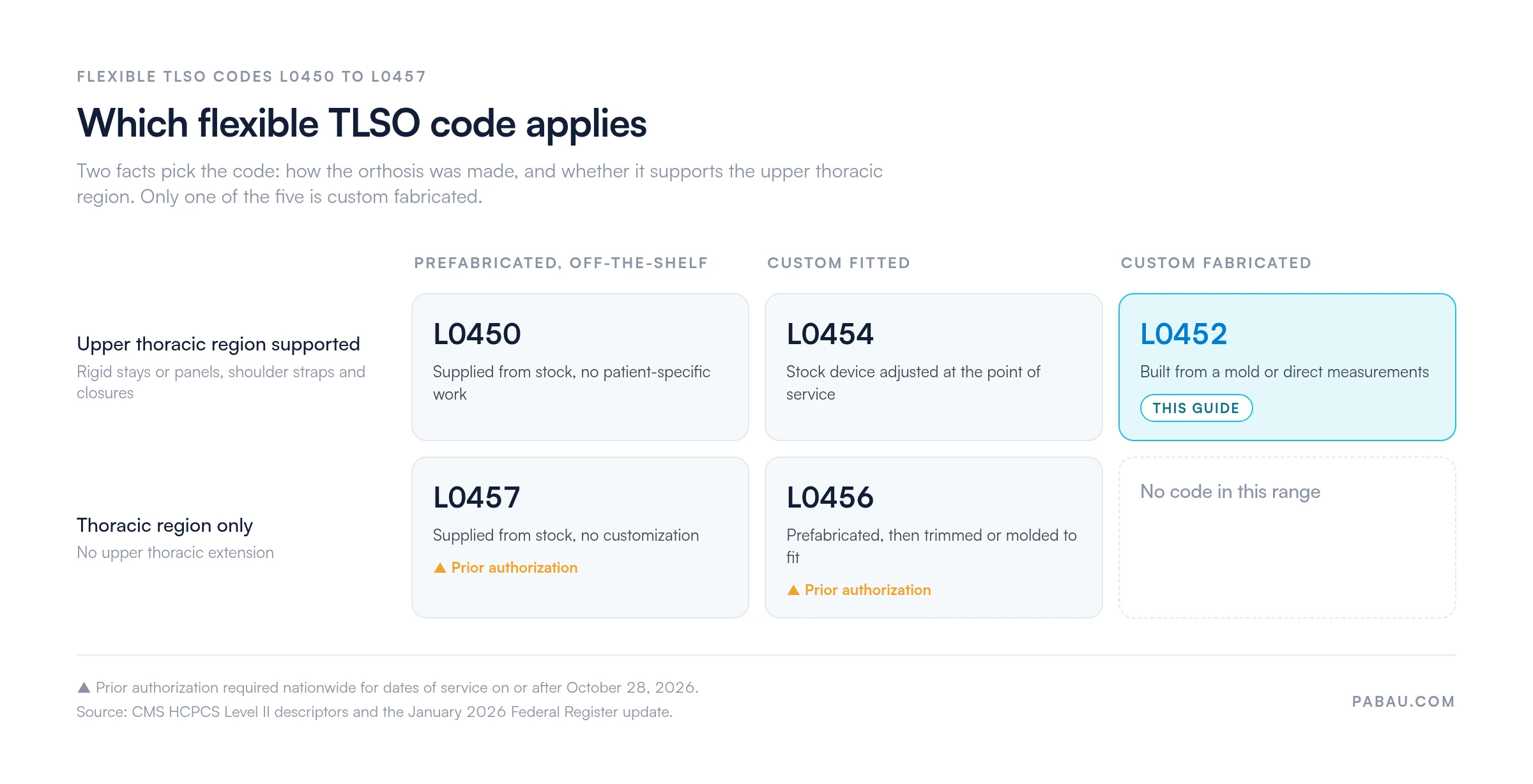
Two of the codes in that table are about to get harder to bill. The January 2026 Federal Register update adds L0456 and L0457 to the CMS Required Prior Authorization List. The requirement applies nationwide to dates of service on or after October 28, 2026.
L0452 is not on that list. A custom fabricated claim still turns on the documentation in the patient’s file rather than on a prior-authorization number. The fabrication evidence stays the deciding factor.
The Office of Inspector General (OIG) and CMS regularly target spinal orthosis claims in DME compliance reviews. L0452 draws extra scrutiny because it pays more than the adjacent codes, which makes upcoding from L0454 or L0456 a known pattern. Denials cluster into five causes.
Practices with high DME claim volumes should run an internal audit against these five causes each quarter. Finding the pattern yourself is cheaper than having a contractor find it during a post-payment review.
Review denied L0452 claims within 30 days of the remittance. Check whether the denial came from missing documentation, a fabrication classification error, or an imprecise diagnosis code. Appeal windows typically run 60 to 120 days from the remittance date, and missing the window forfeits the claim.
An L0452 claim is usually assembled from three places at once. The order sits in the patient chart, the measurement and fabrication record sits with the orthotist, and the delivery signature sits in a folder somewhere. A reviewer asks for all three together.
Practice management software like Pabau keeps the order, the clinical note, the measurement record, and the delivery confirmation on one patient timeline. Claims are built from that record instead of being retyped, so the diagnosis code on the claim matches the one in the note.
Payer responses land against the same record. That lets you see which denials cluster around fabrication evidence and which come from diagnosis specificity. The quarterly audit then takes an afternoon rather than a week.

Pabau’s claims management tools help orthotists and DME billers submit accurate HCPCS claims, track reimbursements, and reduce denial rates across payers.

L0452 is a narrow code, and the narrowness is the whole point. If the orthosis came off a shelf and was adjusted to fit, the claim belongs to L0454. The severity of the patient’s condition does not change that.
Since the Certificate of Medical Necessity was retired, no form declares medical necessity on your behalf. The Standard Written Order proves the order exists, and the clinical record has to carry the rest of the argument.
Practices that write the fabrication detail into the note at the time of service rarely lose a post-payment review. Book a demo to see how Pabau keeps orthotic orders, fabrication records, and payer responses on one patient record.

Dealing with rejected orthosis claims? Denial management in healthcare covers how to structure an appeals process and cut recurring denials.
Billing the off-the-shelf version instead? HCPCS Code L0457 covers the prefabricated TLSO that needs prior authorization from October 2026.
New to how DME claims reach the payer? Medical billing workflows explained shows how a claim moves from the practice to the payer.
HCPCS Code L0452 is a Level II HCPCS code for a flexible thoracic-lumbar-sacral orthosis (TLSO) that supports the upper thoracic region. The device must be custom fabricated from a mold or from measurements taken directly from the patient. It is billed as durable medical equipment under Medicare Part B.
L0452 requires custom fabrication, so the device is built from a patient-specific mold or set of measurements. L0454 is custom fitted, meaning a prefabricated device is selected and adjusted at the point of service. Billing L0452 for a device that was only fitted is a known upcoding pattern and a common audit trigger.
Yes. Medicare covers L0452 under the Part B DME benefit when the device is medically necessary. The claim must also meet the documentation requirements in the applicable Local Coverage Determination. Coverage criteria, covered diagnoses, and documentation rules vary by DMEMAC region, so check the LCD for your jurisdiction.
You need a Standard Written Order signed before delivery, plus supporting medical records. You also need measurement or mold records that demonstrate custom fabrication, a signed delivery confirmation, and clinical notes supporting the diagnosis. CMS discontinued the Certificate of Medical Necessity for claims dated on or after January 1, 2023. Missing fabrication records remain the leading cause of post-payment audit failures.
Commonly paired ICD-10-CM codes include M47.816 for lumbar spondylosis without myelopathy and M51.16 for lumbar disc disorders with radiculopathy. M48.06 covers lumbar spinal stenosis and M41.20 covers idiopathic scoliosis. Vertebral fracture codes such as S32.009A also apply. Always verify covered diagnoses against the applicable DMEMAC LCD.
Medicare reimbursement for L0452 varies by MAC locality and is updated annually by CMS. Use the CMS DME fee schedule lookup tool at cms.gov to find the allowed amount for your jurisdiction. Verify the rate each plan year before submitting claims, because it is not fixed across regions.